

Types of Rocks for Crushing: Igneous, Sedimentary and Metamorphic Compared
What You Will Learn from This Guide
Rocks are classified as igneous, sedimentary or metamorphic by how they form, but crushing cost depends on strength, abrasiveness, fracture behavior and moisture rather than on the class name alone. This guide explains the three classes, compares the common quarry rocks on measurable properties, and shows how each rock type points toward a crushing route, with background in jaw crusher types explained. It is written for engineers, plant operators and procurement managers who are evaluating a deposit or specifying a new circuit. After reading it, you can turn a rock description into a short list of test requirements and equipment options, and you can continue with the cone crusher types overview.
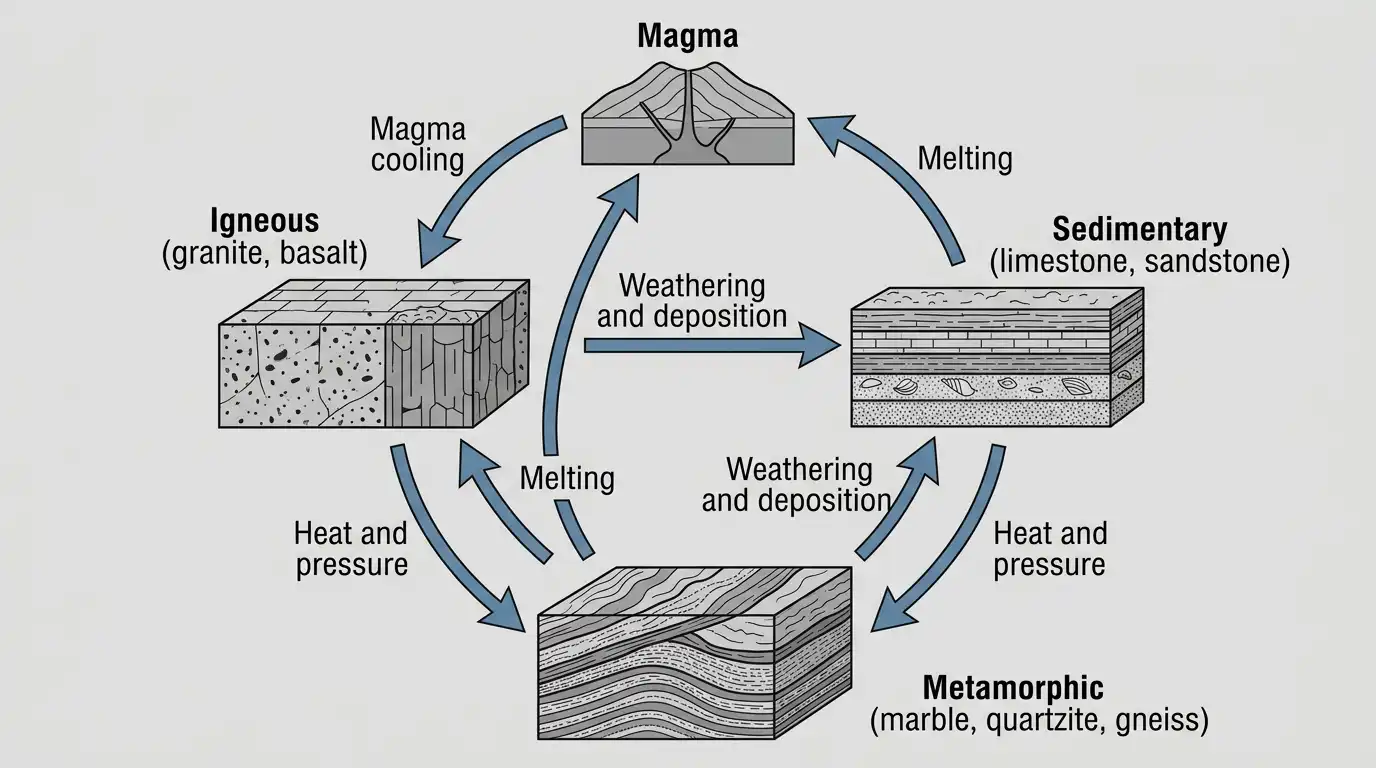
The Three Rock Classes and How They Form
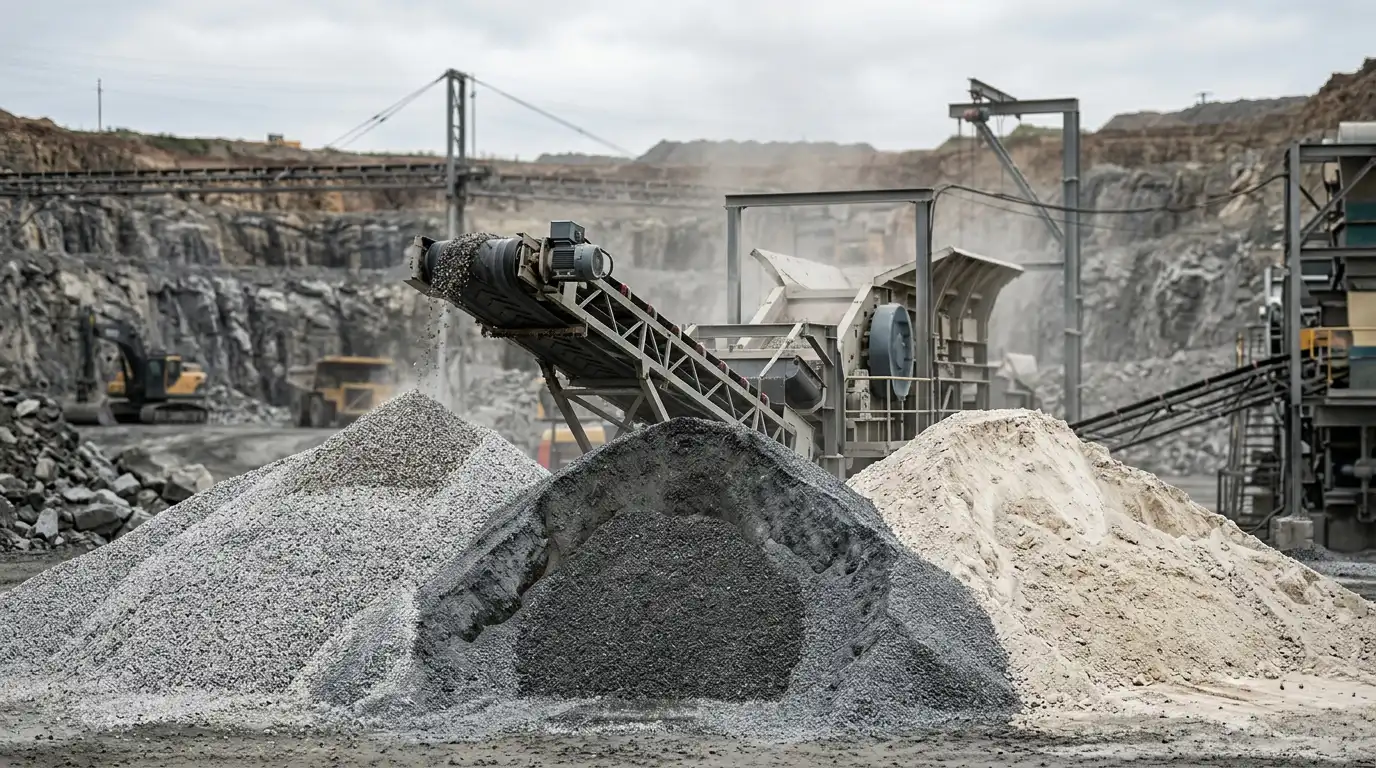
Every quarry rock belongs to one of three classes, and the class gives the first clue about texture and wear. The cone crusher types overview shows how these differences later affect chamber selection.
Igneous rocks form when molten rock cools.
- Intrusive (plutonic) rocks cool slowly at depth and develop coarse, interlocking crystals. Granite, diorite and gabbro are examples.
- Extrusive (volcanic) rocks cool quickly at or near the surface. They are fine-grained or glassy. Basalt, andesite and rhyolite are examples. geologiaweb Vesicular volcanic rocks such as scoria contain gas cavities, which lowers their density and strength.
Sedimentary rocks form from deposited particles, organic remains or chemical precipitates that are compacted and cemented. trasteandoenlaescuela
- Limestone and dolomite are carbonate rocks.
- Sandstone and conglomerate are clastic rocks.
- Shale and mudstone are fine-grained clastic rocks with high clay content.
- These rocks are usually layered (bedded), so bed thickness and clay seams affect blasting and feed preparation.
Metamorphic rocks form when existing rocks are changed by heat and pressure without melting.
- Limestone becomes marble. tiposdetodo
- Quartz sandstone becomes quartzite.
- Granite or sediments become gneiss.
- Shale becomes slate.
- Foliated metamorphic rocks (gneiss, schist, slate) break along planes, which can increase flaky particles in the product. Non-foliated rocks (marble, quartzite) break more uniformly.
The class does not set the crushing behavior on its own. A fresh basalt and a weathered basalt belong to the same class but can differ greatly in strength. River gravel can contain fragments of all three classes in one feed. For this reason, the properties in the next section are the basis for equipment decisions. For a structural comparison of primary machines, see single toggle vs double toggle jaw crusher.
Rock Properties That Control Crushing Cost
Four properties decide most of the cost in a crushing circuit: strength, energy demand, abrasiveness and the presence of fines or moisture. The primary impact crusher feasibility analysis explains why two of these properties must be kept separate.
Uniaxial compressive strength (UCS) is the axial stress that a rock specimen carries before it fails, with no confining pressure. geoengineer It sets the force that a compression crusher must apply. Published ranges are wide because grain size, weathering and microcracks change the result. Test rate also matters: laboratory work on hard rocks shows that UCS rises with loading rate. springer For this reason, quarry samples are tested to a standard procedure (ASTM D7012 or the ISRM suggested method) and not taken from a handbook.
Bond work index (Wi) is the energy, in kWh/t, needed to reduce a material from a very large size to 80% passing 100 µm. mekaglobal It is used to size motors and mills. Tabulated ball-mill values are:
- granite: 15.13 kWh/t
- limestone: 12.74 kWh/t
- dolomite: 11.27 kWh/t
- quartzite: 9.58 kWh/t
Single deposits can fall far from these averages.
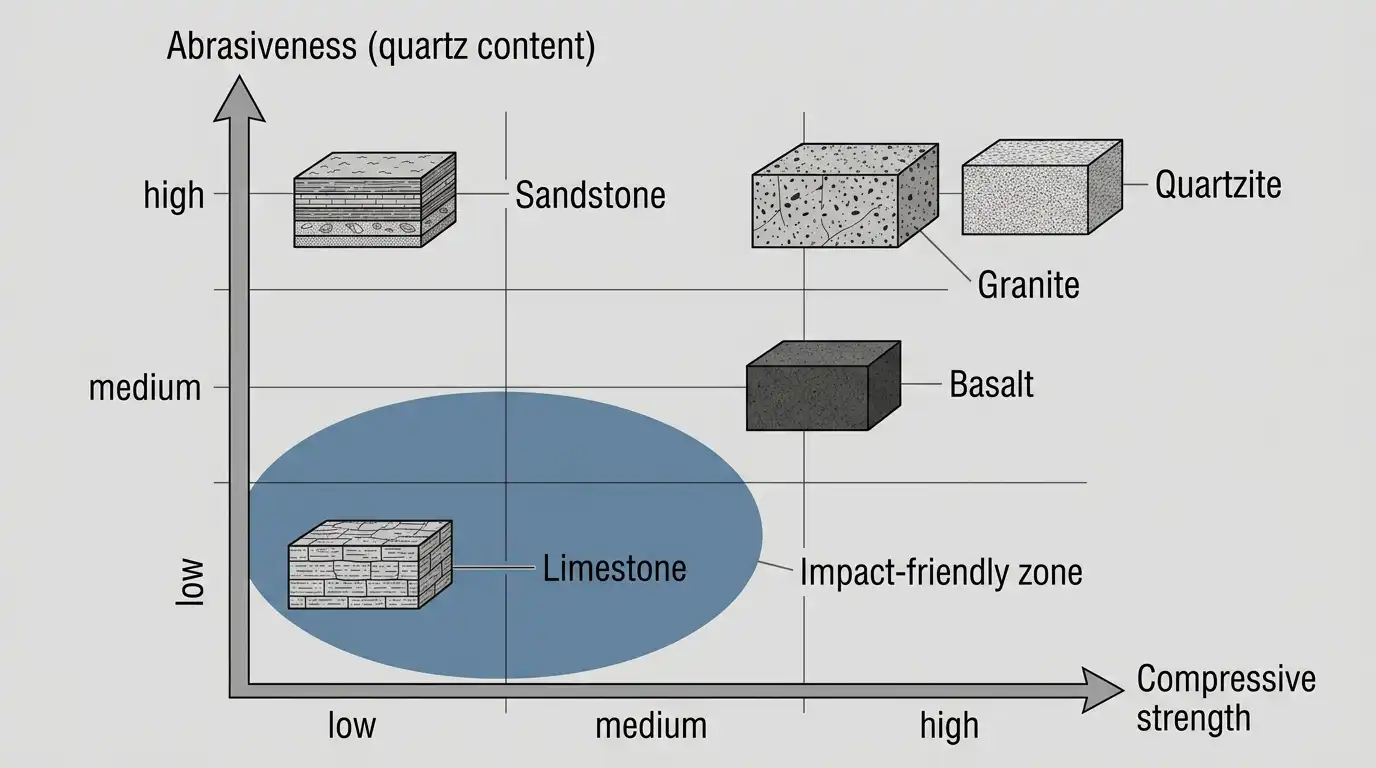
Abrasiveness decides wear-part life. mrcrushermill It is driven mainly by hard minerals, especially free quartz (Mohs 7). Abrasiveness and strength are different properties. Quartzite has a lower tabulated work index than granite but is one of the most abrasive quarry rocks. A rock can therefore be cheap to break in energy terms and expensive in liner and blow-bar replacement. The Los Angeles abrasion test (ASTM C131/C131M) and silica content are practical first indicators. mrcrushermill
Moisture, clay and fracture behavior affect throughput more than most specification sheets show.
- Clay seams in limestone or weathered rock can pack crushing chambers and blind screens.
- Feed for dry grinding mills must stay below a set moisture limit.
- Foliated rocks and columnar-jointed basalt tend to produce flaky particles unless the chamber and the reduction ratio are selected for shape.
The effect of these properties on wear parts is explained further in the PF impact crusher explained.
Common Rock Types Compared
The table below compares the rocks that appear most often in aggregate, cement and industrial-mineral projects. Use it as a screening tool, not as design data. For the jaw side of the comparison, see the C Series jaw crusher comprehensive guide.
| Rock | Class | Dominant minerals (Mohs) | Typical UCS range, MPa (psi) | Abrasiveness (relative) | Typical crushing route |
|---|---|---|---|---|---|
| Granite | Igneous, intrusive | Quartz (7), feldspar (6) | 100–250 (14,500–36,300) | High | Jaw → cone → VSI for sand |
| Basalt | Igneous, extrusive | Plagioclase (6), pyroxene (5–6) | 100–300 (14,500–43,500) | Medium to high | Jaw → multi-cylinder cone |
| Andesite / diabase / gabbro | Igneous | Plagioclase, pyroxene, amphibole (5–6) | Test required | Medium to high | Jaw → cone |
| Limestone | Sedimentary, carbonate | Calcite (3) | 30–250 (4,400–36,300) | Low | Jaw or impact → impact; mill for powder |
| Dolomite | Sedimentary, carbonate | Dolomite (3.5–4) | Test required | Low | Jaw or impact → impact; mill for powder |
| Sandstone | Sedimentary, clastic | Quartz grains (7) in variable cement | 20–170 (2,900–24,700) | Medium to very high | Jaw → cone (impact if weakly cemented and low silica) |
| Marble | Metamorphic | Calcite or dolomite (3–4) | Test required | Low | Jaw → impact |
| Quartzite | Metamorphic | Quartz (7) | 150–300 (21,800–43,500) | Very high | Jaw → cone; limit impact stages |
| Gneiss | Metamorphic, foliated | Quartz, feldspar, mica | Test required | High | Jaw → cone; control flakiness |
| River gravel / pebble | Mixed (alluvial) | Often quartz-rich | Varies by clast | High | Screen → cone → VSI |
Table note: UCS ranges are from the Attewell & Farmer (1976) compilation and cover fresh to moderately weathered rock. geoengineer Mohs values refer to the dominant minerals, not the whole rock. Abrasiveness ratings and crushing routes are engineering estimates and typical market practice, not standardized values. “Test required” means no qualifying range was verified for this table.
Two points come out of the table:
- The strongest rocks (basalt, quartzite) are not always the most abrasive.
- The most common aggregate rocks (limestone, dolomite) are the least abrasive.
That pattern explains why carbonate quarries can use impact crushing in more stages than granite quarries can. Model-level options appear in PEW European jaw crusher technical differences.
Which Rocks Supply Most Crushed Stone
Carbonate rock dominates crushed stone in the United States. The limestone raw-material profile covers its downstream uses. Of the US crushed stone produced in 2025, the split was:
- limestone and dolomite: about 70%
- granite: 14%
- traprock (dark, fine-grained igneous rock such as basalt and diabase): 6%
- miscellaneous stone: 6%
- sandstone and quartzite: 3%
- marble, volcanic cinder and scoria, calcareous marl, shell and slate: the remaining 1% rockproducts
Total US output in 2025 was revised to about 1.48 billion metric tons. rockproducts Crushed stone was the leading US nonfuel mineral commodity by value in 2025, at an estimated $26.8 billion, or 24% of the total estimated value of US nonfuel mineral production.
Most of that tonnage goes into specified products. In North America, ASTM C33 defines grading and quality requirements for fine and coarse aggregate in concrete, astm and ASTM C131 measures resistance to degradation in the Los Angeles machine. appliedtesting In Europe, EN 12620 sets aggregate properties for concrete, EN 13043 covers bituminous mixtures and road surfaces, EN 13242 covers unbound and hydraulically bound layers, and EN 13450 covers railway ballast. itehstrataglobal A rock that passes one specification can fail another. For example, a soft limestone can make good base course but fail a polish or abrasion limit for a wearing course.
For a producer, the practical message is simple. The rock type sets the products that the deposit can supply, and the product specification then sets the crushing stages and shape control that the plant needs. A related comparison is which is better: cone crusher or jaw crusher.
Matching Rock Type to Crusher and Mill
The equipment match follows the strength–abrasiveness position of the rock. The mining grinding mill types overview covers the powder side of the same decision.
Primary crushing (all hard and medium rocks).
- The C Jaw Crusher accepts rock with compressive strength up to 320 MPa. That covers river stone, granite, basalt, limestone, quartz, iron ore and construction waste. Its non-welded frame, double-wedge discharge adjustment (mechanical or hydraulic, at the customer’s choice) and elastic limit block with rubber shock absorber suit continuous hard-rock duty.
- The PE Jaw Crusher uses mechanical shim adjustment. The PEW Jaw Crusher adds hydraulic adjustment, a V-shaped cavity, an integral cast-steel bearing seat and centralized lubrication. Both handle primary to medium crushing of granite, marble, basalt, limestone, quartz and pebble.
Secondary and tertiary crushing of hard, abrasive rock (granite, gneiss, quartzite, basalt, gravel). Compression is preferred because the rock moves slowly against the liners, which reduces wear per tonne.
- The CS Symons Cone Crusher is a hybrid design. It uses a spring safety device with hydraulic adjustment of the discharge opening.
- The HST Single-cylinder Hydraulic Cone Crusher covers the same material range as the CS.
- The HP Hydraulic Multi-Cylinder Cone Crusher keeps a spring component alongside its hydraulics. It uses lamination (inter-particle) crushing to give a cubical product, which matters for basalt and other rocks that tend to break into flakes.
Soft to medium-hard, low-silica rock (limestone, dolomite, marble, some pebble).
- The PF Impact Crusher suits medium-hard and soft materials. Its impact plates are high-manganese steel and its blow hammers are high-chromium cast iron.
- The PFW Hydraulic Impact Crusher comes in two configurations. Type II is the coarse (primary) configuration, with a feed opening of 1,100–1,450 mm. Type III is the medium (secondary) configuration, with a third impact chamber and a feed opening of 570–800 mm, and it produces fine graded aggregate for manufactured sand.
Sand making and shaping. The VSI Vertical Shaft Impact Crusher, VSI5X Vertical Shaft Impact Crusher and VSI6X Vertical Shaft Impact Crusher work in “stone crushing stone” (rock-on-rock) or “stone crushing iron” (rock-on-iron) mode.
- Rock-on-rock mode lowers metal wear on abrasive granite and quartz-rich gravel.
- Rock-on-iron mode gives a higher reduction on less abrasive feed.
Screening. The S5X Vibrating Screen and Y Vibrating Screen close the circuit and separate product sizes.
Powder production from carbonate and industrial minerals.
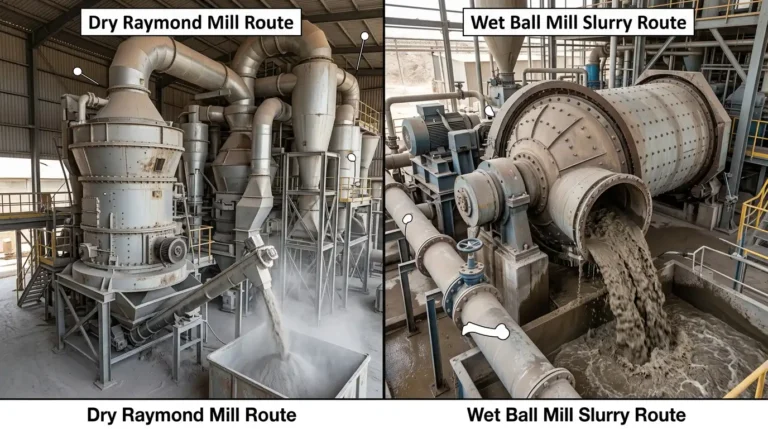
- The MGW Intelligent Raymond Mill grinds materials below Mohs 9, with feed moisture below 6% and pre-crushed feed below 20 mm.
- The MSF Ultrafine Mill reaches up to 3000 mesh on non-flammable, brittle materials below Mohs 9, such as limestone, calcite, dolomite, barite and talc.
- The MQ Ball Mill covers wet or dry grinding where a mill circuit follows crushing.
| Rock group | Primary | Secondary / tertiary | Shaping / sand | Powder |
|---|---|---|---|---|
| Granite, gneiss, quartzite | C, PEW or PE jaw | CS, HST or HP cone | VSI series, rock-on-rock | — |
| Basalt, andesite, diabase | C, PEW or PE jaw | HP cone (cubical product) | VSI series | — |
| Limestone, dolomite, marble | PE/PEW jaw or PFW (II) | PF or PFW (III) impact | VSI series | MGW, MSF, MQ |
| River gravel / pebble | Screening first; jaw for oversize | CS or HST cone | VSI series, rock-on-rock | — |
Table note: Source: Mr Crusher Mill product datasheets. Final selection depends on test results for the specific deposit.
Plant examples for hard rock are in MR hydraulic crusher used for a granite quarry and basalt jaw crusher helps a client’s aggregate production line.
How to Characterize a Deposit Before Selecting Equipment
A short test program prevents most crusher selection errors. The single-cylinder vs multi-cylinder hydraulic cone crusher comparison shows how hardness results change the cone decision. Follow these steps:
- Take representative samples. Collect samples across the face and at depth, not only from the most accessible bench. Include weathered zones and clay seams if they will reach the feed.
- Ask for petrographic identification. Ask for mineral content, especially free quartz, and for alteration and foliation.
- Test strength and breakage energy. Order UCS (ASTM D7012 or the ISRM method) or a point-load index. Add a Bond crushing or work index test if a mill circuit is planned.
- Test abrasiveness. Order Los Angeles abrasion (ASTM C131/C131M) and an abrasion index or Cerchar test, so that wear-part life can be estimated.
- Measure moisture and fines. Measure moisture, clay content and material finer than 75 µm in the run-of-mine feed during wet and dry seasons.
- Check the product specification. Confirm the target grading and shape limits (ASTM C33, EN 12620 or the project specification) before the number of stages is fixed.
Send the results with the required capacity and product sizes when you request a circuit proposal. Chamber choice for the final stage is covered in standard vs short-head chamber.
Frequently Asked Questions
What are the three main types of rocks? The three main types are igneous rocks (cooled from magma or lava, such as granite and basalt), sedimentary rocks (compacted and cemented deposits, such as limestone and sandstone) and metamorphic rocks (changed by heat and pressure, such as marble, quartzite and gneiss). For crusher selection, see jaw crusher types explained.
Which rock type is the hardest to crush? No single rock is “hardest” on every measure. Basalt and quartzite reach the top of the UCS range (up to about 300 MPa) and need high crushing force. Quartzite and quartz-rich gravel cause the fastest wear because of their quartz content. The C Jaw Crusher handles rock up to 320 MPa compressive strength.
Is granite or basalt better for aggregate? Both produce strong coarse aggregate. Granite is usually more abrasive because of its free quartz. Basalt is often stronger and tends to give flaky particles unless the circuit controls shape. A multi-cylinder cone such as the HP Hydraulic Multi-Cylinder Cone Crusher is a common secondary choice for basalt.
Can an impact crusher process granite? An impact crusher can break granite, but high quartz content shortens blow-bar and liner life. Impact crushers are most economical on limestone, dolomite and other low-silica rock. The PF Impact Crusher is designed for medium-hard and soft materials.
Which rocks can be ground into fine powder? Brittle, non-flammable minerals below Mohs 9, such as limestone, calcite, dolomite, barite and talc, are typical feeds. The MSF Ultrafine Mill reaches up to 3000 mesh. The calcite raw-material profile gives more detail.
References & Sources
Equipment background for this guide is also available in how a Raymond mill works.
- U.S. Geological Survey — Mineral Commodity Summaries 2026
- Rock Products — USGS Production Report (August 2026)
- U.S. Geological Survey — Crushed Stone, Mineral Commodity Summaries 2020
- GeoEngineer.org — Unconfined Compression Test (UCS ranges after Attewell & Farmer, 1976)
- Bulletin of Engineering Geology and the Environment (Springer) — Stress-rate dependency of uniaxial compressive strength of hard rock
- ScienceDirect Topics — Bond Work Index
- ASTM International — C33/C33M Standard Specification for Concrete Aggregates
- CEN — EN 12620:2013 Aggregates for concrete (catalogue entry)
- Pavement Interactive — Aggregate
Related reading: impact crusher types.