

Single-Cylinder vs Multi-Cylinder Hydraulic Cone Crusher: Structure and Performance Compared
What You Will Learn from This Guide
A single-cylinder hydraulic cone crusher supports its main shaft inside the eccentric sleeve on a bowl bearing, while a multi-cylinder unit uses a thicker, shorter shaft that stands directly on the frame. This guide compares the two machines structurally and by performance, not just by cylinder count. It serves an engineer or buyer already set on a hydraulic cone crusher and choosing between these two designs. After reading, you will know which structural difference actually drives the capacity and product-shape gap between them.
Overview
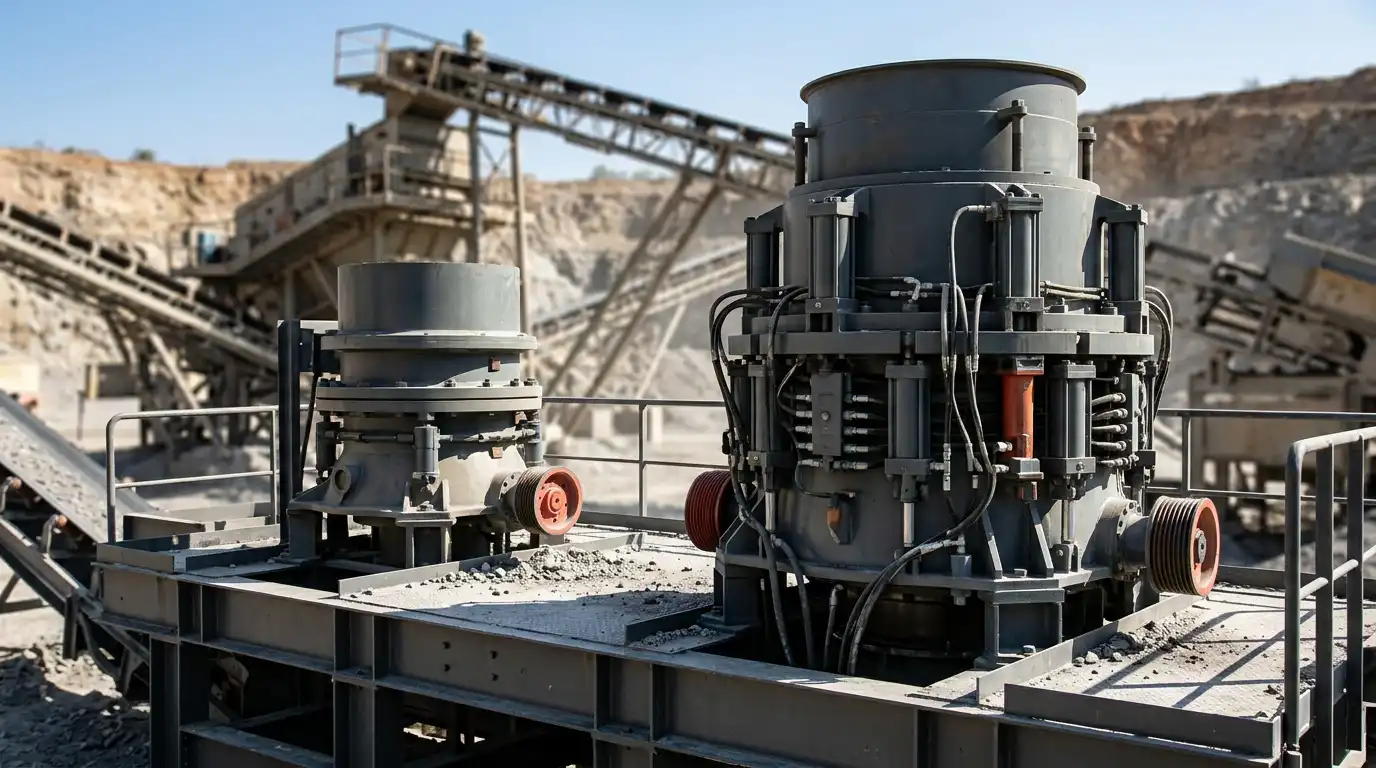
Both machines are hydraulic cone crushers. Both gyrate a mantle inside a concave to break rock. The difference that matters is not simply “one cylinder versus several.” It is how each design supports its main shaft and distributes crushing force through the frame.
That structural choice cascades into everything else: capacity on different ore hardness, product shape at fine settings, and purchase price. Neither design is universally better. Each fits a different point on the hardness and throughput scale.
Working Principle
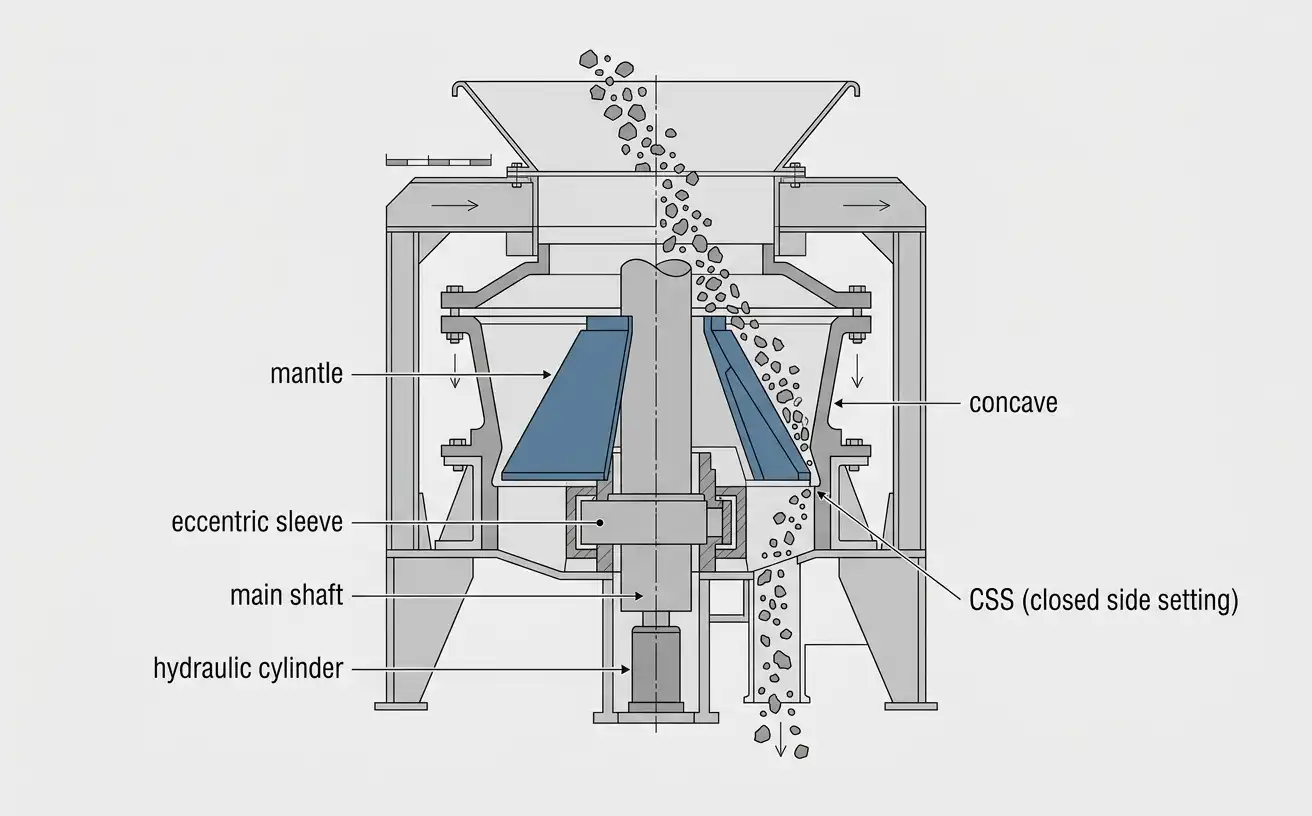
Both machines share the cone crusher’s basic mechanism. An eccentric sleeve drives the main shaft in a gyrating motion, sweeping the mantle around inside the concave. As the gap narrows, rock is compressed and fractured. As it widens, broken material moves down toward the discharge.
A hydraulic cylinder or cylinders set the closed side setting (CSS) and absorb overload events. This is common to both designs. What differs is how many cylinders do that job, and how the main shaft itself is held in place while it works.
Structural Differences: Main Shaft Support
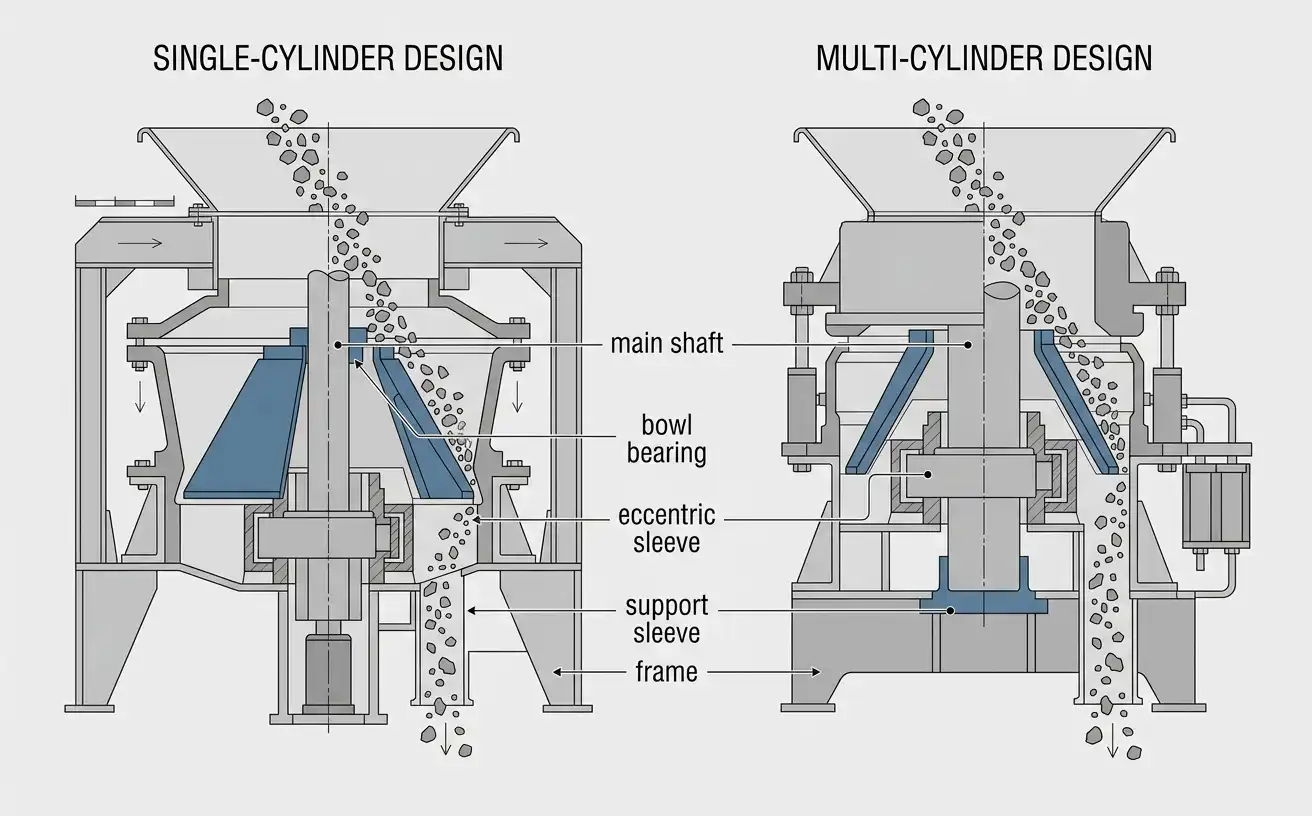
A single-cylinder hydraulic cone crusher supports its main shaft on a bowl bearing, seated inside the eccentric sleeve. This resembles the traditional spring cone crusher’s shaft arrangement. The shaft and moving cone effectively act as their own base support, and the eccentric sleeve drives the shaft directly to generate crushing force.
A multi-cylinder unit uses a different arrangement. Its main shaft is shorter and thicker, sized to stand directly on the frame rather than inside the eccentric sleeve. The frame itself carries the bearing load. This gives the multi-cylinder design a higher load-bearing capacity at the same nominal size.
This support difference is the root cause of most of the performance gap described later in this guide. A shaft supported by the frame handles higher crushing forces more predictably than one relying on a bowl bearing and eccentric sleeve alone.
Structural Differences: Cylinder Count and Force Distribution
A single-cylinder design uses one hydraulic cylinder, positioned at the base of the main shaft. It adjusts the CSS and absorbs overload events through that single point. This keeps the hydraulic system compact and mechanically simple.
A multi-cylinder design distributes both functions across several cylinders, commonly two to six, arranged around the crusher body. Each contributes to holding the setting and absorbing load. This distributed arrangement is what lets the frame-supported shaft actually use its higher load capacity. Force is applied more evenly around the chamber, rather than through one central point.
Performance Differences: Capacity by Ore Hardness
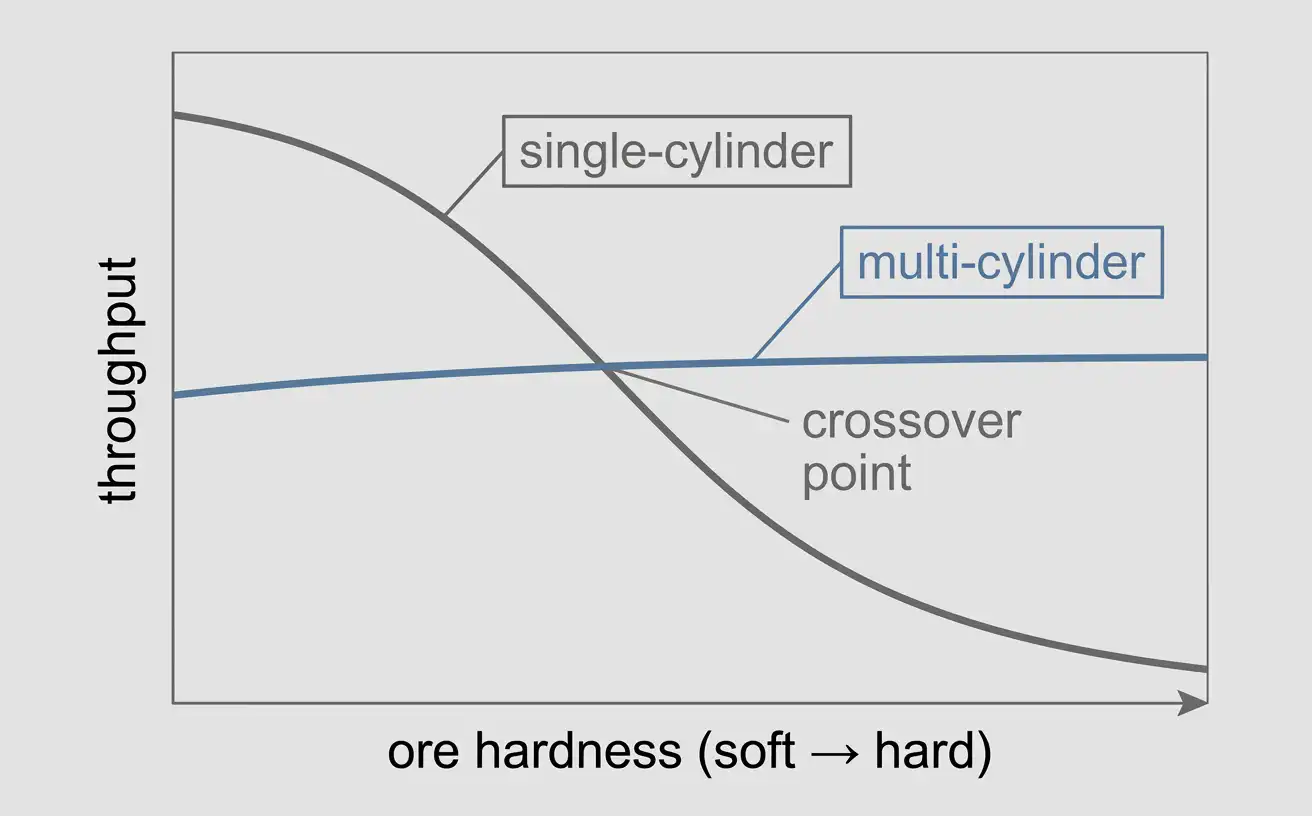
On soft or weathered ore, a single-cylinder unit typically delivers higher throughput. Its simpler chamber geometry and lower internal resistance let material pass through faster when the rock itself does not demand high crushing force.
On medium-hard to hard ore, a multi-cylinder unit generally performs better. Its higher load-bearing capacity and distributed force handle the added crushing resistance more consistently, and it holds capacity better as hardness increases. The harder the rock, the larger this gap tends to become.
Performance Differences: Product Shape and Fine Crushing
Both designs can run full-chamber feeding, where the crushing chamber stays filled with material throughout operation. Full-chamber feeding drives interparticle crushing, where rock breaks against rock as well as against the mantle and concave.
A multi-cylinder unit’s higher bearing capacity generally sustains full-chamber feeding more reliably at fine settings. This produces more consistent interparticle crushing and a higher share of fine, cubical particles. A single-cylinder unit still produces good shape at medium crushing settings, but its fine-crushing output typically contains less of that same fine, cubical fraction.
Specifications Comparison
Table 1. Single-cylinder vs multi-cylinder hydraulic cone crusher
| Feature | Single-cylinder | Multi-cylinder |
|---|---|---|
| Main shaft support | Bowl bearing inside eccentric sleeve | Shaft stands directly on frame |
| Number of hydraulic cylinders | One | Typically two to six |
| Best-suited ore hardness | Soft to weathered | Medium-hard to hard |
| Throughput on soft ore | Higher | Lower, relatively |
| Fine-crushing product shape | Good | Generally better |
| Structural complexity | Lower | Higher |
| Typical purchase price | Lower | Higher |
Source: general industry classification of single-cylinder and multi-cylinder hydraulic cone crusher mechanisms as commonly described across equipment manufacturers. Exact feature sets vary by model and should be confirmed against a specific supplier’s documentation.
Selecting Between the Two
Ore hardness is the first filter. Soft or weathered rock, where throughput matters more than maximum crushing force, favors a single-cylinder unit. Medium-hard to hard rock favors a multi-cylinder unit, and the harder the rock, the stronger that preference becomes.
Target product shape is the second filter. An application with a strict fine-aggregate cubicity requirement benefits from a multi-cylinder unit’s more consistent interparticle crushing at fine settings. An application producing medium-crushed product with less strict shape requirements can run efficiently on a single-cylinder unit.
Budget and maintenance capability close the decision. A single-cylinder unit costs less and is simpler to maintain with less specialized labor. A multi-cylinder unit costs more and often needs technicians familiar with its more complex hydraulic and structural system. It still delivers more consistent performance on harder, more demanding feed.
Applications by Material and Industry
Single-cylinder units suit quarries and pits working consistently soft or weathered rock. There, high throughput at a lower capital cost outweighs the need for maximum crushing force. Multi-cylinder units suit operations crushing granite, basalt, and other hard rock at scale. Both capacity and product shape need to hold steady as hardness increases.
The two designs are also commonly staged together rather than treated as competitors. A single-cylinder unit can handle a coarser secondary stage, feeding a multi-cylinder unit positioned for the finer, harder tertiary stage that follows it.
Maintenance and Cost
A single-cylinder unit’s simpler structure generally means a lower failure rate and shorter downtime for routine part replacement. Fewer hydraulic cylinders mean fewer seals and connections to inspect. This is a real advantage for a site without dedicated hydraulic-system technicians on staff.
A multi-cylinder unit requires more specialized maintenance knowledge. Modern designs typically allow major components to be serviced from the top or side, though, without dismantling the frame. This offsets some of the added complexity.
Purchase price runs higher for the multi-cylinder design. This reflects its added hardware and higher-capacity frame construction. Buyers should weigh that premium against the throughput and product-shape gains on harder feed.
Frequently Asked Questions
What is the main structural difference between single-cylinder and multi-cylinder cone crushers?
A single-cylinder unit supports its main shaft on a bowl bearing inside the eccentric sleeve, similar to a traditional spring cone crusher. A multi-cylinder unit uses a shorter, thicker shaft that stands directly on the frame, which carries the bearing load and supports higher crushing forces.
Which is better for hard rock, single-cylinder or multi-cylinder?
A multi-cylinder hydraulic cone crusher generally performs better on medium-hard to hard rock. Its frame-supported shaft and distributed hydraulic cylinders handle higher crushing forces more consistently than a single-cylinder design’s bowl-bearing arrangement.
Does cylinder count alone explain the performance difference?
No. Cylinder count reflects a deeper structural choice: how the main shaft is supported and how crushing force reaches the frame. That support structure, not the cylinder count by itself, is what drives the capacity and product-shape differences between the two designs.
Can single-cylinder and multi-cylinder cone crushers work in the same plant?
Yes. They are often staged together rather than treated as competing choices. A single-cylinder unit commonly handles a coarser secondary stage, feeding a multi-cylinder unit positioned for a finer, harder tertiary stage.