

Mobile vs Stationary Jaw Crusher: How to Choose a Deployment Configuration
What You Will Learn from This Guide
Choosing between a mobile and a stationary jaw crusher is a deployment decision, not just an equipment purchase. This guide explains what structurally separates the two configurations. It covers the project conditions that favor each type, and the capacity ceiling mobile units cannot cross.
You will also see setup time and mobilization cost data. It covers why no universal cost breakeven exists. A regulatory detail follows, tied to how long a portable unit stays at one site. By the end, you will have a framework for matching deployment type to your project’s duration and output target.
What Actually Separates Mobile from Stationary
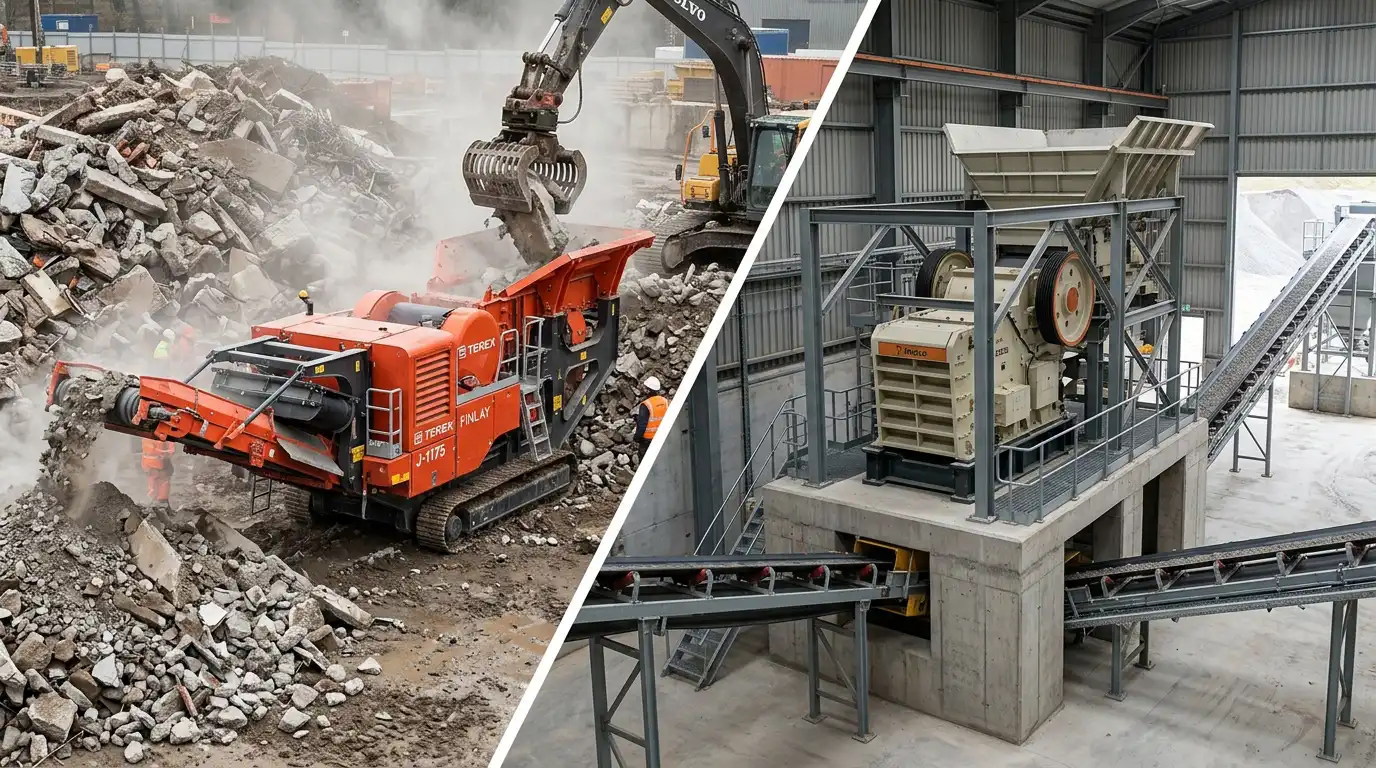
A stationary jaw crusher is bolted to a concrete foundation and wired to grid power. It is part of a fixed plant layout. It cannot be relocated without a demolition and rebuild. A PE jaw crusher is a typical example, built to run for years from one fixed position.
A mobile jaw crusher is different. It is a self-contained unit, with the crusher, drive, and often a feeder and discharge conveyor all mounted on one chassis. This category splits into two types that are often confused with each other.
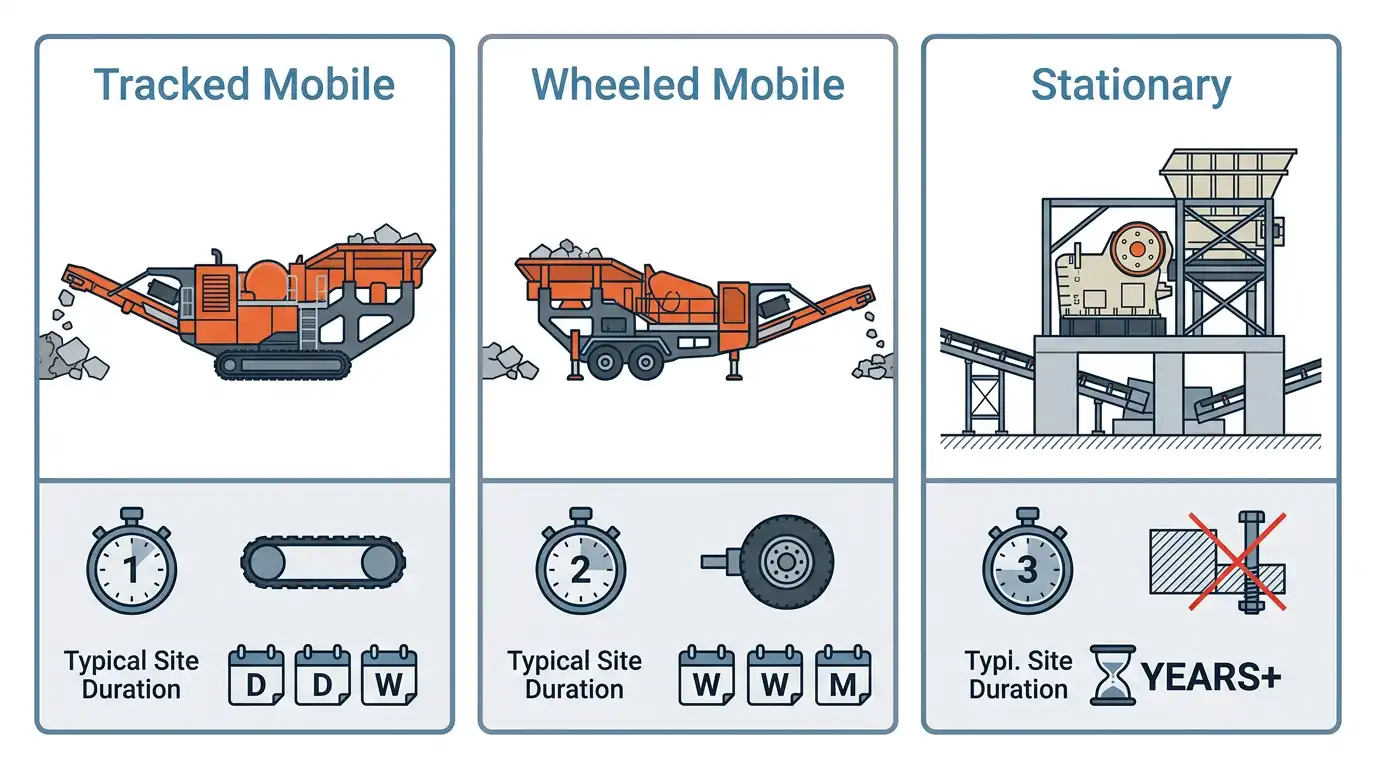
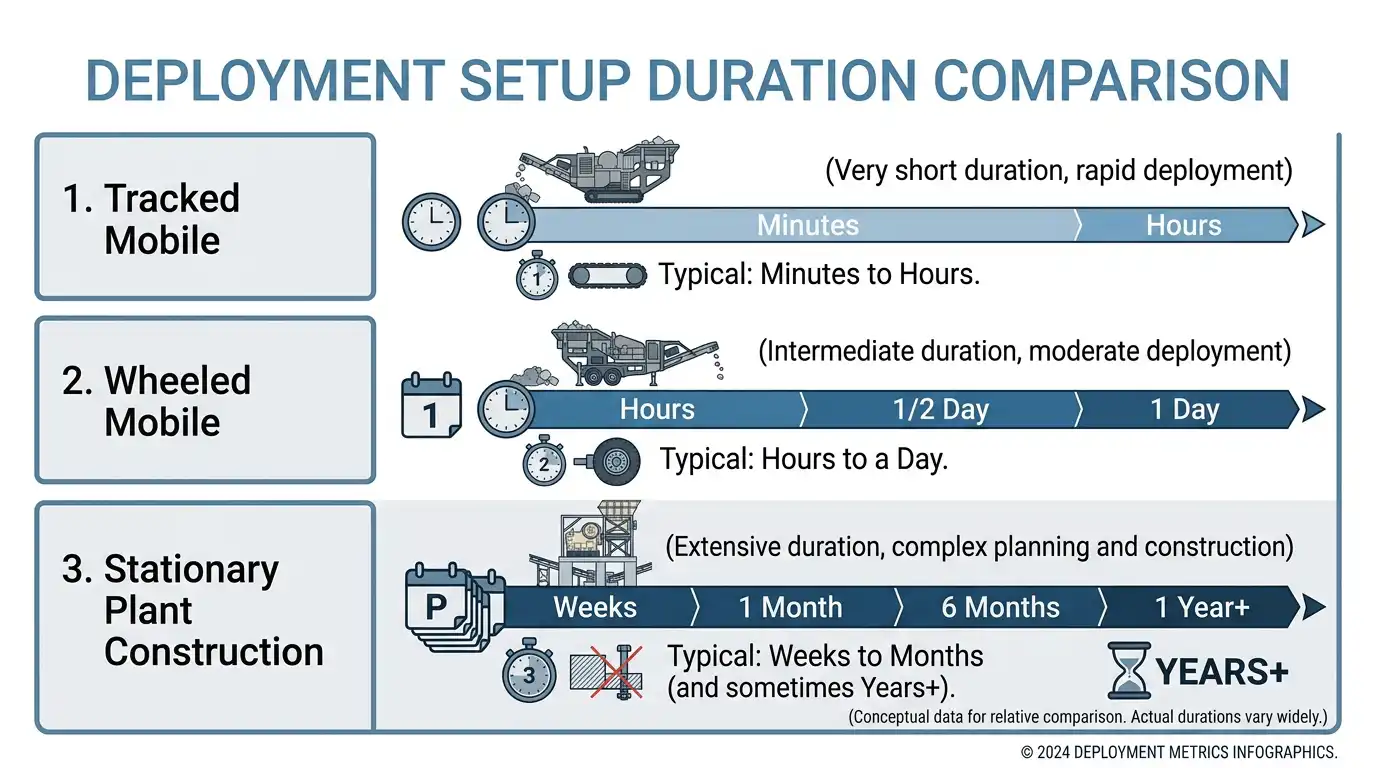
A tracked mobile crusher is self-propelled. It can reposition itself within minutes, using the same tracks found on excavators. A wheeled mobile crusher, sometimes called a portable crusher, is towed between sites on its own axles. It needs a transport vehicle and longer setup time at each new location.
The crawler mobile crusher and portable crusher with wheels product line covers both variants.
The practical difference comes down to two things. How fast does the unit go from parked to processing material, and how far can it travel without a flatbed truck?
When a Project Favors Mobile Deployment
Short-duration jobs are the clearest case for mobile deployment. A contractor processing one quarry face over a few months gains little from a permanent foundation. The same applies to a demolition recycling operation moving between job sites.
The crusher travels to the material pile instead of trucking material to a fixed plant. This cuts haul distance when rubble or rock is spread across a wide area.
Remote sites without reliable grid power are another strong fit. Tracked and wheeled units run on diesel power packs and do not depend on a utility connection. Rental fleets and multi-site contractors also favor mobile units. The same machine can be redeployed across several active jobs within one season, spreading its cost across more total tonnage.
When a Project Favors Stationary Deployment
Long-life, high-output quarries are the strongest case for a stationary jaw crusher. A site with a 20-year extraction plan and an output target above roughly 500 tonnes per hour needs a fixed plant layout. That layout integrates the crusher with downstream screens, conveyors, and secondary crushing stages. A larger model such as the C jaw crusher can be specified without the road-transport weight limits that cap mobile chassis sizing.
Grid electricity is the other practical advantage. A stationary plant wired to utility power avoids years of fuel delivery logistics, diesel storage, and generator maintenance that a remote mobile fleet requires.
The Capacity Ceiling Mobile Units Cannot Cross
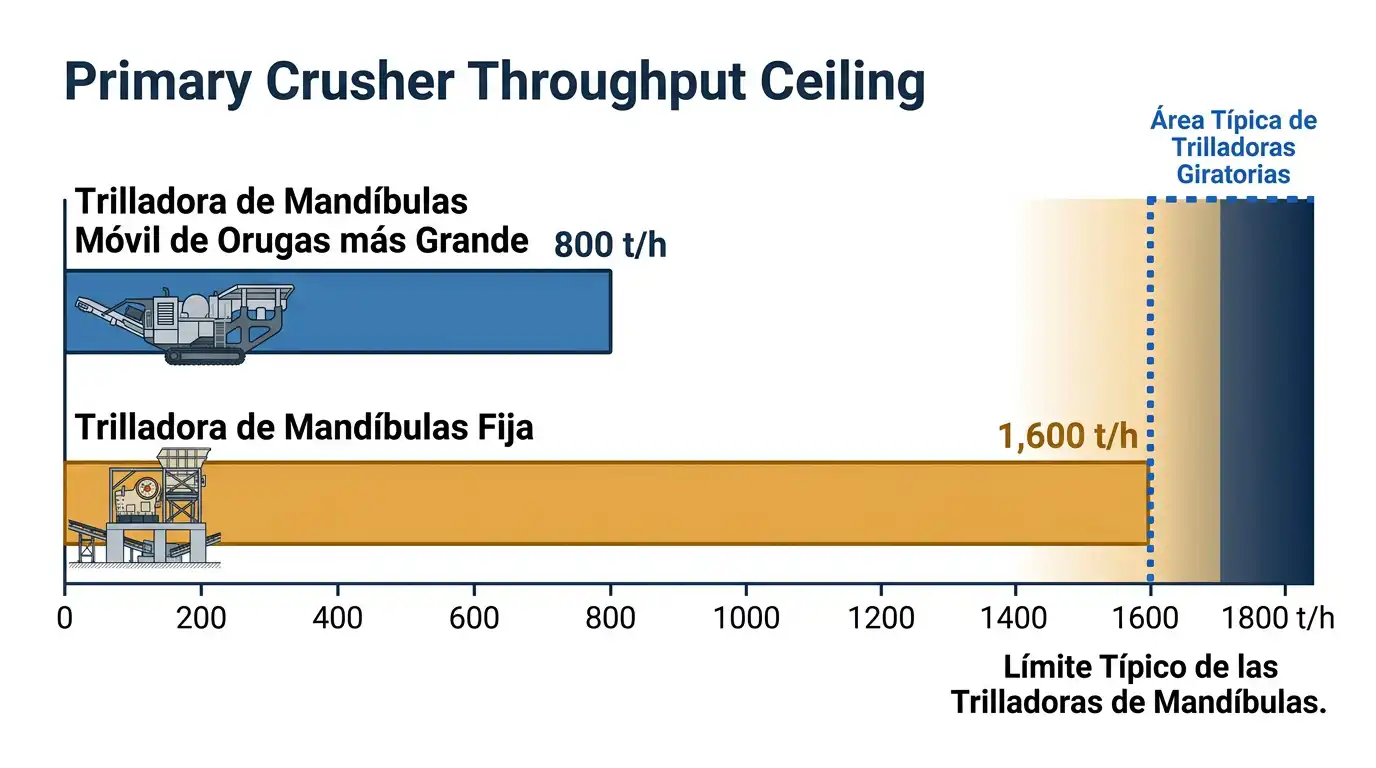
Mobile jaw crushers face a hard physical limit that stationary units do not. A tracked mobile crusher typically reaches an operating weight of roughly 120 to 185 tonnes. That ceiling is set by what a crawler undercarriage can support, and by road weight limits for transport between sites. The result is a practical throughput ceiling of around 800 tonnes per hour for the largest tracked models currently offered.
Stationary jaw crushers face no such constraint, since they are assembled on-site and never move again. This allows stationary jaw crusher lines to scale up to roughly 1,600 tonnes per hour. Beyond that point, a plant designer typically switches to a gyratory crusher as the primary stage instead.
For any project targeting output above the mobile ceiling, a stationary configuration is not just preferable. It is the only option.
Setup Time and Mobilization Cost
The cost gap between relocating a tracked unit and a wheeled unit is well documented. One published industry worked example compared mobilization cost on a 15,000-tonne job. A tracked crusher moved for approximately $0.99 per tonne. A wheeled crusher on the same job cost approximately $1.96 per tonne, once towing, setup, and site preparation were included.
The gap narrows or widens depending on how many times a unit relocates within one contract. Tracked units absorb repeated moves far more cheaply.
Stationary plant construction runs on an entirely different timescale. Site civil works, foundation curing, and structural steel erection typically take several weeks to several months before first load. That schedule commitment only makes sense when spread across years of operation.
Total Cost of Ownership: Why There Is No Universal Breakeven
Many sales materials cite a specific premium percentage for mobile equipment, or a fixed payback period against a stationary alternative. No independently verified universal threshold exists. Most of those figures trace back to equipment vendors rather than neutral third-party cost studies. Site conditions also vary too widely for one number to apply broadly.
The clearest independent data point comes from a peer-reviewed study of semi-mobile in-pit crushing and conveying systems in mining. It found capital costs roughly 60 percent higher than conventional truck haulage. It found operating costs roughly 43 percent lower, and net present cost roughly 28 percent lower over the project life.
The study was explicit that this advantage only appears when the mine has a long operating life. The higher upfront capital needs years of lower operating cost to pay itself back, which a short-duration project will rarely achieve.
A Regulatory Wrinkle Most Buyers Miss
A detail in US federal regulation changes how a portable crusher is classified, based on how long it stays in one place. Under 40 CFR 1068.30, a portable engine that stays at a single location for more than 12 consecutive months is reclassified as a stationary engine. This happens even though the physical unit never changed. The reclassification can trigger different permitting and emissions requirements than the unit was originally purchased under.
US EPA rules under 40 CFR Part 60 Subpart OOO add a separate wrinkle. Fixed plants processing 25 tonnes per hour or less are exempt from certain requirements. Portable plants get a higher exemption threshold, at 150 tonnes per hour.
In the UK, Defra guidance under PG 3/16 expects a tracked mobile unit to be operational within roughly half an hour of arriving on site. That standard reflects how regulators treat mobile equipment differently from fixed installations. Any buyer planning to park a “mobile” unit at one site for an extended project should confirm how these rules apply.
Frequently Asked Questions
Is a tracked mobile jaw crusher always cheaper than a stationary one?
No. A tracked unit is typically cheaper to relocate and faster to deploy. A stationary plant has a lower cost per tonne over a long operating life at high output. The better choice depends on project duration and target throughput, not a fixed cost rule.
What is the difference between a tracked mobile crusher and a wheeled portable crusher?
A tracked mobile crusher is self-propelled and can reposition itself within minutes using built-in tracks. A wheeled portable crusher is towed by a separate vehicle and needs more setup time at each new location. It can still be less expensive to purchase.
Can a mobile jaw crusher reach the same capacity as a stationary one?
No. Tracked mobile jaw crushers are limited by transport weight to roughly 800 tonnes per hour at the largest available models. Stationary jaw crushers can scale up to roughly 1,600 tonnes per hour before a plant typically switches to a gyratory crusher instead.
Does a mobile crusher stay classified as mobile if it stays at one site for years?
Not necessarily, under US federal rules. A portable engine that remains at one location for more than 12 consecutive months can be reclassified as a stationary engine under 40 CFR 1068.30. That reclassification may change the emissions requirements that apply to it.
References & Sources
- U.S. Environmental Protection Agency, 40 CFR Part 60 Subpart OOO — Standards of Performance for Nonmetallic Mineral Processing Plants
- U.S. Government Publishing Office, 40 CFR 1068.30 — Definitions (portable vs. stationary engine classification), Federal Register
- UK Department for Environment, Food and Rural Affairs, Process Guidance Note PG 3/16 — Statutory Guidance for Mobile Crushing and Screening Plants
- ScienceDirect, “Jaw Crusher” topic overview, ScienceDirect Topics
- Pit & Quarry, mobile crusher mobilization cost comparison (tracked vs. wheeled)