

What Is Screening? How Vibrating Screens Separate Particles by Size
What You Will Learn from This Guide
Screening is a mechanical sizing process that sorts crushed or mined material into size fractions. It passes the material over a vibrating deck fitted with sized openings. This guide explains how screens separate particles and compares the two main vibrating-screen designs. It also covers why real screening efficiency rarely reaches the number printed on a datasheet. It serves an engineer or plant manager sizing a screening stage, and after reading, you will understand why moisture, particle shape, and aperture geometry matter as much as deck size.
How a Vibrating Screen Separates Particles by Size
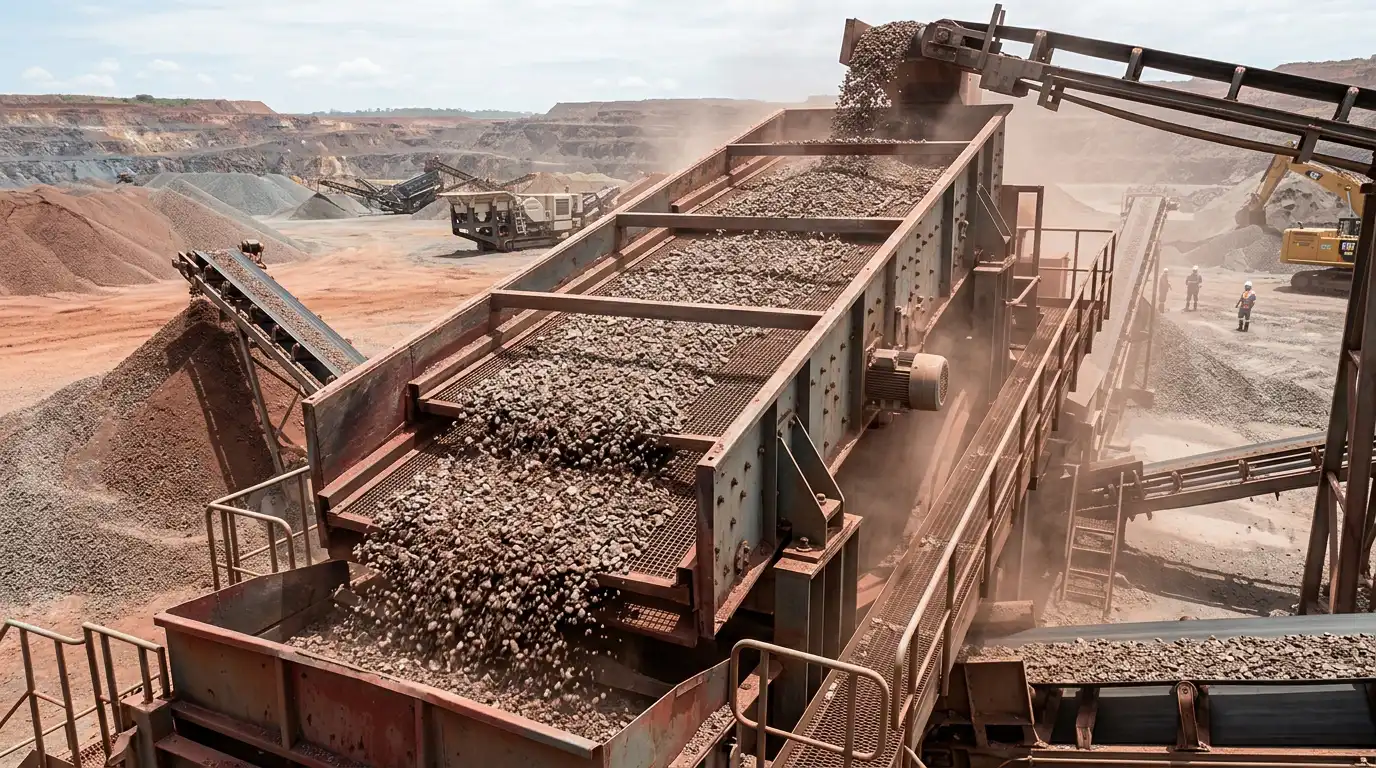
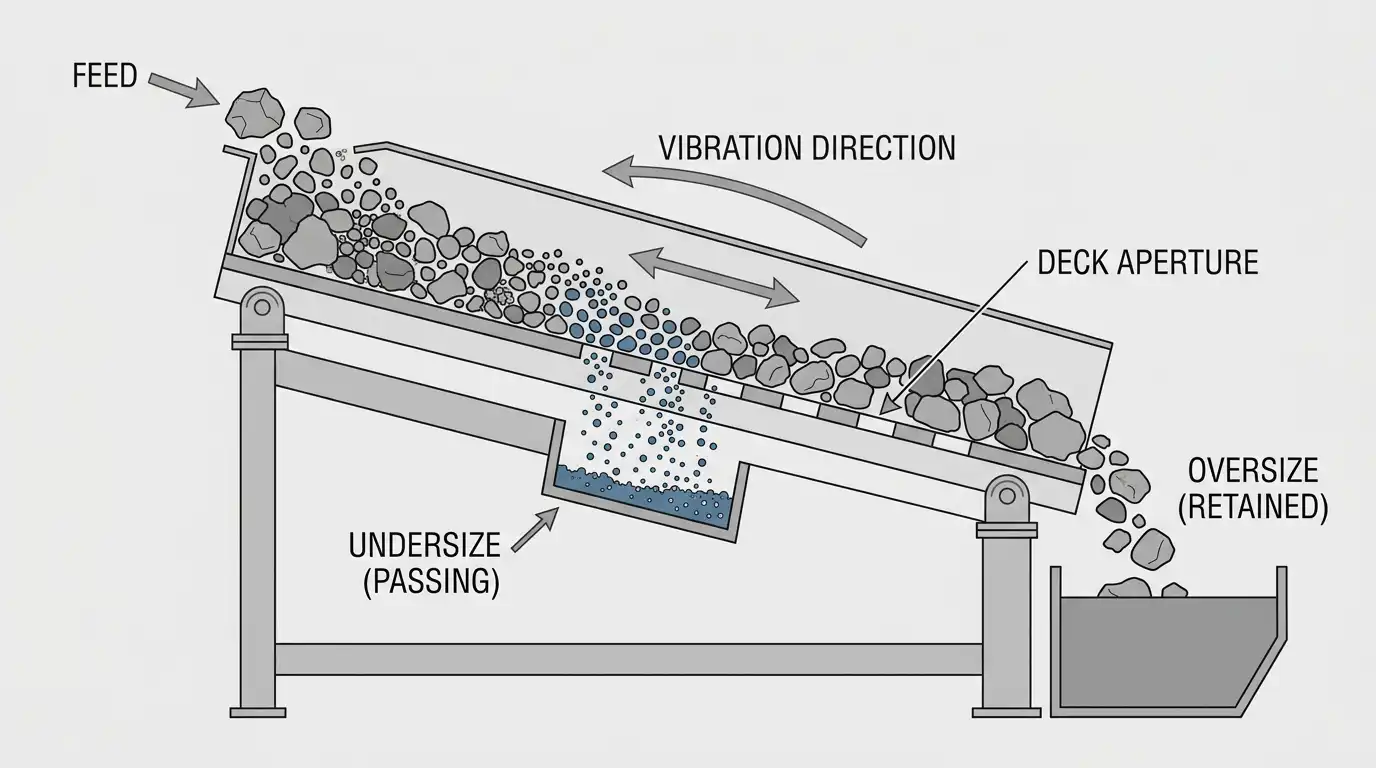
A screen deck works as a dimensional gauge rather than a sorting machine. Each deck carries openings of a fixed size, and vibration carries the material across it in a thin, moving bed. Particles smaller than the opening fall through, while particles larger than the opening are carried forward and discharged as oversize. A multi-deck screen repeats this process at progressively finer openings to produce several sized products from one pass, in the same way the equipment covered in this guide to classifier types separates material by a different mechanism.
Vibration does two jobs at once. It moves material across the deck, so every particle gets repeated chances to find an opening, and it keeps the bed loose enough that fines are not trapped under coarser particles. Without enough vibration intensity, fine material rides on top of the bed and never reaches the deck surface. It then reports as oversize even though it is small enough to pass.
The stream leaving a screen is never perfectly sorted. A particle near the aperture size has roughly even odds of passing or being retained, and that uncertainty band widens as particle shape departs from a sphere. Academic modeling of rectangular-aperture screens treats this as a probability rather than a hard cutoff, assigning each particle size a passing chance instead of a simple yes-or-no result.
Inclined Circular-Motion Screens vs High-Speed Linear Screens
Two mechanical families cover most crushing and aggregate screening duty. Each suits a different combination of feed rate, material, and available headroom. Selecting between them is a real engineering decision, and it shapes the rest of the S5X Vibrating Screen or Y Vibrating Screen specification.
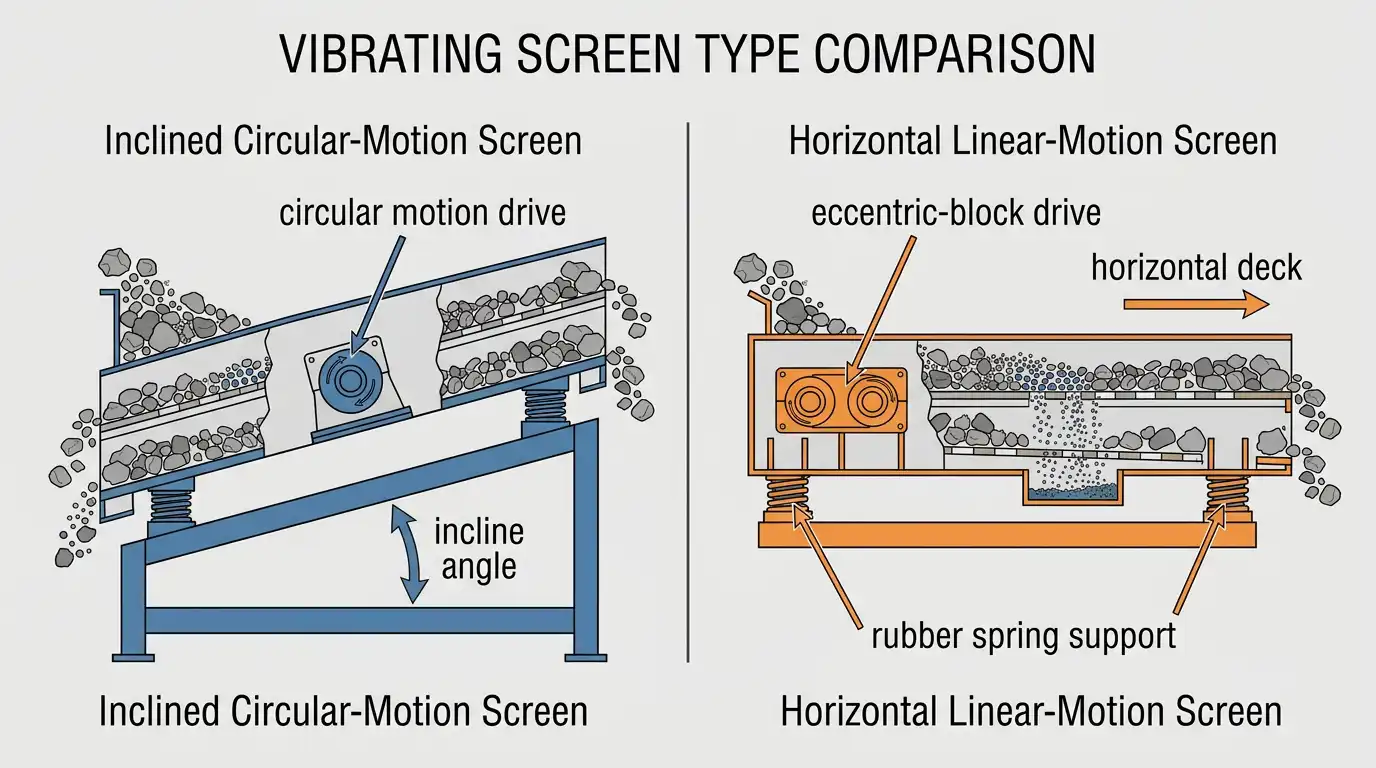
An inclined circular-motion screen, such as the S5X, mounts the deck at a fixed slope and drives it through a circular motion that moves material downhill while it is sorted. Rubber springs replace metal coil springs on this design. The manufacturer’s datasheet credits this choice with longer service life, corrosion resistance, lower noise, and less vibration transmitted to the supporting structure. The S5X operates at a G-force of 3.2 to 4.2 g, at 800 to 900 rpm, with an amplitude of 7 to 12 mm, and it is built for heavy, medium, and fine screening duty across multiple decks.
A high-speed linear screen, such as the Y Vibrating Screen, drives the deck with an eccentric-block mechanism instead, at a higher vibration frequency. This design suits applications where a compact footprint or a particular throw pattern matters more than the inclined screen’s simpler layout. Both families handle two or more decks. The choice between them usually comes down to the feed material’s abrasiveness, the plant’s available installation height, and the throughput the circuit requires.
Representative capacity and screening-area figures for inclined circular-motion screens of different sizes, from the manufacturer’s own datasheets
| Model | Deck size (mm) | Decks | Capacity (t/h) | Mesh range (mm) |
|---|---|---|---|---|
| S5X1845 | 1800 × 4500 | 2–3 | 60–450 | 2–70 |
| S5X2160 | 2100 × 6000 | 2–4 | 85–700 | 2–70 |
| S5X2760 | 2700 × 6000 | 2–3 | 120–900 | 2–70 |
| S5X3072 | 3000 × 7200 | 2 | 150–1200 | 2–70 |
Source: Mr Crusher Mill product datasheets.
Capacity rises with deck width and length. The published ranges already assume a feed that behaves close to the material the screen was rated against. A wetter or stickier feed will not reach the top of the printed range without a wider deck, a coarser mesh, or both.
Why Real Screening Efficiency Falls Short of the Catalog Number
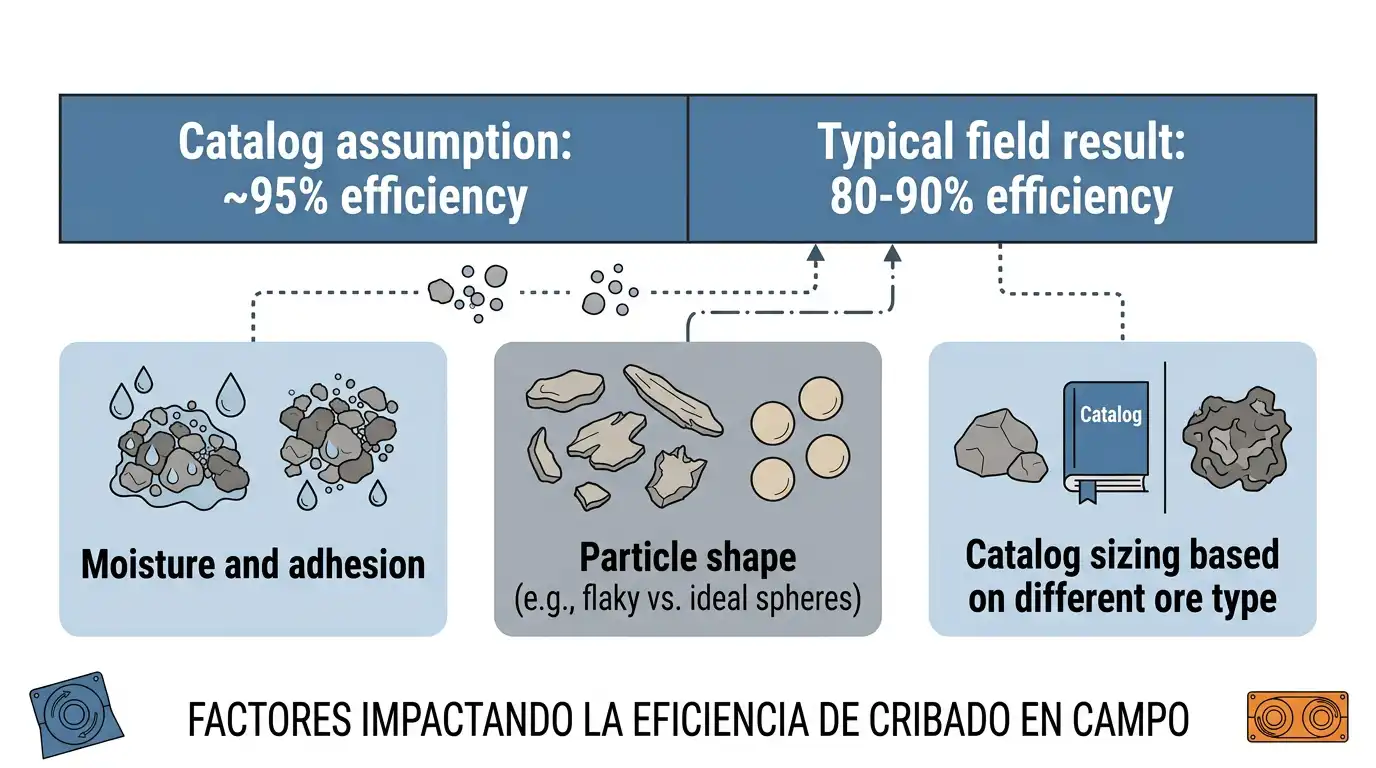
Screening efficiency is the share of undersize material actually present in the feed that ends up in the undersize stream. A screen sized with standard capacity formulas, the same formulas behind the S5X Vibrating Screen capacity table above, is commonly assumed to run near 95 percent efficiency, but field performance usually lands closer to 80 to 90 percent, and 100 percent is not achievable with any mesh. That gap is not a sign of a defective screen; it is a predictable result of how real feed material behaves.
Moisture is one of the largest contributors to the gap. Research on hydrated iron ore screening found that moist, fine particles adhere to each other and to the deck surface, a different problem from simple blinding, where an oversize particle physically lodges in an aperture. Sticking fines shrink the usable opening around each aperture that remains clear, even when no aperture is fully blocked. The same research compared square and rectangular aperture shapes and found that aperture geometry changes how much open area survives this effect. Mesh selection for a wet, fine feed is therefore not interchangeable with mesh selection for a dry, coarse one.
Particle shape adds a second source of the gap. Mineral particles are rarely spherical, and a flat or elongated particle near the aperture size can pass lengthwise through an opening that would reject a rounder particle of the same nominal size. Published modeling of rectangular-aperture screening treats this as a probability tied to particle shape and orientation, not a fixed size cutoff, so two feed batches with an identical size distribution can screen differently if their particle shapes differ.
Sizing error compounds both problems. Industry research on crushing and screening circuit design found that catalog capacity tables are built mainly from calcareous-ore test data, adjusted for density. Using those tables for denser, less regular ores, such as hematitic or goethitic iron ore, can mis-size a screen even after a density correction, because particle shape and surface stickiness do not scale the same way density does. The same research found that screening and crushing together account for roughly 10 percent of a mineral processing plant’s total operating cost, which makes screen sizing a cost decision as much as a technical one.
Frequently Asked Questions
What causes a vibrating screen to blind or peg?
Blinding happens when near-size particles lodge in an aperture and block it. Pegging is the same problem in wire-mesh decks, where a particle wedges between adjacent wires. Both reduce the deck’s effective open area without an obvious change in feed rate, which is why screening efficiency can drop even when throughput looks normal.
How many decks does a screening circuit usually need?
The number of decks depends on how many sized products the circuit must produce in one pass. There is no fixed industry standard. A two-deck screen typically separates feed into three fractions, while four-deck configurations of the S5X Vibrating Screen can produce five. Adding decks increases the equipment’s footprint and cost, so the decision should match the plant’s actual product specification rather than default to the maximum available.
Is a vibrating screen the same thing as a classifier?
No. A vibrating screen sorts material mechanically by physical size, through a deck with fixed openings, which is the subject of this guide. A classifier, covered in this site’s guide to classifier types, typically separates finer material by settling behavior in air or water instead. The two technologies serve different particle-size ranges in a processing plant.
Does a wetter feed always need a bigger screen?
Not necessarily a bigger screen, but usually a different one. A wetter or stickier feed reduces effective open area through adhesion, not through a change in particle size. The fix is often a coarser mesh, a different aperture shape, or added vibration intensity, rather than simply more deck area. Sizing this correctly requires knowing the feed’s moisture behavior, not just its size distribution.
References & Sources
- Minerals Engineering (Elsevier) — Dehghani, Monhemius & Gochin, Evaluating the Nakajima et al. Model for Rectangular-Aperture Screens
- Universidade Federal de Minas Gerais (UFMG) — Peneiramento de Minério de Ferro Hidratado: Efeito da Geometria da Abertura na Área Útil
- ABM Proceedings — Metodologia Empregada para Escalonamento de Circuitos de Peneiramento e Britagem