

How to Correctly Set the Closed Side Setting (CSS): Measurement Methods and Adjustment Steps
What You Will Learn from This Guide
This guide focuses on the closed side setting of a jaw crusher specifically. Cone and gyratory crushers use the same CSS concept, but their measurement and adjustment methods differ enough to need their own guide. This one covers how CSS is actually defined, two practical ways to measure it, and the two adjustment methods, mechanical shim and hydraulic wedge, used to correct it. It serves a plant operator or maintenance technician responsible for keeping a jaw crusher’s product size on target, and after reading, you will be able to measure and adjust CSS correctly rather than guessing at it.

What CSS Actually Is
The closed side setting is the narrowest gap between the fixed jaw and the swing jaw, measured at the bottom of the crushing chamber. It represents the smallest opening the swing jaw reaches during its cycle. That opening sets the maximum size of the product leaving the crusher.
Measuring that gap is not always as simple as it sounds. Jaw plates are commonly corrugated or toothed rather than flat. Depending on the tooth profile, CSS gets measured either top-to-top or bottom-to-top. Both methods match corresponding points on the two jaw faces, rather than the nearest points at any given moment. Using the wrong reference point on a toothed jaw produces a measurement that looks precise but does not match the actual product size.
Two Measurement Methods
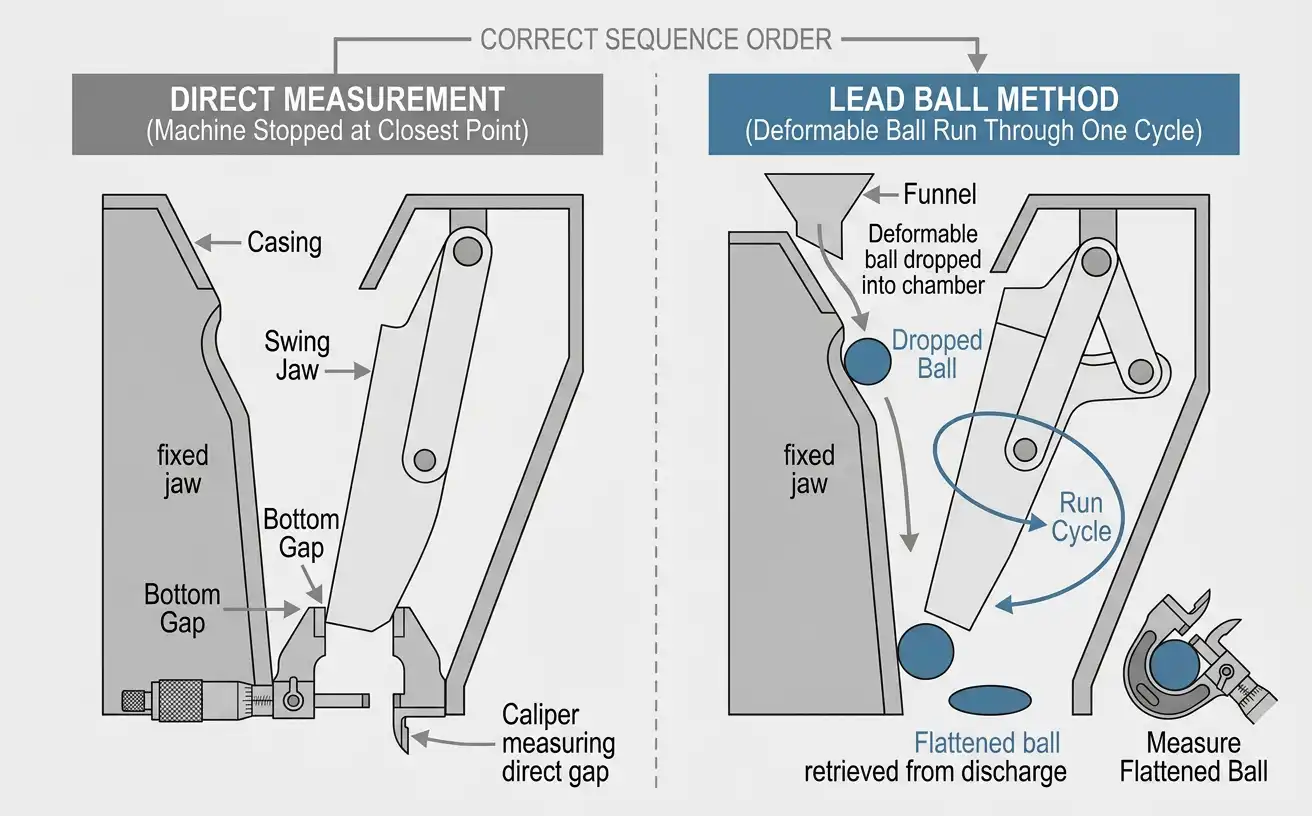
Direct measurement is the simplest method in principle. The machine stops with the swing jaw at its closest point in the cycle. A caliper or ruler then measures the gap directly at the bottom of the chamber.
The difficulty is timing. Stopping the crusher at exactly the right point in its cycle is not always practical or safe to do by eye.
The lead ball method avoids that timing problem entirely. A soft, deformable object, traditionally a lead ball, gets placed in the chamber before a cycle. The crusher runs through one full cycle, compressing the ball to the narrowest point the jaws actually reach.
The flattened object is then retrieved and measured. Its thickness at the narrowest point is the CSS.
The lead ball method’s real advantage is safety and reliability. No one needs to time a stop precisely. It also captures the true minimum gap the jaws reach during actual operation, not an estimate based on where the crusher happened to stop.
Mechanical Shim Adjustment
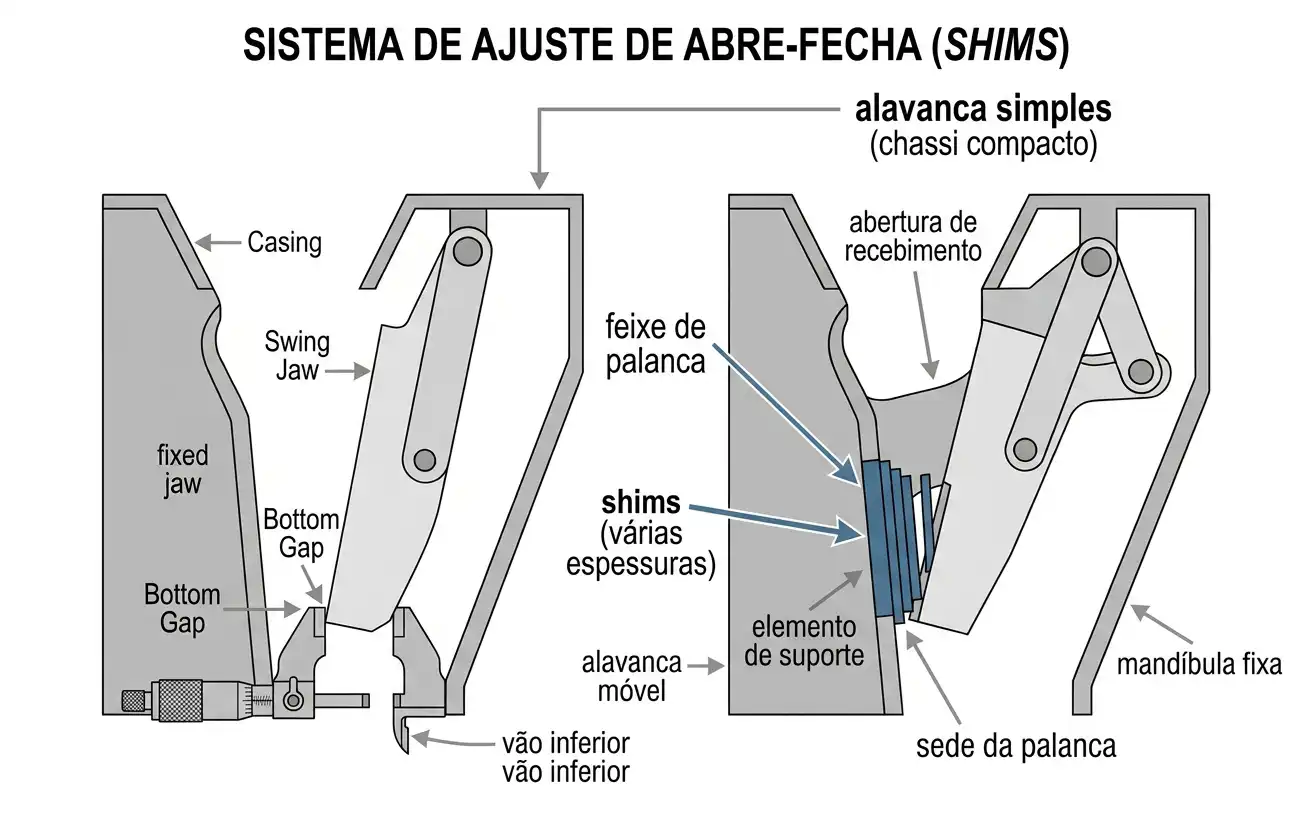
A shim-adjusted jaw crusher sets CSS using solid spacers behind the toggle seat. Shims of different thicknesses sit between the toggle beam and a fixed supporting element. Adding shims pushes the toggle beam into a different resting position. The swing jaw moves with it, changing the gap at the bottom of the chamber.
This adjustment requires a full stop. The crusher cannot be running while shims are added or removed. The work itself is manual. An operator selects and installs a specific combination of shims to reach the target setting.
Shim adjustment has a real advantage in simplicity and lower capital cost. That advantage comes at a cost of its own: downtime and manual labor every time the setting needs to change.
Hydraulic Wedge Adjustment
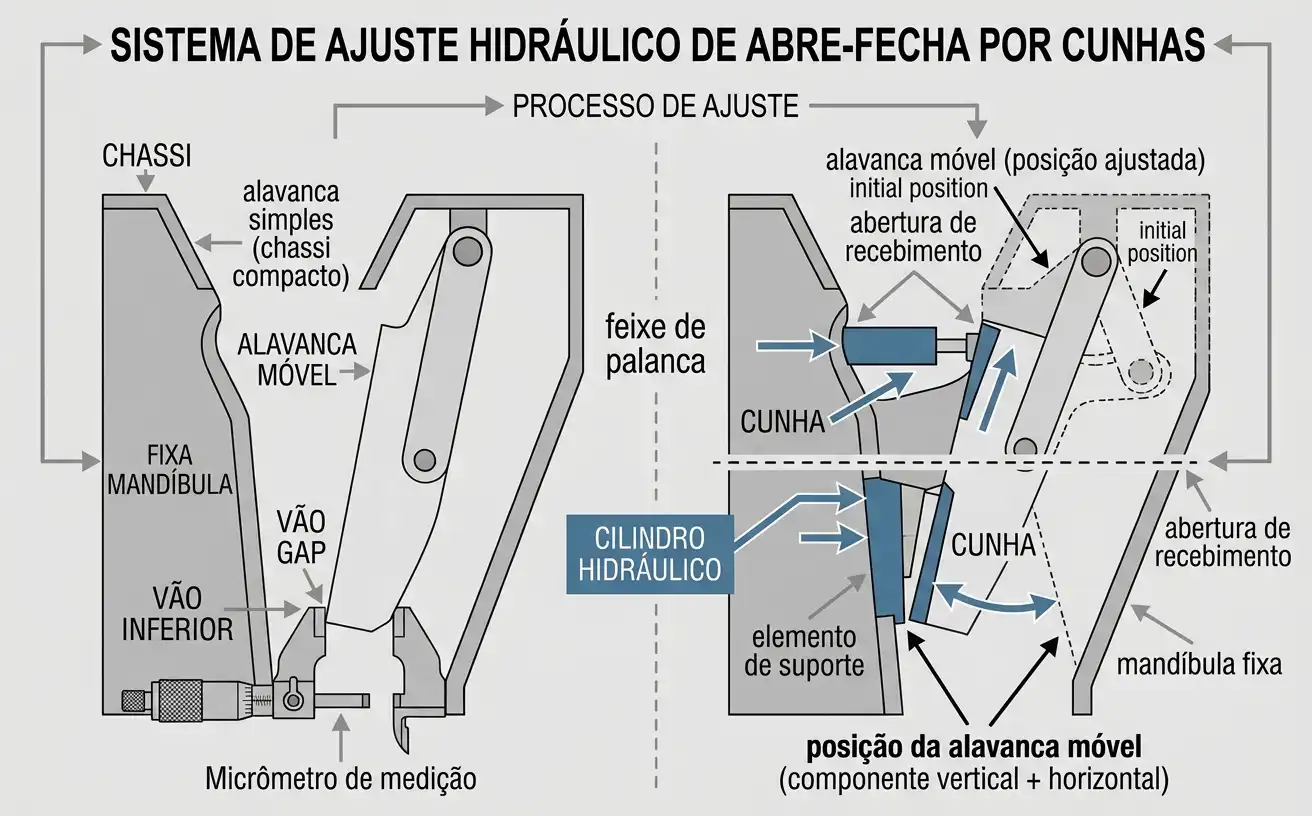
A hydraulically adjusted jaw crusher uses wedges instead of shims. Hydraulic cylinders push these wedges inward or outward behind the toggle seat. This moves the swing jaw closer to or farther from the fixed jaw. The adjustment happens with the push of a button, not a manual shim swap.
This method trades higher upfront cost for speed and convenience. It also changes a machine’s behavior under overload. A shim-adjusted crusher’s toggle plate acts as a mechanical fuse. It breaks under extreme overload from tramp metal or an uncrushable object.
A hydraulically adjusted crusher works differently under that same overload. It can relieve pressure through the hydraulic system itself, letting the obstruction pass without breaking a component.
Why CSS Needs Periodic Re-Checking
CSS does not stay fixed just because the adjustment mechanism has not been touched. Jaw plates wear as the crusher runs. That wear widens the actual gap over time, even with the shims or hydraulic wedges left exactly where they were set.
This means CSS verification is a recurring maintenance task, not a one-time setup step. A crusher commissioned with a correctly measured CSS will drift out of that setting as liners wear. Re-measurement is what catches that drift before product size shifts far enough to matter downstream.
A Practical CSS-Setting Checklist
- Confirm which reference points apply for the jaw plate’s tooth profile before measuring, top-to-top or bottom-to-top.
- Use the lead ball method when a precisely timed stop is impractical or unsafe.
- For shim adjustment, plan for a full stop and the labor time the change requires.
- For hydraulic adjustment, confirm the system can relieve properly under overload, not just adjust CSS during normal operation.
- Re-measure CSS on a recurring schedule tied to liner wear rate, not only when product size complaints prompt a check.
Consequences of Getting CSS Wrong
A CSS set too wide produces oversized product. That oversized product can overload downstream crushing stages designed for a narrower feed range. A CSS set too tight raises power draw and increases wear rate instead. The crusher works harder to force material through a smaller gap than the machine and material are actually matched for.
CSS on a primary crusher affects more than that one machine. The right primary CSS gives a secondary stage feed sized for efficient processing. A poorly set primary CSS pushes that problem downstream. It shows up as reduced efficiency on equipment that was never actually misconfigured itself.
Frequently Asked Questions
What is the difference between measuring CSS top-to-top versus bottom-to-top?
Jaw plates are often corrugated or toothed rather than flat, so a single “gap” measurement needs a consistent reference point. Top-to-top and bottom-to-top refer to matching corresponding points on the tooth profile of the two jaw faces. The correct choice depends on that specific profile.
Why use the lead ball method instead of measuring directly?
Direct measurement requires stopping the crusher at exactly the point where the swing jaw is closest. That timing is difficult to get precisely right and can be unsafe. The lead ball method avoids that. It runs a deformable object through a full cycle and measures it afterward, capturing the true minimum gap without a precisely timed stop.
Should I choose shim adjustment or hydraulic adjustment for a new jaw crusher?
Shim adjustment costs less upfront but requires a full stop and manual labor every time the setting changes. Its toggle plate breaks under extreme overload as a mechanical fuse. Hydraulic adjustment costs more upfront but adjusts with the push of a button, and it can relieve pressure under overload instead of breaking a component.
How often should CSS be re-measured?
CSS should be checked on a schedule tied to the crusher’s liner wear rate, not only when a product size problem is noticed. Jaw plates wear continuously during operation, widening the actual gap even when the adjustment mechanism itself has not been touched.