

Why Grind Size Depends on Mineral Grain Size
What You Will Learn from This Guide
Grind size is set by the grain size of the valuable mineral because random breakage only frees a mineral when the ground particles become about as small as, or smaller than, the mineral grains themselves; that is the condition for mineral liberation. This guide explains the link between grain size and particle size, shows how liberation changes across the grain-size range in real ore, and gives a step-by-step method to turn grain-size data into a grind target and a grinding flowsheet. It is for process engineers and plant owners who must fix a P80 from the ore itself before you compare the mining grinding mill types.
Grain Size and Particle Size Are Two Different Measurements
Two sizes are often confused. The grain size (also called dissemination size) is the size of the mineral crystals inside the rock, as they formed in the deposit. The particle size is the size of the pieces that leave the crusher or mill, normally reported as a P80. Comminution can change the particle size, but it cannot change the grain size. The grind target is therefore found by bringing the particle size down until it matches the grain size well enough for separation.
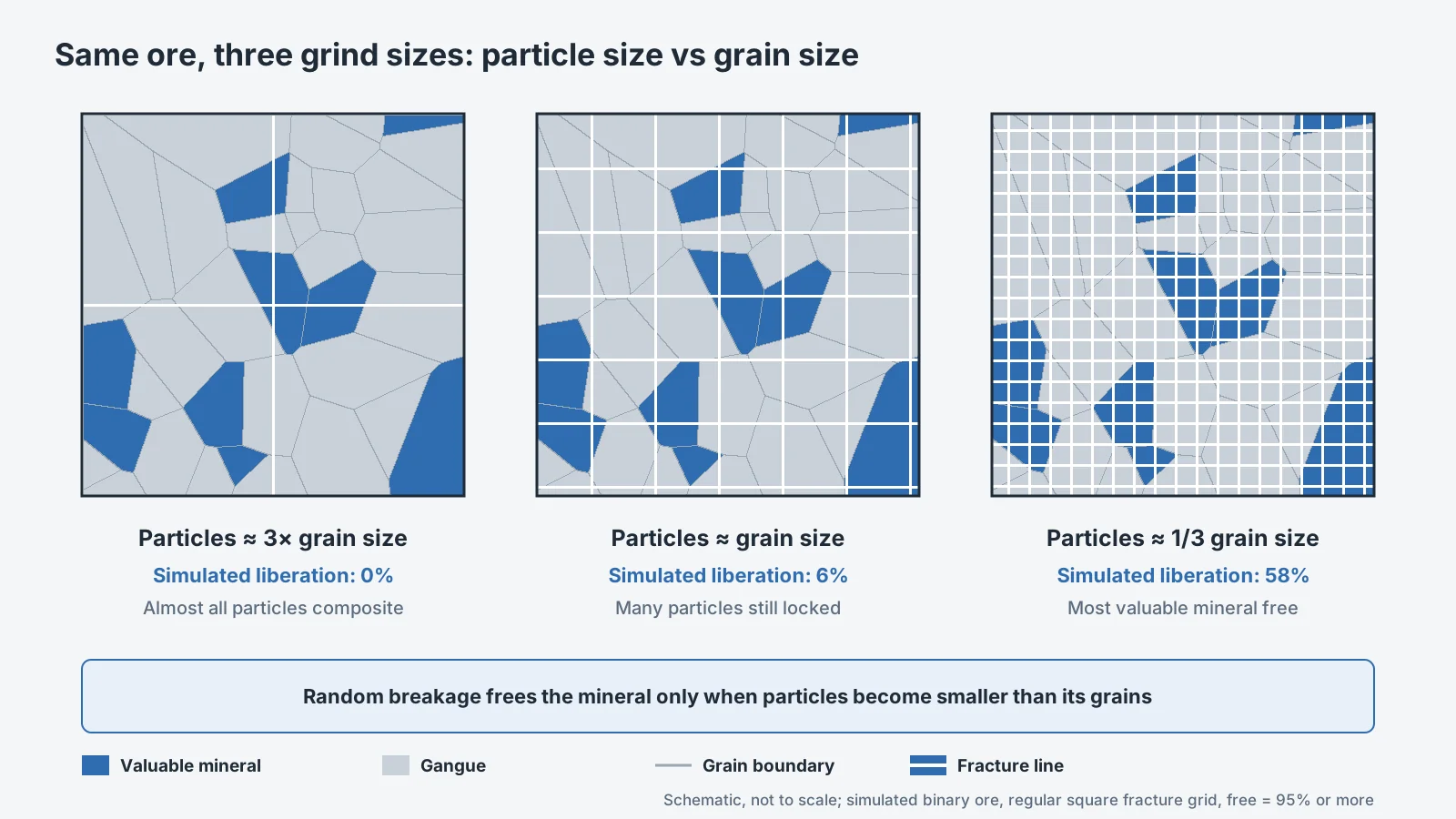
The figure shows one simulated ore broken at three sizes. In most mills, cracks run through the rock without regard to grain boundaries. As long as the particles are larger than the grains, almost every particle that contains the valuable mineral also contains gangue. When the particles are close to the grain size, many are still composite, because a crack rarely falls exactly on a grain boundary. Only when the particles are clearly smaller than the grains does most of the mineral end up in free particles. In the simulation, the share of the valuable mineral in free particles rose from 0% to 6% and then to 58% as the particle size dropped from about three times to one-third of the grain size.
The classic liberation-by-size-reduction model describes the same behaviour: liberation depends on the effective grain size, the particle size and the volume share of the mineral. A lower mineral content makes the problem harder, because each small grain sits in more gangue. This is why ores with similar hardness can need very different grinds, a point explained further in crushing vs grinding.
What Plant Data Show: Liberation Jumps Near the Grain Size
Size-by-liberation data from real ore show a sharp change once particles reach the grain-size range. The table gives chalcopyrite liberation in each sieve fraction of the flotation feed from a low-grade porphyry copper ore, with sizes given as in standard particle size terms.
| Size fraction (µm) | Chalcopyrite liberation (%) |
|---|---|
| 147–208 | 34.6 |
| 104–147 | 42.2 |
| 74–104 | 74.0 |
| 53–74 | 89.1 |
| 38–53 | 92.1 |
| below 38 | 100 |
Source: Markovic, Jankovic and Tomanec (2008), listed in References & Sources.
Liberation changes little between 104 and 208 µm, then rises from about 42% to 74% and then to 89% over the next two fractions. This step indicates the size range where the particles pass through the typical chalcopyrite grain size of this ore. Below about 74 µm, extra fineness adds only a few percent of liberation, while it costs more energy and creates more slimes. For this ore, the data point to a grind target of around 75 µm. A grind of 150 µm would leave most of the chalcopyrite in composite particles, whatever the mill.
The same principle is written into iron ore practice. For taconite, the ore must be ground to a particle size close enough to the grain size of the iron-bearing mineral, and most taconite needs very fine grinding for that reason. The fine-grained magnetite, not the hardness of the rock, is what drives these plants to their fine grind. A related trade-off for flotation feeds is described in ball mill selection for gold flotation circuits.
Why Hardness Does Not Set the Grind Target
Hardness and grindability decide how much energy a grind costs; grain size decides which grind is needed. Bond’s equation, the standard tool for ball mill sizing, makes the split clear:
W = 10 × Wi × (1/√P80 − 1/√F80), where W is the specific energy (kWh/t), Wi is the Bond work index (kWh/t), and P80 and F80 are the product and feed sizes in micrometres.
The work index is a property of the rock. The P80 is a decision, and the mineralogy should make it. For an illustrative ore with Wi = 14 kWh/t and F80 = 2,000 µm, the energy changes with the target as follows:
| Target P80 (µm) | Specific energy (kWh/t) | Change vs P80 150 µm |
|---|---|---|
| 150 | 8.3 | — |
| 106 | 10.5 | +26% |
| 75 | 13.0 | +57% |
Illustrative calculation with Bond’s equation, not measured data.
Two practical points follow. First, a hard ore with coarse grains can be ground coarsely, and a soft ore with fine grains may still need a fine grind. Second, because energy rises steeply as P80 falls, a grind that is finer than the grain size requires wastes power in every hour of operation. Grinding too coarse loses metal; grinding too fine loses money and creates slimes. Grain size also affects grindability: in some iron ores, the grain size of the quartz controls both how easily the ore breaks and how well it liberates. The choice of media for the selected target is covered in steel ball gradation design.
Grain Size Classes and the Grinding Strategy They Call For
Grain size and its spread decide the shape of the grinding circuit, not only the final P80. The ranges below are indicative, for discussion only; they are not a standard classification, and real ores often fall across two classes.
| Grain size of the valuable mineral (indicative) | Typical consequence | Usual strategy |
|---|---|---|
| Coarse: about 1 mm and above | Much of the mineral is free after crushing or a coarse grind | Early rejection of gangue by screening, dense media or jigs; coarse grind of the concentrate |
| Medium: roughly 0.1–1 mm | Good liberation at a moderate grind | Single-stage ball mill grind in closed circuit |
| Fine: roughly 20–100 µm | Liberation needs a fine grind; slimes become a risk | Fine grind with tight classification, often a regrind of the concentrate |
| Very fine: below about 20 µm | Full liberation is uneconomic or impossible by grinding | Regrind of a small concentrate stream, leaching, or acceptance of a lower recovery |
| Uneven (coarse and fine grains together) | A single grind either overgrinds the coarse grains or leaves the fine ones locked | Stage grinding and stage separation |
Indicative ranges for discussion; confirm with mineralogy and tests on the actual ore.
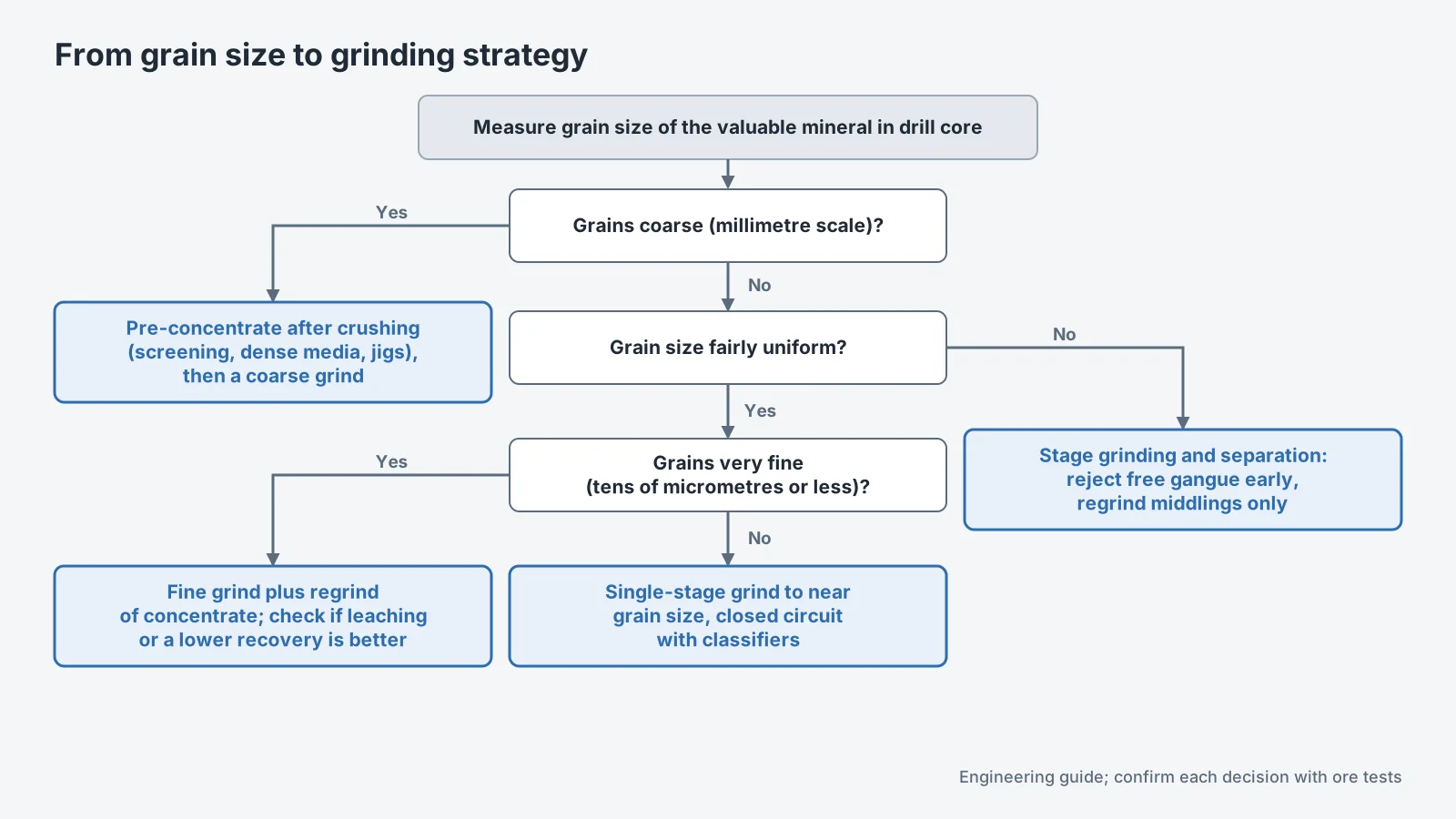
Uneven dissemination is common and is the main reason for stage grinding. A first, coarse grind frees the coarse grains and a large part of the gangue. These are removed at once by gravity, magnetic or flotation separation. Only the middlings, a much smaller mass, go on to a finer regrind. Iron ore plants apply the same idea when they remove liberated iron particles and barren gangue from the grinding circuit as soon as they form and return only the larger particles to the mill. In magnetic ores, this early rejection is the job of the magnetic separator.
Texture: When Grain Size Alone Is Not Enough
Grain size is the first number, but texture (how the grains are arranged and bonded) decides how well that number predicts liberation. Four basic intergrowth types are used to describe binary ores:
- Simple: grains meet along smooth, unbranched boundaries. Liberation follows grain size closely.
- Coated (rimmed): one mineral forms a thin rim around another. The rim is hard to free; it often stays on the host particle.
- Emulsion (inclusions): many small grains are scattered in a host. These inclusions are much finer than the main grain size and stay locked after a normal grind.
- Stockwork (veins): the mineral forms branching veinlets. Breakage often follows the veins, so part of the mineral frees at a coarse size and part stays locked.
Grain boundaries also matter. When they are weak, cracks follow them and the mineral detaches cleanly at a size close to its grain size, or even coarser. In iron formations, more intense metamorphism and deformation tend to give satisfactory liberation at coarser grinds, so the same deposit can need different grinds from zone to zone. When texture is complex, size reduction alone does not always raise liberation, and the exposed surface of a grain can matter more than its full release, as in flotation and leaching. The behaviour of different rock types under breakage is covered in types of rocks for crushing.
How to Set the Grind Target from Grain Size: A Practical Method
A defensible grind target comes from a short chain of tests, carried out on samples that represent each ore type in the mine plan. The steps below lead from mineralogy to a P80 and then to the mill.
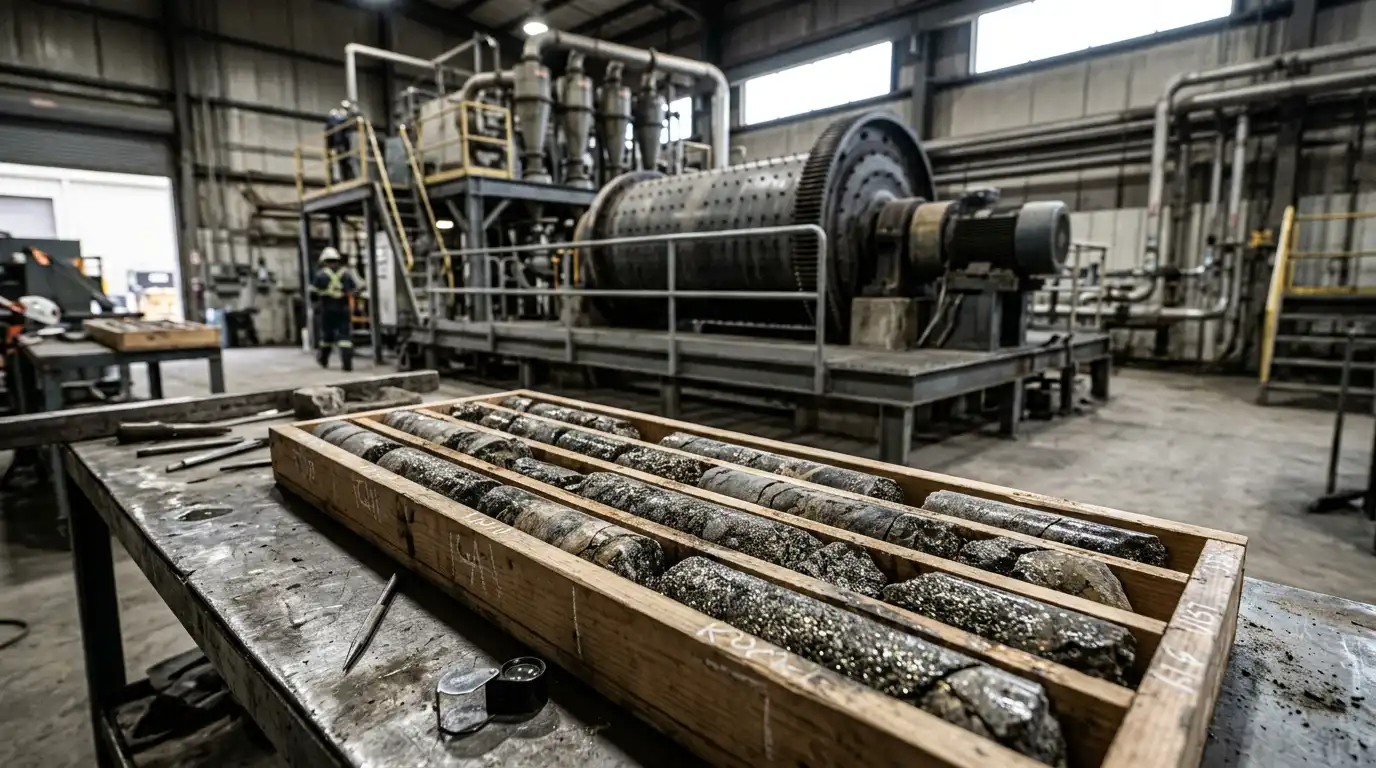
- Measure grain size on drill core. Use optical microscopy or automated mineralogy (MLA, QEMSCAN) to obtain the grain-size distribution of the valuable mineral and its main associations. Record the texture type.
- Grind at three or four levels. Grind laboratory samples to several P80 values that bracket the grain size, for example from about twice the median grain size down to about half of it.
- Measure size-by-liberation. Analyse each sieve fraction. Find the size range where liberation rises sharply, as in the table above.
- Run separation tests at each grind. Flotation, gravity or magnetic tests show the grade and recovery that each grind delivers. Liberation alone does not predict recovery.
- Compare value with cost. Use Bond’s equation or a grinding test to price the extra energy and media of each finer step against the extra metal recovered.
- Check variability. Repeat for each ore type. Where grain size varies widely, design for stage grinding or for a regrind rather than for one fine grind of all the ore.
The ball mill then has to deliver the chosen P80 at the design throughput. The MQ Ball Mill grinds by impact plus sliding and rolling of the media, which are lifted along the liner and then fall. It is offered in dry and wet types, with shells from Ф900×1800 mm (18.5 kW) to Ф3600×4000 mm (800 kW) and a long Ф3000×11000 mm model at 1250 kW, so a primary mill and a smaller regrind mill can be selected from one range. Overgrinding risk at the discharge end is compared in grate discharge vs overflow ball mill; model data are listed under MQ Ball Mill specifications.
FAQ
Is grain size the same as liberation size?
No. Grain size describes the mineral in the rock. Liberation size is the particle size at which a chosen degree of liberation is reached. For random breakage, the liberation size is usually at or below the grain size; for ores with weak grain boundaries, it can be coarser. The difference is explained in what is mineral liberation.
Can a grind target be copied from another plant on the same mineral?
Only as a starting point. Two copper or gold ores can have very different grain sizes and textures. A grind copied from another plant can leave metal locked or waste energy on overgrinding.
Why not simply grind everything very fine to be safe?
Energy rises steeply as the P80 falls, mill capacity drops, and very fine particles are harder to recover in flotation and gravity separation. A grind finer than the grain size requires usually costs more than it returns.
How can coarse-grained ores reduce grinding cost?
When grains are coarse, much of the gangue can be rejected after crushing and screening, before the mill. Less tonnage then goes to grinding. This option is reviewed in what is screening.
Which ball mill suits a stage grinding circuit?
Stage circuits usually combine a larger primary mill with a smaller regrind mill, both in closed circuit with classifiers. Shell sizes, power and ball load for each model are listed for the MQ Ball Mill.
References & Sources
The sources below support the data and principles in this guide. For background on the full size-reduction chain, see what is comminution.
- Markovic, Z. S., Jankovic, A. & Tomanec, R. (2008). Effect of particle size and liberation on flotation of a low grade porphyry copper ore. Journal of Mining and Metallurgy 44A(1), 24–30
- U.S. EPA. AP-42, Chapter 11.23: Taconite Ore Processing
- Wiegel, R. L. (2000). Development of an approach to the simulation of size reduction/mineral liberation for magnetic taconite ore in tumbling mills. University of Minnesota Duluth, technical report
- Pérez-Barnuevo, L., Pirard, E. & Castroviejo, R. (2012). Textural descriptors for multiphasic ore particles. Image Analysis & Stereology 31, 175–184
- Ferreira, R. F. et al. (2011). Relação entre o grau de metamorfismo e deformação e as características que influenciam na definição da malha de moagem de minérios de ferro. ABM Proceedings, 12th Mining Seminar
- França, J. R. O. (2019). Caracterização mineralógica e da fragmentação de tipologias de minério de ferro e sua liberação. Universidade Federal do Rio de Janeiro
Related reading: what is flotation.