

What Is Comminution? The Science Behind Crushing and Grinding
What You Will Learn from This Guide
Comminution is the general term for reducing solid material into smaller particles. Crushing and grinding are its two main methods. This guide explains what comminution actually means, why it splits into distinct crushing and grinding stages, and what physically happens to a particle when it breaks. It serves anyone trying to understand the fundamental science behind crushing and grinding equipment, not just one specific machine. After reading, you will understand why this single process family sits at the center of mining, construction materials, cement, and a wide range of industrial manufacturing.
What Comminution Actually Means
Comminution means reducing a solid material from one average particle size to a smaller one. Crushing, grinding, cutting, and vibrating all count as comminution methods. Each one breaks material down by mechanical force, not by chemical or thermal means.
This is a broader term than either crushing or grinding alone. Crushing and grinding are the two most common comminution methods used on rock and minerals specifically. The underlying concept applies wherever a bulk solid needs to end up in smaller pieces. Cement production, fertilizer manufacturing, and pharmaceutical powder processing all rely on comminution, even though none of them are mining operations.
Two Stages: Crushing vs Grinding
Crushing and grinding are not two names for the same thing done at different speeds. They are distinct stages, separated by the particle size range each one handles.
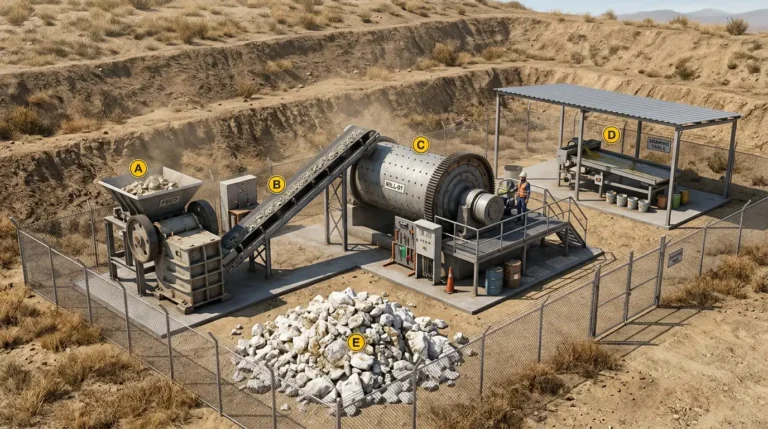
Crushing works on larger material. It typically starts from feed measured in tens of centimeters or more and reduces it down to a few centimeters. Grinding takes over from there, working on material already reduced by crushing. It takes that material down to millimeters, then to fine powder measured in micrometers.
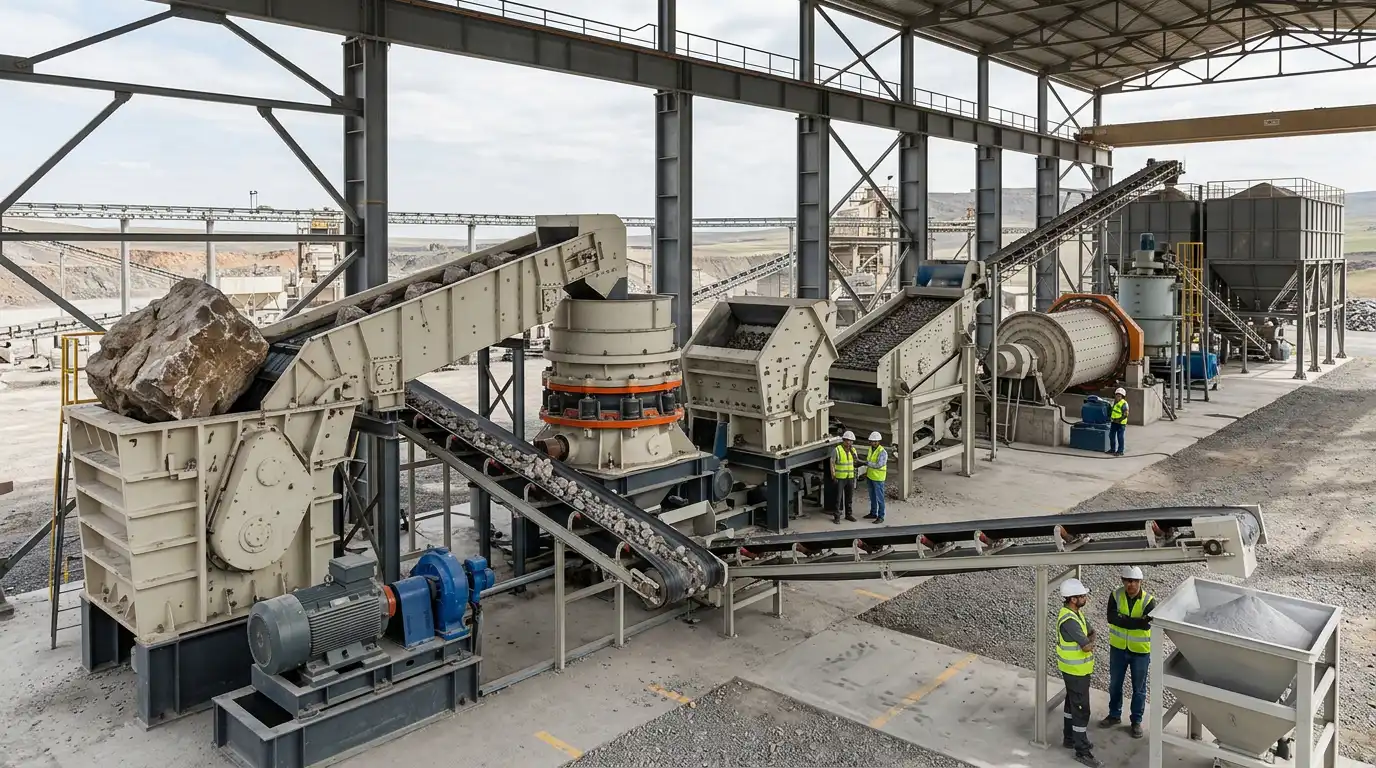
No single machine handles this entire range efficiently. A crusher built to break large rock is the wrong tool for producing fine powder. A grinding mill built for fine powder cannot accept large rock feed at all. This is why a processing line runs crushing and grinding as separate stages, not one continuous machine doing both jobs.
Four Ways to Break Material
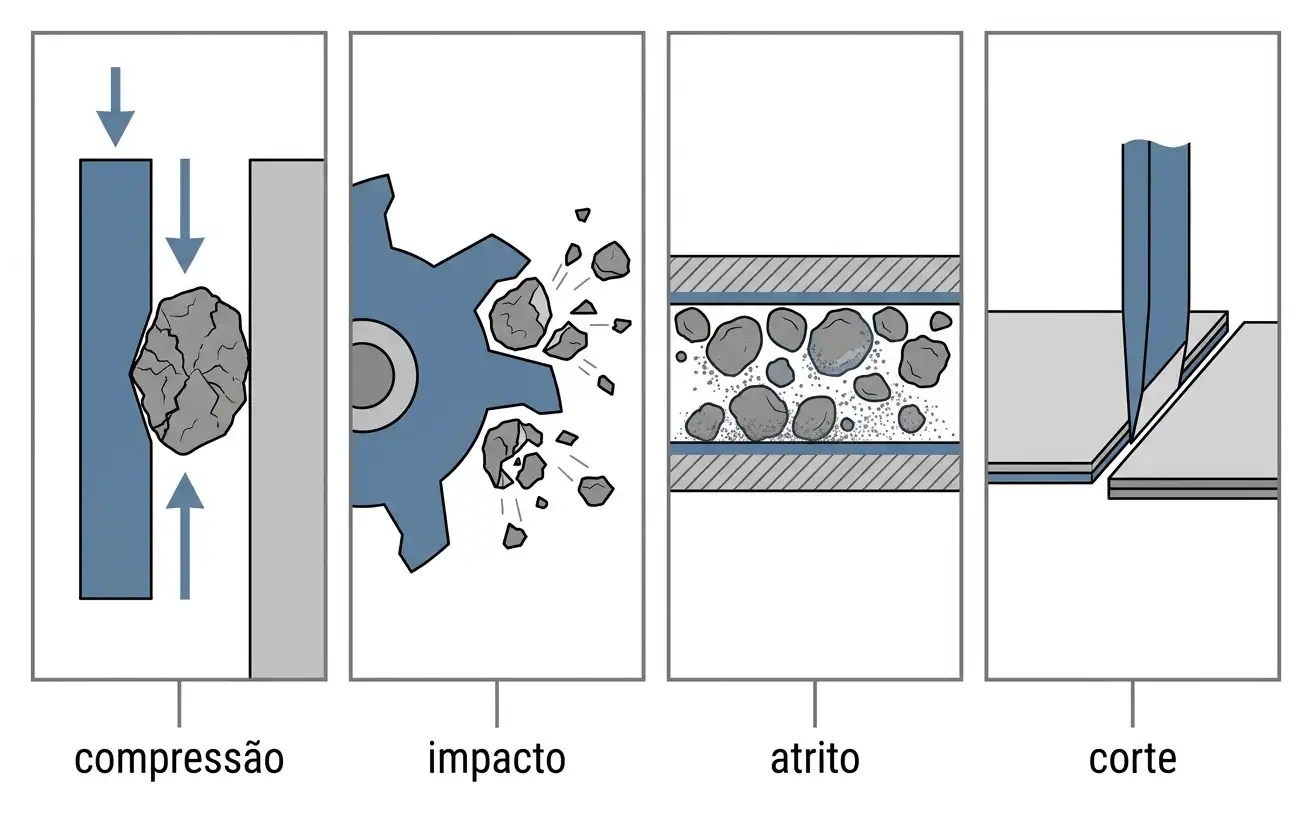
Every comminution method relies on one or more of four physical mechanisms. Compression grips material between two surfaces and breaks it by squeezing. Impact strikes material with a fast-moving surface. This transfers kinetic energy that creates internal stress until the particle fractures.
Attrition applies pressure similar to compression. The two surfaces also move relative to each other, though, adding shear force to the mix. Cutting applies force over a narrow area using a sharp edge. This mechanism is more common outside mineral processing than within it.
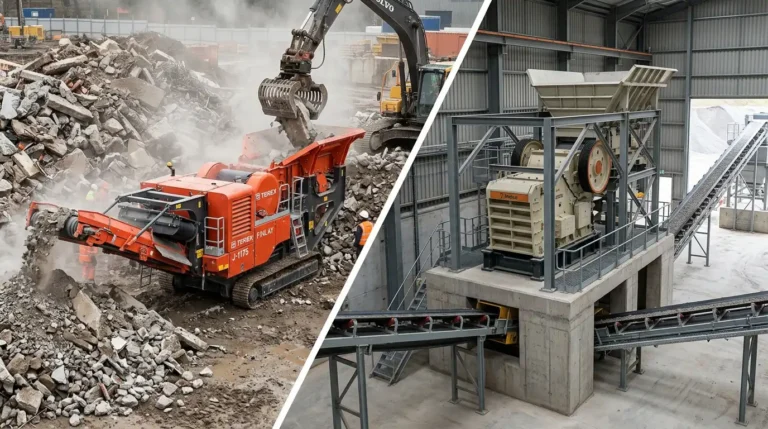
Specific equipment types lean on specific mechanisms. Jaw and cone crushers rely mainly on compression. Impact crushers rely on high-velocity impact.
Ball mills combine impact and attrition together. The balance shifts depending on ball size, mill speed, and the material being ground. This is why equipment selection depends on more than just target particle size. It also depends on which breakage mechanism actually suits the material.
Why Size Reduction Takes So Much Energy
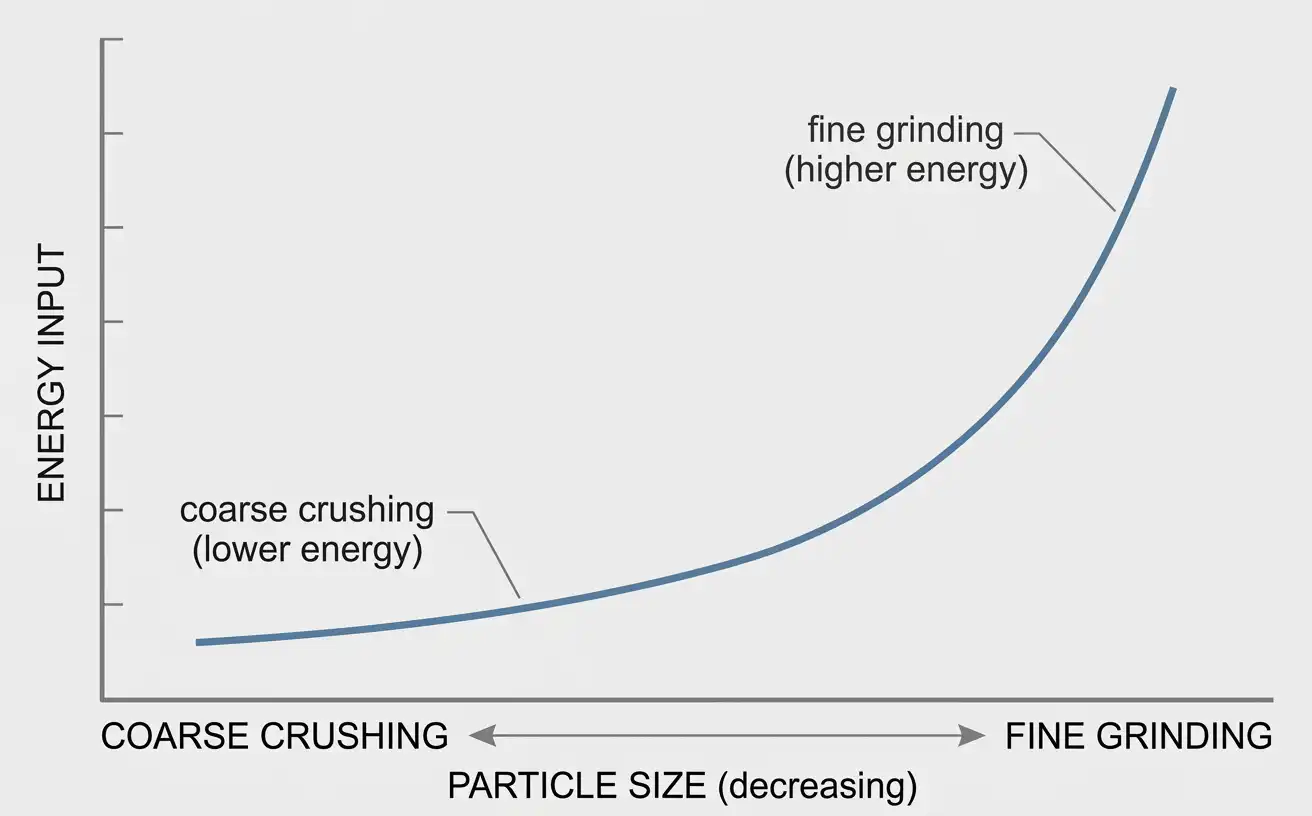
Comminution has a well-documented reputation for poor energy efficiency. The energy required climbs sharply as target particle size drops. Producing fine powder takes disproportionately more energy than producing coarse crushed rock, even accounting for the smaller absolute size involved.
Bond’s Law, developed in 1952, remains the most widely used framework for estimating that energy requirement. It treats the work needed for size reduction as proportional to the new crack length created in the particle during breakage.
That relationship is captured in a single material-specific value called the Bond Work Index. Harder, tougher materials carry a higher Work Index. They demand more energy to break at any given reduction target.
This energy cost is not a minor line item. In the United States, mineral beneficiation and processing account for roughly 39 percent of total mining industry energy use. Crushing and grinding together make up about 75 percent of that processing-stage total. Comminution is, by a wide margin, the most energy-intensive step most mined material goes through.
Reduction Ratio and Why Multiple Stages Exist
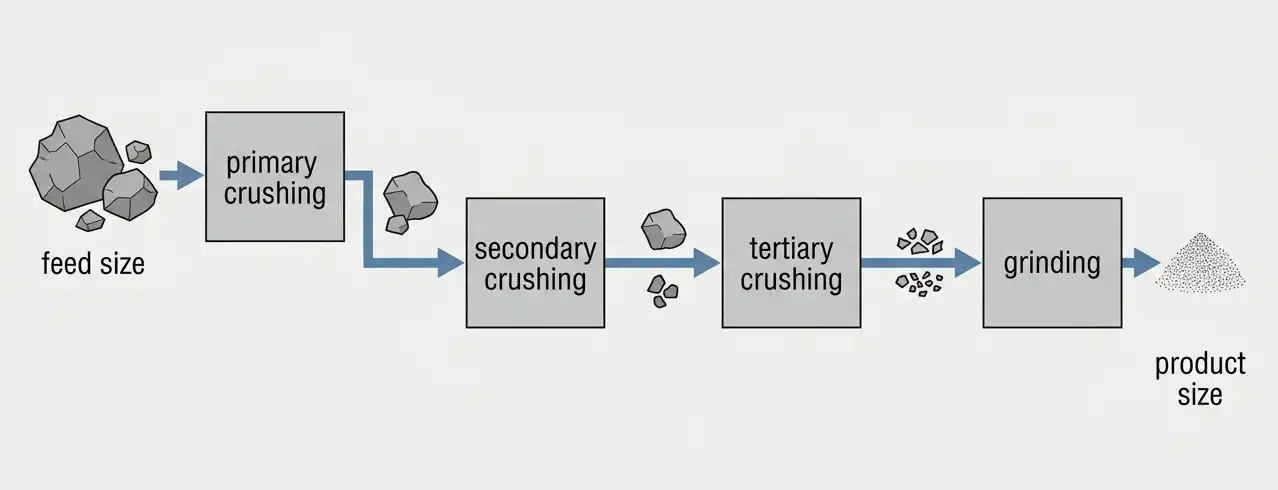
The reduction ratio describes how much smaller a comminution stage makes its material. It is calculated as feed size divided by product size. A large reduction ratio in a single stage sounds efficient on paper, but it is rarely the most practical approach in practice.
Real crushing and grinding circuits typically stage this reduction across several steps instead. Primary crushing takes the largest reduction ratio. Secondary and tertiary crushing refine it further.
Grinding takes over once material is small enough for that stage to work efficiently. Each stage operates within the size range its equipment actually handles well, rather than any one machine being asked to do the whole job.
Where Comminution Fits: Beyond Mining
Mining and quarrying are the most visible comminution users, but far from the only ones. Cement production grinds raw material and clinker as a core part of manufacturing. Fertilizer production grinds phosphate rock and other mineral inputs to usable particle sizes. Pharmaceutical manufacturing uses comminution to control particle size for consistent drug dosing and dissolution.
Industrial minerals processing is another major application. It supplies ground calcium carbonate, kaolin, talc, and similar fine powders as raw material inputs. Those powders feed the paint, plastics, and paper industries in turn. Any process that needs a bulk solid broken down to a controlled particle size is running some form of comminution, whatever industry it sits in.
Frequently Asked Questions
What is the difference between comminution and crushing?
Comminution is the general term for reducing solid material into smaller particles by any mechanical means. Crushing is one specific comminution method, working on larger material and typically producing pieces measured in centimeters. Grinding is a separate comminution method that takes over where crushing leaves off.
Why can’t one machine handle both crushing and grinding?
Crushing and grinding operate on very different particle size ranges, and equipment designed for one is inefficient or unworkable for the other. A crusher built to break large rock cannot accept the fine feed a grinding mill works with. A grinding mill cannot process large rock at all.
What is the Bond Work Index?
The Bond Work Index is a material-specific value representing the energy needed to reduce that material’s particle size, based on Bond’s Law from 1952. Harder, tougher materials have a higher Work Index. They require more energy input to achieve the same size reduction as a softer material.
Why does comminution use so much energy?
Energy efficiency in comminution is inherently low, and the energy required increases sharply as target particle size decreases. In the United States, crushing and grinding together account for roughly 75 percent of the energy used in mineral processing. That makes comminution the most energy-intensive step in most material processing chains.