

Grate Discharge vs Overflow Ball Mill: Power, Capacity and Selection
What You Will Learn from This Guide
A grate discharge ball mill removes slurry through a slotted grate and pulp lifters at a low level, while an overflow ball mill lets slurry leave by flowing over the lip of the discharge trunnion. This guide compares the two discharge designs of a ball mill on slurry level, power draw, capacity, overgrinding, maintenance and cost, and shows which design fits which grinding duty. It is written for engineers and procurement managers who are specifying a new mill or reviewing an existing circuit, so that you can state the correct discharge type, charge level and circuit in your inquiry. For the basic structure of the machine, see what a ball mill is and how it works.
How the Two Discharge Designs Work
Both designs use the same shell, liners, grinding media and drive, as described in the ball mill structure overview. The difference is at the discharge end, and that difference changes how much slurry stays inside the mill.
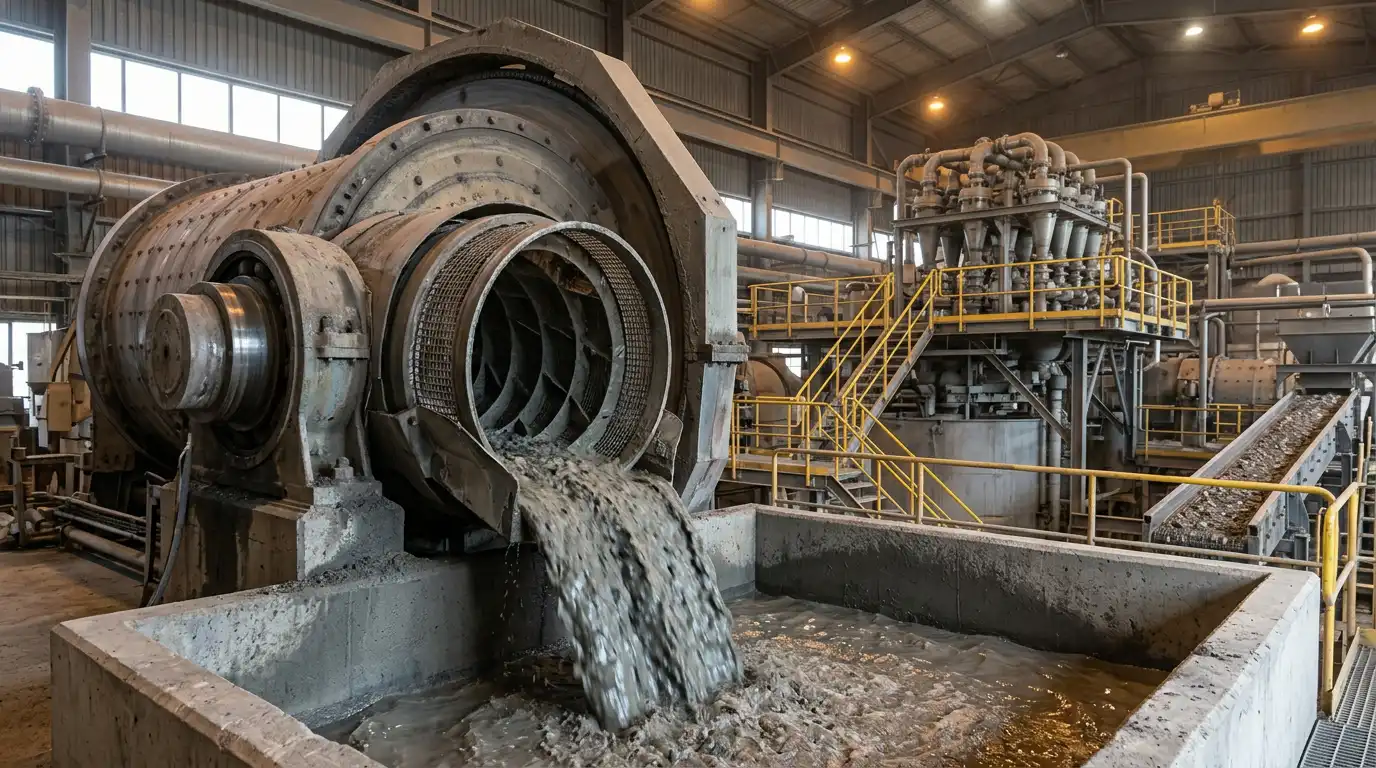
Overflow discharge. The discharge trunnion has a larger inside diameter than the feed trunnion. Slurry flows along the mill under a small hydraulic gradient and leaves when its level reaches the lip of the discharge trunnion. A trommel screen or a reverse spiral inside the discharge trunnion returns escaping balls and coarse scats. The design has no internal discharge parts, so the slurry level in the mill stays high, close to the trunnion lip.
Grate (diaphragm) discharge. A grate plate with slots is installed across the discharge end. Behind it, radial pulp lifters raise the slurry that passes through the slots and deliver it to a central discharge cone. Because slurry is removed at the shell periphery, the slurry level drops toward the discharge end and stays low. The grate also holds back balls and coarse particles.
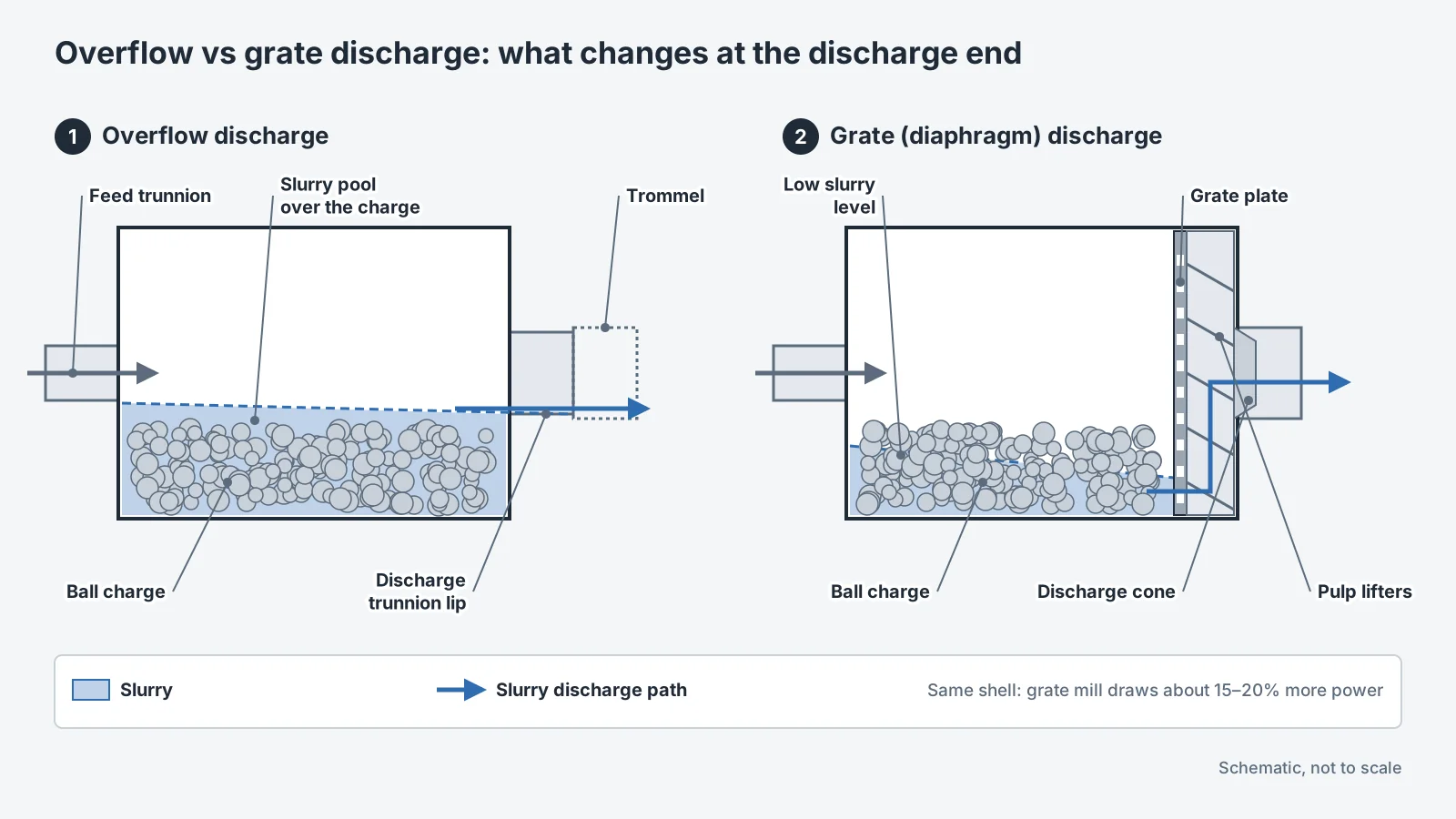
All the performance differences in the rest of this guide follow from one fact: an overflow mill holds a pool of slurry above part of the ball charge, and a grate mill does not. The other classification axes of ball mills are covered in ball mill types explained.
Grate vs Overflow Ball Mill: Side-by-Side Comparison
The table compares the two designs at the same shell size and speed. Mill size itself is selected first, as described in the ball mill dimensions and size selection guide.
| Factor | Overflow discharge | Grate (diaphragm) discharge |
|---|---|---|
| Discharge mechanism | Slurry flows over the discharge trunnion lip | Slurry passes grate slots; pulp lifters raise it to the discharge cone |
| Slurry level in the mill | High; slurry pool above part of the charge | Low, falling toward the discharge end |
| Power draw, same shell size | Reference | About 15–20% higher |
| Maximum practical ball charge | About 40–45% of mill volume | Up to about 50% of mill volume |
| Throughput from one shell | Reference | Higher; older plant comparisons report about 15–25% more |
| Fines residence time | Longer; more risk of overgrinding without good classification | Shorter; fines leave as soon as they pass the slots |
| Ball and scat retention | Trommel or reverse spiral | Grate slots |
| Internal wear parts at discharge | None inside the mill | Grate plates, pulp lifters, discharge cone |
| Capital and maintenance cost | Lower | Higher |
| Typical duty | Fine grinding and regrinding in closed circuit with hydrocyclones | Coarser primary ball milling; duties where fast removal of fines matters |
Table note: ranges are engineering summaries of published plant and pilot comparisons; actual values depend on ore, slurry density, charge level and grate open area.
Overflow discharge is the most common design in industry, and it is often specified for new ball mills by default rather than after a comparison. The grate design is less common but gives more grinding from the same shell. The MQ Ball Mill covers capacities from 0.04 to 400 t/h in wet and dry types, with shell sizes from Ф900×1800 mm (18.5 kW) to Ф3600×4000 mm (800 kW) and Ф3000×11000 mm (1250 kW); the discharge arrangement is one of the points to state in the inquiry. Full figures are on the MQ Ball Mill specifications page.
Why a Grate Mill Draws More Power, and What the Extra Power Buys
Power draw in a tumbling mill depends on how the charge is lifted and how much of it does useful work. In an overflow mill, the slurry pool covers the toe of the charge. That pool reduces the effective weight of the charge and absorbs energy, so the mill draws less power. A grate mill keeps the charge drained, which is why the classical ball mill power method multiplies the overflow figure by about 1.15 for wet grate discharge. Operating guidance for this is in the ball mill operation guide.
Higher power is not waste if it produces more breakage. The available comparisons show:
- A pilot mill of 1.25 m × 2.20 m, run with the same ore and the same feed rates in both configurations, drew on average 18% more power with a grate than with overflow discharge. The grate configuration had higher breakage and discharge rates and produced a much finer product.
- Older plant comparisons found an intermediate-level grate drew about 11% more power per tonne of media and gave about 15% more grinding capacity; a low-level grate drew about 20% more power and gave about 25% more capacity.
- The net gain in energy efficiency is modest: estimates range from about 4–5% to 10% more product per unit of energy, and plant data reported 5–8% more production per horsepower-hour.
Two practical conclusions follow. First, a grate mill gets more tonnage or a finer grind from a given shell, but it needs a larger motor than an overflow mill of the same size. Second, the common statement that “a grate mill gives a coarser product” is only true when the grate mill is pushed to a higher throughput. At the same feed rate, the higher breakage rate of the grate mill gives a finer product.
The ball charge level interacts with both effects, and it is set together with the steel ball gradation design.
Overgrinding, Residence Time and the Downstream Process
Overgrinding is the reason most buyers ask about grate mills. Particles that are already fine enough but stay in the mill keep breaking into slimes, and slimes are hard to recover in gravity concentration and in many gold flotation circuits.
A grate mill reduces this risk inside the mill: fines pass the slots and leave at once, while coarse particles stay in the drained charge. An overflow mill holds fines longer, so it depends on external classification to limit overgrinding. In a closed circuit, the mill product goes to hydrocyclones or a spiral classifier, the fine fraction leaves as product and the coarse fraction returns. With a well-run classifier and a suitable circulating load, an overflow mill avoids most overgrinding because the residence time of each pass is short.
The discharge choice therefore depends on the circuit:
- Open circuit or weak classification: a grate mill controls overgrinding better.
- Closed circuit with hydrocyclones: an overflow mill is the normal choice, and the cyclone sets the product size.
- Friable or dense valuable minerals (for example native gold or galena): fast removal of fines has more value, and a grate mill, or an overflow mill with tight classification, should be considered.
Circuit options are compared in open circuit vs closed circuit grinding, and classifier types in the three main types of classifiers. For small gold plants, the link between grind size and gravity recovery is explained in processing hard-rock gold ore without mercury.
Selection Guide: When to Choose Each Design
The decision starts from the target product size and the circuit, not from the mill. Define the product with the P80 and mesh terms first, then use the following rules:
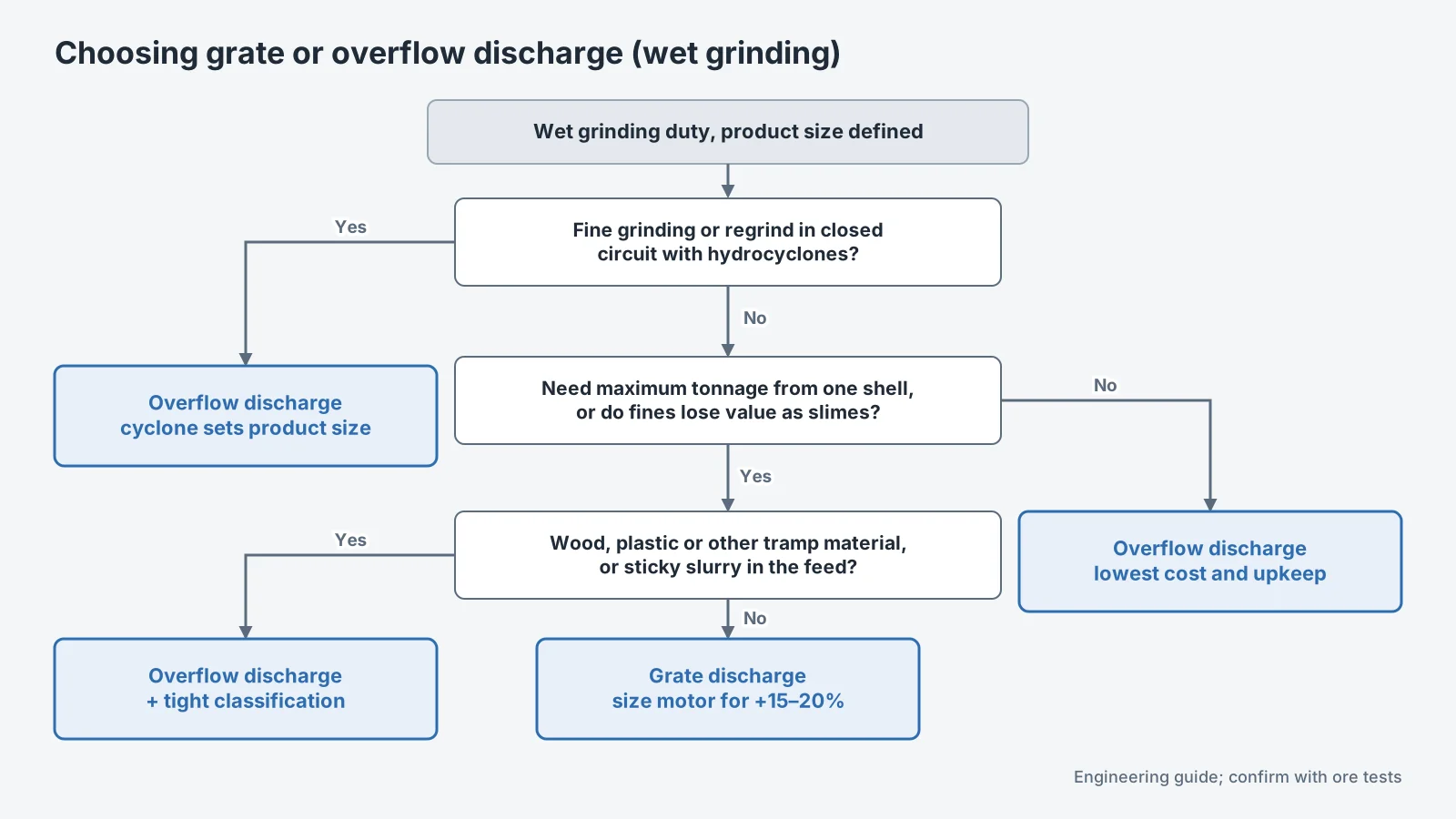
- Fine grinding or regrinding in closed circuit with hydrocyclones: choose overflow discharge. The cyclone controls the product, the mill is simpler, and it has no grate to plug or wear.
- Coarser primary ball milling where maximum tonnage from one shell is needed: choose grate discharge, and size the motor for the higher power draw.
- Open circuit, or ores that lose value as slimes: choose grate discharge, or add effective classification to an overflow mill.
- Feeds with wood, plastic or other tramp material, or ores that make sticky slurry: prefer overflow discharge, because these materials can plug grate slots.
- Lowest capital cost and maintenance: overflow discharge, if the duty allows it.
Dry grinding is a separate case: dry mills normally use air-swept discharge with an external classifier, as described in wet ball mill vs dry ball mill.
Maintenance and Operating Checks for Each Design
The discharge design changes the maintenance plan. General routines are in ball mill maintenance; the checks below are specific to each discharge type.
Grate discharge mill:
- Inspect the grate slots at each shutdown for pegging by worn balls and rock. Plugged slots raise the slurry level and remove the grate advantage.
- Measure slot width. Worn slots let small balls and scats leave the mill.
- Check the pulp lifters for wear and for slurry flowing back into the mill. Lifter capacity limits how much slurry the grate can remove.
- Tighten grate and lifter bolts to the specified torque; loose plates break quickly.
Overflow discharge mill:
- Watch the trommel for balls and scats. A steady flow of balls means the slurry is too dilute or the ball charge is too high.
- Control slurry density. Too dilute a slurry carries balls out; too dense a slurry raises viscosity and reduces grinding.
- Do not raise the ball charge above the practical limit of about 40–45% of mill volume.
- Inspect the trommel screen and reverse spiral for wear.
Balls lost through worn grates or an overloaded trommel show up directly in media cost, which is tracked in steel ball unit consumption.
Frequently Asked Questions
Which is more common, grate or overflow ball mills?
Overflow ball mills are more common, especially in large concentrators where the mill runs in closed circuit with hydrocyclones. Grate mills are used where more grinding from one shell, or fast removal of fines, has clear value. The overall classification is covered in ball mill types explained.
Does a grate discharge ball mill always give a coarser product?
No. A grate mill gives a coarser product only when it runs at a higher throughput. At the same feed rate, it draws more power and breaks particles faster, so its product is finer than that of an overflow mill of the same size.
Can an overflow ball mill be converted to grate discharge?
Yes, but it is a design change, not a part swap. The grate and pulp lifters take some of the mill length, the motor must cover the higher power draw, and the discharge head and trunnion must suit the new arrangement. A conversion should be checked against the motor rating and the target capacity before it is ordered.
Which discharge type suits gold ore?
Both are used. In closed circuit with hydrocyclones, overflow is normal. Where gold is coarse and gravity recovery is important, a grate mill or tight classification helps reduce slimes. The MQ Ball Mill is used for gold, silver, copper, lead and zinc ores; state the target grind and circuit when requesting a design. Gold-specific grinding is covered in ball mill selection for gold flotation circuits.
References & Sources
Background on mill sizing and media for the topics below is in the ball mill size selection guide.
- Mwale, A. N. (2023). Developing a ball mill model that incorporates grate and overflow discharge configurations. PhD thesis, University of Cape Town
- Makni, S. & McIvor, R. Effects of the discharge design on wet grinding mill performance. XXXI International Mineral Processing Congress 2024 Proceedings, SME
- Golpayegani, M. H. & Rezai, B. (2022). Modelling the power draw of tumbling mills: a comprehensive review. Physicochemical Problems of Mineral Processing 58(4)
- Morrell, S. & Latchireddi, S. The operation and interaction of grates and pulp lifters in autogenous and semi-autogenous mills. The AusIMM Proceedings 306(1)
Related reading: wet ball mill vs dry ball mill.