

Wet Ball Mill vs Dry Ball Mill: Technical Comparison and Selection Guide
What is the difference between a wet ball mill and a dry ball mill? A wet ball mill grinds material suspended in water, producing a slurry that typically contains 60–75% solids by weight, and discharges the ground product through an overflow or grate opening. A dry ball mill grinds material at less than 1% moisture and relies on airflow to carry the powder to an external cyclone classifier and bag filter. Laboratory tests on coal published in Powder Technology measured approximately 20% lower specific grinding energy for wet grinding than for dry grinding at solids concentrations below 50% by volume [2]. Wet grinding reaches a finer ultimate particle size — a median diameter around 0.5–0.6 µm, against approximately 2 µm for dry grinding [4] — while dry grinding reduces the rate of grinding media and liner wear compared with wet grinding [5]. The correct choice depends on the downstream process, the required product fineness, water availability, and feed abrasiveness.
What You Will Learn from This Guide
This guide compares wet and dry ball mill grinding across working principle, structural design, energy consumption, product fineness, wear behavior, and selection criteria. It serves engineers and procurement teams at the stage of writing a grinding-circuit specification or evaluating a supplier proposal for a new or expanded plant. After reading this guide, a reader will be able to identify which grinding method fits a given ore type, downstream process, and site condition, and will be able to ask a supplier specific technical questions before requesting a formal quotation, rather than relying on a sales engineer’s summary of the trade-offs.
Wet Ball Mill vs Dry Ball Mill: Summary Comparison
A wet ball mill and a dry ball mill share the same size-reduction mechanism. Steel or ceramic balls tumble inside a rotating cylindrical shell and fracture particles by impact and attrition between balls, and between balls and the liner. The two configurations differ in the medium that carries material through the mill, the discharge design, and the auxiliary equipment connected to the shell, as documented in a 6 t/h manganese ore wet ball mill installation.
Table 1. Wet Ball Mill vs Dry Ball Mill — Summary Comparison
| Parameter | Wet Ball Mill | Dry Ball Mill |
|---|---|---|
| Grinding medium | Water slurry, 60–75% solids by weight | Air, feed moisture below 1% |
| Specific grinding energy below 50 vol% solids | Approximately 20% lower than dry [2] | Baseline |
| Ultimate median particle size | ~0.5–0.6 µm [4] | ~2 µm [4] |
| Particle size distribution width | Narrower [5] | Wider [5] |
| Grinding media and liner wear rate | Higher [5] | Lower [5] |
| Discharge type | Overflow or grate, slurry | Air-swept, powder to external classifier |
| Post-grinding processing | Dewatering and filtration before dry storage | None required |
| Dust generation at the mill | None | Present; requires bag filter or cyclone |
| Typical downstream process | Flotation, leaching, wet classification | Dry storage, bagging, pneumatic conveying |
The specific-energy advantage of wet grinding narrows, and can reverse, above roughly 50 vol% solids concentration, where slurry viscosity increases and the breakage rate for dry grinding exceeds wet grinding by a factor of approximately 2.3 [1][3]. The solids concentration of the target slurry, not the wet-versus-dry label alone, is what most often determines the energy outcome in a specific circuit.
Working Principle: How Wet and Dry Grinding Differ
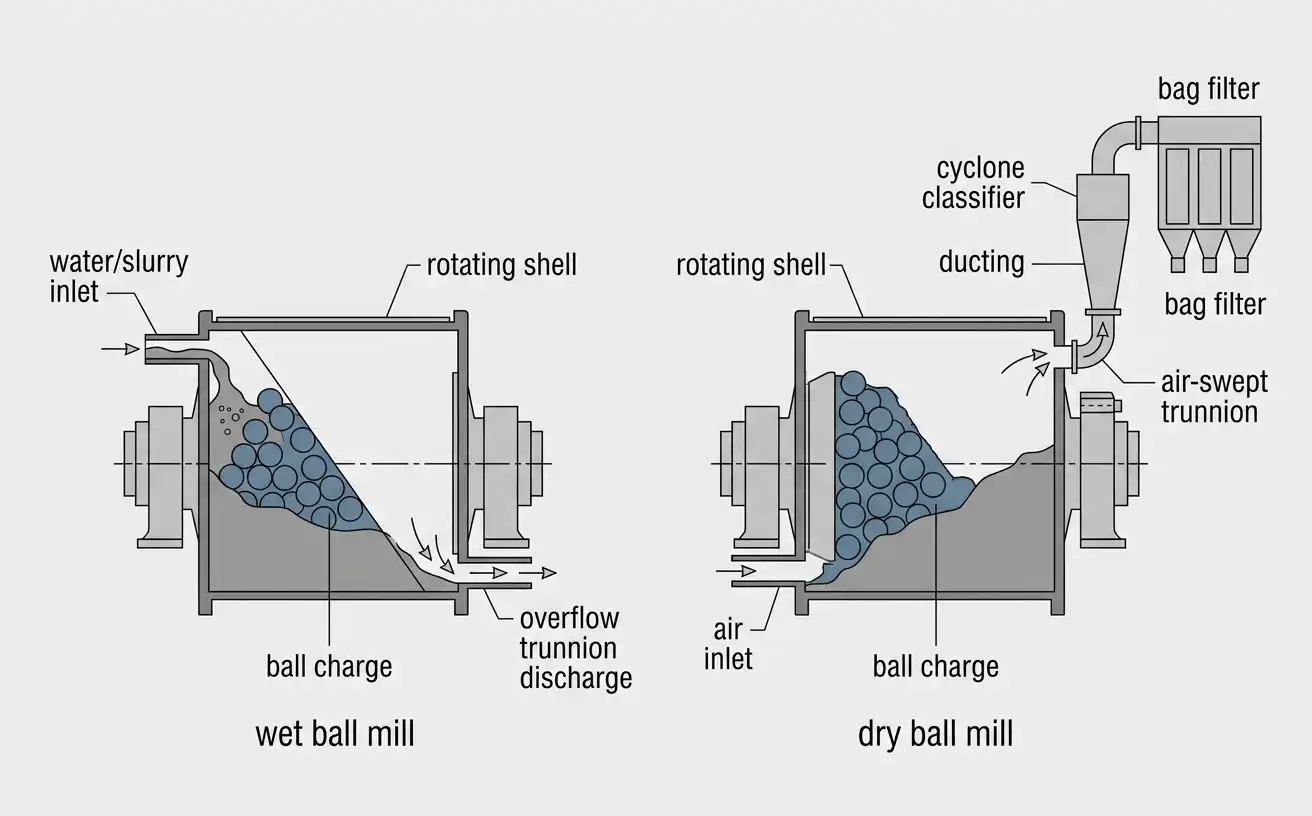
The grinding chamber of both mill types holds a ball charge occupying 30–45% of the internal shell volume. Rotation of the shell lifts the ball charge along the shell wall; balls cascade and cataract back onto the descending charge, applying compressive and shear forces to particles trapped between balls, and between balls and the liner. The difference between wet and dry operation begins downstream of this shared mechanism, in how ground particles leave the grinding zone and how the ball charge behaves in the presence of water. A 3–5 t/h feldspar ball mill case study documents both a wet and a dry configuration processing feldspar feed at comparable throughput.
Wet Ball Mill Working Principle
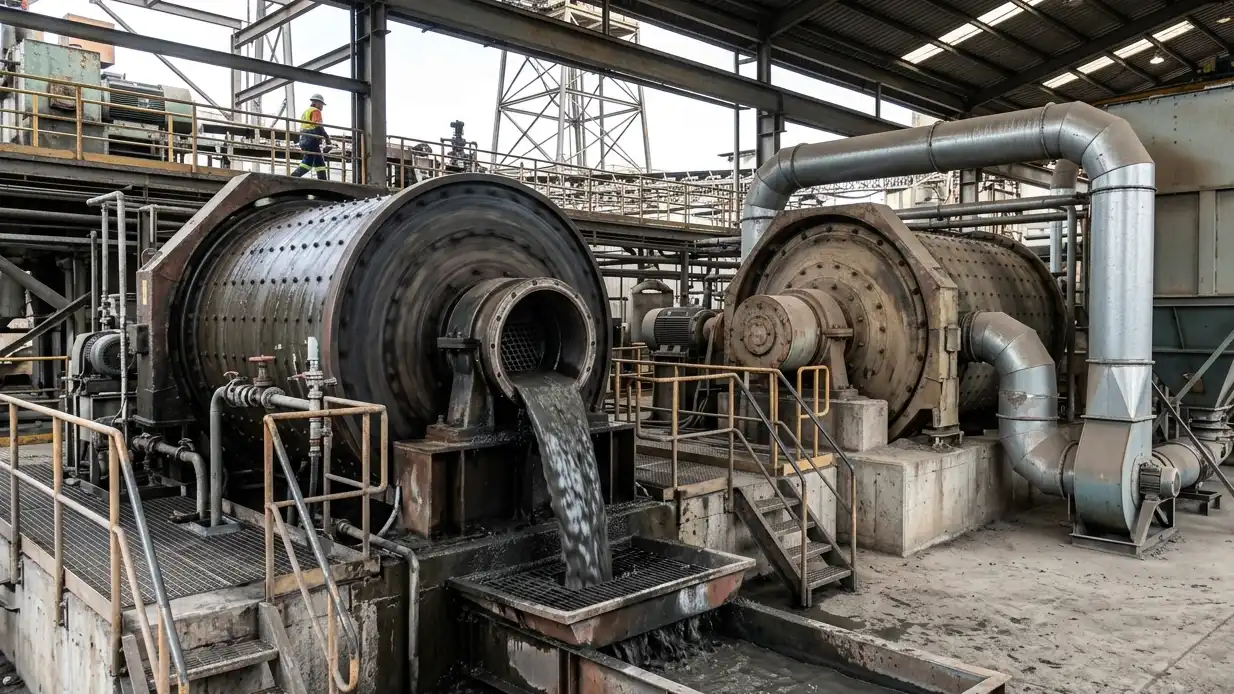
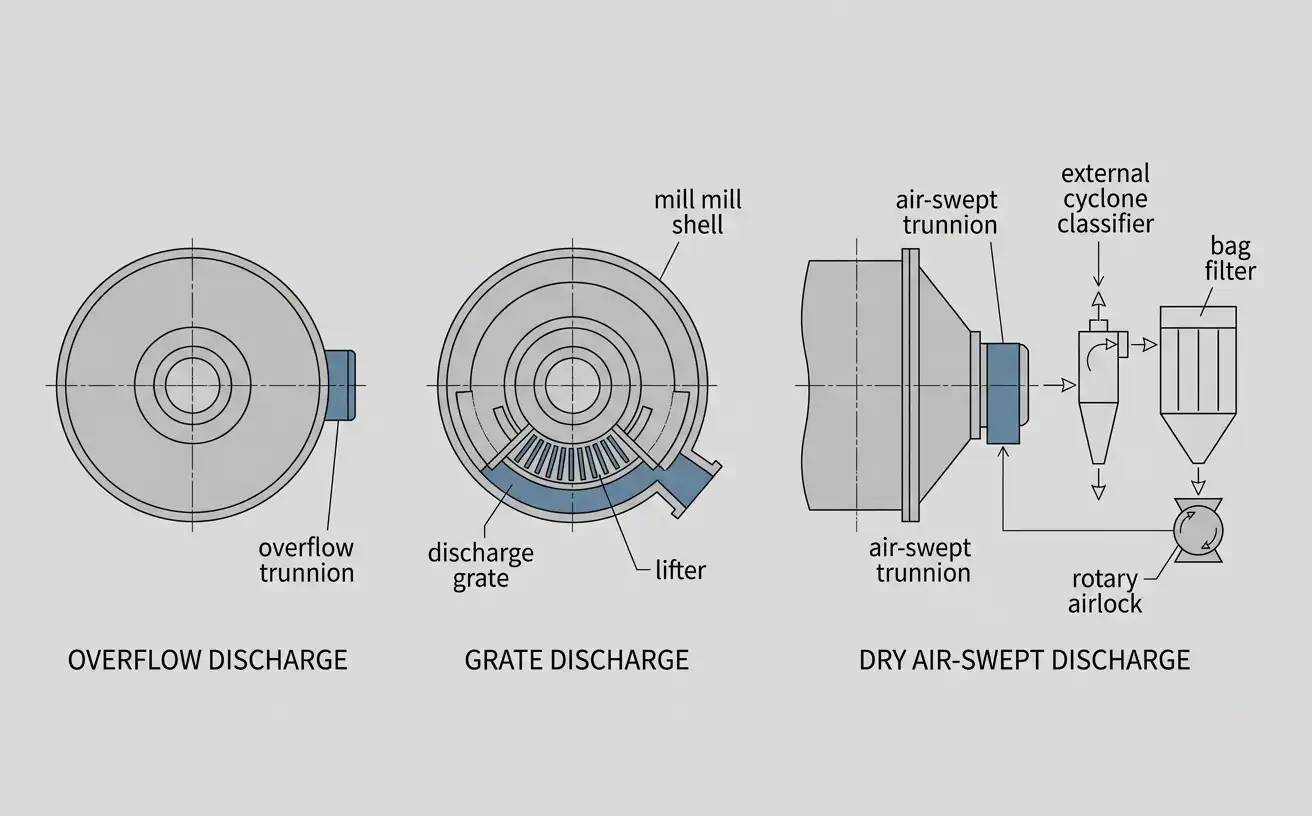
Water enters the mill with the feed material, at a ratio that produces 60–75% solids by weight in the discharge slurry. The water reduces friction inside the ball charge and reduces particle re-agglomeration, which allows fine particles to separate from the ball charge without repeated impact. Ground slurry exits through an overflow trunnion, flowing out under the natural slurry level inside the shell, or through a discharge grate, where slotted plates retain the ball charge and allow slurry to pass through the grate openings into internal lifters. Grate discharge produces a coarser, more controlled product size than overflow discharge for the same shell dimensions, because grate discharge removes material from the mill before it reaches full residence time.
Dry Ball Mill Working Principle
Feed material enters the mill at less than 1% moisture. Airflow, generated by an induced-draft fan positioned downstream of the mill, carries fine particles out of the shell through an air-swept trunnion. Particles too coarse to entrain in the airstream remain in the mill for further grinding. The air-particle stream passes through a cyclone classifier, which separates product-size particles from oversize particles; the classifier returns oversize particles to the mill inlet for regrinding. A bag filter or electrostatic precipitator captures fine particles that pass through the cyclone before the air is released or recirculated. Static charge and particle re-agglomeration — sometimes described as cold welding when ductile materials weld together under repeated impact — reduce grinding efficiency in dry operation as particle size approaches the low-micron range.
Structural Differences: Discharge Systems and Auxiliary Equipment
The shell and drive train of a wet ball mill and a dry ball mill are structurally similar. Most of the structural difference sits at the discharge end and in the auxiliary equipment connected to the mill, as shown in a 2–3 t/h graphite ore ball mill case study, which documents an overflow discharge and spiral classifier arrangement used in a wet mineral processing circuit.
Liner material selection differs between the two configurations. Wet ball mills commonly use rubber liners or high-chromium white iron liners, both selected to resist the combined abrasion and corrosion present in a slurry environment. Dry ball mills commonly use manganese steel or high-chromium alloy steel liners, selected primarily for abrasion resistance, since corrosion is not a significant wear mechanism at low moisture content. Trunnion bearing seals also differ: a wet mill requires a water-flush gland seal or a labyrinth seal designed to exclude slurry from the bearing housing, while a dry mill requires a dust-tight labyrinth seal designed to exclude fine powder.
Auxiliary equipment adds to the footprint of a dry ball mill circuit. A wet ball mill typically discharges to a spiral classifier or hydrocyclone and a slurry pump, a relatively compact arrangement. A dry ball mill requires an induced-draft fan, ducting, a cyclone classifier, a bag filter or baghouse, and a rotary airlock to return captured fines to the process, which occupies a larger plant footprint and adds electrical load beyond the mill drive itself. The cited literature does not quantify a general capital-cost premium for the dry air-handling package, since the required equipment size depends on airflow rate and the emission limit that applies at a given site; a project-specific budget estimate should be requested from the equipment supplier once airflow and dust-emission requirements are defined.
Energy Consumption and Grinding Efficiency
Wet grinding measured approximately 20% lower specific grinding energy than dry grinding in laboratory ball mill tests on coal, at solids concentrations below 50 vol% [2]. This pattern does not hold at all solids concentrations, a distinction documented in the throughput data recorded during the manganese ore ball mill project referenced earlier in this guide.
Table 2. Published Specific Grinding Energy and Breakage-Rate Data, Wet vs Dry Ball Milling
| Parameter | Value | Unit | Condition / Test Method |
|---|---|---|---|
| Specific grinding energy, wet vs dry | ~20% lower for wet | % difference | Laboratory ball mill, coal, solids concentration below 50 vol% [2] |
| Breakage rate constant S1, dry grinding | 0.48 | min⁻¹ | Laboratory ball mill, coal, solids concentration above 50 vol% [1] |
| Breakage rate constant S1, wet grinding | 0.21 | min⁻¹ | Laboratory ball mill, coal, solids concentration above 50 vol% [1] |
| Solids concentration at maximum breakage rate | ~45 | vol% | Laboratory ball mill, quartz, coal, and copper ore [3] |
| Breakage-rate trend with grinding time at 70 vol% solids, dry | Increases | — | Laboratory conical ball mill, coking coal [3] |
| Breakage-rate trend with grinding time at 70 vol% solids, wet | Decreases | — | Laboratory conical ball mill, coking coal [3] |
The energy advantage of wet grinding is largest at moderate solids concentration and narrows as slurry density increases toward the point where rising viscosity begins to restrict ball movement inside the charge. Above roughly 50 vol% solids, breakage rate for dry grinding exceeds wet grinding, reversing the general energy pattern [1][3]. A grinding-circuit specification should state the target slurry solids concentration, not only “wet” or “dry”, because the energy comparison depends on that value. Comminution — crushing and grinding combined — typically accounts for 35–50% of total mineral processing cost at a mine site [6], which makes the wet-versus-dry energy difference a material factor in operating cost rather than a secondary technical detail.
Particle Size and Product Fineness
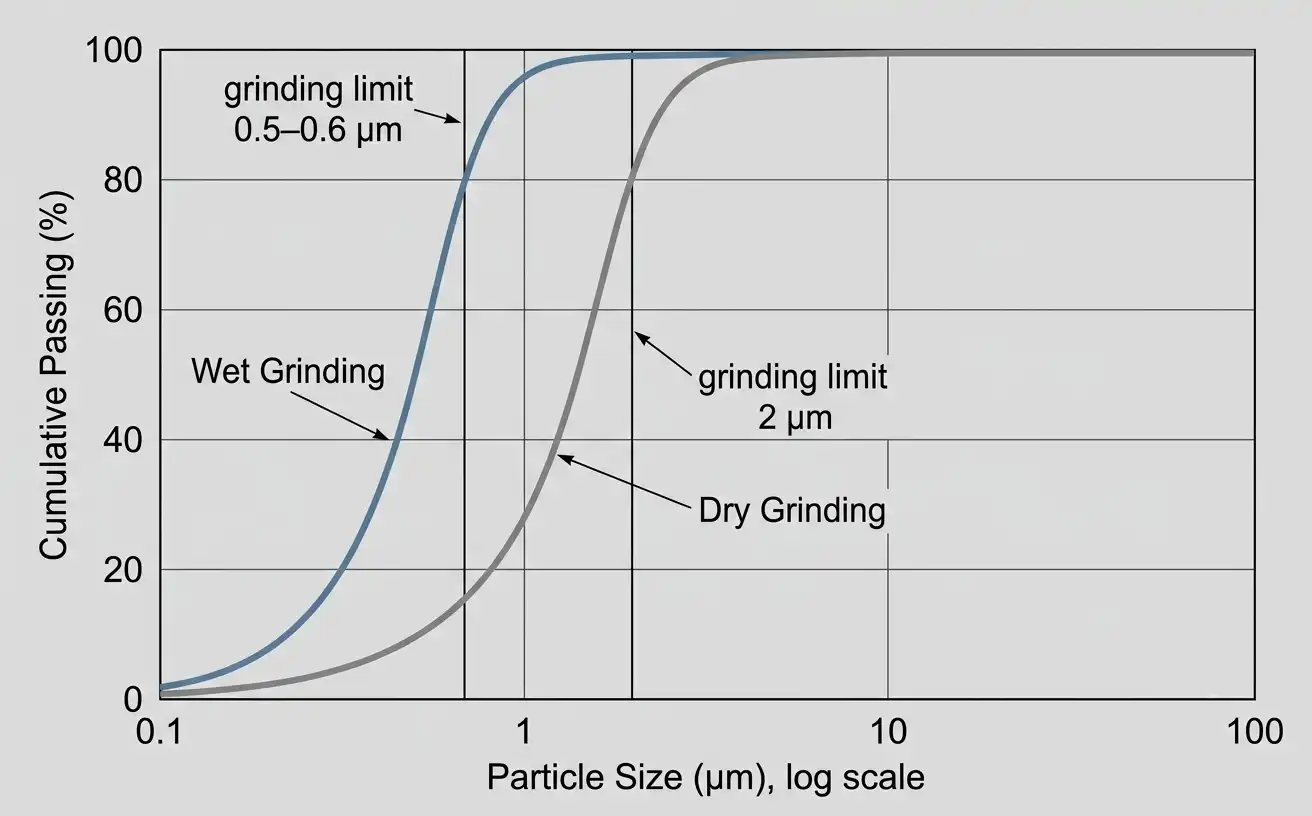
The practical grinding limit differs between wet and dry ball milling. Laboratory tests report a median particle size at the grinding limit of approximately 0.5–0.6 µm for wet grinding, compared with approximately 2 µm for dry grinding, under otherwise comparable conditions [4]. Wet grinding also produces a narrower particle size distribution than dry grinding at a given median size [5], which the feldspar ball mill case study illustrates through fineness results recorded on the dry side of that project.
In production circuits, dry ball mill systems combined with a cyclone classifier commonly target a product range of 45–150 µm (325 to 100 mesh) for minerals and cement. Wet ball mill circuits commonly target 20–75 µm for flotation feed, with sub-micron fineness achievable in closed circuit with a hydrocyclone for applications such as fine mineral fillers. Reaching sub-2 µm fineness in a dry circuit generally requires a dry ultra-fine mill rather than a conventional dry ball mill, because conventional dry ball milling becomes energy-inefficient as particle size approaches its grinding limit.
Wear, Corrosion, and Maintenance Requirements
Wear mechanisms differ between the two configurations. Wet grinding combines mechanical abrasion with electrochemical corrosion, since water and dissolved minerals in the slurry accelerate galvanic wear between the grinding media and the liner. Dry grinding wear is primarily abrasive, with a comparatively minor corrosion component at low moisture content. Published data document that dry grinding significantly decreases the rate of grinding media and liner wear compared with wet grinding [5], an observation consistent with the liner condition documented in the graphite ore ball mill case study referenced earlier.
This wear difference offsets part of the energy advantage of wet grinding in a total-cost comparison: a wet circuit that consumes less energy per tonne ground may consume more grinding media and replacement liner material per tonne ground than a dry circuit processing the same ore. Wear-life figures depend on ore hardness, moisture content, ball and liner alloy composition, and mill operating parameters, and are not generalized to a single figure in the cited literature. Project-specific wear-life estimates for a defined feed material can be requested through the contact form.
Maintenance routines differ accordingly. A wet ball mill requires periodic inspection of slurry-side seals and scheduled replacement of pump and cyclone wear parts. A dry ball mill requires bag-filter replacement on a fixed interval, rotary-airlock maintenance, and periodic cleaning of ducting to prevent material buildup that reduces airflow.
MQ Ball Mill: Wet and Dry Configuration Options
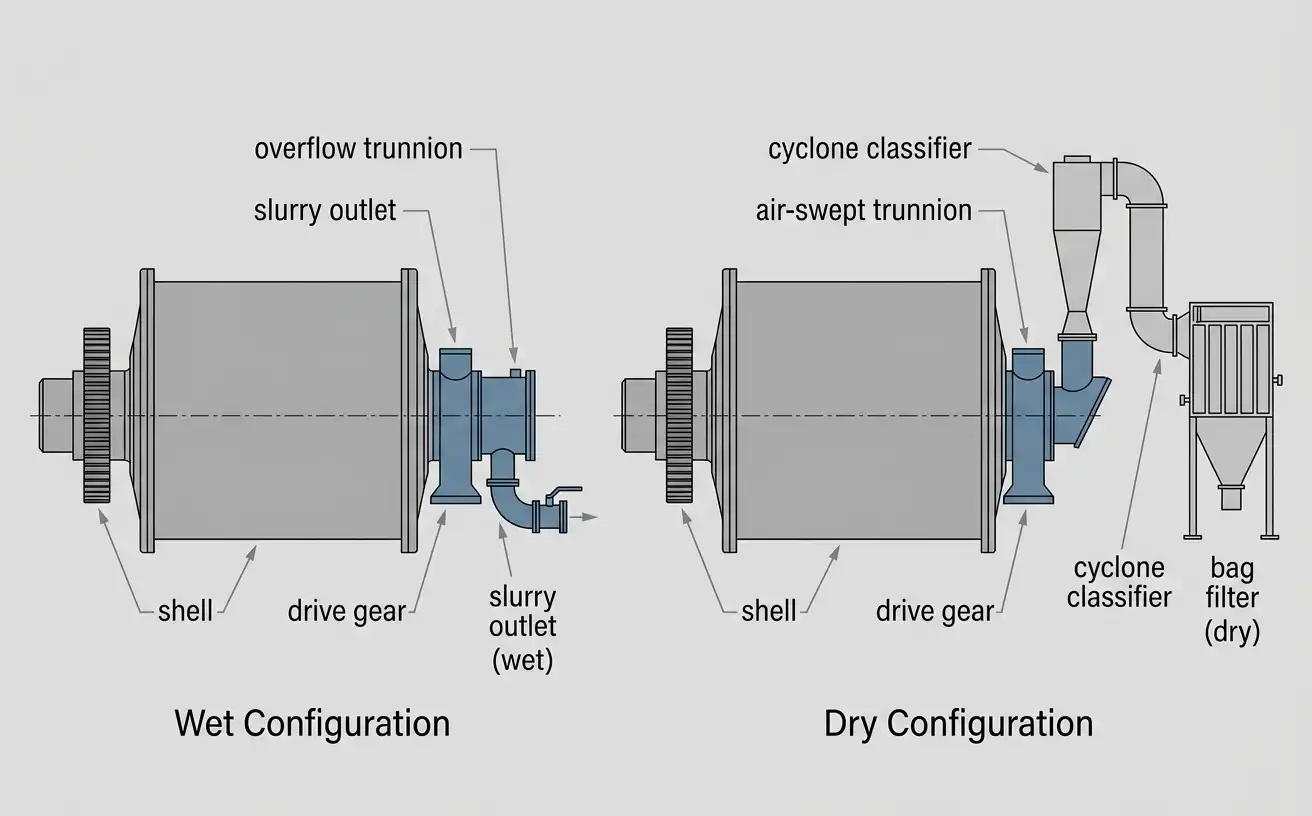
The MQ Ball Mill technical specifications page documents a shell and drive design that accommodates either configuration. A grate or overflow trunnion converts the base shell to wet duty; an air-swept trunnion, external cyclone classifier, and bag filter package convert the same base shell to dry duty. Selecting between the two configurations for a given project depends on the criteria described in the following sections of this guide, not on a difference in the base mill structure itself.
For applications that require dry product fineness beyond what a conventional dry ball mill circuit achieves economically, the MGW Intelligent Raymond Mill and the MSF Ultrafine Grinding Mill provide alternative dry grinding technology built around a different size-reduction mechanism than a ball mill. Both are suited to non-metallic mineral powders that must remain dry and reach a finer target size than a standard dry ball mill circuit is designed to produce.
Applications by Material and Industry
Metallic ore processing — gold, copper, iron, and manganese ore — predominantly uses wet ball milling, because the downstream flotation, leaching, or wet magnetic separation process requires the ore in slurry form. The graphite ore processing case referenced earlier documents this pattern for a non-metallic mineral processed with a downstream flotation step.
Industrial minerals such as feldspar, quartz, and calcium carbonate use either configuration, depending on the end-use product. Feldspar destined for ceramic or glass raw-material blending is commonly ground dry, since the product is stored, transported, and batched as a dry powder. Calcium carbonate destined for fine filler or coating applications is commonly ground wet, since these applications require sub-5 µm fineness at the low end of the range this guide describes in the particle-size section above.
Cement and construction materials use dry ball milling as the standard configuration, since cement clinker must remain a free-flowing dry powder through storage and transport, and any contact with water begins the hydration reaction the material is designed to undergo only after final placement.
Coal processing uses both configurations. Pulverized coal for direct combustion in a boiler is ground dry, since the fuel must be delivered to the burner as an airborne dry powder. Coal-water slurry fuel, an alternative fuel form used at some industrial boiler installations, is ground wet to produce a pumpable, stable suspension.
Selection Criteria: A Decision Framework
The manganese ore grinding circuit selection basis documented in the case referenced earlier reflects the criteria described in this section, applied to a specific ore and downstream process.
Table 3. Selection Criteria — Wet Ball Mill vs Dry Ball Mill
| Criterion | Favors Wet Ball Mill | Favors Dry Ball Mill |
|---|---|---|
| Downstream process | Flotation, leaching, wet magnetic separation | Dry storage, bagging, pneumatic transport, calcining |
| Water availability | Adequate process and make-up water supply | Limited or regulated water supply |
| Target product fineness | Sub-5 µm required | 45 µm (325 mesh) or coarser acceptable |
| Feed reactivity with water | No adverse reaction | Hydrates, oxidizes, or otherwise degrades on contact with water |
| Liner and media wear budget | Higher wear cost acceptable in exchange for lower energy cost | Wear cost minimization is the priority |
| Tailings and water discharge | Slurry disposal or thickening infrastructure available | Regulatory or logistical limits on wet tailings |
No single criterion determines the outcome for every project. The downstream process requirement most often overrides the other criteria: a flotation or leaching circuit fed by a dry ball mill requires a separate wet re-pulping step, which adds capital and operating cost that is rarely justified when a wet ball mill can produce the slurry directly.
Scenario-Based Recommendations
The feldspar dry grinding scenario documented earlier in this guide illustrates one row of the following table in an operating plant.
Table 4. Scenario-Based Recommendations by Material
| Material / Application | Typical Circuit | Rationale |
|---|---|---|
| Gold ore, flotation or carbon-in-leach (CIL) circuit | Wet | Downstream leaching or flotation requires slurry feed |
| Copper porphyry ore, flotation | Wet | Downstream flotation requires slurry feed; dry grinding combined with dry flotation is used at a small number of water-scarce sites but is not the industry default |
| Manganese ore, beneficiation | Wet | Consistent with the manganese ore ball mill case referenced in this guide |
| Iron ore, pellet feed | Wet or dry | Wet grinding is conventional; dry circuits using high-pressure grinding rolls and air classification are used at water-constrained sites |
| Feldspar and quartz, ceramics and glass | Dry | Product is sold as a dry powder; no downstream slurry requirement |
| Cement clinker | Dry | Product must remain a free-flowing dry powder; water contact begins clinker hydration |
| Calcium carbonate, fine filler | Wet | Sub-5 µm fineness targets favor the lower grinding limit of wet milling [4] |
| Coal, pulverized fuel firing | Dry | Boiler firing requires dry, airborne fuel delivery |
Material reactivity with water and the physical state required by the downstream process eliminate one option in most rows of this table before energy consumption or wear cost is weighed as a secondary factor.
Frequently Asked Questions
What is the difference between a wet ball mill and a dry ball mill?
A wet ball mill grinds material in a water slurry and discharges through an overflow or grate opening. A dry ball mill grinds material at low moisture content and discharges ground powder in an airstream to a cyclone classifier and bag filter. The MQ Ball Mill is available in both configurations from the same base shell design.
Which uses less energy, wet or dry ball milling?
Wet ball milling uses approximately 20% less specific grinding energy than dry ball milling at solids concentrations below 50 vol%, based on laboratory coal-grinding data [2]. Above roughly 50 vol% solids, slurry viscosity increases and the energy advantage of wet grinding narrows or reverses [1][3].
Can a ball mill be converted from dry to wet grinding?
Converting a dry ball mill to wet operation requires replacing the discharge trunnion and liners, removing the air-handling system, and adding a water supply, a slurry pump, and downstream dewatering equipment. The shell and drive train can often be reused if the base structural design supports both configurations.
Why is cement ground dry instead of wet?
Cement clinker is ground dry because contact with water begins the hydration reaction that cement is designed to undergo only after final placement. Wet grinding would begin hardening the material inside the mill and the downstream handling equipment.
What particle size can a wet ball mill achieve?
A wet ball mill combined with classifying equipment can reach a median particle size around 0.5–0.6 µm at the practical grinding limit, compared with approximately 2 µm for a dry ball mill under comparable conditions [4]. Reaching the finest end of this range in production requires closed-circuit operation with a hydrocyclone or similar classifier, not a single pass through the mill.
References & Sources
- Celik, M.S. — A Comparison of Dry and Wet Fine Grinding of Coals in a Ball Mill, Powder Technology (1988)
- Bu, X. et al. — Wet and Dry Grinding of Coal in a Laboratory-Scale Ball Mill: Particle-Size Distributions, Powder Technology (2020)
- Bu, X. et al. — Differences in Dry and Wet Grinding With a High Solid Concentration of Coking Coal Using a Laboratory Conical Ball Mill, Advanced Powder Technology (2019)
- Kotake, N. et al. — Influence of Dry and Wet Grinding Conditions on Fineness and Shape of Particle Size Distribution of Product in a Ball Mill, Advanced Powder Technology (2011)
- Chelgani, S.C. et al. — A Comparative Study on the Effects of Dry and Wet Grinding on Mineral Flotation Separation — A Review, Journal of Materials Research and Technology (2019)
- Ballantyne, G.R. and Powell, M.S. — Benchmarking Comminution Energy Consumption for the Processing of Copper and Gold Ores, Minerals Engineering (2014)