

Homogeneous vs Heterogeneous Mixtures in Mineral Processing
What You Will Learn from This Guide
A homogeneous mixture has a uniform composition at the scale at which it is observed, while a heterogeneous mixture contains particles or regions that differ in composition. This guide explains both definitions in engineering terms, shows why run-of-mine ore and aggregate are heterogeneous mixtures, and matches each property difference to a separation, blending or sampling method. It is written for engineers, plant operators and procurement managers who need to know what a feed requires before specifying equipment, and it builds on the science behind crushing and grinding.
Homogeneous vs Heterogeneous Mixtures: Working Definitions
A mixture is a portion of matter that consists of two or more chemical substances, called constituents. Each constituent keeps its own identity, so a mixture can be separated by physical or chemical means without breaking chemical bonds inside the constituents. Rocks are a familiar example: the common rock types fed to crushers are mixtures of minerals, not single substances.
The classification depends on whether the composition is the same everywhere:
- Homogeneous mixture (solution): one phase. Any sample taken from it has the same composition. Examples: air, seawater, brine, process water with dissolved salts and most metal alloys.
- Heterogeneous mixture: two or more phases, or particles that can be told apart. The composition changes from one sample to the next. Examples: gravel, concrete, ore, mill slurry and dust-laden air.
School definitions usually leave out one point that matters in a plant: scale. A conveyor load of crushed limestone looks uniform from 10 m away. Under a hand lens it is a collection of particles with different sizes and impurity contents. Under a microscope, a single particle can contain several minerals. “Homogeneous” is therefore a statement about a material at a stated observation scale and sample mass, not an absolute property of the material.
| Mixture in a plant | Phases present | Classification | Typical separation route |
|---|---|---|---|
| Brine or leach solution | 1 (liquid) | Homogeneous | Evaporation, crystallization, precipitation |
| Ground ore in water (mill slurry) | 2 (solid + liquid) | Heterogeneous | Classification, thickening, filtration |
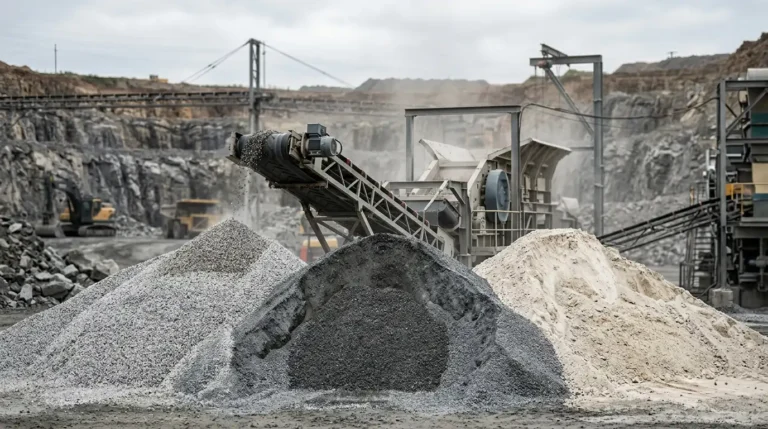
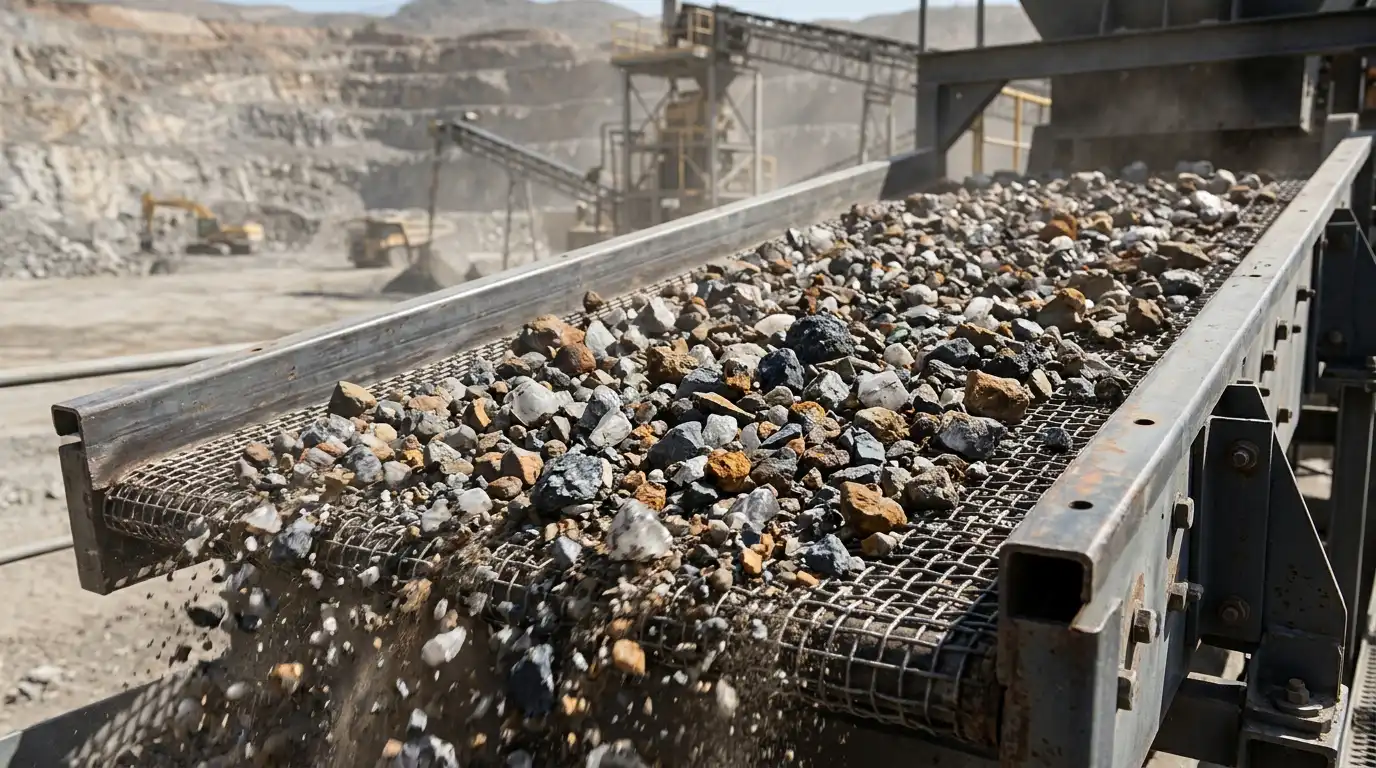
| Crushed aggregate | 1 (solid), many particle sizes | Heterogeneous | Screening by size |
| Gold-bearing quartz ore | 1 (solid), several minerals | Heterogeneous | Grinding to liberation, then gravity concentration |
| Dusty exhaust air from a mill | 2 (gas + solid) | Heterogeneous | Cyclone collector, bag filter |
Table note: engineering classification of common process streams; the separation route shows the usual first step, not the full flowsheet.
The size vocabulary used in the rest of this guide is explained in F80, P80, mesh and micron terms.
Why Ore and Aggregate Are Heterogeneous Mixtures
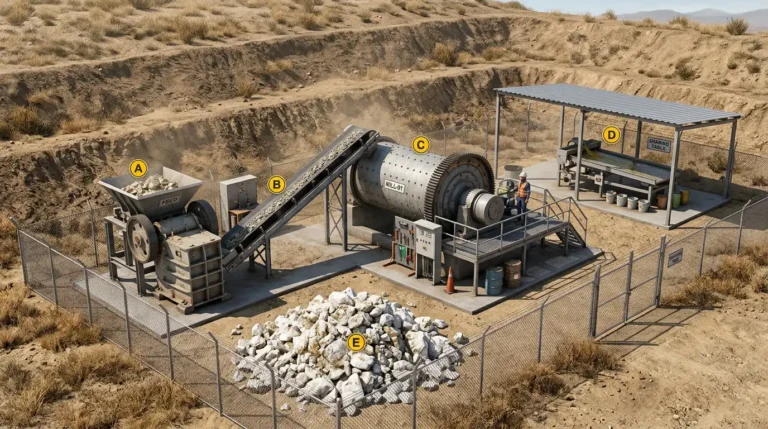
The material that reaches a crushing plant is heterogeneous at every scale that matters for processing. Even a fairly pure deposit such as the limestone used for cement and calcium carbonate carries clay seams, silica bands and weathered zones. Three scales control how a plant behaves:
- Deposit and stockpile scale (meters): grade changes between benches, blasts and truckloads. A stockpile that looks uniform still holds this variation.
- Particle scale (millimeters): after crushing, particles differ in size, shape and composition. Soft minerals and clay tend to report to the fines.
- Grain scale (micrometers): valuable minerals occur as grains locked in gangue. A physical separator can only recover a mineral grain that is free from the gangue, or mostly free.
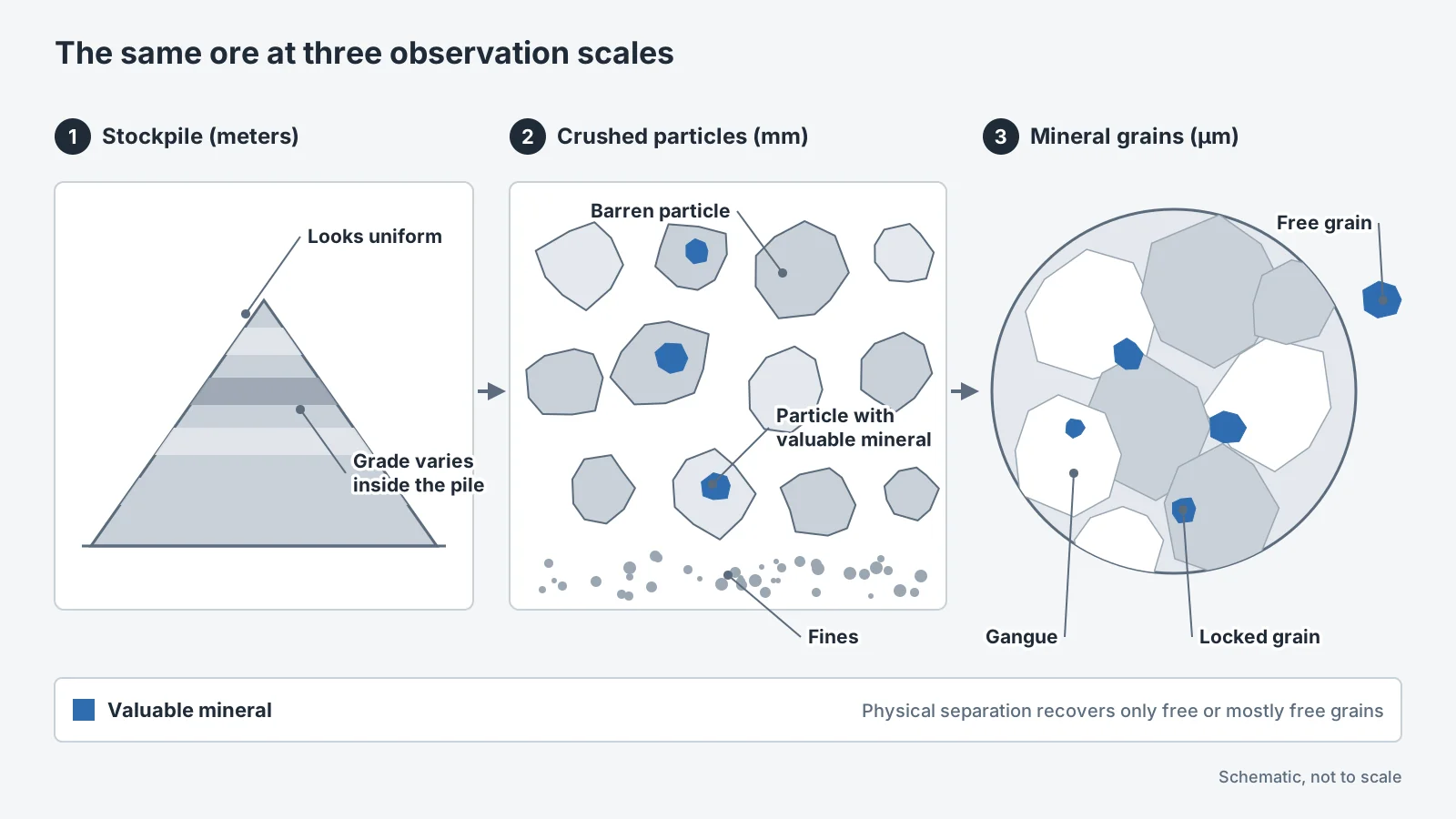
The grain scale explains why ore is ground at all. Crushing and grinding break particles until most valuable grains are liberated. The target grind size is set by the grain size of the valuable mineral, not by convenience. Grinding coarser leaves grains locked and lost to tailings; grinding much finer than needed wastes energy and creates slimes that most separators recover poorly.
Handling adds a second effect. A heterogeneous mixture of particles un-mixes when it moves: coarse particles roll to the toe of a stockpile, and fines collect under the discharge point of a chute or conveyor. This segregation is the main reason two samples from the “same” pile can give different results. Gold ore is an extreme case, and processing hard-rock gold ore without mercury shows how grind size and gravity recovery depend on each other.
Separating Heterogeneous Mixtures: Match the Property Difference to the Method
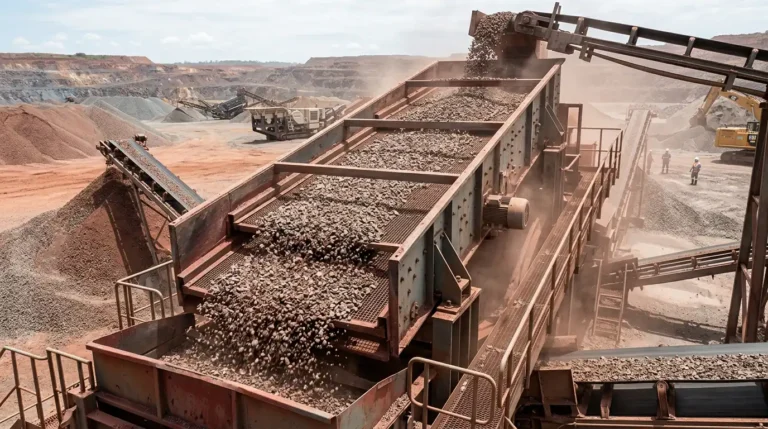
Every physical separation uses one property difference between the particles of a heterogeneous mixture. Particle size is the simplest and the most common: vibrating screens separate particles by size, and almost every crushing circuit depends on them. The classroom methods for separating mixtures have direct industrial versions:
| Property difference | Basic principle | Industrial equipment | Typical use |
|---|---|---|---|
| Particle size | Sieving | Vibrating screen | Aggregate grading, closed-circuit crushing |
| Settling velocity in a fluid | Sedimentation | Hydrocyclone, spiral classifier | Closing a ball mill circuit |
| Density | Panning, decanting | Jig, shaking table, centrifugal concentrator | Gold, tin, tungsten, heavy mineral sands |
| Magnetic susceptibility | Hand magnet | Magnetic separator | Tramp-iron removal, magnetite recovery |
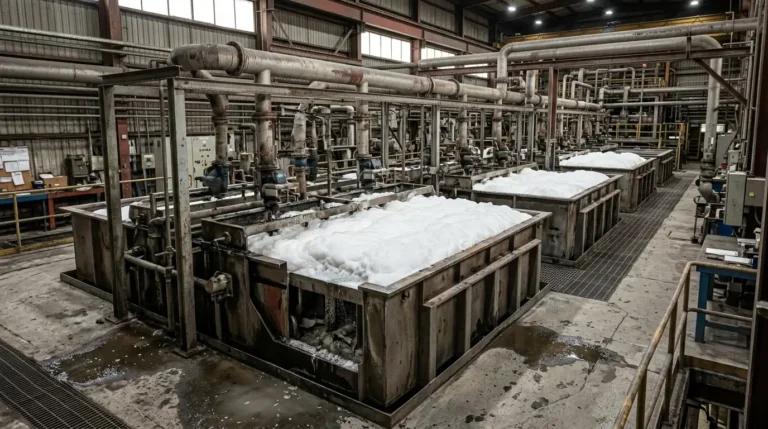
| Surface wettability | Controlled by reagent chemistry | Flotation cell | Sulfide ores, phosphate, fine particles |
| Electrical conductivity | Induced currents or charge | Eddy-current or electrostatic separator | Non-ferrous metals from scrap, mineral sands |
Table note: engineering summary of common physical separation methods; the equipment column lists typical choices, not every option.
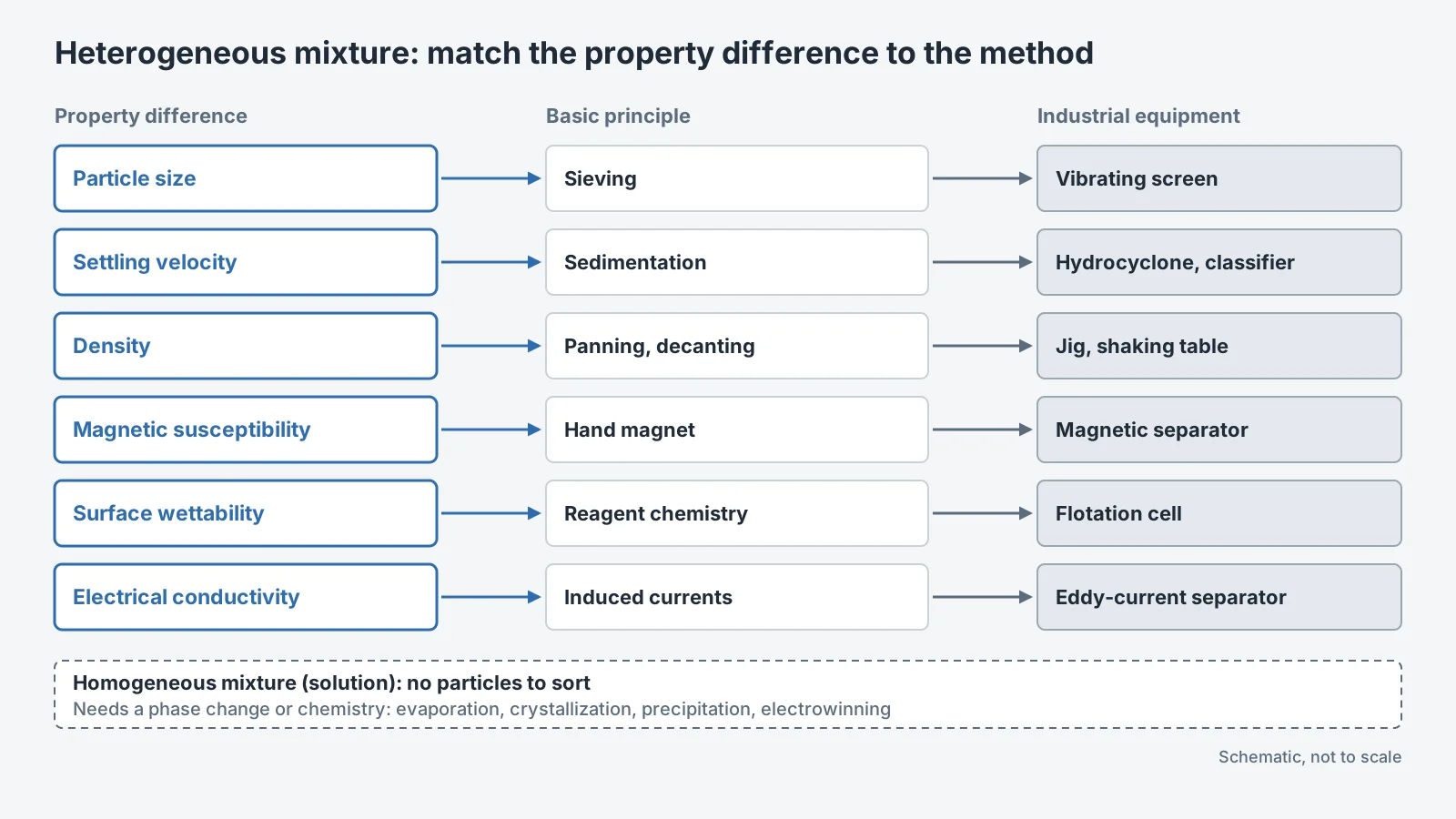
Three practical rules follow from the table:
- Use the largest property difference. Gold (density about 19 g/cm³) and quartz (about 2.65 g/cm³) separate easily by gravity once liberated. Two minerals with similar density need another property, such as surface chemistry in froth flotation.
- Prepare the size range first. Most density, magnetic and flotation methods work well only within a limited size range. Screens and classifiers set that range.
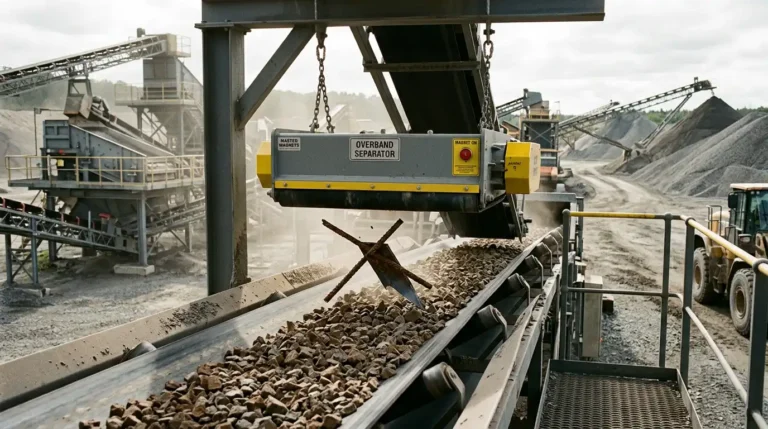
- Remove what damages the equipment. Tramp iron in a crusher feed is also a heterogeneous impurity, and a magnetic separator protects the downstream line.
For size separation of crushed rock, the S5X Vibrating Screen is an inclined circular-motion screen built in widths from 1800 to 3000 mm, with 2 to 4 decks, mesh openings of 2–70 mm and capacities from 60 to 1200 t/h depending on model. It runs at 800–900 rpm with an amplitude of 7–12 mm and is supported on rubber springs. For simpler screening duty, the Y Vibrating Screen is the alternative.
Homogeneous Mixtures in a Processing Plant
Hydrocyclones and classifiers can split a slurry into solids and water, but the water that leaves them still carries dissolved salts and reagents. That water is a homogeneous mixture, and no crusher, mill or screen can separate it, because there are no particles to sort.
A homogeneous mixture is separated only by a phase change or a chemical reaction:
- Evaporation and crystallization: salt from brine, potash from solution.
- Precipitation: a reagent turns a dissolved metal into a solid, which then becomes a heterogeneous mixture again and can be filtered.
- Solvent extraction, ion exchange and electrowinning: recovery of copper, gold and other metals from leach solutions.
Hydrometallurgy deliberately moves material between the two classes. Leaching dissolves a metal out of a heterogeneous ore and creates a homogeneous solution; precipitation or electrowinning then turns the metal back into a solid. Mechanical equipment sits upstream of this chain: crushing and grinding expose the mineral surfaces so that the leach solution can reach them.
Water chemistry also matters on the physical-separation side, because dissolved ions change how particles respond to reagents in froth flotation.
Making a Heterogeneous Feed Behave Like a Homogeneous One: Blending
Many processes run best on feed that is as close to homogeneous as possible: a cement kiln, a flotation circuit tuned for one grade, or a Raymond mill line producing ground calcium carbonate. When the deposit cannot supply uniform material, the plant blends it.
A blending stockpile is built in many thin layers and reclaimed across its full face, so that each reclaimed slice contains material from every layer. The result is measured as the variance reduction ratio (VRR), the variance of the output divided by the variance of the input. Lower is better:
- Chevron-type stacking with full-face reclaiming can approach a tenfold reduction in variance (VRR about 0.1).
- Simulations of circular stockpiles gave a VRR of about 0.12 for optimized chevron-type stacking and about 0.23 for optimized cone-shell stacking.
- Longer blending tails and faster stacker travel lower the VRR, but the benefit levels off, and a long tail uses buffer volume.
Blending has limits. It smooths short-term fluctuations within the volume of one pile; it cannot correct a long-term change in deposit grade, and it cannot remove segregation that happens after reclaiming. Feed consistency also depends on size and moisture, not only on chemistry.
Grinding mills show why. The MGW Intelligent Raymond Mill requires feed pre-crushed to below 20 mm, with moisture below 6% and Mohs hardness below 9. Its belt feeder, main mill and fan are interlocked, and the feed rate adjusts automatically to the material level, which helps hold product fineness when the feed varies. A blended, sized and dry feed lets that control work within a narrow band. The full equipment sequence for such a plant is shown in the limestone grinding line layout.
Sampling a Heterogeneous Material
Every grade-control decision, plant acceptance test and product certificate from an aggregate washing and screening line depends on a sample that represents a heterogeneous lot. The theory of sampling separates two kinds of heterogeneity:
- Constitution heterogeneity: the particles themselves differ in composition. It causes the fundamental sampling error. This error can be reduced by taking a larger sample or by crushing finer before splitting, but it can never be eliminated.
- Distribution heterogeneity: the particles are not randomly distributed because of segregation. It causes grouping and segregation error, which is reduced by taking many small increments instead of a few large ones.
Systematic errors are different: delimitation, extraction and preparation errors come from incorrect procedure and can be eliminated. Aggregate sampling standards in North America and Europe define where and how increments are taken for this reason. The practical rules are:
- Take many increments across the full stream. One grab from the surface of a pile is not a sample.
- Sample from a falling stream or from a stopped belt across its full width. Avoid the toe and the surface of stockpiles, where segregation is strongest.
- Crush before splitting, and split with a riffle or rotary divider. Use cone-and-quartering only when no divider is available.
- Record particle size and moisture with every result, so that later results can be compared on the same basis.
Sampling points should be planned together with the flowsheet, because the best location is often a transfer point in open and closed crushing circuits.
Frequently Asked Questions
Is ore a homogeneous or a heterogeneous mixture?
Ore is a heterogeneous mixture. It contains a valuable mineral and gangue minerals in separate grains, and its grade varies from place to place in the deposit. That is why ore is crushed and ground to liberate the valuable grains before separation, as explained in what comminution is.
Is concrete a homogeneous mixture?
No. Concrete is a heterogeneous mixture of cement paste, sand and coarse aggregate. A well-mixed batch is uniform enough for structural use, but a cut section shows separate particles clearly. The aggregate itself is graded by screening.
Is a mill slurry a heterogeneous mixture?
Yes. A slurry is a heterogeneous mixture of solid particles and water; the solids settle when agitation stops. Wet grinding in the MQ Ball Mill produces such a slurry, and a classifier then separates it by settling velocity.
Can a vibrating screen separate a homogeneous mixture?
No. A screen separates particles by size, and a homogeneous mixture has no particles to separate. Dissolved salts pass through any screen with the water. Screens such as the S5X Vibrating Screen work on heterogeneous solid mixtures only.
Why does a uniform-looking stockpile give different lab results?
Because the stockpile is heterogeneous at the particle scale and segregated by handling. Coarse particles roll to the toe and fines stay near the center, so samples from different spots differ. Many small increments from a moving stream give a far more representative result, together with consistent particle size reporting.
References & Sources
For the size-separation background behind several of these sources, see how vibrating screens separate particles.
- IUPAC Compendium of Chemical Terminology (Gold Book) — mixture
- Marques & Chieregati, REM – International Engineering Journal (2023): sampling constants and Pierre Gy’s factors for bauxite
- Loubser & de Korte, Journal of the SAIMM (2015): factors influencing blending efficiency on circular stockpiles
- ASTM D75/D75M — Standard Practice for Sampling Aggregates
- EN 932-1 — Tests for general properties of aggregates, Part 1: Methods for sampling
Related reading: how rock types affect crushing.