

The Advantages of Ball Mills: Why It Remains the First Choice for Industrial Grinding
Walk into any mine, cement plant, pharmaceutical facility, or research laboratory, and you will almost certainly find a ball mill somewhere in the process flow. The concept is deceptively simple: a rotating steel cylinder, a charge of grinding media, and the combined forces of impact and attrition reduce almost any solid material to a controlled powder. Yet this simplicity masks a remarkable range of capabilities. A single machine design can process copper ore at thousands of tons per day or grind active pharmaceutical ingredients to sub-micron precision, scale from a bench-top laboratory unit to a floor-shaking industrial installation without changing the underlying process parameters, and operate sealed against the atmosphere when hazardous materials demand it. This article examines each of these advantages in turn and concludes with a candid comparison against competing technologies so you can decide whether a ball mill is the right fit for your operation.
Versatility
Few pieces of grinding equipment match the breadth of applications served by the ball mill. The same operating principle supports:
| Industry | Typical Material | Purpose |
|---|---|---|
| Mining & Metallurgy | Copper, gold, iron ore | Mineral liberation, improve recovery |
| Cement & Construction | Clinker, limestone, fly ash | Control fineness, improve strength |
| Chemicals & Coatings | Pigments, barium sulfate, calcium carbonate | Homogenization, color stability |
| Pharmaceuticals | Active pharmaceutical ingredients (API) | Reduce particle size, increase bioavailability |
| Ceramics | Kaolin, alumina, feldspar | Refine body material, improve sintering |
| Research Laboratories | Minerals, metal powders | Sample preparation, material synthesis |
This cross-industry applicability means that operating know-how, spare parts sourcing, and supplier relationships built in one sector transfer directly to another—a practical advantage for multi-division manufacturers.
Fine Powder Production
Ball mills are among the few grinding machines capable of reliably producing powders with particle sizes at or below 10 µm. This capability stems from the dual grinding mechanism:
- Impact: Media balls drop from near the top of the rotating shell, delivering direct kinetic energy to coarser particles.
- Attrition: Ball-on-ball and ball-on-liner sliding friction progressively wears particles down to the micron and sub-micron range.
The achievable size range typically spans 5 µm to 200 µm in standard industrial units. High-energy planetary ball mills used in laboratories can reach the nanometer scale. The key variables that govern final particle size are:
- Grinding media diameter and density
- Mill rotational speed (typically 65–78% of critical speed)
- Material residence time inside the mill
- Ball-to-material loading ratio
In pharmaceuticals, particle size directly governs dissolution rate and bioavailability. In cement manufacturing, grind fineness determines early-age compressive strength. Both sectors depend heavily on the ball mill’s fine-grinding capability.
Wet and Dry Grinding
A ball mill can operate in either wet or dry mode, a flexibility that most specialized grinders cannot match.
Dry grinding suits materials sensitive to moisture, processes requiring direct use of dry powder, and ceramic workflows that include high-temperature sintering.
Wet grinding offers measurable advantages: published engineering data indicate that wet-mode operation reduces unit energy consumption by 20–30% compared with dry mode, while also increasing throughput, eliminating dust, and simplifying product discharge. Mineral processing and pigment production predominantly use wet ball milling for these reasons.
| Parameter | Dry Mode | Wet Mode |
|---|---|---|
| Unit energy | Higher | 20–30% lower |
| Particle size | Controllable, slightly coarser | Finer, narrower distribution |
| Best materials | Moisture-sensitive, dry powder needed | Ores, pigments, slurries |
| Post-processing | None | Dewatering or filtration |
| Dust control | Requires dedicated system | Negligible dust |
Continuous Operation and High Throughput
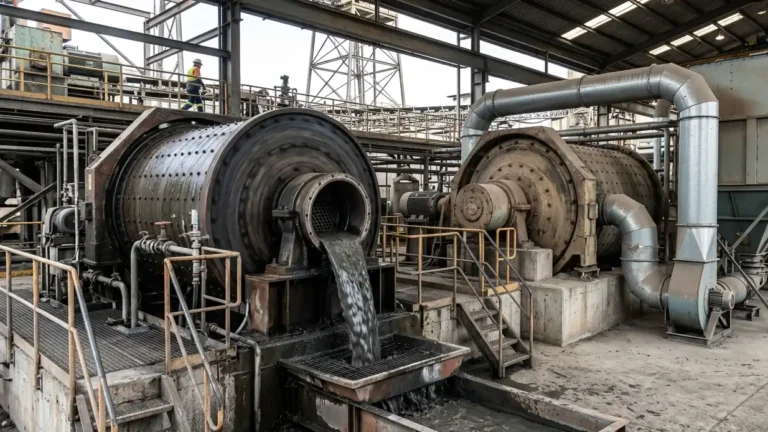
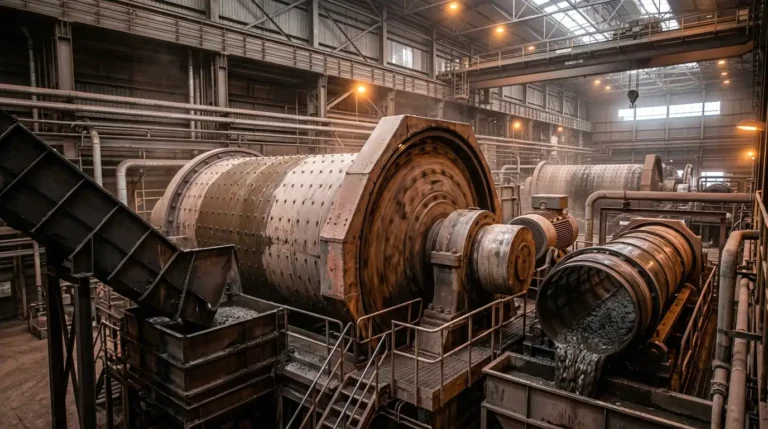
Industrial ball mills are designed for continuous 24/7 operation. Overflow and grate-discharge configurations accept a steady feed at one end and discharge ground product at the other, integrating cleanly into high-volume production lines without scheduled interruptions for loading or unloading.
In industries such as copper mining, the ball mill sits at the critical throughput bottleneck: one hour of unplanned downtime ripples through the entire downstream circuit. MR’s ball mill cylinders are manufactured from high-performance wear-resistant steel plates with key wear parts engineered to last approximately 40% longer than standard market products, directly reducing planned and unplanned maintenance stops. See the MR ball mill Latin America shipment case for a real-world example.
Safe Handling of Toxic and Hazardous Materials
The fully enclosed cylinder of a ball mill is one of its most underappreciated advantages. The mill can be operated as a closed system, and the grinding chamber can be purged and backfilled with an inert gas such as nitrogen or argon, providing two layers of protection:
- Operator safety: No dust or vapor escapes the process enclosure.
- Material integrity: Oxygen-sensitive materials (battery electrode powders, reactive metals) are protected from oxidation.
This makes the ball mill the default choice in:
- Pharmaceutical manufacturing: Grinding APIs with zero cross-contamination risk.
- Hazardous chemical processing: Handling flammable or toxic powders under controlled atmosphere.
- Battery material production: Cathode and anode materials are processed in sealed mills to prevent oxidation.
Open-circuit grinders such as Raymond mills offer no equivalent protection.
From Laboratory Bench to Full Industrial Production
The scale-up logic of a ball mill is unusually straightforward. From a 0.01-liter planetary mill on a laboratory bench to a multi-hundred-liter industrial horizontal mill, the governing physics do not change. This means:
- Process parameters validated at laboratory scale (speed ratio, media-to-material ratio, residence time) serve directly as the starting baseline for industrial commissioning.
- Pharmaceutical and advanced-materials companies face a smoother technology transfer from pilot to production, without repeating the full process development cycle.
- Equipment suppliers offer complete product families covering every capacity tier.
MR’s MQ series covers the full range from small batch units to large continuous mills. Detailed specifications are available on the MR grinding mill product page.
Simple Structure and Low Maintenance Requirements
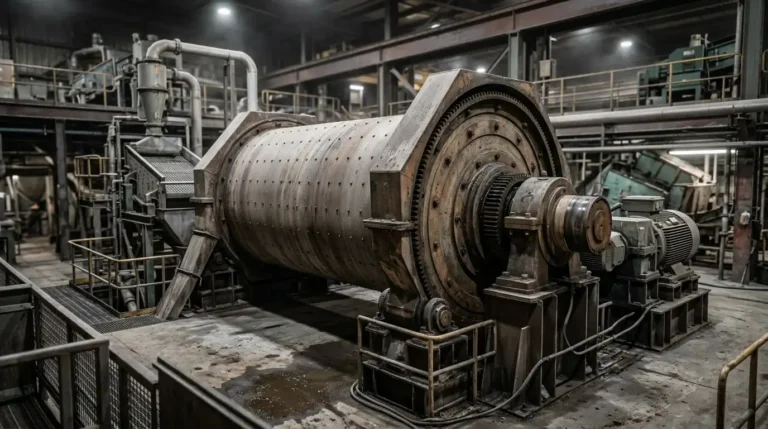
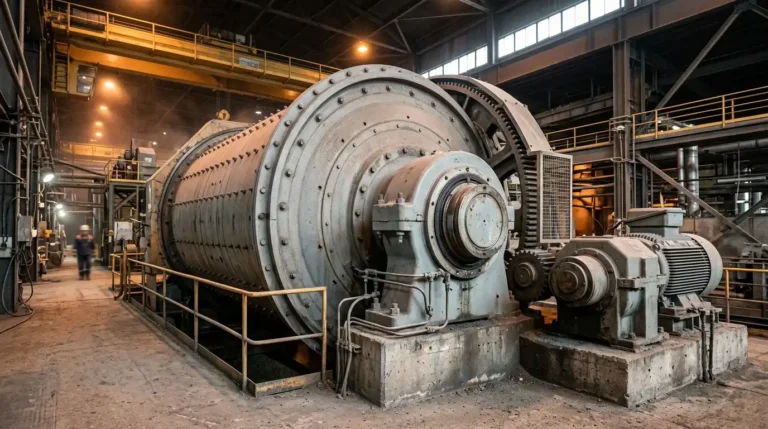
A ball mill has no cutting tools, no precision high-speed spindles, and no complex fluid dynamics to manage. The mechanical architecture—a rotating cylinder driven through a gear or belt transmission—is inherently robust. Practical maintenance advantages include:
- Replaceable liners: Worn liner plates bolt off and on; the cylinder itself is not consumed.
- Commodity grinding media: Steel and ceramic balls are globally available and inexpensive to restock.
- Low skill threshold: Routine operation and scheduled maintenance can be handled by trained technicians without specialized expertise.
- Predictable failure modes: Liner wear, bearing lubrication, and seal aging are all gradual, foreseeable, and budgetable.
MR provides comprehensive ball mill installation and commissioning guidance along with resident engineering teams across Latin America.
Low Capital Cost and Controllable Long-Term Economics
Compared with vertical roller mills and high-pressure grinding rolls, ball mills typically carry a lower unit purchase price—an important factor for budget-constrained projects. Wikipedia’s ball mill entry explicitly lists “low cost of installation and grinding medium” among the machine’s primary advantages.
Across the full equipment lifecycle, cost drivers are:
- Capital cost: Generally lower than vertical mills and HPGR systems.
- Grinding media consumption: Steel ball pricing is stable and globally competitive.
- Energy cost: Wet-mode operation is favorable; dry large-scale mills consume more, but optimization of speed and loading can reduce consumption by 10–20%.
- Planned maintenance cost: Liner and media replacement schedules are predictable and budgetable.
- Equipment lifespan: A well-maintained industrial ball mill typically operates for 15–20 years.
Ball Mill vs Other Grinding Mills
| Criterion | Ball Mill | Raymond Mill | Rod Mill | Vertical Roller Mill |
|---|---|---|---|---|
| Product fineness | 5–200 µm, nanoscale possible | 45–180 µm (80–325 mesh) | 0.5–5 mm (coarse) | 20–200 µm |
| Material hardness | Mohs ≤ 9 | Mohs ≤ 7 | Medium-hard ores | Medium-hard ores |
| Wet/dry capability | Both | Dry only | Both | Dry only |
| Unit energy | Medium (wet: lower) | Low to medium | Medium | Low (saves 30–50%) |
| Hazardous material handling | Excellent | Limited | Limited | Moderate |
| Scale-up ease | Excellent | Moderate | Moderate | Good |
| Capital cost | Low to medium | Low | Medium | High |
| Maintenance complexity | Low | Low to medium | Low | Medium to high |
Selection guidance: For hard ores, hazardous materials, or processes requiring fine and consistent powder with a direct path from laboratory to production, the ball mill is the most reliable choice. For softer materials at medium throughput where energy cost is the dominant concern, a Raymond mill (such as the MR MGW series) may offer better economics.
Summary
The ball mill’s enduring dominance in industrial grinding is not the result of any single exceptional performance metric. It is the product of a rare combination: broad industry applicability, reliable fine-powder production, wet/dry process flexibility, sealed operation for hazardous materials, straightforward scale-up, low maintenance burden, and predictable lifetime cost—all delivered by a mechanically simple machine. For operations in mining, cement, chemicals, pharmaceuticals, or materials research that require long-term, stable grinding, it remains one of the most dependable choices available. Before purchasing, align your material properties, target fineness, and production volume with a qualified supplier to identify the optimal configuration.
FAQ
What is the difference between a ball mill and a Raymond mill, and how do I choose?
The core difference lies in the grinding mechanism and application scope. A ball mill uses steel balls for impact and attrition, handling materials up to Mohs 9 hardness in both wet and dry modes. A Raymond mill uses grinding rollers under pressure, suited to materials below Mohs 7 in dry mode only, with lower energy consumption but a limited upper fineness ceiling. Choose a ball mill for hard materials, fine-powder requirements, or wet processing; choose a Raymond mill for softer materials when energy efficiency is the priority.
What materials are best suited for wet ball milling?
Wet ball milling is most effective for ores (copper, gold, iron), pigments, calcium carbonate, and ceramic raw materials that can be mixed with water. It reduces energy consumption by 20–30% versus dry mode and produces finer, more uniformly distributed particles with minimal dust. It is not suitable for moisture-reactive materials or processes that require dry powder as a direct output.
What are the typical maintenance intervals and tasks for an industrial ball mill?
Key maintenance activities include: daily checks of bearing temperature and lubrication oil level; weekly inspection of grinding media wear; quarterly measurement of liner plate thickness; periodic replenishment or replacement of grinding balls and liners (typically every 6–12 months based on wear rate); and annual overhaul covering the drive system and seals. Proper maintenance typically extends major component life by 30–50%.
Can laboratory ball mill parameters be transferred directly to industrial scale?
The core parameters—speed-to-critical-speed ratio, media-to-material ratio, and media material—transfer directly. This is the most significant scale-up advantage of ball mills. However, thermal effects and material flow behavior change at larger scales, so retaining a 10–15% process adjustment margin during initial industrial commissioning is advisable.
What is the typical energy consumption of a ball mill per ton of material?
Consumption varies significantly with material hardness, target fineness, and operating mode. General reference ranges: cement clinker grinding 25–40 kWh/t; ore grinding 10–25 kWh/t; wet mode is 20–30% more efficient than dry. Optimizing media size distribution, mill speed, and loading ratio can typically reduce consumption by 10–20% from the baseline.