

Horizontal Ball Mill vs Other Grinding Mills: A Practical Comparison and Selection Guide
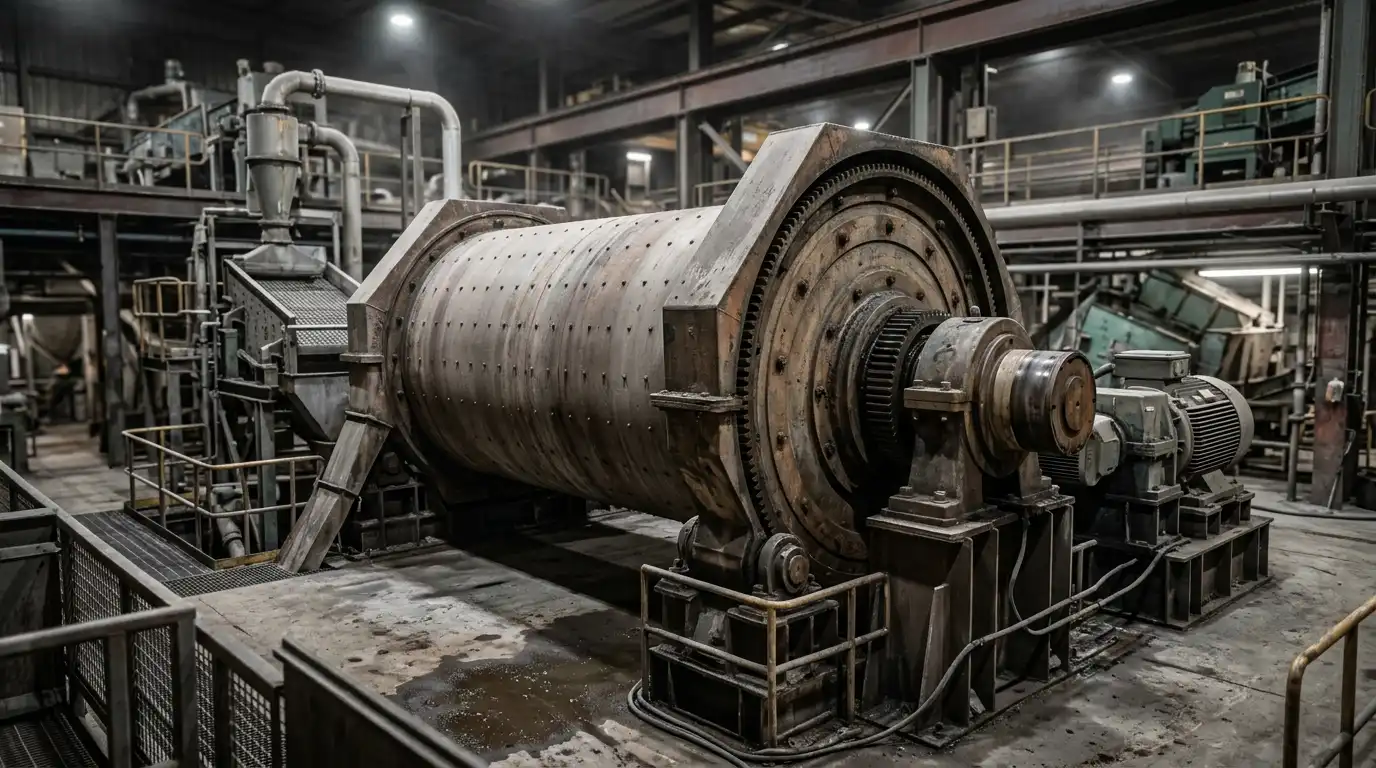
What is the difference between a horizontal ball mill and other grinding mills? A horizontal ball mill reduces particle size by tumbling steel or ceramic grinding media inside a rotating horizontal cylinder, so size reduction occurs through impact and attrition. Raymond mills and vertical roller mills instead compress material between a ring and rollers or between rollers and a grinding table, which lowers specific energy consumption but narrows the range of feed hardness and moisture the machine can handle. Rod mills and SAG mills use different grinding media — steel rods or the ore itself — and sit upstream of a ball mill in a grinding circuit rather than competing with it for the same duty. The correct mill for a given application depends on target fineness, feed hardness, required throughput, and whether the process runs wet or dry, not on which machine is newest or most complex.
What You Will Learn from This Guide
This guide compares the horizontal ball mill against the equipment types most often confused with it or proposed as alternatives: the Raymond (ring-roller) mill, the ultrafine grinding mill, the rod mill, the SAG mill, and vertical roller and stirred mill technologies. It is written for plant engineers and procurement teams at the equipment-selection stage, after a target fineness and material type have been identified but before a mill model or supplier has been chosen. Each comparison section presents the structural and performance differences in a table, followed by the specific operating conditions under which one design outperforms another. After reading this guide, you will be able to match a mineral-processing or powder-grinding application to the correct mill category, define a realistic fineness and throughput range for a horizontal ball mill inquiry, and identify which wear-part and maintenance factors change total cost of ownership across mill types.
Quick Verdict: Matching Mill Type to Your Application
A horizontal ball mill is the correct choice when the application requires fine-to-ultrafine grinding, tolerates either a wet or dry circuit, and processes ore or mineral feed across a wide hardness range. The MQ Ball Mill covers this duty for continuous mineral and powder grinding lines. A Raymond mill is the more energy-efficient choice for dry, non-metallic mineral powders in the coarser fine-powder range, at lower installed power per tonne processed. An ultrafine grinding mill outperforms both when the target fineness falls below roughly 45 µm (325 mesh per ASTM E11 sieve designation [1]). Rod mills and SAG mills belong upstream of a ball mill, not in competition with it, because they prepare coarse feed rather than finished powder. Vertical roller mills and stirred (attrition) mills reduce specific energy consumption relative to a ball mill but require higher capital investment and a narrower operating window.
Table 1. Grinding mills compared by mechanism, output range, and primary trade-off.
| Mill Type | Grinding Mechanism | Typical Output Range | Primary Trade-off |
|---|---|---|---|
| Horizontal Ball Mill | Impact and attrition from tumbling steel or ceramic media | Coarse powder to approximately 45 µm (325 mesh) | Higher specific energy use than compression mills; wide material and hardness range |
| Raymond (Ring-Roller) Mill | Compression between a stationary ring and rotating rollers | Approximately 150 µm to 45 µm (100 to 325 mesh) | Limited to non-metallic minerals of moderate hardness; dry process only |
| Ultrafine Grinding Mill | Impact grinding combined with internal air classification | Below 45 µm, down to single-digit micron particle size | Lower throughput per unit of installed power than a ball mill at coarser targets |
| Rod Mill | Line-contact impact and attrition from steel rods | Coarse, uniformly sized product; not a finished powder | Not designed to reach fine or ultrafine output |
| SAG Mill | Impact from the ore itself plus a small steel ball charge | Coarse primary-stage product | High installed power; economical only at large processing scale |
| Vertical Roller / Stirred Mill | Bed compression (roller mill) or shear and attrition (stirred mill) | Fine to ultrafine | Lower specific energy but higher capital cost and narrower feed tolerance |
Source: mesh-to-micron correlation per ASTM E11 sieve designation [1]; mechanism classifications reflect standard comminution equipment categories.
Target fineness is the variable that decides mill selection most often. It separates the ball mill and Raymond mill decision from the ultrafine mill decision, and it separates all three from rod mills and SAG mills, which are not built to produce finished powder at all.
How a Horizontal Ball Mill Works
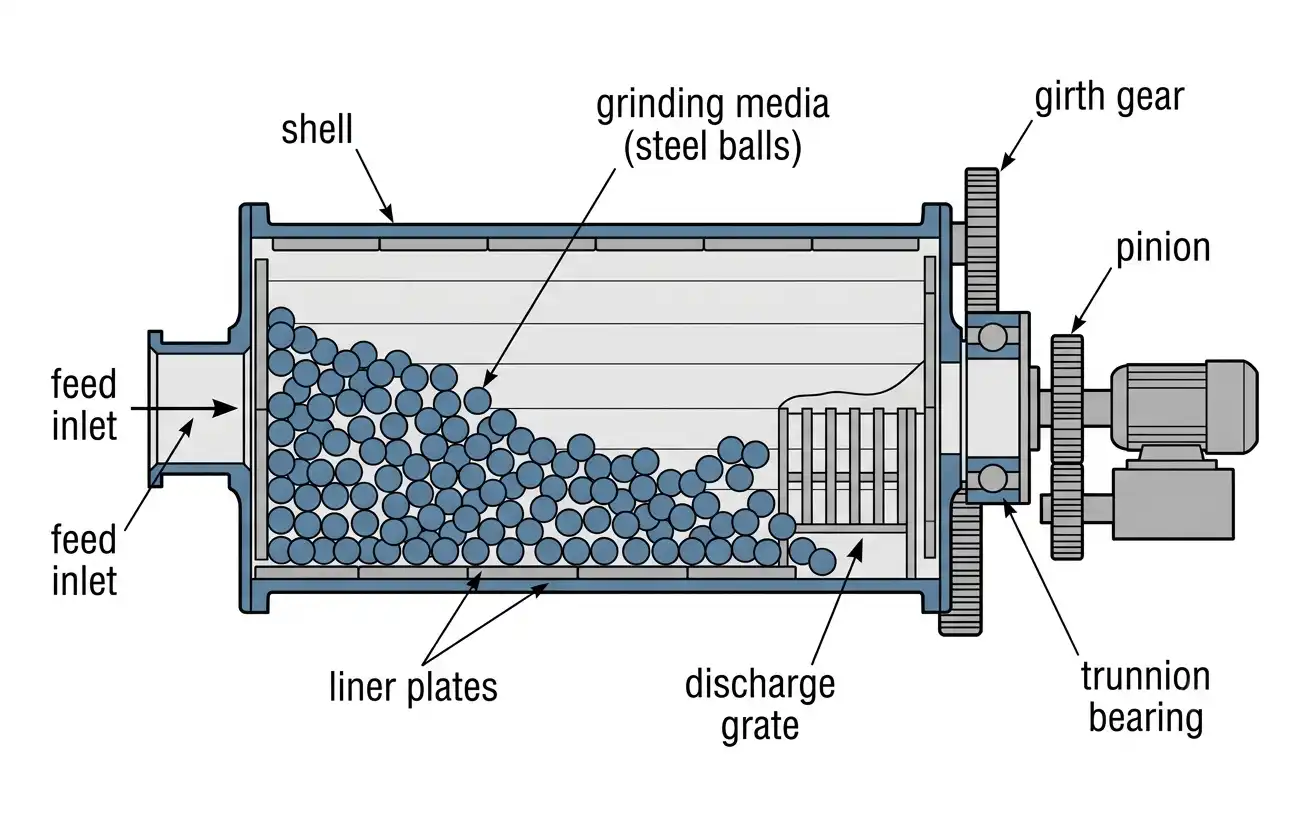
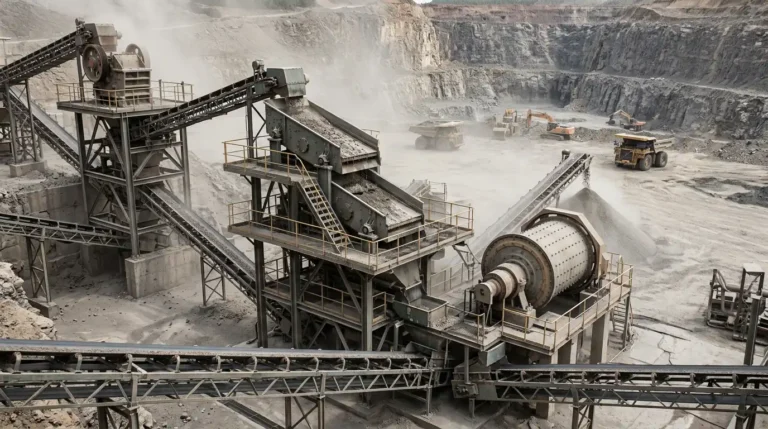
The MQ Ball Mill is built around a horizontal steel cylinder mounted on trunnion bearings at both ends. Wear-resistant liner plates cover the inner shell wall and protect it from direct contact with the grinding media and the material being processed. A girth gear and pinion drive rotate the cylinder at a speed low enough that the steel or ceramic grinding balls inside cascade and tumble rather than centrifuge flat against the shell wall.
Feed material enters through a hollow trunnion at one end. As the shell rotates, the grinding media lift along the rising side of the cylinder and fall onto the material bed below, breaking particles through impact. Continued rotation drags the media and material together across the shell surface, producing additional size reduction through attrition. Ground material exits through a discharge grate or an overflow opening at the opposite end, depending on the discharge configuration selected for the application.
Two liner and discharge configurations are common. A grate-discharge mill retains coarser media inside the shell and allows finer, correctly sized slurry or powder to pass through the discharge grate, giving tighter control over final particle size. An overflow-discharge mill uses a simpler opening and relies on the natural pulp level to carry ground material out, which suits lower-throughput, finer-grinding duty. Selecting between the two configurations depends on the target particle size distribution and the downstream classification equipment already installed in the circuit, as illustrated in the ball mill case for grinding feldspar.
Horizontal Ball Mill vs Raymond Mill: Structure, Fineness Range, and Throughput
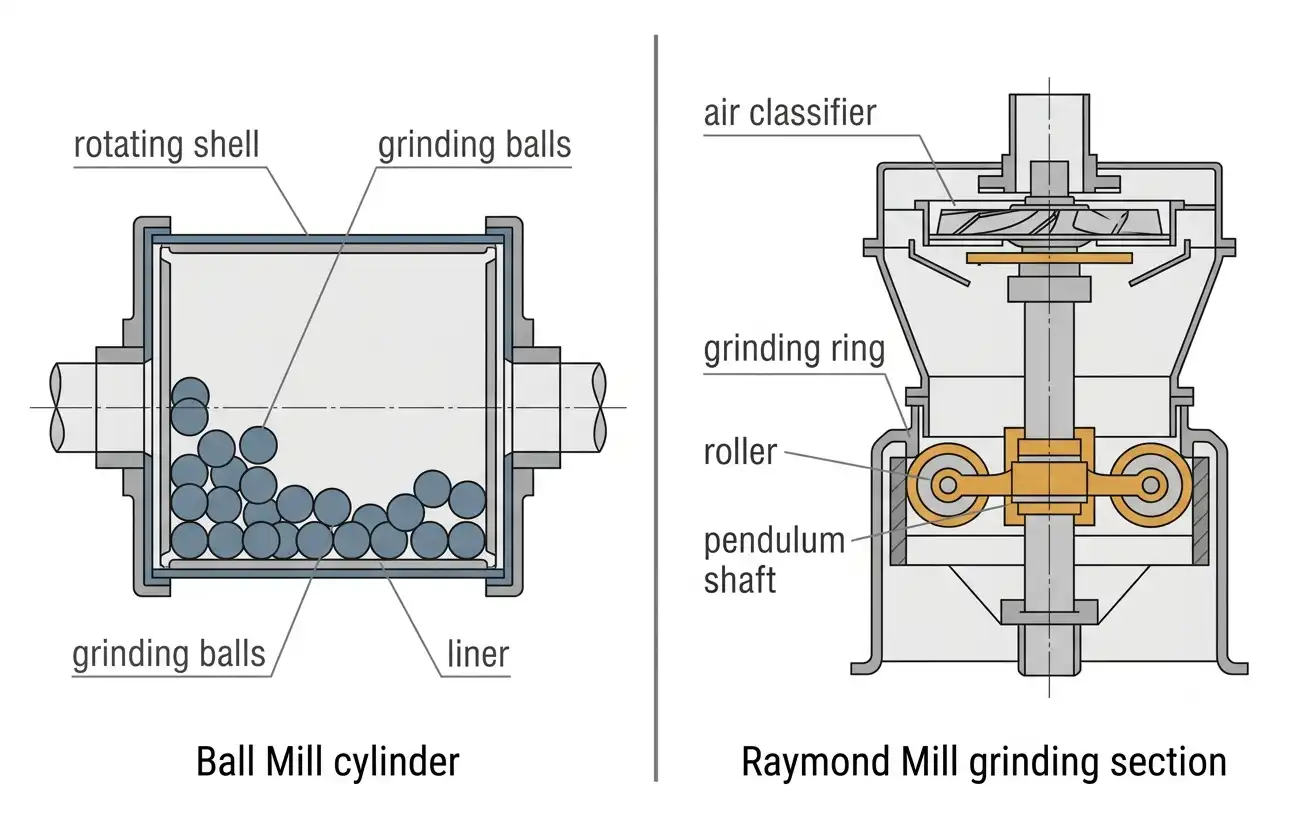
The MGW Intelligent Raymond Mill grinds material by pressing it between a stationary grinding ring and rollers that revolve around a central shaft, driven outward by centrifugal force. This compression mechanism differs fundamentally from the impact-and-attrition action of a ball mill, and the difference shows up directly in energy consumption, fineness range, and moisture tolerance.
Table 2. Horizontal ball mill and Raymond mill compared across four operating variables.
| Variable | Horizontal Ball Mill (MQ Series) | Raymond Mill (MGW Series) |
|---|---|---|
| Grinding mechanism | Impact and attrition from tumbling media | Compression between ring and rollers |
| Process type | Wet or dry | Dry only |
| Feed hardness suitability | Broad, including harder metallic ores | Best suited to non-metallic minerals of moderate hardness |
| Typical output fineness | Coarse powder to approximately 45 µm (325 mesh) | Approximately 150 µm to 45 µm (100 to 325 mesh) |
| Moisture tolerance | Handles higher-moisture feed, especially in wet-process configuration | Requires drier feed; excess moisture causes ring and roller blockage |
| Installed power per tonne processed | Higher, due to media lifting and cascading | Lower, because compression uses applied force more directly |
Source: mesh-to-micron correlation per ASTM E11 sieve designation [1]; equipment characteristics reflect standard specifications for MQ Series and MGW Series grinding mills.
The variable that most often drives this decision is feed hardness combined with process type. Dry, non-metallic minerals such as barite, calcite, and calcium oxide grind efficiently on a Raymond mill at lower power draw. See the 12 t/h Raymond mill case for grinding barite and the 25–30 t/h Raymond mill case for grinding calcium oxide for representative throughput and material profiles. Harder ores, wet feed, or a process that must run in a closed wet circuit call for the ball mill instead, as shown in the 3–5 t/h ball mill case for grinding feldspar.
Horizontal Ball Mill vs Ultrafine Grinding Mill: Meeting Sub-325-Mesh Fineness Targets
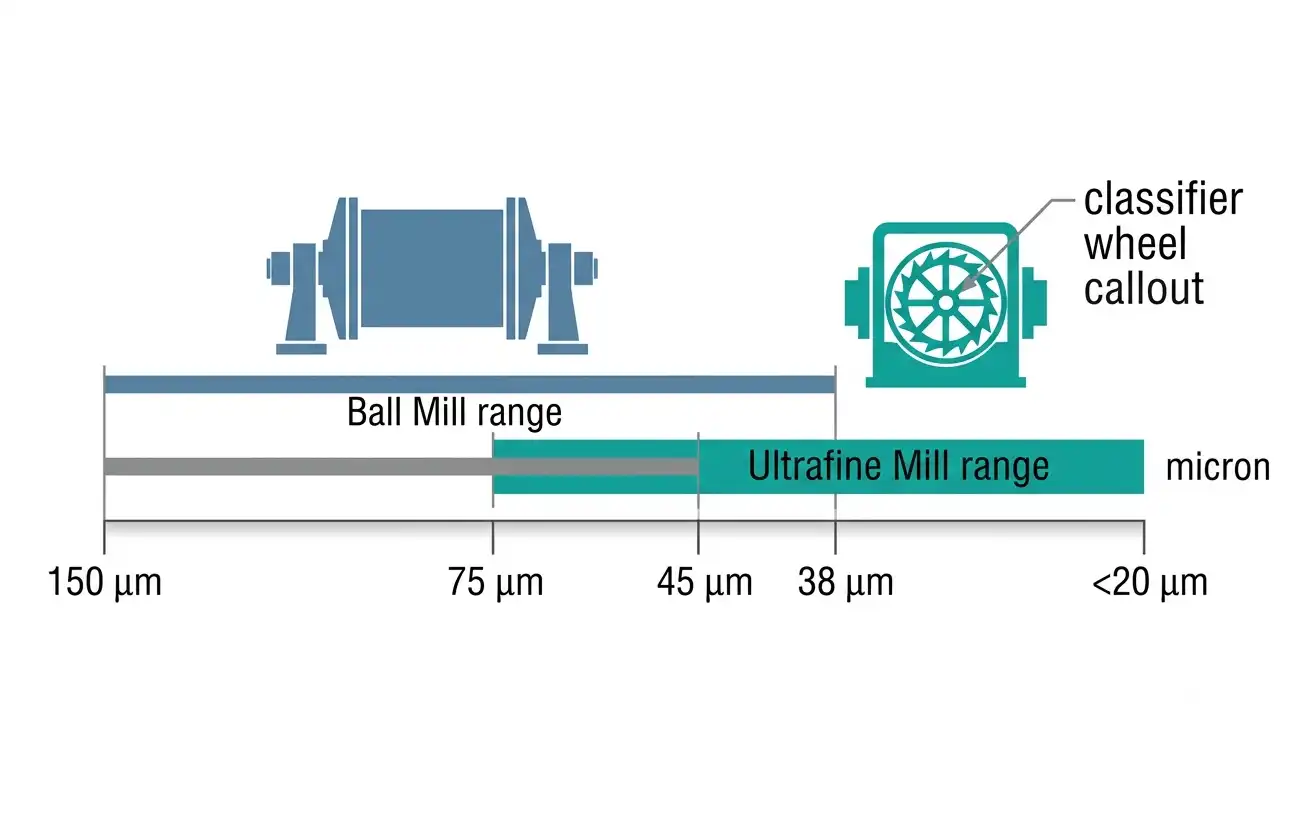
The MSF Ultrafine Grinding Mill combines an impact grinding stage with an internal air classifier that continuously separates particles that have reached target size from those requiring further grinding. This closed internal loop is what allows the ultrafine mill to produce consistent output below 45 µm (325 mesh per ASTM E11 [1]), a fineness range where a standard horizontal ball mill becomes progressively less efficient because grinding time increases sharply for each additional micron of size reduction.
Table 3. Horizontal ball mill and ultrafine grinding mill compared for fine-powder duty.
| Variable | Horizontal Ball Mill (MQ Series) | Ultrafine Grinding Mill (MSF Series) |
|---|---|---|
| Classification method | External cyclone or screen, separate from the mill | Internal air classifier integrated into the mill housing |
| Practical fineness ceiling | Efficient down to approximately 45 µm; efficiency drops beyond this point | Purpose-built for output well below 45 µm |
| Throughput at coarse targets | Higher throughput for coarse-to-medium fineness | Lower throughput than a ball mill at the same coarse fineness |
| Best-fit materials | Ores and minerals across a wide hardness range | Non-metallic minerals requiring high-purity, narrow particle size distribution |
| Typical industries served | Mining, mineral processing, cement raw material | Fillers, coatings, pharmaceuticals, advanced ceramics, composite materials |
Source: mesh-to-micron correlation per ASTM E11 sieve designation [1]; equipment characteristics reflect standard specifications for MQ Series and MSF Series grinding mills.
Applications that require both a coarse pre-grind and an ultrafine finish sometimes use a ball mill and an ultrafine mill in sequence rather than choosing one over the other. The 21–25 t/h ultrafine mill case for grinding dolomite, the 2–24 t/h ultrafine mill case for grinding calcite, and the ultrafine mill case for grinding composite materials illustrate the fineness and material range this configuration covers.
Horizontal Ball Mill vs Rod Mill and SAG Mill: Grinding Media and Circuit Position
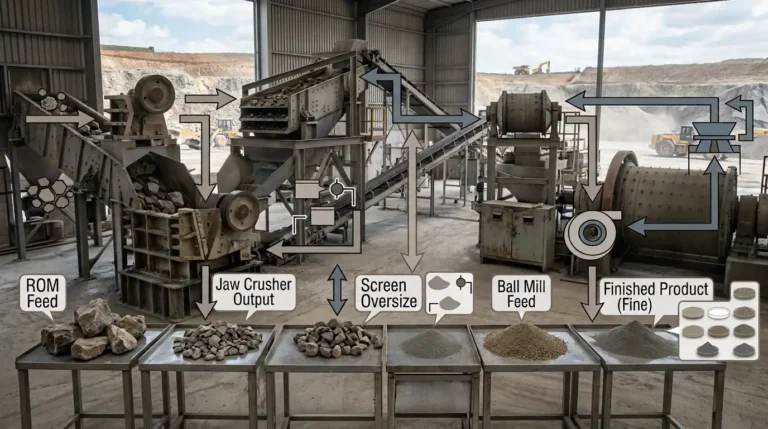
A rod mill uses long steel rods instead of balls as grinding media, feeding coarse, pre-sized material into finish-grinding equipment such as the one used in the ball mill case for grinding manganese ore. The rods make line contact with the material rather than the point contact of a ball, which produces a more uniform coarse product with fewer fines and reduces over-grinding of brittle material. This selective grinding behavior makes a rod mill well suited to coarse, first-stage grinding ahead of a ball mill, not as a substitute for it.
A SAG mill uses the ore itself as the primary grinding medium, supplemented by a small steel ball charge, inside a shell with a large diameter relative to its length. This geometry favors lifting and dropping large rock fragments rather than fine grinding. SAG mills operate at the front of large-scale mineral processing circuits, reducing run-of-mine ore to a size a ball mill can then finish.
Table 4. Grinding media, circuit position, and product characteristics across three tumbling mill types.
| Variable | Ball Mill | Rod Mill | SAG Mill |
|---|---|---|---|
| Grinding media | Steel or ceramic balls | Steel rods | Ore itself, plus a small steel ball charge |
| Contact type | Point contact | Line contact | Impact from lifted ore fragments |
| Shell proportions | Length approximately equal to diameter | Length greater than diameter | Diameter greater than length |
| Typical circuit position | Secondary or finish grinding | Primary, coarse grinding | Primary grinding at large processing scale |
| Product character | Fine to ultrafine powder | Coarse, uniformly sized product | Coarse product feeding a secondary ball mill |
Source: equipment classifications reflect standard mineral-processing comminution circuit design practice.
Circuit position, not grinding fineness alone, is what separates these three machines. A rod mill or SAG mill prepares feed; a ball mill finishes it. The ball mill case for grinding graphite ore operates as the finish-grinding stage of its circuit, receiving pre-sized feed from upstream crushing rather than run-of-mine rock.
Horizontal Ball Mill vs Vertical Roller Mill and Stirred (Attrition) Mills: Energy and Fineness Trade-offs
A vertical roller mill grinds material by compressing a bed of particles between rollers and a rotating table, a mechanism that differs from the tumbling action used in the ball mill case for grinding feldspar and applies force more directly to the particle bed. A stirred mill — also called an attrition mill — replaces tumbling entirely with a central shaft that agitates fine grinding media at high speed, producing size reduction primarily through shear and attrition rather than impact [4].
This mechanical difference has a measurable effect on energy consumption. Beneficiation and processing account for 39 percent of total energy use in U.S. mining operations, and crushing and grinding activities alone account for 75 percent of the energy used within that beneficiation and processing stage [3]. Because grinding represents such a large share of processing cost, even a moderate improvement in specific energy consumption changes the economics of a plant. In a peer-reviewed industrial-scale trial, a vertical (tower) stirred mill achieved 35 percent higher grinding efficiency than a batch ball mill when processing iron and copper ore samples at feed sizes up to 1.57 mm and 1.13 mm respectively [5].
Table 5. Horizontal ball mill compared to vertical roller mill and stirred mill technology.
| Variable | Horizontal Ball Mill | Vertical Roller Mill | Stirred (Attrition) Mill |
|---|---|---|---|
| Grinding mechanism | Impact and attrition from tumbling media | Bed compression between rollers and table | Shear and attrition from an agitated media bed |
| Relative specific energy use | Baseline | Lower than a ball mill for equivalent fineness | Lower than a ball mill at fine and ultrafine targets [4] [5] |
| Capital cost | Lower initial investment; mature, standardized design | Higher initial investment; more complex integrated system | Higher initial investment; specialized for fine and ultrafine duty |
| Feed tolerance | Broad range of hardness and moisture | Requires a stable, consistent grinding bed | Best suited to fine feed rather than run-of-mine ore |
| Maintenance profile | Simple — worn media is replenished; liners scheduled for periodic replacement | Requires precision-machined roller and table components | Requires wear-resistant internals sized for continuous high-speed agitation |
Sources: energy data per U.S. Department of Energy [3]; grinding mechanism and comparative efficiency data per Metso [4] and a peer-reviewed industrial HPGR/tower mill trial [5].
A horizontal ball mill remains the more practical choice where feed hardness or moisture varies significantly, where capital budget favors a simpler standardized machine, or where the process does not justify the added engineering complexity of bed-compression or stirred-media technology. Vertical roller and stirred mills earn their higher capital cost primarily in high-volume, energy-cost-sensitive operations running at a consistent fineness target, unlike the variable-hardness duty shown in the ball mill case for grinding manganese ore.
Selection Criteria: Matching Material, Target Fineness, and Capacity to Mill Type
Three variables narrow the mill selection faster than any others: the Mohs hardness of the feed material, the target fineness expressed in mesh or microns, and whether the process must run dry or can tolerate a wet circuit.
Table 6. Mill selection by material category and target fineness.
| Material Category | Recommended Mill | Typical Target Fineness | Reference Case |
|---|---|---|---|
| Metallic ores (graphite, manganese, feldspar) | MQ Ball Mill | Coarse to fine powder | Graphite ore case, manganese ore case |
| Non-metallic industrial minerals, dry (barite, alumina, calcium oxide, bentonite) | MGW Intelligent Raymond Mill | 100 to 325 mesh | Alumina case, bentonite case |
| High-purity fine powders (fertilizer carriers, petroleum coke, composite materials) | MGW Intelligent Raymond Mill or MSF Ultrafine Grinding Mill, depending on target mesh | 100 to 425 range, application-dependent | Fertilizer case, petroleum coke case |
| Sub-325-mesh fillers and specialty powders (dolomite, calcite, composites) | MSF Ultrafine Grinding Mill | Below 45 µm | Dolomite case, calcite case |
Source: mesh classification per ASTM E11 [1]; material-to-equipment matching drawn from documented case installations referenced in-table.
Material hardness sets the outer boundary of what a Raymond mill or ultrafine mill can process economically; feed above approximately Mohs 7 typically returns to ball mill grinding regardless of the target fineness, because ring-roller and impact-classification mechanisms wear disproportionately fast against harder particles.
Wear Parts and Maintenance Considerations Across Mill Types
Grinding media and liner plates account for most of the recurring cost difference between mill types, as documented in the ball mill case for grinding graphite ore. Ball mill liners and grinding balls are commonly specified in abrasion-resistant white cast iron conforming to ASTM A532/A532M, which covers alloy classes such as nickel-chromium and high-chromium white iron selected for resistance to abrasive wear in mining and milling service [2]. Raymond mill rollers and rings wear more slowly under normal dry, moderate-hardness duty but are more expensive to machine and replace as matched sets. Ultrafine mill classifier wheels and impact plates require closer dimensional tolerances, which raises the unit cost of replacement parts relative to a ball mill liner.
Wear rates in any of these mills vary with ore hardness, moisture content, circuit configuration, and operating hours, so a single wear-life figure does not apply across installations. Plant-specific wear-life and throughput data for a proposed application are available on request through the MQ Ball Mill product inquiry form, based on the material type, feed size, and target fineness supplied by the operator.
Frequently Asked Questions
What is the difference between a ball mill and a Raymond mill?
A ball mill grinds by impact and attrition from tumbling steel or ceramic media inside a rotating cylinder and can run wet or dry. A Raymond mill grinds by compressing material between a ring and rollers, runs dry only, and is generally more energy-efficient for non-metallic minerals of moderate hardness.
Can a ball mill produce the same fineness as an ultrafine grinding mill?
A ball mill can reach approximately 45 µm (325 mesh) but becomes progressively less efficient beyond that point. An ultrafine grinding mill is purpose-built with an internal air classifier for consistent output below 45 µm and is the more efficient choice at that fineness range.
Do I need a crusher before feeding material into a ball mill?
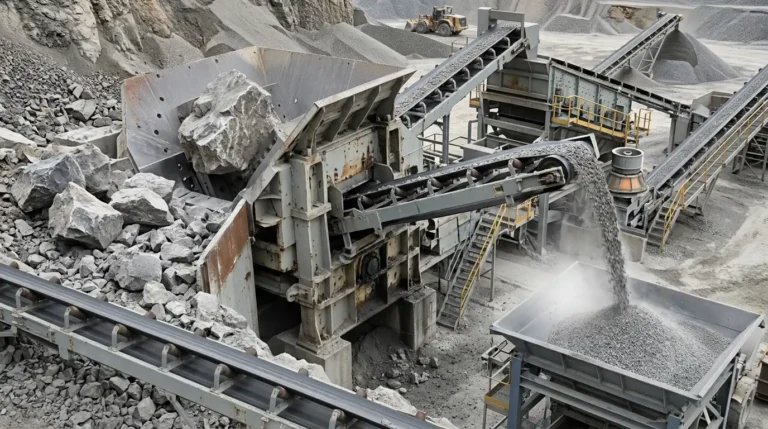
Yes, in most mineral-processing applications. A ball mill is designed for feed already reduced to a manageable size, typically by a jaw crusher or cone crusher upstream. The C Jaw Crusher is commonly used as the primary crushing stage ahead of ball mill grinding.
Is a rod mill better than a ball mill for coarse grinding?
For coarse, first-stage grinding where a uniform product with minimal fines matters, a rod mill is generally more energy-efficient than a ball mill because it avoids producing unwanted fine particles. Rod mills are typically positioned upstream of a ball mill rather than used as a replacement for it.
How long do ball mill liners last before replacement?
Liner life depends on ore hardness, moisture content, ball charge, and operating hours, so a single figure does not apply across installations. Liners specified to ASTM A532/A532M abrasion-resistant cast iron grades are selected specifically to extend service life under these variable conditions.
References & Sources
- ASTM International — E11-24 Standard Specification for Woven Wire Test Sieve Cloth and Test Sieves
- ASTM International — A532/A532M-10(2023) Standard Specification for Abrasion-Resistant Cast Irons
- U.S. Department of Energy — Energy and Environmental Profile of the U.S. Mining Industry
- Metso — Stirred Mills for Wet Grinding
- MDPI (Minerals) — Optimization of High-Pressure Grinding Roll (HPGR) Performance in an Industrial-Scale HPGR/Tower Mill Comminution Circuit
- FLSmidth — High Pressure Grinding Rolls (HPGR)