

Pendulum Mill: Working Principle, Types and Applications
Walk through any calcium carbonate or clay processing plant built in the last forty years and you’ll find at least one pendulum roller mill somewhere in the circuit. The equipment has earned its place not through novelty but through a specific combination of characteristics no other dry grinding technology quite replicates: classification built directly into the grinding chamber, simultaneous drying, and a product that comes off the separator at a tight, adjustable cut point. Yet despite a century of industrial use, the pendulum mill remains poorly documented in English compared to, say, the ball mill. What follows covers how it works, the main commercial variants, where it outperforms competing technologies, and the specification data you need to size one correctly.
What Is a Pendulum Mill?
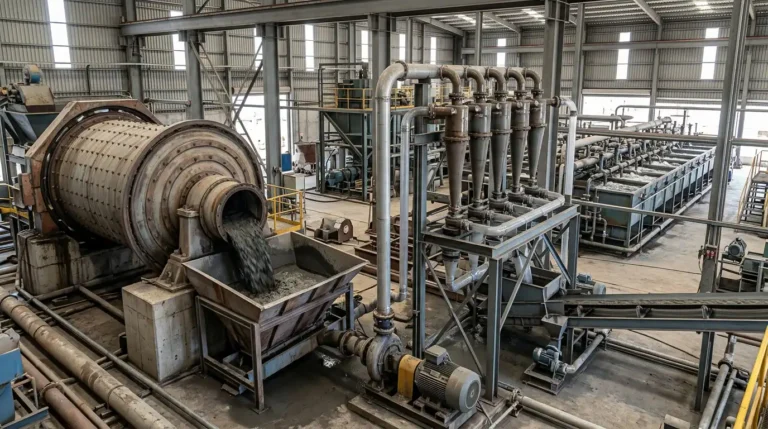
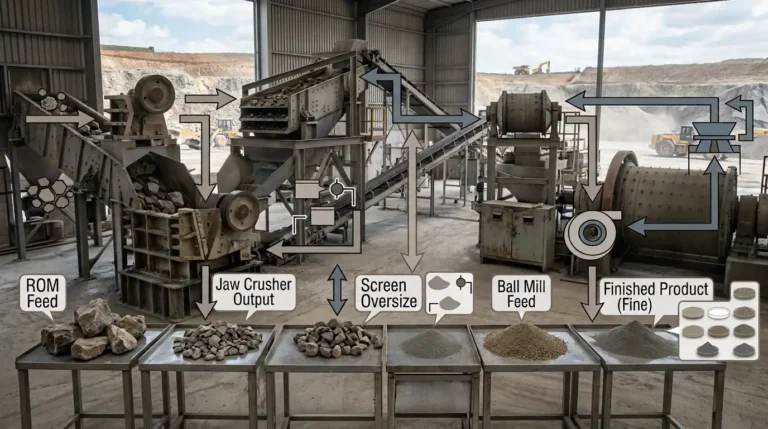
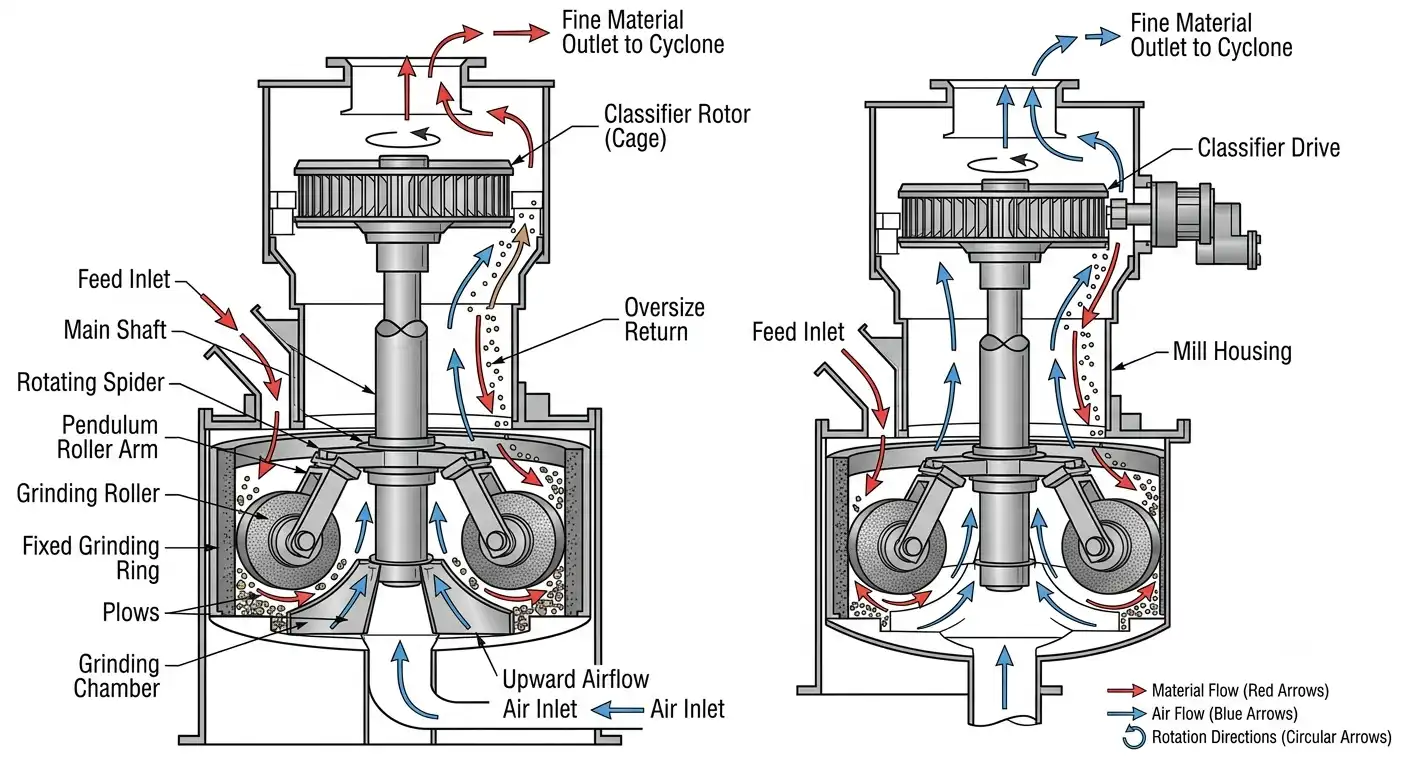
A pendulum mill — also called a Raymond mill, roller mill, or swing mill depending on the market — is a dry, closed-circuit grinding machine for non-metallic minerals and soft to medium-hard materials. Its defining feature is that grinding, pneumatic classification, and drying happen simultaneously inside one housing. Feed enters the grinding chamber where a set of roller assemblies, each suspended from a central spider frame by a pivoting arm, swings outward under centrifugal force and presses against a fixed grinding ring. The rollers crush and shear the material against that ring. An internal airflow then carries ground particles upward to a classifier, which separates fine product from oversize. The oversize falls back for regrinding; the fines exit to a cyclone, then to a bag filter.
The name “pendulum” comes directly from the roller mechanics. Each roller hangs from a pivot pin at the top of the spider and swings outward like a pendulum when the spider rotates. Higher rotational speed equals higher centrifugal force equals harder roller contact with the ring.
Raymond Brothers developed the original design in the United States during the 1920s, initially for coal pulverization. The company was acquired by CE Engineering in the 1950s, which licensed the technology widely. Today that same operating principle survives in dozens of commercial variants produced by manufacturers in Europe, North America, China, and Brazil.
Working Principle
The Grinding Cycle
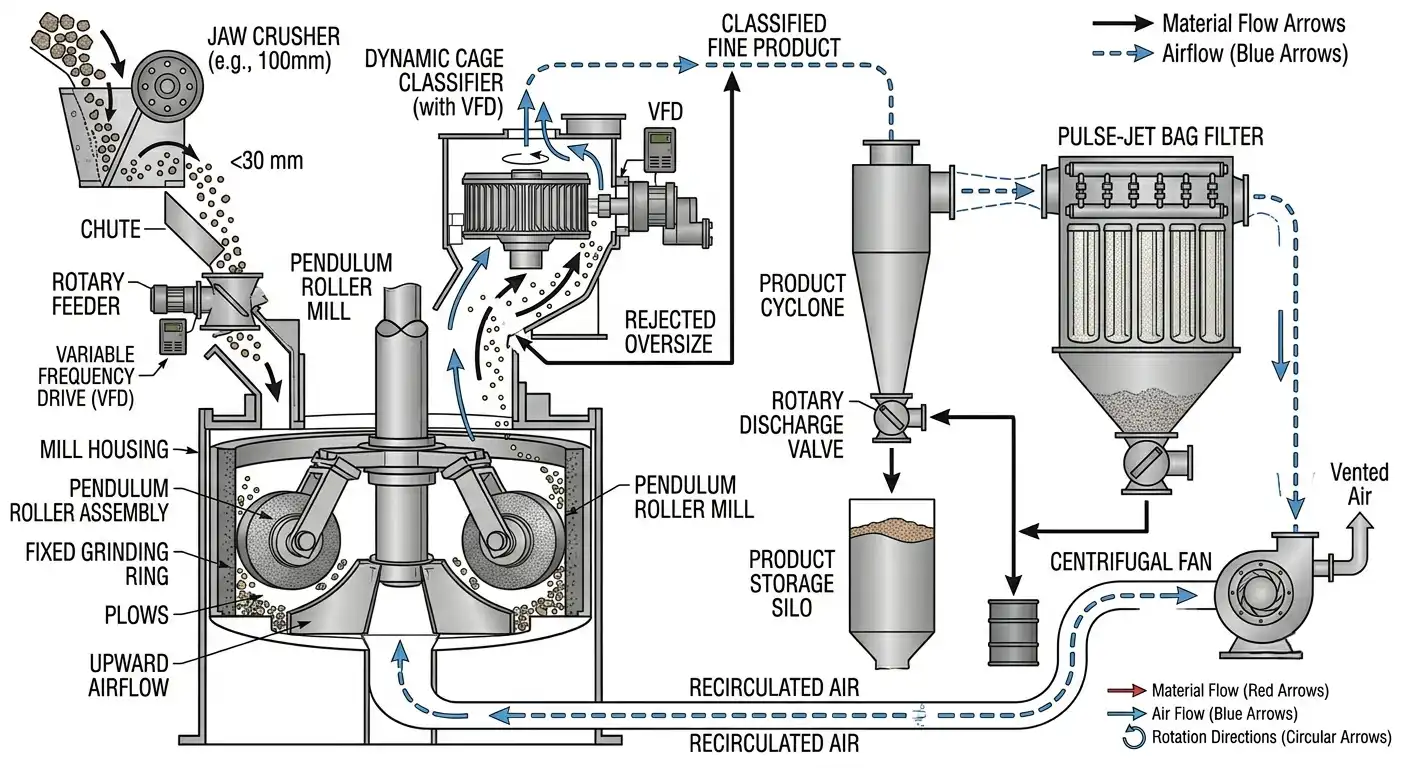
Feed material, pre-crushed to under 50 mm — though 20–30 mm is the practical limit for the rotary feeder — enters the grinding chamber through an automatic rotary feeder. A variable-frequency drive on that feeder modulates throughput in response to differential pressure across the chamber. When the mill starts running full, differential pressure rises; the VFD slows the feeder to avoid a choke. The result is a constant, dense material bed under the rollers.
Plows — sometimes called sweepers or scrapers — attached to the spider base push material continuously under the rollers. The rollers squeeze it against the ring through combined compression and shear. Typical ring diameters run from 900 mm on small units to 2,500 mm on the largest commercial models.
Pneumatic Classification
A centrifugal fan draws air upward through the chamber via tangential slots at the base of the grinding ring. The rising airstream lifts ground particles to the classifier mounted directly above the chamber. Depending on the model, that classifier is static (fixed vanes), static double-cone (two rows of fixed vanes), or dynamic (a motor-driven rotating cage).
Coarse particles are thrown to the classifier walls and fall back down the annular return channel for regrinding. Fine particles small enough to pass through travel with the airstream to the product cyclone, where they settle and discharge through a rotary valve at the bottom. The air, carrying residual ultrafine dust, then passes through a pulse-jet bag filter before venting or recirculating.
The mill operates under negative pressure throughout. No positive-pressure zone means dust does not escape to the building even with imperfect seals at the feed inlet — a significant advantage over positive-pressure hammer or impact mills.
Simultaneous Drying
For feed with up to 15–20% surface moisture, hot gas or preheated air is admitted at the chamber air inlet in place of ambient air. The turbulence inside the chamber creates near-instantaneous contact between hot gas and freshly fractured particle surfaces. Evaporation happens before the particles even reach the classifier. The process temperature at the bag filter outlet is monitored — typically held at 75–90 °C — to protect the filter medium and prevent condensation.
Above roughly 20% moisture, the heat load required per tonne of water evaporated makes a separate pre-dryer more economical.
Types of Pendulum Mills
By Number of Pendulums
The number of roller assemblies determines capacity more than any other single variable. Three-pendulum units serve small- to medium-scale operations (roughly 1–5 t/h depending on material and target fineness). Four, five, and six-pendulum configurations scale production to 30–40 t/h on the largest models. Additional rollers also reduce vibration amplitude by distributing grinding forces more evenly around the ring circumference.
By Classifier Type
Three classifier configurations appear across commercial models:
- Static classifier — fixed vanes create a spiral airflow that separates by particle mass. Product cut: 200–600 µm (mesh 30–80). Used where coarse products are acceptable and mechanical simplicity takes priority.
- Static double-cone classifier — two rows of fixed vanes in series give a sharper cut. Product range: 63–125 µm (mesh 120–230).
- Dynamic classifier — a rotating cage with a separate VFD-controlled motor. Product cut: 35–50 µm (mesh 325–400). Cut point adjustable during operation by changing cage speed.
The dynamic classifier is standard on any specification requiring product below 100 µm. Static classifiers remain common on coarser applications where capital cost and simplicity matter more than precision.
Commercial Models
Selected commercial pendulum mill configurations
| Model | Manufacturer | Ring Ø (mm) | Pendulums | Product range (µm) | Mill power (kW) |
|---|---|---|---|---|---|
| MP 3/90 | Verdés / Brasprocess | 900 | 3 | 200–600 | 37 |
| MP 6/190 | Verdés / Brasprocess | 1,900 | 6 | 35–600 | 160 |
| Molomax MS 6/230 | Manfredini & Schianchi | 2,300 | 6 | 35–600 | 315 |
| HC1700 | Guilin HongCheng | 1,700 | 5 | 38–180 | 132 |
| MTM 160 | SBM | 1,600 | 5 | 44–180 | 132 |
| Airswept Pendulum | Bradley Pulverizer | Custom | 3 | 20–300 | Custom |
Sources: Manfredini & Schianchi product catalogue (2023); Verdés technical documentation (2023); Guilin HongCheng product data sheet; Bradley Pulverizer technical brochure (2025).
The Airswept Variant
Bradley Pulverizer’s airswept pendulum mill integrates a fluidized-bed drying zone into the base of the grinding chamber, before the rollers. Feed enters that zone first, reducing surface moisture before grinding starts. This allows processing of materials at up to 25% surface moisture without a separate pre-dryer. The classifier and filtration circuit is otherwise standard. The variant is used heavily in coal, gypsum, and natural clay applications where moisture is consistently high and pre-drying capital cost is unwelcome.
Main Advantages
The pendulum mill’s commercial persistence across a century reflects genuine technical strengths.
Integrated processing in one pass. Grinding, classification, and drying share one housing and one airflow circuit. Separate dryers, external air classifiers, and inter-stage conveyors are eliminated. For a GCC plant at 150 µm, a pendulum mill circuit typically contains fewer equipment items than an equivalent ball mill circuit.
Lower specific energy. Specific energy consumption runs 30–50% lower per tonne than a comparable ball mill for products in the 44–200 µm range. Modern designs like the MGW Intelligent Raymond Mill push this advantage further through optimized airflow geometry and roller profiling. For products coarser than 100 µm, the energy gap widens.
Negative-pressure containment. No dust escapes the system envelope. For calcium carbonate, talc, and barite — all materials where fugitive dust is a health hazard and a product loss — this matters in both regulatory and economic terms.
On-the-fly product adjustment. A dynamic classifier lets the operator change cut point by adjusting cage speed, with no mechanical modification and no mill shutdown. Quarry feed with variable particle size or seasonal moisture variation can be accommodated without stopping production.
Low maintenance burden. Primary wear parts are the grinding rollers and grinding ring. On modern self-lubricating pendulum assemblies, bearing regreasing intervals run 500–800 hours. A roller and ring change on a six-pendulum unit takes two operators four to six hours. Compare that to the media charge management, liner work, and trunnion bearing service on a ball mill of equivalent throughput.
Pendulum Mill vs Other Grinding Technologies
vs. Ball Mill
The ball mill grinds harder materials (up to Mohs 9.3), achieves finer products (below 10 µm wet), and works wet or dry. It does not perform inline classification or drying. Per-tonne energy is higher for products in the 75–200 µm range, often by 40–60%. Ball mills require no feed pre-classification but need grinding media replacement and liner inspection on a fixed schedule.
For materials at or below Mohs 5 requiring products between 37 and 200 µm, the pendulum mill is nearly always the lower operating cost option per tonne.
vs. Vertical Roller Mill (VRM)
VRMs process harder materials and reach capacities above 500 t/h. Capital cost is an order of magnitude higher. They dominate cement raw meal and slag grinding. Below about 50 t/h of non-metallic mineral processing, a VRM’s capital cost rarely justifies itself over a pendulum mill.
vs. Impact / Hammer Mill
Impact mills produce coarser products (100–2,000 µm) and suit friable materials. No internal classification. Energy efficiency drops sharply below 150 µm target sizes. For products below 100 µm, the pendulum mill produces a tighter size distribution and lower specific energy.
vs. Ultrafine Mill
Below 37 µm, the standard pendulum mill hits its practical limit. Ultrafine grinding mills using ring-and-puck or stirred media mechanisms take over in that range. The two technologies sit at different ends of the fineness spectrum and complement each other in plant circuits.
Grinding technology comparison for non-metallic minerals (soft to medium-hard materials)
| Parameter | Pendulum Mill | Ball Mill | VRM | Impact Mill | Ultrafine Mill |
|---|---|---|---|---|---|
| Max. feed hardness (Mohs) | 5–6 | 9.3 | 7–8 | 4–5 | 6 |
| Typical product (µm) | 37–600 | 5–200 | 44–300 | 100–2,000 | 2–37 |
| Built-in classification | Yes | No | Yes | No | Yes |
| Simultaneous drying | Yes | No | Yes | No | No |
| Specific energy vs. ball mill | −30 to −50% | Baseline | −20 to −40% | −10 to −30% | +50 to +100% |
| Typical capacity (t/h) | 1–40 | 0.5–100 | 10–500+ | 1–30 | 0.1–10 |
Sources: Wills’ Mineral Processing Technology, 8th ed. (Elsevier, 2016); Manfredini & Schianchi comparative study (2021); Bond, F.C. “Crushing and Grinding Calculations,” British Chemical Engineering, Vol. 6 (1961).
Technical Specifications and Capacity
Feed Size and Moisture
Standard pendulum mills accept feed up to 50 mm, but most manufacturers recommend pre-crushing to 20–30 mm with a jaw crusher to protect the rotary feeder and reduce roller wear. Free moisture at the feed point should not exceed 20% for standard hot-gas configurations.
Product Fineness Range
Tyler mesh equivalents and typical product specifications
| Tyler Mesh | Approx. opening (µm) | Passing (%) | Classifier type |
|---|---|---|---|
| 30 | 595 | 80–95% | Static |
| 100 | 150 | 90–99% | Static double-cone |
| 200 | 74 | 90–99% | Dynamic |
| 325 | 44 | 95–99.9% | Dynamic |
| 400 | 37 | 90–99.9% | Dynamic |
Source: ASTM E11 standard sieve series; Brasprocess technical documentation (2023).
Bond Work Index and Capacity
Throughput scales with material grindability. The Bond Work Index (Wi) provides the standard reference.
Bond Work Index values for materials commonly ground in pendulum mills
| Material | Wi (kWh/t) | Relative capacity at 325 mesh |
|---|---|---|
| Gypsum | 6.73 | High |
| Clay | 6.30 | High |
| Barite | 4.73 | High |
| Talc | 5.50 | High |
| Calcite / GCC | 10.51 | Medium |
| Bentonite | 8.80 | Medium-high |
| Dolomite | 11.27 | Medium |
| Petroleum coke | 15.13 | Medium-low |
Source: Bond, F.C. “Crushing and Grinding Calculations,” British Chemical Engineering, Vol. 6, No. 6 (1961); CETEM, Ministério da Ciência e Tecnologia, Brazil (2004).
Real-world throughput figures appear in these published case studies: 12 t/h barite circuit, 4–5 t/h petroleum coke circuit, 7 t/h bentonite circuit, and 25–30 t/h calcium oxide circuit.
Foundation and Space Requirements
The concrete foundation must weigh a minimum of four times the combined equipment weight. A six-pendulum unit with auxiliaries (cyclone, bag filter, fan) typically needs 130–160 m² of floor area and 15–20 m of clear height. Structural steel support instead of poured concrete is not recommended by any manufacturer; the vibration isolation is markedly inferior. Foundation work frequently represents 15–25% of total installed cost on larger units — an item often missing from early capital estimates.
Industrial Applications
Ceramics and Construction Materials
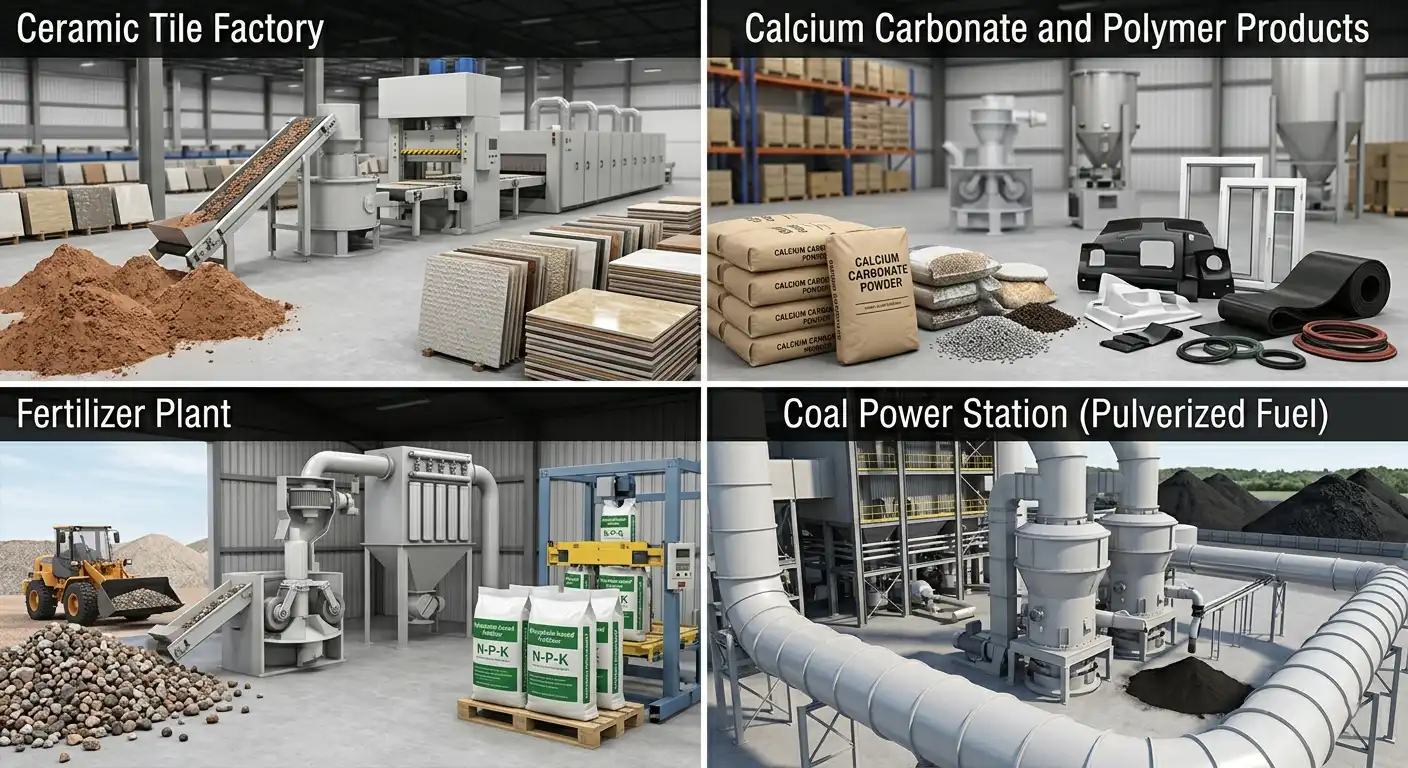
Dry-process wall and floor tile manufacturing relies on pendulum mills to grind clay blends, chamotte, feldspar, and dolomite to the 80–200 µm range needed for spray-dryer tower feed. The mill handles raw clay at up to 15% moisture without pre-drying, which simplifies plant layout and reduces capital cost.
Non-Metallic Minerals
The widest application base: GCC for plastics, rubber, and paper; talc for cosmetics and polymer compounds; bentonite for foundry bonding and drilling fluids; barite for oil-field mud weighting; kaolin for ceramics and coatings. GCC production at 150 µm has used the pendulum mill as the industry standard circuit for decades.
Chemical Industry and Fertilizers
Phosphate rock ahead of acidulation, quicklime hydration product, activated carbon, sulfur, pigments, resins, and agro-chemical carriers all appear as routine pendulum mill applications. The fertilizer grinding case at 15–26 t/h illustrates a typical circuit layout for that sector.
Energy Applications
Coal pulverization for power generation was the original application and remains active. Petroleum coke ground for kiln fuel, lignite for briquetting, and anthracite for electrode carbon production follow the same circuit arrangement.
Equipment Selection
Material Data Required
Before specifying a pendulum mill, the following data must be established:
- Mohs hardness or Bond Work Index (from lab grindability test)
- Surface and absorbed moisture at the feed point (minimum, average, maximum seasonal)
- Feed particle size distribution (d₈₀ recommended; maximum particle size hard limit)
- Target product specification: % passing at which mesh, and whether d₅₀ or d₉₀ applies
- Required throughput in dry tonnes per hour and annual operating hours
- Maximum allowable product temperature (relevant for heat-sensitive materials)
Materials above Mohs 5 cause accelerated roller and ring wear. At Mohs 6 — feldspars, some calcitic quartzites — wear rates can make operating cost per tonne prohibitive. Where hardness exceeds the pendulum mill’s comfort zone, the ball mill or ultrafine mill is the rational alternative.
Classifier Selection
If the product specification requires 90%+ passing 200 mesh (74 µm), a dynamic classifier is not optional — it’s required. Static classifiers cannot reliably hold that cut point. Over-specifying a static classifier for a fine product creates recirculation loads that destabilize differential pressure control and reduce throughput.
Common Specification Mistakes
Four mistakes appear repeatedly in pendulum mill procurement:
- Sizing the feeder for 50 mm feed without specifying a pre-crusher. Most rotary feeders perform best below 20 mm. A missing jaw crusher in the budget creates an operational problem on day one.
- Using lab moisture to represent field moisture. Outdoor stockpiles of clay or calcium carbonate can deliver material 5–8 percentage points wetter than lab samples taken in dry season.
- Sizing the bag filter for average airflow rather than peak. The filter and fan must handle the instantaneous maximum, not the average operating point.
- Excluding foundation cost from the capital budget. On a large installation, poured concrete foundation work can represent 15–25% of total installed cost.
Procurement Checklist
- Lab grindability test completed (Bond Wi or manufacturer in-house test)
- Feed moisture range confirmed for all seasons
- Product specification: % passing at target mesh, confirmed by end-use customer
- Annual operating hours and peak throughput established
- Utility data confirmed: voltage, frequency, compressed air pressure and volume
- Foundation budget allocated and geotechnical report obtained
- Spare parts stocking confirmed with manufacturer for your region
Summary
The pendulum mill occupies a precise niche in dry size reduction: soft to medium-hard materials (Mohs ≤5–6), product sizes from 37 to 600 µm, capacities from 1 to 40 t/h. Its combination of integrated classification, optional simultaneous drying, negative-pressure operation, and lower energy consumption per tonne makes it the default circuit for GCC, clay, bentonite, barite, talc, and similar non-metallics. Where feed is harder than Mohs 5–6, products must go below 37 µm, or throughputs exceed 40 t/h, then ball mills, ultrafine mills, or VRMs take over. Matching machine to material — starting with hardness and moisture — is the central task, and the most consequential data point in any selection exercise.
FAQs
What is the finest product a pendulum mill can produce?
Standard units with dynamic classifiers reach approximately 37 µm (400 Tyler mesh) at 90–99.9% passing. Some modified designs push to 15–20 µm, but at that point an ultrafine grinding mill is the more practical choice.
How does a pendulum mill dry wet feed materials?
Hot gas or preheated air from a burner is admitted at the chamber air inlet. Turbulence inside the grinding chamber drives rapid contact between hot gas and freshly fractured particle surfaces — evaporation is near-instantaneous. Materials up to 20% surface moisture are handled this way; above that threshold, a separate pre-dryer is typically more economical.
What is the difference between a pendulum mill and a Raymond mill?
They are the same machine. “Raymond mill” is the original trade name; “pendulum mill” describes the operating principle. In North American and Chinese markets the Raymond name dominates; in European and Latin American markets “pendulum mill” is the standard term.
How long do the grinding rollers and ring last?
On calcium carbonate (Mohs 3), high-chrome cast iron rollers typically last 6,000–10,000 operating hours. On harder or more abrasive materials (Mohs 4–5), expect 2,000–5,000 hours. Manufacturers offer wear parts in standard and premium alloy grades; the higher-cost premium alloys often reduce the total cost per tonne when material is moderately abrasive.
Can a pendulum mill grind petroleum coke and coal?
Yes — coal pulverization was the original application, and petroleum coke is a routine product today. The 4–5 t/h petroleum coke grinding case shows a standard circuit layout. For explosive dust materials (bituminous coal, coke), the circuit must be designed to applicable explosion protection standards (ATEX Zone 22 in Europe, NEC Class II in North America), typically including CO₂ or N₂ inerting.