

Ore Crushability and Grindability: Tests, Work Index and Equipment Sizing
What You Will Learn from This Guide
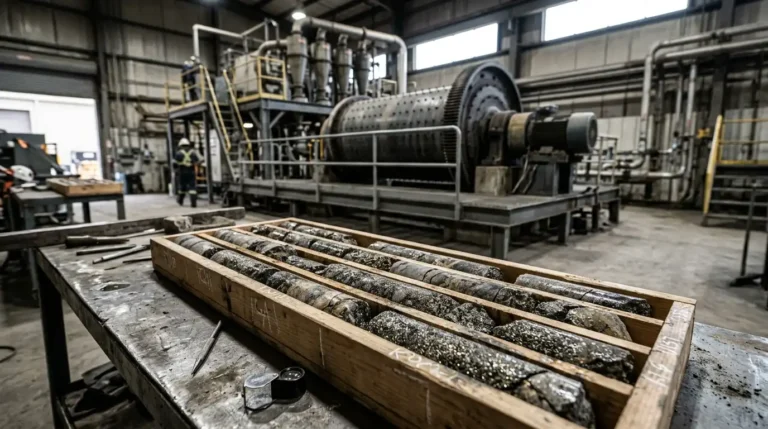
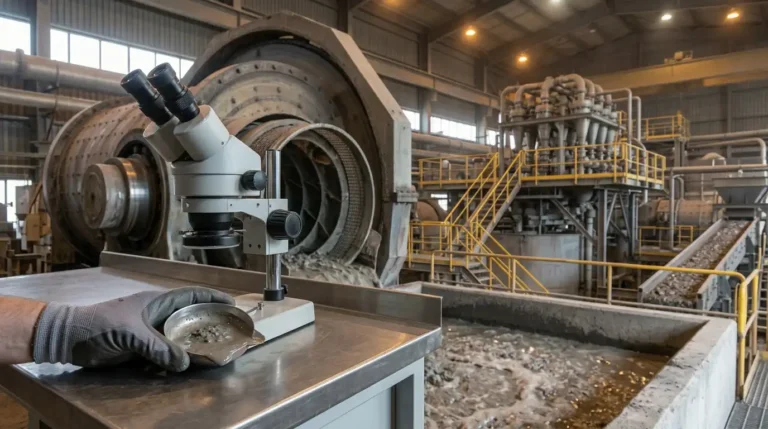
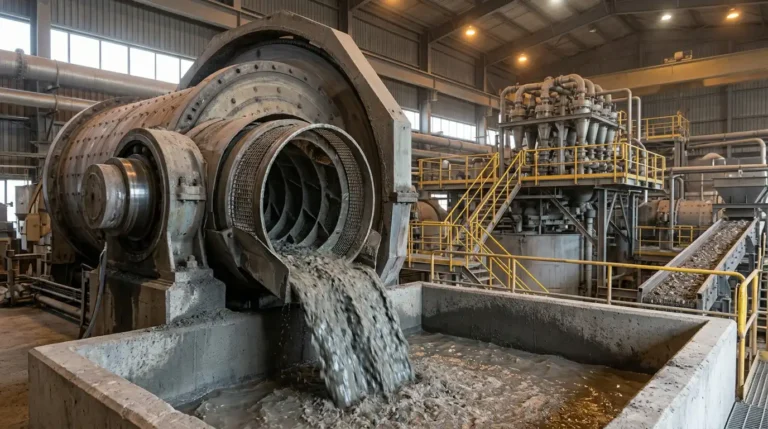
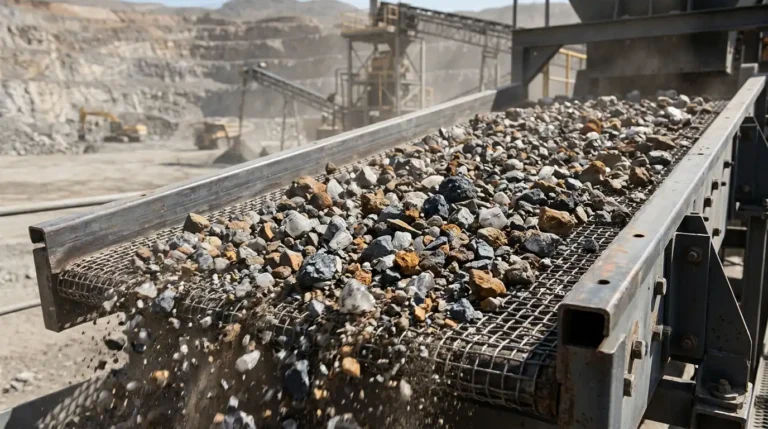
Crushability is an ore’s resistance to breakage at coarse sizes in crushers, and grindability is the energy it needs to be reduced at fine sizes in mills; the two are measured by different tests and do not always rank ores in the same order. This guide explains the main tests (UCS, Bond crushing, rod and ball mill work indices, JK drop weight A×b and the Bond abrasion index), what each number means, and how the results are used to choose and size crushers and grinding mills. It is written for engineers and buyers who must plan a test program or read a test report before you request quotations for a comminution circuit.
Crushability and Grindability Are Two Different Properties
Both terms describe how hard an ore is to break, but they apply to different size ranges and different breakage mechanisms. Crushers break large lumps, mainly by compression and impact, from run-of-mine size down to a few millimetres. Mills reduce particles from a few millimetres to the micrometre range, by many repeated impacts, abrasion and attrition. The difference between the two stages is covered in crushing vs grinding.
Because the mechanisms and sizes differ, a single “hardness” number cannot describe both. A coarse lump can contain cracks, bedding planes or clay seams that make it weak under impact, while its fine particles, free of those flaws, resist grinding. The reverse also occurs. In tests on nine samples of one copper ore, the sample with the highest A×b (the softest under impact) also had the highest operating work index in a grinding test, about 14.9 kWh/t against about 9.1 kWh/t for the easiest sample. The impact index and the grinding index were not directly correlated, and each had to be explained separately from the mineralogy.
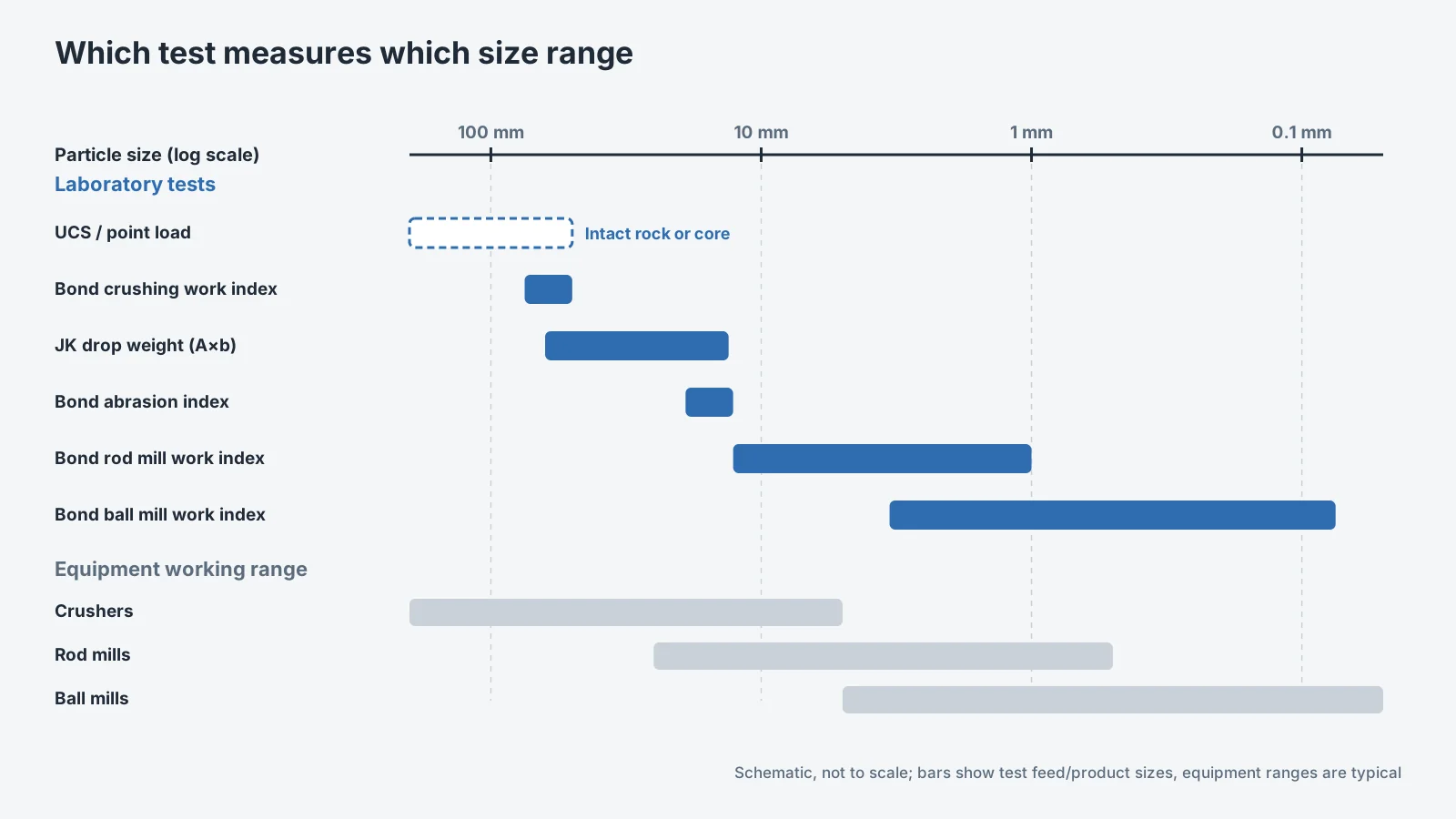
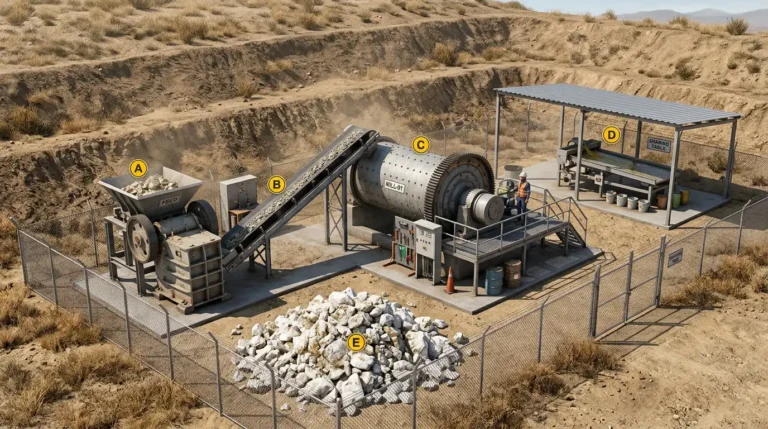
The figure shows why the tests are not interchangeable: each one works on a different size range, which matches a different machine. A crusher must be selected from coarse-size data, and a ball mill from fine-size data. Rock-strength basics for quarry materials are covered in types of rocks for crushing.
The Main Crushability and Grindability Tests
The table summarizes the tests that appear most often in comminution test reports. Example values are taken from the references and show the range of real results; they are not design values for any ore.
| Test | What it measures | Sample | Result and units | How to read it | Example values |
|---|---|---|---|---|---|
| Uniaxial compressive strength (UCS), point load index | Strength of intact rock | Core or rock specimens | MPa | Higher = stronger rock; sets crusher force and limits | Test per deposit |
| Bond crushing (impact) work index, CWi | Energy to break single lumps by pendulum impact | Lumps of about 50–75 mm | kWh/t | Higher = harder to crush; used for crusher power | Test per deposit |
| JK drop weight test, A×b | Breakage under controlled impact energy | Size classes from 63 mm down to 13.2 mm | Dimensionless | Lower A×b = more resistant to impact | 21.3–37.3 (copper ore samples) |
| Bond rod mill work index, RWi | Energy for coarse grinding | Feed crushed to −12.7 mm | kWh/t | Higher = more energy; used for rod mill sizing | Test per deposit |
| Bond ball mill work index, BWi | Energy for fine grinding | About 10 kg, crushed to −3.35 mm | kWh/t | Higher = more energy per tonne; used for ball mill sizing | 9.8 (zeolite), 17.8 (dacite), 21.1 (basalt) |
| Bond abrasion index, Ai | Wear of a hardened steel plate by the ore | 1.6 kg of 12.7–19.05 mm particles | g (mass loss) | Higher = more wear on liners, media and crusher parts | 0.006–0.770 (one copper-gold deposit) |
Example values from the references listed in References & Sources; they are not design data.
Two points help when reading a report. First, A×b runs the opposite way to the work indices: a low A×b means a hard ore, while a low work index means an easy ore. Second, abrasion is a separate property. An ore can need little energy to break and still wear liners quickly, which is why the abrasion index is reported next to the work indices and not replaced by them. Wear-part consumption is discussed further in steel ball unit consumption.
How the Bond Ball Mill Work Index Test Works
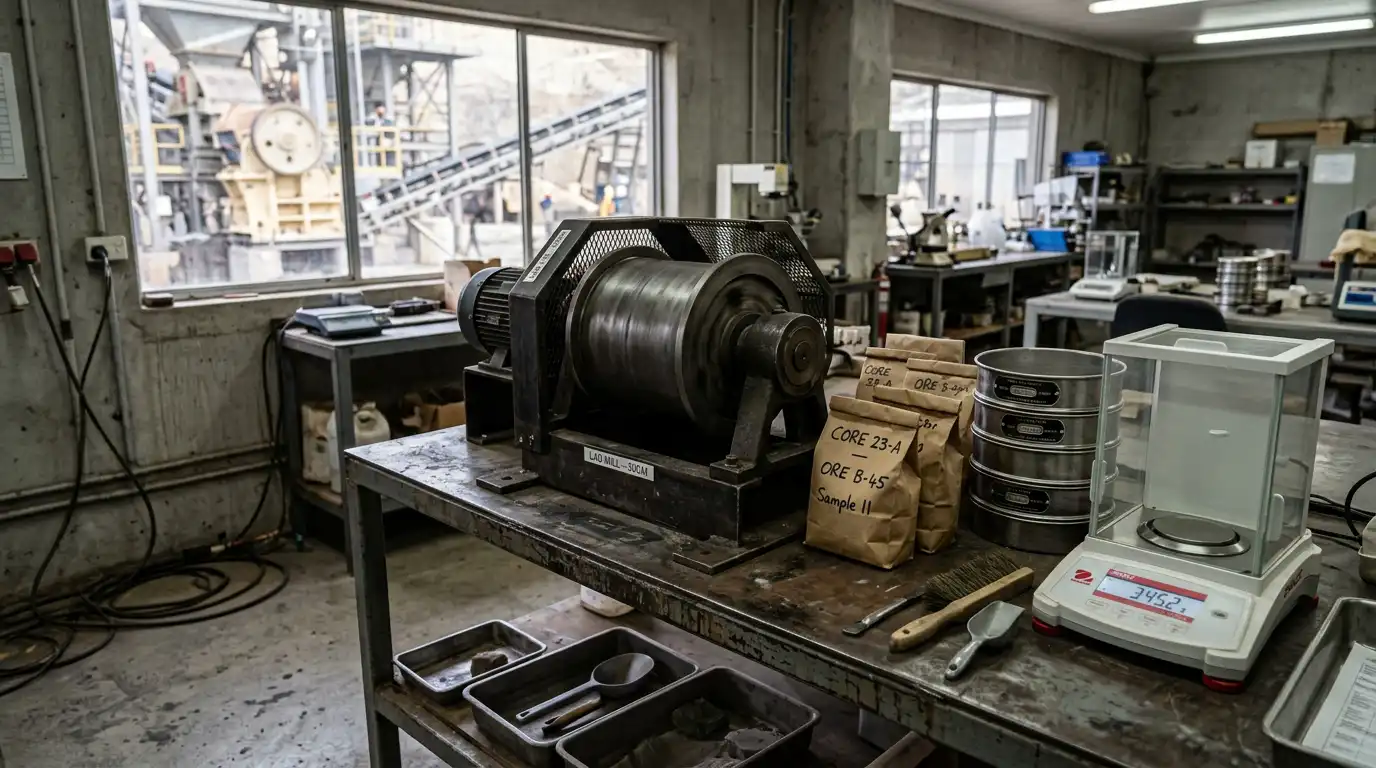
The Bond ball mill work index is the number most often used to size a ball mill, so its method and its limits are worth knowing. The test runs in a standard dry laboratory mill:
- Mill: 305 mm × 305 mm, rotating at 70 r/min, with a charge of about 20 kg of steel balls of mixed size.
- Feed: ore crushed to 100% passing 3.35 mm; a fixed volume of 700 cm³ is ground in each cycle.
- Closing screen: a test sieve chosen near the target product size of the plant (for example 75 µm or 106 µm).
- Cycles: after each cycle the undersize is removed and fresh feed is added, until the mill reaches a steady state at 250% circulating load. This normally takes 7 to 10 cycles, about 10 kg of ore and more than 8 hours.
The result is the grindability (net grams of undersize produced per mill revolution), which is converted to the work index with Bond’s equation:
Wi = 1.1 × 44.5 / [P1^0.23 × Gbp^0.82 × (10/√P80 − 10/√F80)], in kWh/t, where P1 is the closing screen size (µm), Gbp the grindability (g/rev), and P80 and F80 the 80% passing sizes of product and feed (µm).
Three conditions affect the result and should be checked in any report:
- Closing screen. The work index changes with the test sieve, so it should be measured near the plant’s target size.
- Natural fines in the feed. Friable ores contain many fines after crushing to 3.35 mm. In tests on Brazilian iron ores, work indices measured without removing these fines were on average about 35% higher than those measured on scalped samples, and over 40% higher for friable itabirites.
- Non-standard feed. When less sample is available or the feed size differs from the standard, the measured work index shifts; it rises as the feed becomes finer. Correction methods exist, but they are valid only within the conditions tested.
The test also assumes an efficient circuit. In four ball mills of a cement plant, the measured plant energy exceeded the Bond prediction by about 126% to 229%, mainly because poor classification returned fines to the mills. The work index sets the energy an efficient circuit should need; classification decides how close a plant gets to it. See open vs closed circuit.
From Test Results to Crusher and Mill Selection
Each test result supports a different equipment decision. The figure maps the main links, and the paragraphs below give examples with the crushing stages and mills involved.
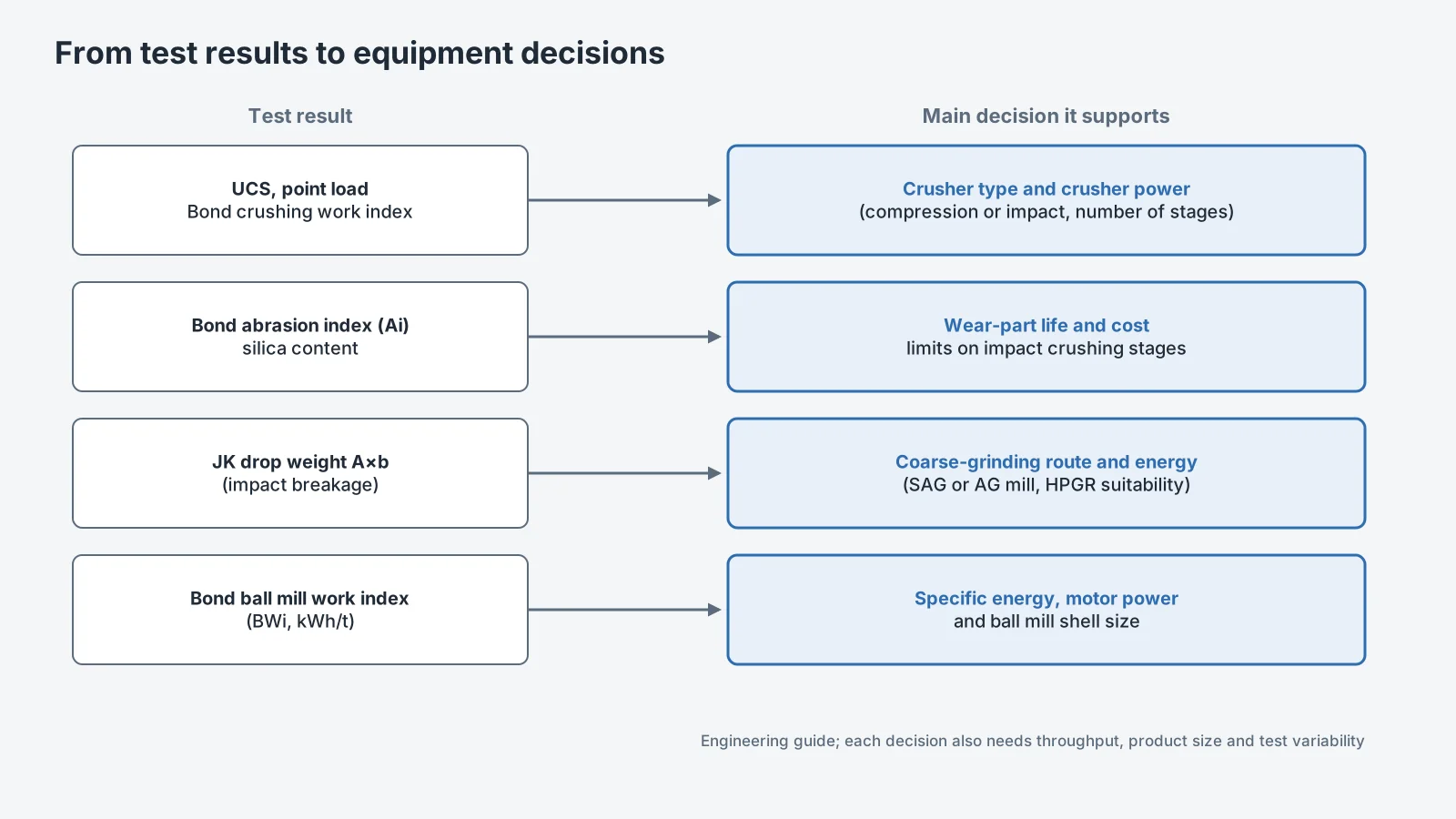
Crushers: strength and abrasion first. Compressive strength decides whether a crusher can break the rock at all and at what force. The C Jaw Crusher is rated for rock up to 320 MPa compressive strength, which covers most hard ores and aggregates in the primary stage. Abrasion decides the secondary and tertiary route. The PF Impact Crusher is intended for medium-hard and soft materials such as limestone; on hard, quartz-rich ores the wear of blow bars rises quickly, so compression crushers such as the HST Single-cylinder Hydraulic Cone Crusher are the usual choice. The crushing work index then sets the power needed for the chosen reduction ratio.
Mills: work index to power and shell size. The ball mill work index converts to specific energy with Bond’s third-theory equation, W = 10 × Wi × (1/√P80 − 1/√F80). An illustrative calculation, not a design:
| Input | Value |
|---|---|
| Ball mill work index, Wi | 15 kWh/t |
| Feed size, F80 | 2,000 µm |
| Product size, P80 | 106 µm |
| Throughput | 20 t/h |
| Specific energy, W | 11.2 kWh/t |
| Power at the mill (before efficiency factors) | about 224 kW |
Illustrative calculation with Bond’s equation, not a design for any ore.
The MQ Ball Mill datasheet lists several shells with installed motors of 245 kW, for example Ф1830×7000 mm, Ф2100×4500 mm and Ф2400×3000 mm, and larger shells above that. Which one fits depends on efficiency factors, mill speed, ball load and the circuit; the final selection should be checked by the supplier against the test report. If the work index had been 18 kWh/t instead of 15, the same duty would need 20% more power, which can move the selection up a size. Ball sizing for the selected mill is covered in the complete guide to grinding media.
Coarse grinding route. A×b and the rod mill work index matter when the circuit includes a SAG, AG or rod mill. For a crushing-plus-ball-mill circuit of the type supplied by most ball mill users, the crushing tests, Ai and the ball mill work index usually carry the decision; models and data are listed under MQ Ball Mill specifications.
Ore Variability: Why One Test Is Not Enough
A single sample rarely represents a deposit. Crushability and grindability change with rock type, alteration and weathering, and so do the grain size and texture of the minerals. Two examples show the scale of the effect:
- In a copper-gold deposit in Brazil, the Bond abrasion index of 40 samples ranged from 0.006 g to 0.770 g. Lithology averages ranged from about 0.013 g for a talc-tremolite schist to about 0.573 g for a metavolcanic rock. When the plant feed shifted toward the more abrasive rock, consumption of wear materials rose by about 7%.
- In compact itabirites, resistance to breakage increased progressively with compactness, so the same iron formation needed different crushing and grinding energy from zone to zone.
For this reason, test programs sample each ore type that will reach the plant, in proportion to the mine plan, and design for the harder end of the range with a margin. Where the variation is wide, a circuit with spare power or a second stage gives more stable throughput. Feed size control before the mill also limits the effect of hard ore on mill capacity; see what is reduction ratio.
Planning a Test Program
A practical program follows the project stage. The list below can be used to brief a laboratory and to check that the results will cover the size ranges that the equipment will handle.
- Define ore types. Split the deposit into rock types or geometallurgical domains, and plan samples from each one in proportion to the mine plan.
- Test strength and abrasion. Order UCS or point load tests on core and a Bond abrasion index (1.6 kg of 12.7–19.05 mm material per test). These guide crusher type and wear-part planning.
- Test crushing energy. Add a Bond crushing work index or a drop weight test (A×b) when crusher power or a SAG/AG route must be decided.
- Test grinding energy. Order Bond ball mill work index tests with a closing screen near the plant target size; add a rod mill test if a rod mill or a coarse ball mill feed is planned.
- Check the sample preparation. Ask the laboratory to report how fines were handled, the closing screen used and the feed F80.
- Send results with the duty. Provide throughput, feed size, target P80 and the range of results, not only the average, when you request equipment proposals.
The final stage of crushing in such a program is often decided between cone types; see single-cylinder vs multi-cylinder hydraulic cone crusher.
FAQ
Is a high Mohs hardness the same as poor grindability?
Not always. Mohs hardness describes scratch resistance of a mineral, while grindability depends on the whole rock: grain size, cracks, cementation and clay content. Mohs hardness is a better guide to abrasion than to grinding energy. Rock-level properties are compared in types of rocks for crushing.
Can the ball mill work index be used to size a crusher?
No. It is measured on −3.35 mm feed and describes fine grinding. Crushers should be sized from strength, crushing work index or drop weight data taken on coarse lumps.
Why does my plant use more energy than the Bond calculation?
The Bond figure assumes an efficient closed circuit. Poor classification, a wrong ball size, low circulating load or a feed coarser than designed all raise real energy use. Check classification first; then review the media, as in steel ball gradation design.
What is a “hard” ore in A×b terms?
A lower A×b means higher resistance to impact breakage. Laboratories use their own classification bands, so the value should be read against the laboratory’s scale and against other ores from the same district.
Which MR equipment is matched to ore hardness?
The C Jaw Crusher handles rock up to 320 MPa compressive strength; the PF Impact Crusher suits medium-hard and soft materials; and the ball mill work index and the required throughput set the size of the MQ Ball Mill.
References & Sources
The sources below support the test methods, values and plant observations in this guide. For the wider context of size reduction, see what is comminution.
- Nikolić, V. et al. (2025). Proposal of a method for calculating the Bond work index for samples with non-standard feed particle size distribution. Minerals 15(4), 358
- Gharehgheshlagh, H. H. (2016). Kinetic grinding test approach to estimate the ball mill work index. Physicochemical Problems of Mineral Processing 52(1), 342–352
- Rincon, J., Gaydardzhiev, S. & Stamenov, L. (2019). Coupling comminution indices and mineralogical features as an approach to a geometallurgical characterization of a copper ore. Minerals Engineering 130, 57–66
- Barbosa, P. A. et al. (2021). Determination of abrasiveness in copper-gold sulfide ores: a contribution to the geometallurgical model of the Sossego deposit. Minerals 11(12), 1427
- Yang, J. et al. (2025). Study on impact and abrasion resistance of minerals based on JK drop weight test and grinding test. Minerals 15(4), 407
- Ferreira, K. C. et al. (2015). Efeito do escalpe no Work Index de Bond. HOLOS 7, 59–64
- Colorado-Arango, L. et al. (2023). Grinding and classification efficiency evaluation in raw materials: cement plant study. DYNA 90(229), 148–158
- Pereira, A. S. G. et al. (2010). Caracterização dos itabiritos compactos da Serra Azul quanto à cominuição. ABM Proceedings
Related reading: crushing vs grinding.