

Cone Crusher Maintenance Plan: The Maintenance Rhythm of Lubrication, Hydraulics, and Liners
What You Will Learn from This Guide
A cone crusher’s maintenance plan is not one calendar. It is three, running at different rhythms: lubrication, hydraulics, and liners. This guide explains what belongs on each rhythm. It also explains why treating all three systems the same way misses the actual signal each one gives. It serves a maintenance planner or technician responsible for a cone crusher’s upkeep, and after reading, you will be able to build a schedule around condition and evidence rather than a blind fixed interval.
The Daily Rhythm: What Gets Checked Every Shift
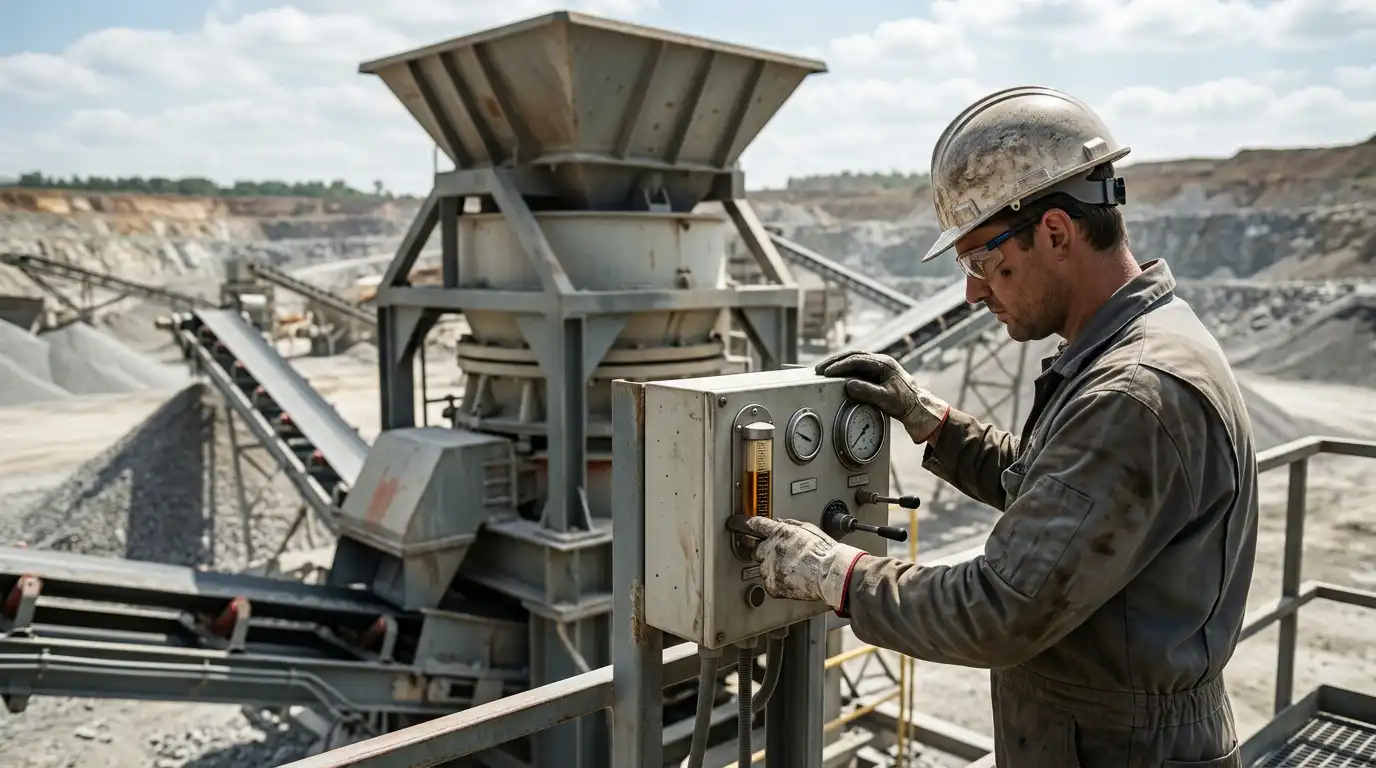
A short daily routine anchors all three systems at once. It takes roughly fifteen to twenty minutes. It catches early warning signs before they become failures. Oil level, oil pressure, and oil temperature get checked first. A reading outside the normal range is worth investigating immediately, not logging for later review.
Hydraulic pressure and visible leaks get checked next. A slow leak rarely announces itself loudly. A daily glance catches it while it is still a minor repair. Liners get a quick visual check too, alongside vibration and general noise.
This daily pass does not replace deeper inspection. It exists to catch the obvious problem before the next scheduled check would have found it anyway.
Lubrication: Monitoring vs Intervention Cadence
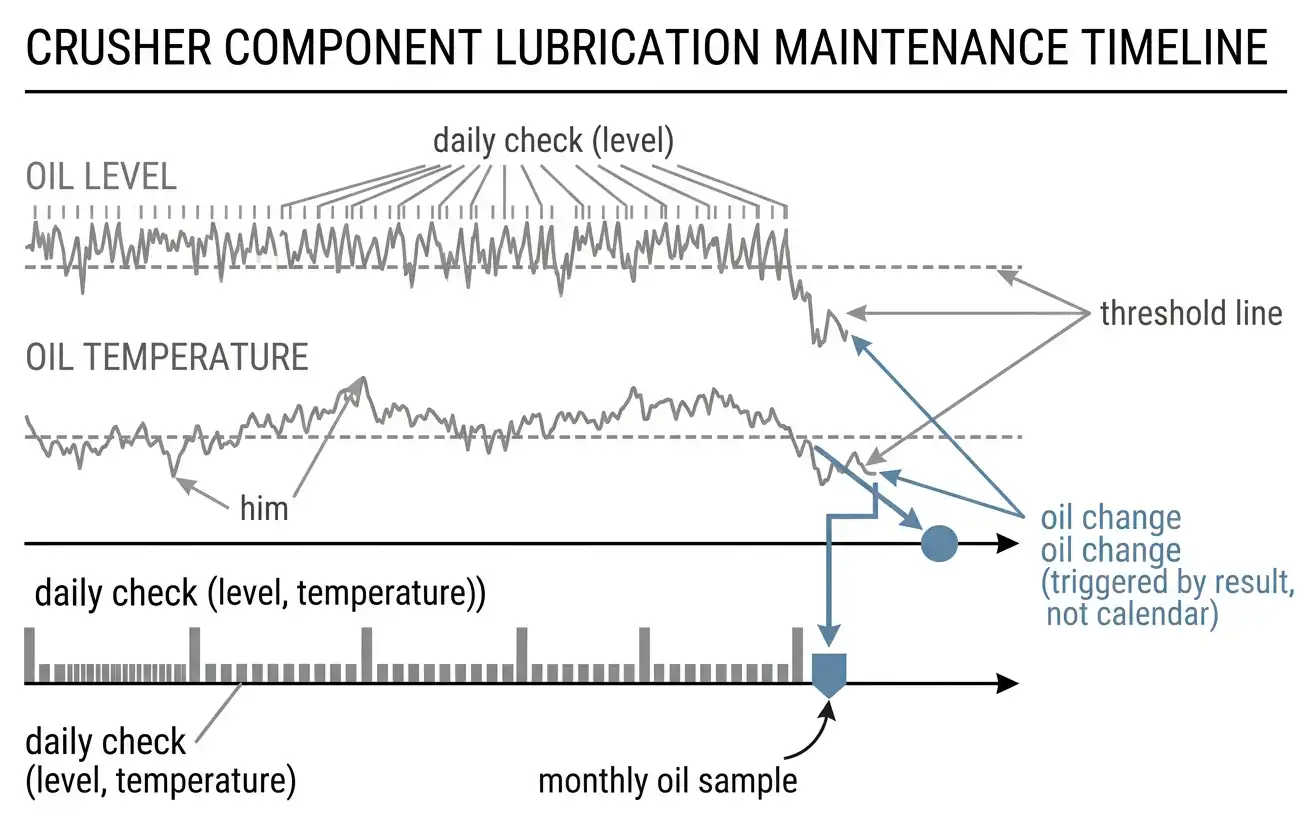
Monitoring and intervention run on different clocks. Daily checks confirm the oil is present, clean-looking, and at a normal temperature. That is monitoring, not maintenance. It tells you whether something has already gone wrong, not whether the oil itself still has useful life left.
Oil sampling answers that second question. It runs on a periodic basis, not daily. A lab report on viscosity, water content, and particle count reveals what a visual check cannot.
Elevated copper or bronze particles point to bushing wear. Iron particles point to gear or shaft wear.
The actual oil change belongs on neither clock alone. It happens when analysis shows degradation past an acceptable limit, not on a fixed calendar chosen in advance.
A blind interval wastes good oil in some cases. In others, it leaves degraded oil in service too long. The same sampling data avoids both mistakes.
Hydraulics: Fluid Cleanliness as the Central Discipline
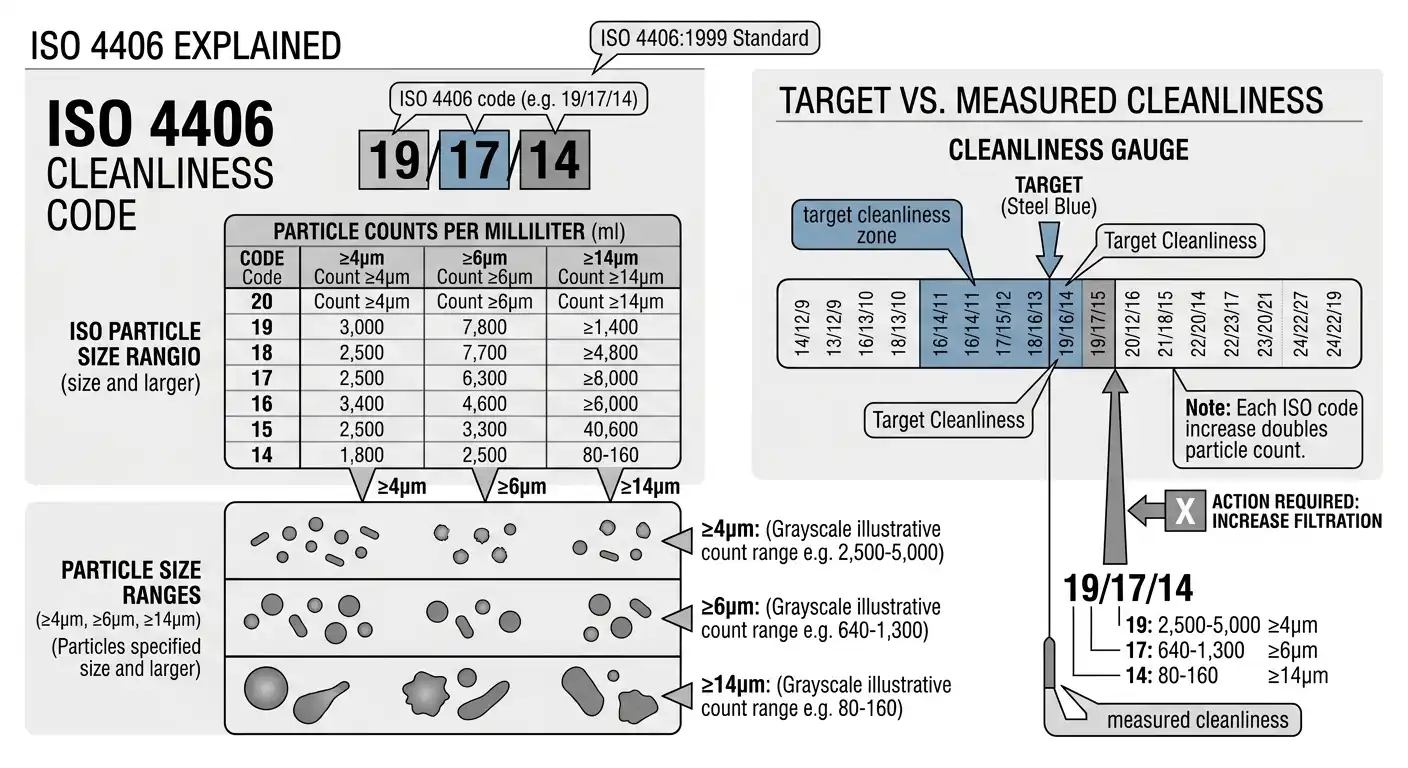
A cone crusher’s hydraulic system drives CSS adjustment and overload relief. Both jobs depend on fluid cleanliness more than almost any other single factor. ISO 4406 gives that cleanliness a standard measure. It is a three-number code reporting particle counts at three size thresholds: four, six, and fourteen microns.
Each step up in that code roughly doubles the particle count at that size. A system drifting from a clean code toward a dirtier one is not a cosmetic problem. Contaminated fluid accelerates wear on the same precision components the hydraulic system exists to protect.
Filters carry the daily weight of keeping that code where it belongs. They need their own service rhythm, separate from the fluid itself. A fixed filter-change schedule catches contamination early. A periodic fluid sample backs that schedule up, tracking whether contamination is trending the wrong way before it reaches expensive components.
Seals and accumulators sit on a longer inspection cycle. Their failure mode develops slowly but ends abruptly once a seal actually lets go.
Liners: Why Replacement Is Never a Calendar Item
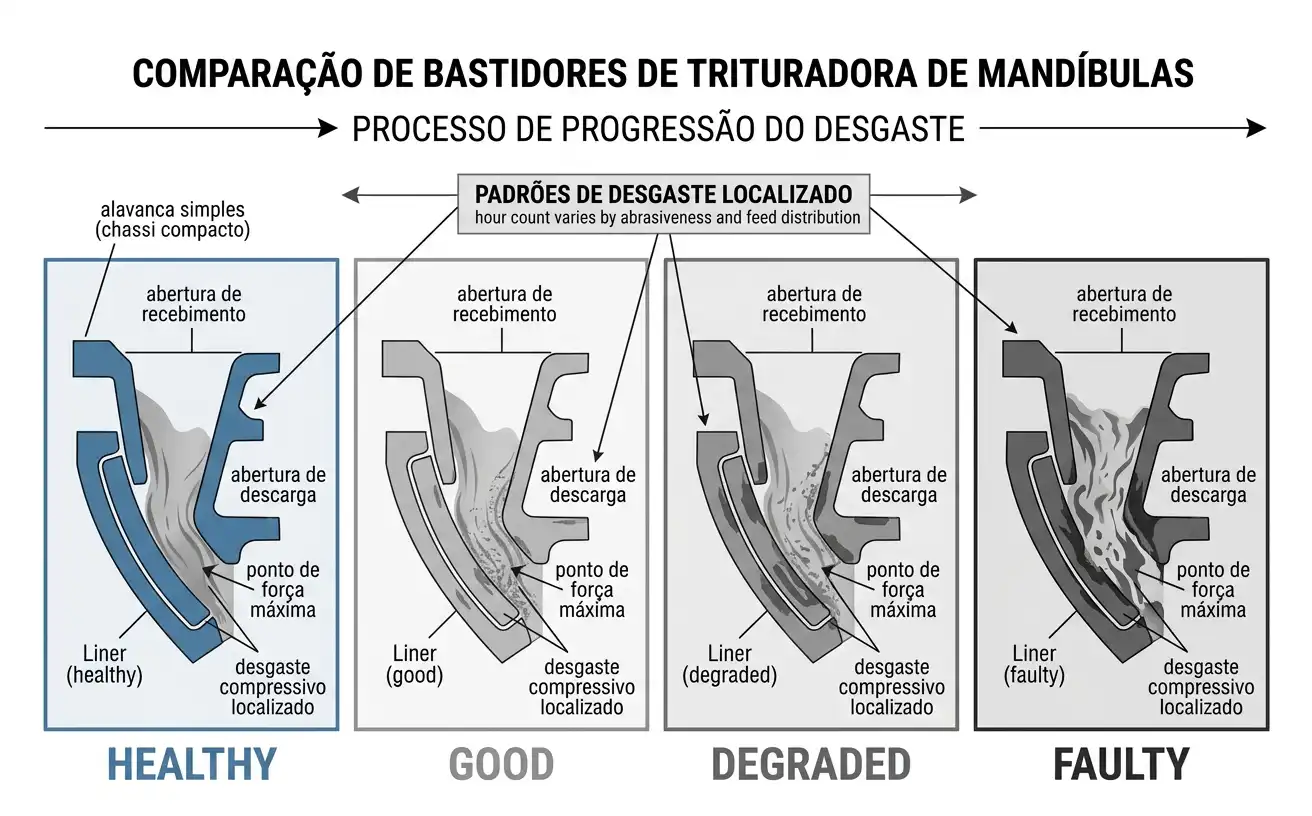
Liner wear is not linear, and it is rarely even across the liner face. Two identical crushers processing different rock can wear out liners on completely different timelines. So can the same rock fed unevenly. A replacement interval fixed in advance is a guess dressed up as a schedule.
Recent research on cone crusher liner health frames wear as a staged condition, not a single wear-out point. The stages run healthy, good, degraded, and faulty. One documented case reached a faulty state at 785 operating hours under its specific conditions. That number has no meaning outside that context.
What matters is the staging concept itself, not that specific hour count. Abrasiveness, feed distribution, and liner material all shift the actual number for any given site.
Feed distribution deserves particular attention here. It connects directly to a cone crusher’s operating discipline. Uneven feed produces uneven wear, showing up as a liner that fails on one side of the chamber while the rest still has useful life.
CSS drift is the other signal worth tracking. A widening CSS on an unadjusted machine is often liner wear making itself visible before a visual inspection would have caught it.
How the Three Systems Signal Each Other
These three rhythms are not independent of each other in practice. A bearing beginning to fail can show up in several places at once. Oil analysis shows rising metal particle counts. Vibration readings show an abnormal signature.
Liner wear shows an uneven pattern. All three trace back to the same underlying problem.
Reading only one signal in isolation risks misdiagnosing the cause. Rising vibration alone might look like a liner problem. Oil analysis would have pointed straight at bearing wear instead. A maintenance plan that checks all three systems on their own rhythm catches this kind of cross-system signal faster than any single check would.
A Practical Maintenance Cadence Checklist
- Daily: oil level, oil pressure, oil temperature, hydraulic pressure, visible leaks, liner visual check, vibration and noise.
- Periodic (weekly to monthly, tuned to operating hours): oil sample analysis, hydraulic fluid sample and ISO 4406 code check, liner wear measurement, CSS verification.
- Condition-triggered, not calendar-fixed: oil change, hydraulic fluid change, liner replacement, bearing or bushing replacement.
- Longer cycle: seal and accumulator inspection, structural and frame inspection, full comprehensive shutdown review.
Consequences of Getting the Rhythm Wrong
A fixed calendar applied to all three systems either wastes resources or misses failures, sometimes both at once. Changing oil on a blind schedule, while skipping sample analysis, can mean replacing oil that still had useful life. Meanwhile a bearing can quietly wear out between calendar-based checks and go undetected until it fails outright.
The cost compounds downstream. A liner can fail unevenly because feed distribution was never checked. A hydraulic system can degrade because fluid cleanliness was never sampled. Both turn a preventable, scheduled repair into an unplanned shutdown.
Frequently Asked Questions
Why shouldn’t oil changes happen on a fixed calendar?
A fixed interval wastes oil that still has useful life in some cases, and leaves degraded oil in service too long in others. Oil sample analysis reveals viscosity, water content, and particle counts that show actual condition. That lets the change happen when it is actually needed.
What does the ISO 4406 code actually measure?
ISO 4406 reports hydraulic fluid cleanliness as a three-number code. It counts particles at four, six, and fourteen micron size thresholds. Each step up in the code roughly doubles the particle count at that size. This gives a standard way to track whether fluid cleanliness is trending toward or away from target.
Why can’t liner replacement be scheduled on a fixed number of hours?
Liner wear rate depends on rock abrasiveness, feed distribution, and liner material. All three vary by site and even by shift. A fixed hour count that works for one crusher can be badly wrong for another. Condition-based staging checks actual wear instead of assuming a number, which makes it a more reliable trigger.
How do the three maintenance systems relate to each other?
A single underlying problem, like a failing bearing, can show up across all three systems at once. It appears as rising metal particles in oil analysis, an abnormal vibration signature, and uneven liner wear. Checking each system on its own rhythm, rather than relying on just one signal, catches cross-system problems faster and more reliably.
References and Sources
- ISO 4406:2021 — Hydraulic Fluid Power: Fluids — Method for Coding the Level of Contamination by Solid Particles
- U.S. Patent 6,702,729 — Centrifugal Cleaner for Industrial Lubricants
- MDPI (Sensors) — Optimization of Moving Cone Liner Dynamics and Health Status Prediction for Cone Crushers
- U.S. Patent 6,129,297 — Cone Crusher with Wear Indicator