

Single Toggle vs Double Toggle Jaw Crusher: Motion Trajectory, Efficiency, and Wear
What You Will Learn from This Guide
Single toggle and double toggle describe two different ways a jaw crusher’s swing jaw is driven. The difference goes deeper than mechanism complexity. It changes the actual path the jaw follows, which changes throughput, wear, and machine size for a given capacity. This guide explains both mechanisms, traces out how their motion paths differ, and connects that difference to the efficiency and wear outcomes each design produces. It serves an engineer or buyer comparing jaw crusher types at a fundamental level, and after reading, you will understand why modern production is dominated by single toggle designs even though double toggle still has a real place in certain applications.
How Each Mechanism Works
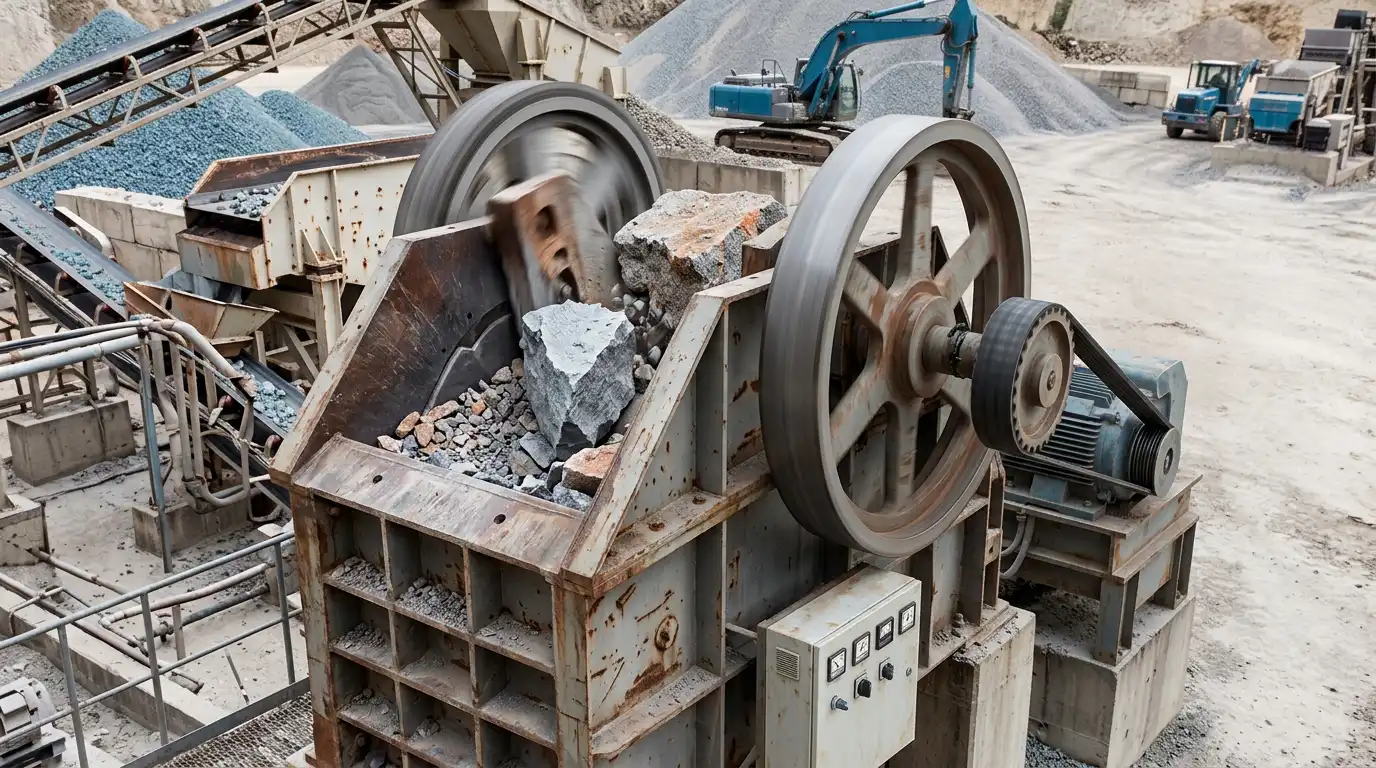
A single toggle jaw crusher mounts the eccentric shaft directly at the top of the swing jaw. The eccentric drives the jaw itself. A single inclined toggle plate connects the bottom of the swing jaw to the frame. This is a simple, direct mechanical path: eccentric shaft, swing jaw, one toggle plate.
A double toggle jaw crusher, the original Blake design dating to 1857, works differently. The swing jaw hangs from a fixed pivot at the top, on a large bushing and pin assembly. An eccentric shaft drives a pitman, and the pitman connects to two toggle plates in series, which push and pull the swing jaw. The swing jaw itself is never directly driven by the eccentric.
This structural difference is the root of everything else in this comparison. A single toggle jaw is driven directly. A double toggle jaw is driven indirectly, through a force-transmitting linkage.
Motion Trajectory: Elliptical vs Near-Pure Arc
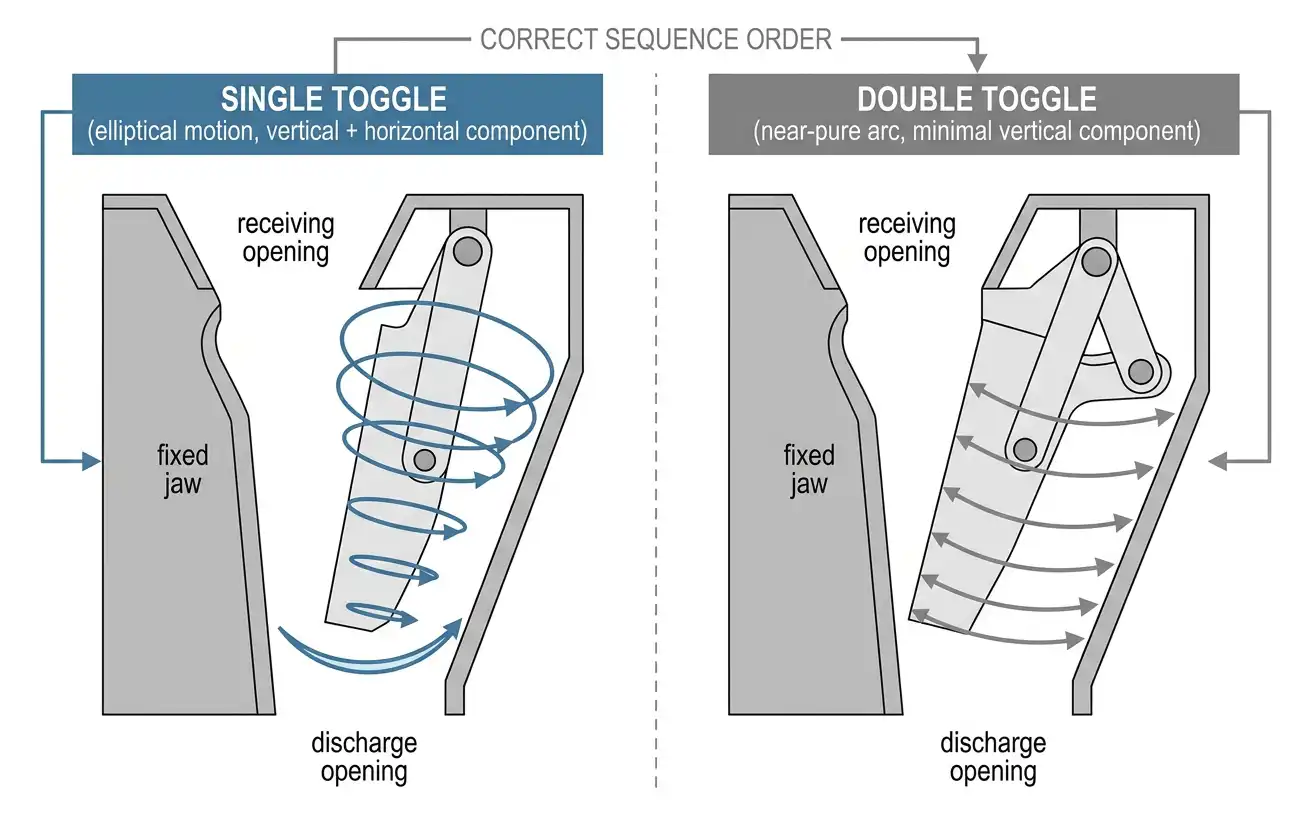
A single toggle jaw’s motion combines two things happening at once. The eccentric shaft at the top moves in a circle. The inclined toggle plate at the bottom adds a rocking action.
At the receiving opening, this combination traces an elliptical path. At the discharge opening, it narrows to a thin crescent shape, tilted upward toward the fixed jaw.
That means every point along a single toggle jaw’s face has both a vertical and a horizontal component of motion, not just a horizontal squeeze. The jaw is simultaneously compressing material and sliding against it.
A double toggle jaw’s motion stays much closer to a pure arc. The jaw swings from a fixed top pivot, rather than being driven directly by the eccentric. The vertical component present throughout a single toggle’s stroke is largely absent here. The jaw moves toward and away from the fixed jaw in something closer to a straight swinging path.
Efficiency: Throughput and Power
The vertical, rubbing component in a single toggle’s motion is not just a wear mechanism. It also helps advance material down through the chamber, since the jaw does more than squeeze at each cycle. This self-advancing effect is a real part of why single toggle crushers generally reach higher throughput for a given chamber size.
That throughput advantage comes with a power cost. The more complex elliptical motion generally draws more power per ton processed than a double toggle’s simpler arc motion. The mechanism does mechanical work in two directions at once, rather than one.
Double toggle crushers trade throughput for a more efficient use of applied force. The double toggle linkage acts as a force-multiplying mechanism. A double toggle crusher applies substantial crushing force through a comparatively small eccentric shaft and motor. The cost is processing less material per cycle than a single toggle machine of similar chamber size.
Wear: Jaw Liners and Bearings
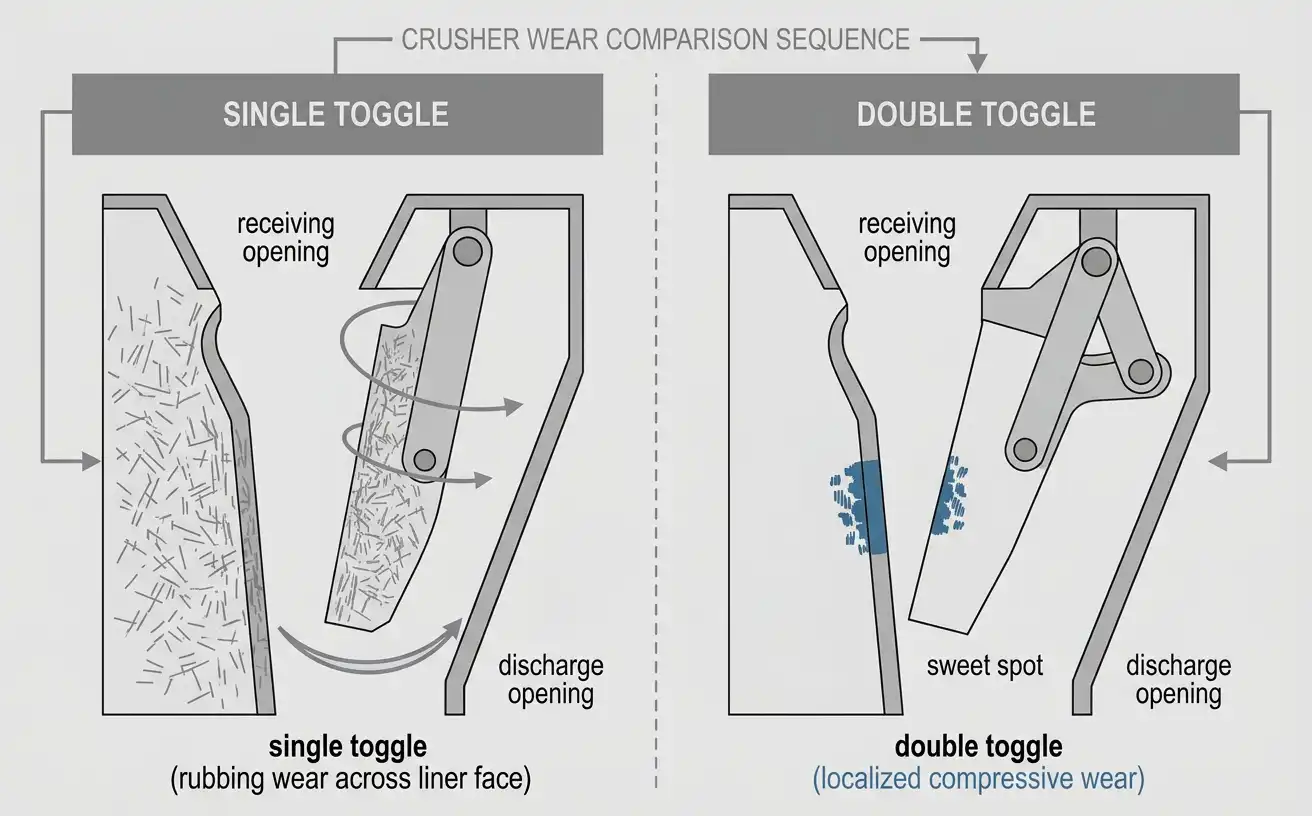
Wear shows up in two different places on these two designs, not just one. On the jaw liners themselves, the vertical rubbing component of single toggle motion directly accelerates wear. The jaw scrubs against material as well as compressing it. A double toggle jaw’s closer-to-linear motion produces comparatively less liner wear for the same duty.
The second wear location is less obvious: the eccentric shaft bearings. In a single toggle design, the full crushing force passes directly through the eccentric shaft bearings, since the eccentric is what drives the jaw. A double toggle design works differently. Its toggle linkage acts as a force-magnifying mechanism.
Roughly a fifth to a sixth of the crushing force reaches the eccentric shaft bearings in a double toggle machine. A single toggle machine’s bearings carry the larger share, under comparable crushing force. Bearing life in a double toggle crusher is correspondingly longer.
This is why double toggle crushers have a long history in highly abrasive, very hard rock applications specifically. Both major wear points, the liners and the bearings, favor the double toggle design when abrasiveness is the dominant cost driver rather than throughput.
Size and Cost for Equivalent Capacity
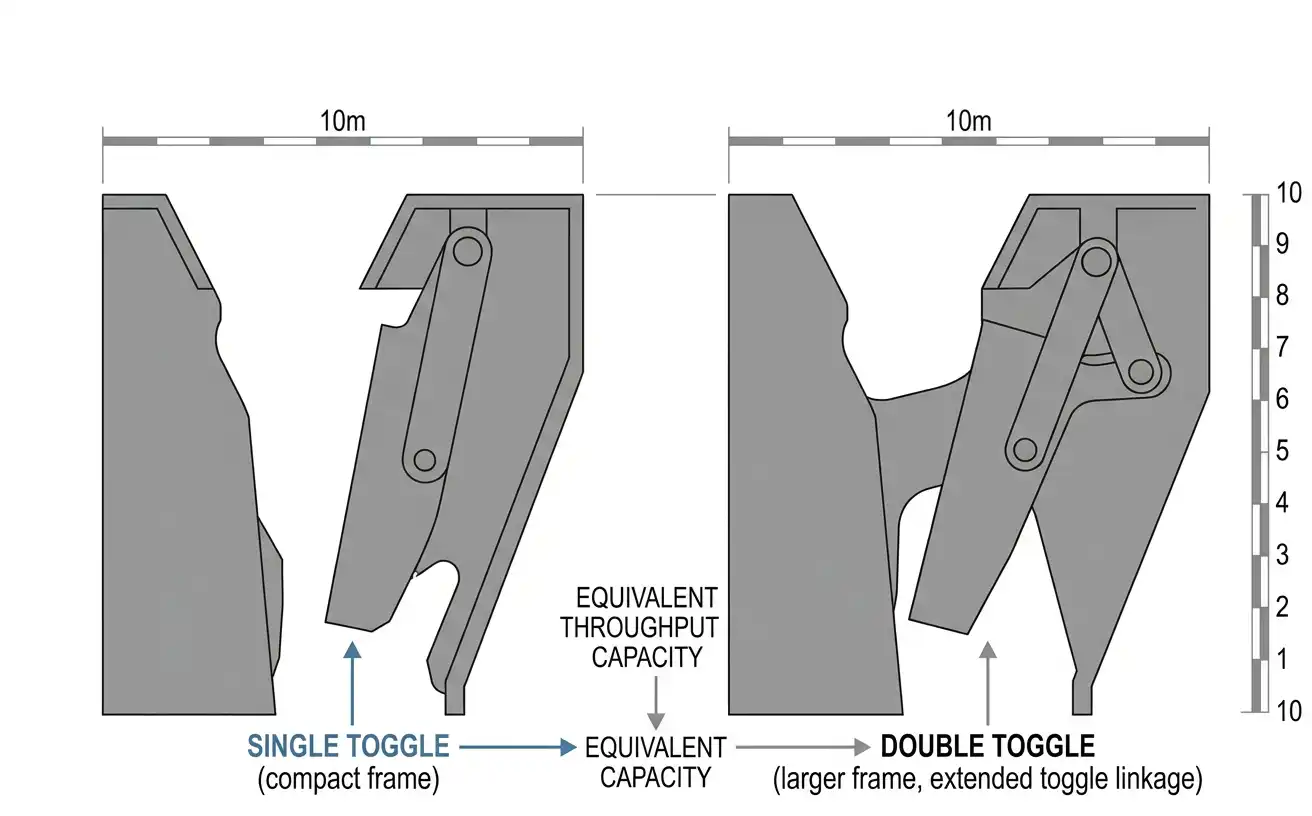
A double toggle crusher is physically larger than a single toggle machine of equivalent capacity. The toggle linkage itself takes up space. The size-adjusting mechanism has to be oriented around that linkage, rather than fitting into a compact frame the way a single toggle design allows.
This size difference translates into cost. A double toggle crusher built to match a single toggle machine’s throughput ends up heavier and more expensive to manufacture. Its individual mechanism has a certain structural elegance to the force-multiplying toggle arrangement, but that elegance doesn’t offset the size penalty. This cost gap is a major reason single toggle designs dominate current production for general-purpose crushing.
Selecting Between the Two
Material abrasiveness is the clearest deciding factor. Highly abrasive, very hard rock is the case where liner and bearing wear cost dominates the total cost of operation. That case still favors a double toggle design in some operations, despite its lower throughput and higher upfront size and cost.
General-purpose quarrying and aggregate production favors single toggle designs instead. There, throughput and capital cost per ton of capacity matter more than maximizing wear life on the most abrasive rock available. This is the reasoning behind why single toggle mechanisms now dominate most jaw crusher product lines, including standard modern PE, PEW, and C Series machines.
Applications by Material and Industry
Single toggle crushers handle the bulk of general aggregate production. Granite, basalt, limestone, and construction and demolition recycling all fit this pattern. High throughput at a manageable size and cost outweighs the wear cost of the elliptical motion.
Double toggle crushers still appear in mining operations processing extremely hard, abrasive ore. There, the cost of frequent liner and bearing replacement on a high-throughput single toggle machine would exceed the throughput loss of a double toggle design.
Frequently Asked Questions
What is the fundamental difference between single toggle and double toggle jaw crushers?
A single toggle crusher’s eccentric shaft drives the swing jaw directly, with one toggle plate at the bottom. A double toggle crusher’s swing jaw hangs from a fixed pivot and is driven indirectly through a pitman connected to two toggle plates in series. This structural difference produces two genuinely different motion paths.
Why does a single toggle jaw crusher wear faster than a double toggle one?
A single toggle jaw’s motion combines vertical and horizontal components at every point in the chamber. The jaw rubs against material as well as compressing it. A double toggle jaw’s motion stays closer to a pure arc, with little vertical rubbing component, producing less liner wear for comparable duty.
Why do double toggle crushers have longer bearing life?
The double toggle linkage acts as a force-multiplying mechanism. Roughly a fifth to a sixth of the crushing force reaches the eccentric shaft bearings in a double toggle machine. A single toggle machine’s bearings carry the larger share under comparable crushing force. Lower force means longer bearing life.
Why do single toggle crushers dominate modern production despite wearing faster?
Single toggle crushers are smaller, lighter, and less expensive to manufacture for a given throughput. Their rubbing motion actually helps advance material through the chamber, increasing capacity. For general-purpose crushing, throughput and cost per ton matter more than maximizing wear life, and that trade-off favors single toggle designs.