

Raymond Mill Grinding Roller Bearing: Greasing Cycle and Temperature Monitoring
What You Will Learn from This Guide
The grinding roller bearing on a Raymond mill runs hotter and harder than most plant bearings, and grease life there depends on temperature more than on any fixed calendar interval. This guide explains what sets the greasing interval for this specific bearing, why temperature monitoring matters more here than elsewhere in the mill, and how to recognize under- and over-greasing before they cause a failure. It serves a maintenance technician or reliability engineer responsible for a Raymond mill, and after reading, you will be able to set a greasing schedule based on actual operating conditions rather than a generic time-based habit.
Where This Bearing Sits in the Mill
The grinding roller does not just swing outward under centrifugal force. It also spins on its own axis, driven by friction contact against the grinding ring. That spinning motion happens on a bearing at the roller’s own axle, separate from the main shaft bearing that supports the central rotating spider.
This distinction matters for lubrication. A mill’s main shaft bearing typically sits inside a centralized oil circuit, since it stays in a fixed position relative to the housing. The roller bearing sits at the end of a swinging pendulum arm, which makes a plumbed oil line impractical. Grease lubrication, applied through a nipple or automatic system, is the practical solution for a bearing in this location.
What Sets the Greasing Interval
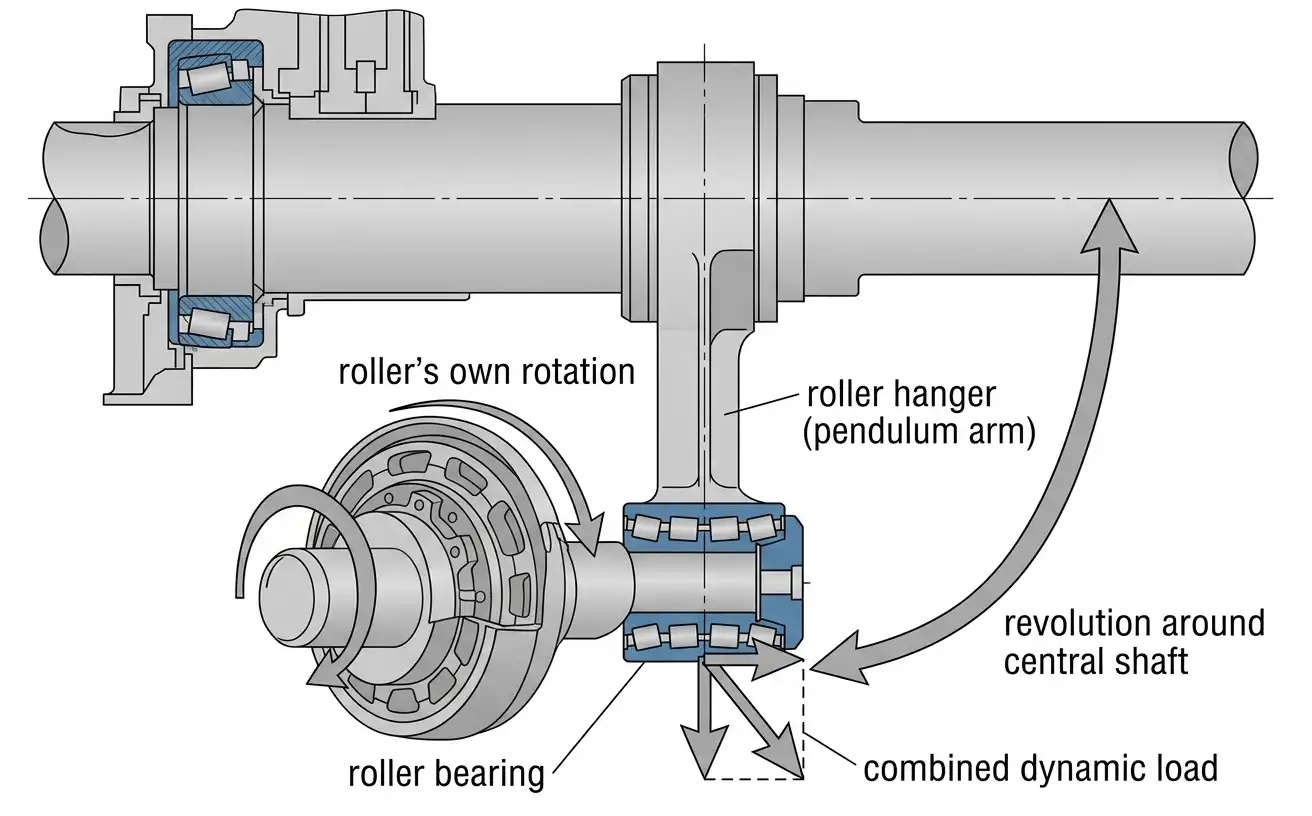
The roller bearing experiences two motions at once. It rotates around its own axle, and that axle also revolves around the central shaft as the spider turns. This combined loading pattern is harsher than a simple rotating shaft bearing in a stationary machine.
Rolling bearing grease life is commonly estimated from a bearing’s speed factor, calculated as rotational speed multiplied by the bearing’s mean diameter. Higher speed factors call for shorter intervals and, past a certain point, greases formulated specifically for high-speed service.
Bearing type matters too. Cylindrical roller bearings typically need roughly twice the regreasing frequency of an equivalent ball bearing. Spherical roller bearings need it even more often, since higher sliding contact generates more heat at the same load and speed.
Grease consistency matters as much as the interval itself. Grease is graded on the NLGI scale, from 000 (nearly fluid) to 6 (solid). NLGI 2 is the general-purpose default for most industrial bearings.
A bearing exposed to sustained heat, like a grinding roller bearing, often calls for something else. It needs a grease specifically formulated for high-temperature service, not just a standard-grade product selected on consistency alone.
Why Temperature Drives Everything
Grease does not fail by simply running out. It fails by aging: the base oil oxidizes, the thickener breaks down mechanically, and the oil-release rate that keeps rolling contacts lubricated drops. Temperature is the strongest accelerant of that aging process.
A widely used engineering rule of thumb holds that grease life roughly halves for every 10 to 15°C rise above a reference temperature near 70°C. A bearing running at 100°C can have an effective grease life a fraction of what the same bearing would show at 70°C.
This is not a linear relationship. It steepens further as temperature climbs. That is why a fixed greasing interval, set once and never revisited, becomes wrong as soon as operating temperature shifts.
A grinding roller bearing runs warmer than most plant bearings, almost by design. It sits close to the friction and impact zone where the roller contacts the ring. Treating it with the same calendar-based interval used for a cool, lightly loaded bearing elsewhere in the plant systematically under-greases it.
Monitoring Temperature in Practice
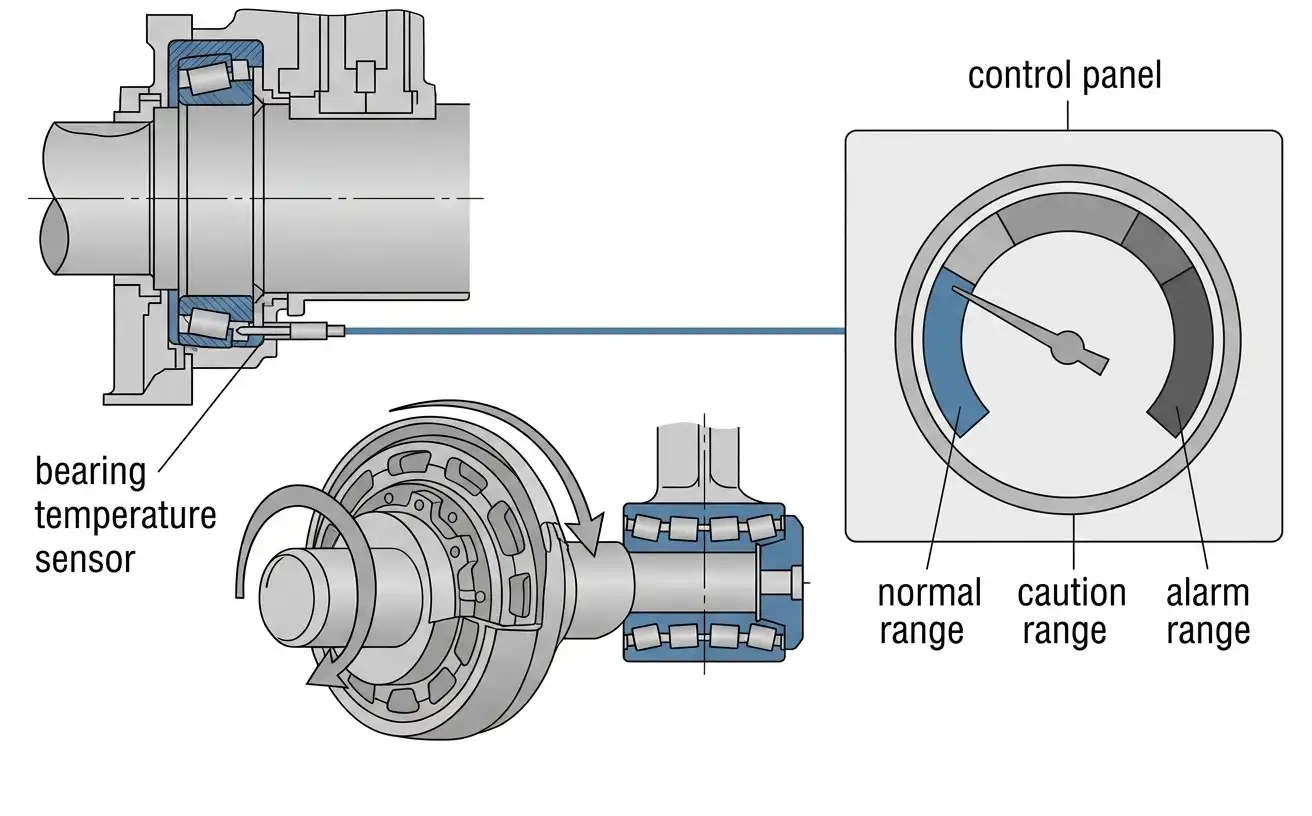
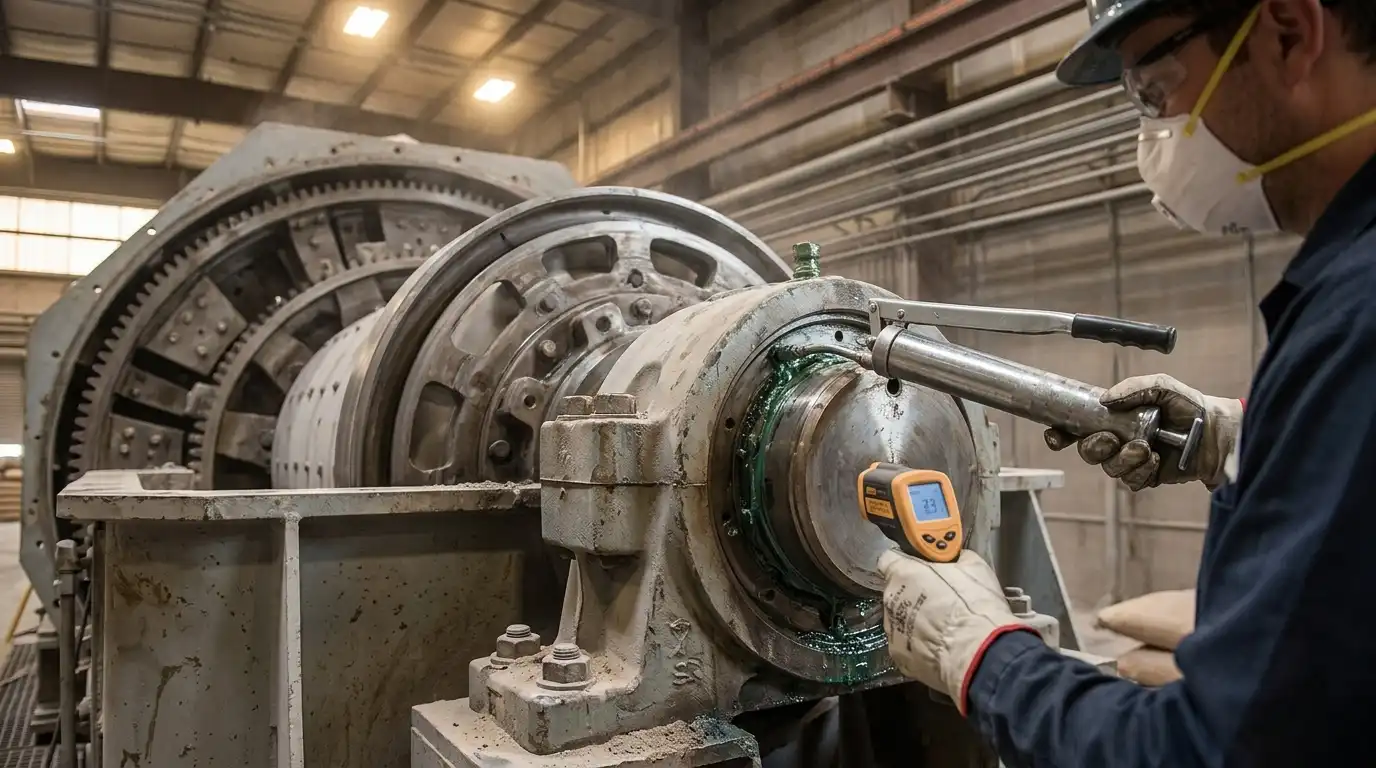
Temperature monitoring turns a guess into a measurement. A sensor at the bearing housing feeds a real-time reading to the mill’s control system. This replaces a fixed regreasing calendar with a schedule that responds to actual operating conditions. This fits naturally into the same current-and-vibration monitoring loop that governs feed rate on a well-specified Raymond mill system.
Setting alarm thresholds requires a baseline first. A bearing’s normal running temperature under stable load establishes the reference point. A rise of even 10 to 15°C above that baseline is the signal to investigate, not wait for a scheduled inspection.
A sudden temperature spike, rather than a gradual rise, points toward a different problem. Contamination, a failed seal, or actual mechanical damage is more likely than simple grease aging.
Recognizing Under- and Over-Greasing
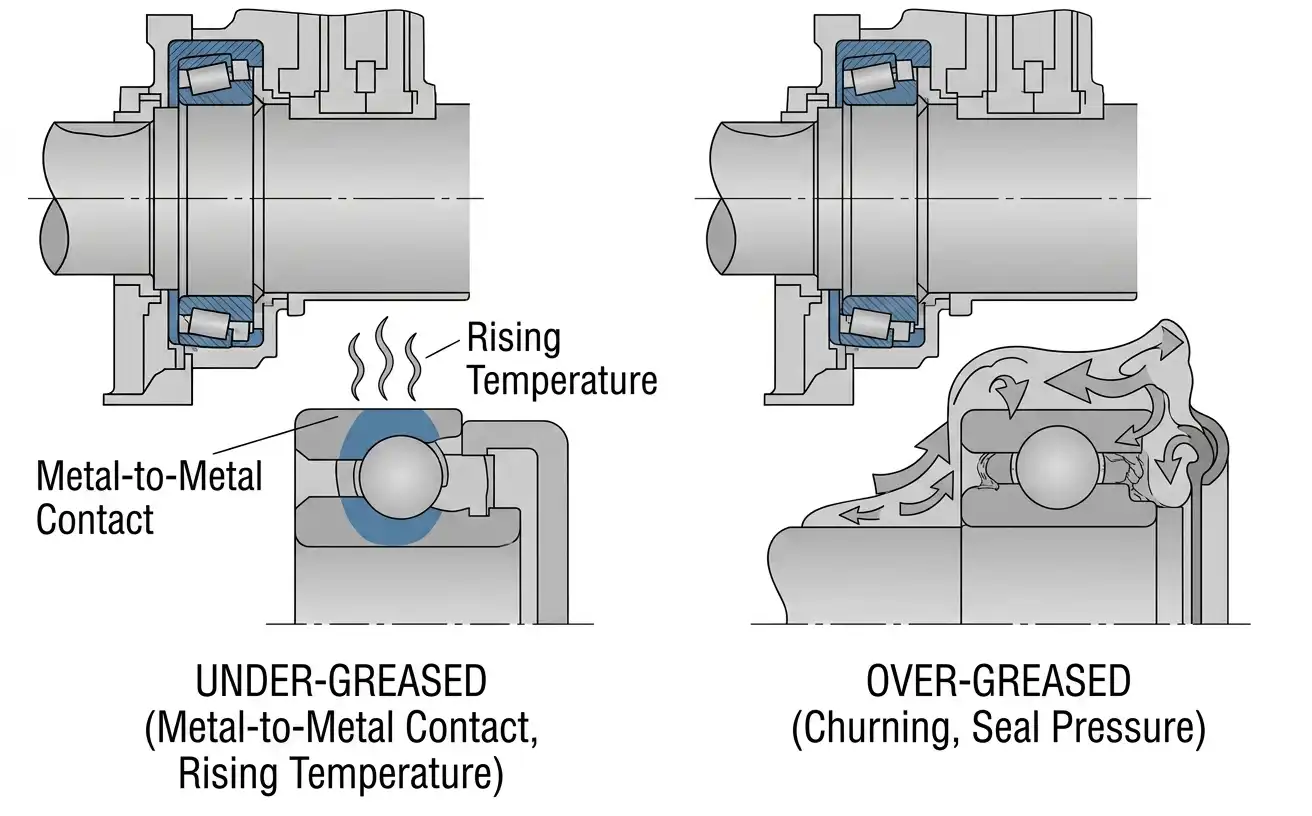
Under-greasing shows up as rising temperature, rising vibration, or both, since metal-to-metal contact between rolling elements and the raceway increases friction directly. Left unaddressed, this progresses to spalling and eventual seizure, a failure mode that looks like normal wear on inspection but traces back to grease starvation.
Over-greasing causes a different problem. Excess grease inside the bearing housing gets churned by the rolling elements, which generates its own heat and can push temperature up rather than down. It can also blow out seals under pressure, letting contamination in. More grease is not a safe default when the correct amount is uncertain.
A Practical Greasing and Monitoring Checklist
- Confirm the grease type matches the bearing’s operating temperature range, not just its NLGI consistency grade.
- Establish a baseline bearing temperature under normal, stable operating load.
- Set the greasing interval from the bearing’s speed factor and type, then shorten it if measured temperature runs above the grease manufacturer’s reference point.
- Treat a sustained temperature rise of 10 to 15°C above baseline as a trigger for inspection, not a scheduled-maintenance item to defer.
- Treat a sudden temperature spike as a different category of problem than gradual grease aging, and investigate contamination or seal failure specifically.
Cost of Getting This Wrong
Bearing failure from incorrect lubrication rarely announces itself as a lubrication problem. It shows up as an unplanned mill stoppage instead. The roller bearing sits in a location that is not quick to access or replace. A bearing on an easily reachable shaft elsewhere in the plant is a much simpler job.
The cost comparison favors monitoring heavily. A temperature sensor and a properly calculated greasing schedule cost far less than an unplanned teardown. They also cost less than the lost production during the stoppage. The roller and ring wear that often accompanies a bearing running hot and under-lubricated adds further cost before it fails outright.
Frequently Asked Questions
Why does the grinding roller bearing need grease instead of the mill’s central oil system?
The roller bearing sits at the end of a swinging pendulum arm, which makes a plumbed oil line impractical. Grease, applied through a nipple or automatic system, is the practical lubrication method for a bearing in this moving location. The main shaft bearing, by contrast, can use a fixed oil circuit.
How much does temperature actually affect greasing interval?
A commonly used rule of thumb holds that grease life roughly halves for every 10 to 15°C rise above a reference temperature near 70°C. A bearing running significantly hotter than that reference needs a correspondingly shorter greasing interval, not the same calendar-based schedule used for cooler bearings.
What is the difference between under-greasing and over-greasing symptoms?
Under-greasing typically shows up as rising temperature and rising vibration from increased metal-to-metal contact. Over-greasing shows up as excess heat from churning inside the housing, and can blow out seals under pressure. Both cause premature failure, through different mechanisms.
Should temperature monitoring replace a fixed greasing schedule entirely?
Not entirely. A calculated baseline interval, based on bearing type and speed factor, is still the starting point. Temperature monitoring adjusts that baseline in response to actual operating conditions, shortening the interval when temperature runs high rather than replacing the calculation altogether.
References and Sources
- MDPI (Lubricants) — Evaluation of Lubricant Selection and Lubrication Intervals for Pin–Bushing Bearings Operating Under High-Temperature Conditions in Heavy-Duty Construction Machinery
- National Lubricating Grease Institute — NLGI Grade
- U.S. Patent 6,432,888 — Grease for Rolling Bearing and Grease-Sealed Rolling Bearing
- U.S. Patent 7,374,019 — Method of and Device for Lubricating Rolling Bearings