

Jaw Crusher Commissioning Procedure: No-Load Run, Load Run, and Parameter Confirmation
What You Will Learn from This Guide
A jaw crusher commissioning sequence runs in three phases: a no-load run, a load run, and parameter confirmation. Each phase exists to catch a specific category of problem before it becomes expensive. This guide covers what to check in each phase, what counts as a pass, and what to do when a check fails. It serves a commissioning engineer or site technician bringing a jaw crusher into service, and after reading, you will have a defensible sequence to follow instead of a vague “run it and see” approach.
Before Starting: Pre-Start Checks
A few checks come before the machine ever turns, and skipping them undermines everything that follows. Confirm the crushing chamber is empty of tools, bolts, or any loose material left over from installation. A forgotten wrench inside the chamber turns the first start into a repair job.
Verify the eccentric shaft’s rotation direction against the arrow marked on the housing. A jaw crusher running backward will not crush correctly. Running it that way even briefly can damage the toggle mechanism.
Confirm all guards are in place. Confirm lockout/tagout has been cleared by whoever performed the installation work, following the same isolation procedure used during installation itself.
Phase One: The No-Load Run
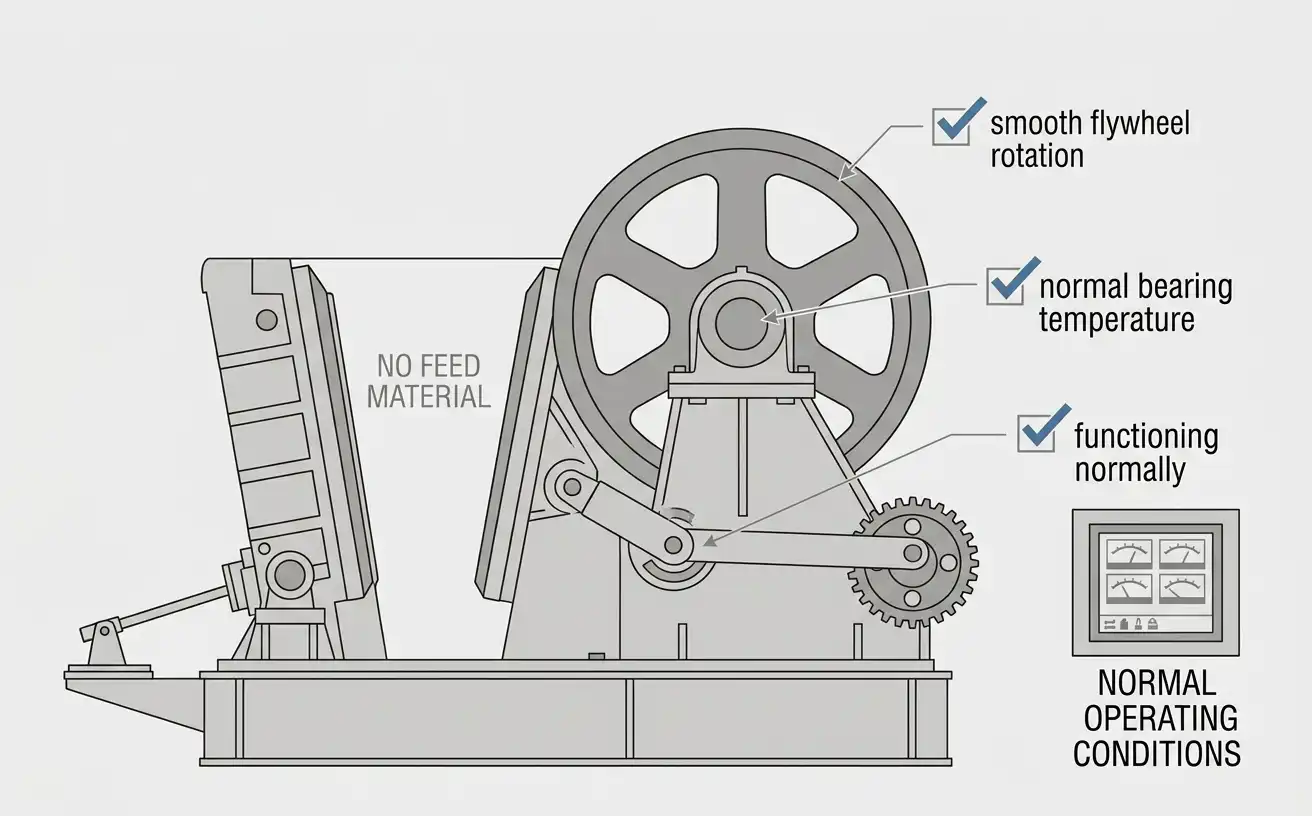
The no-load run starts the crusher with no feed material at all. This isolates mechanical problems from feed-related ones. An empty chamber points the cause toward something mechanical. A bearing, the flywheel, or the foundation is more likely than the material being crushed.
Run duration is not a fixed number of minutes on a clock. It runs until bearing temperature stabilizes, rather than continuing to climb. It also runs until the flywheel and toggle mechanism show consistent, repeatable behavior across multiple cycles.
A short run that looks fine at minute five can still be masking a slow bearing temperature climb. That climb often only shows up after longer running.
Check bearing temperature by hand or with an infrared thermometer at regular intervals during this phase, not just once at the end. A temperature still rising when you stop checking has not actually stabilized. Confirm lubrication reaches every point with no leaks. Confirm every fastener checked during installation is still tight after the vibration of a first run.
Phase Two: The Load Run
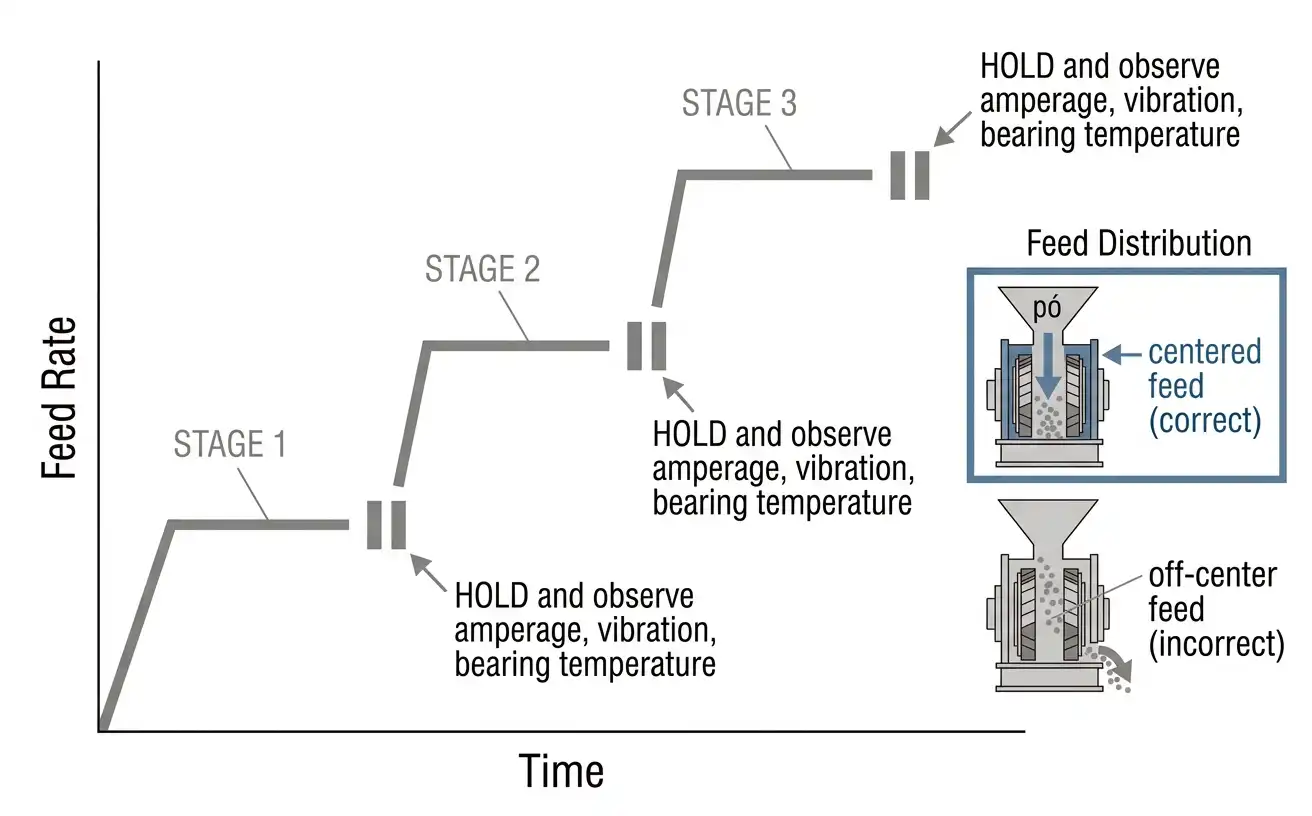
The load run introduces feed material for the first time. It should start well below rated capacity, not at it. A sudden jump to full feed rate gives no chance to catch a problem early. The machine has never processed material before this point.
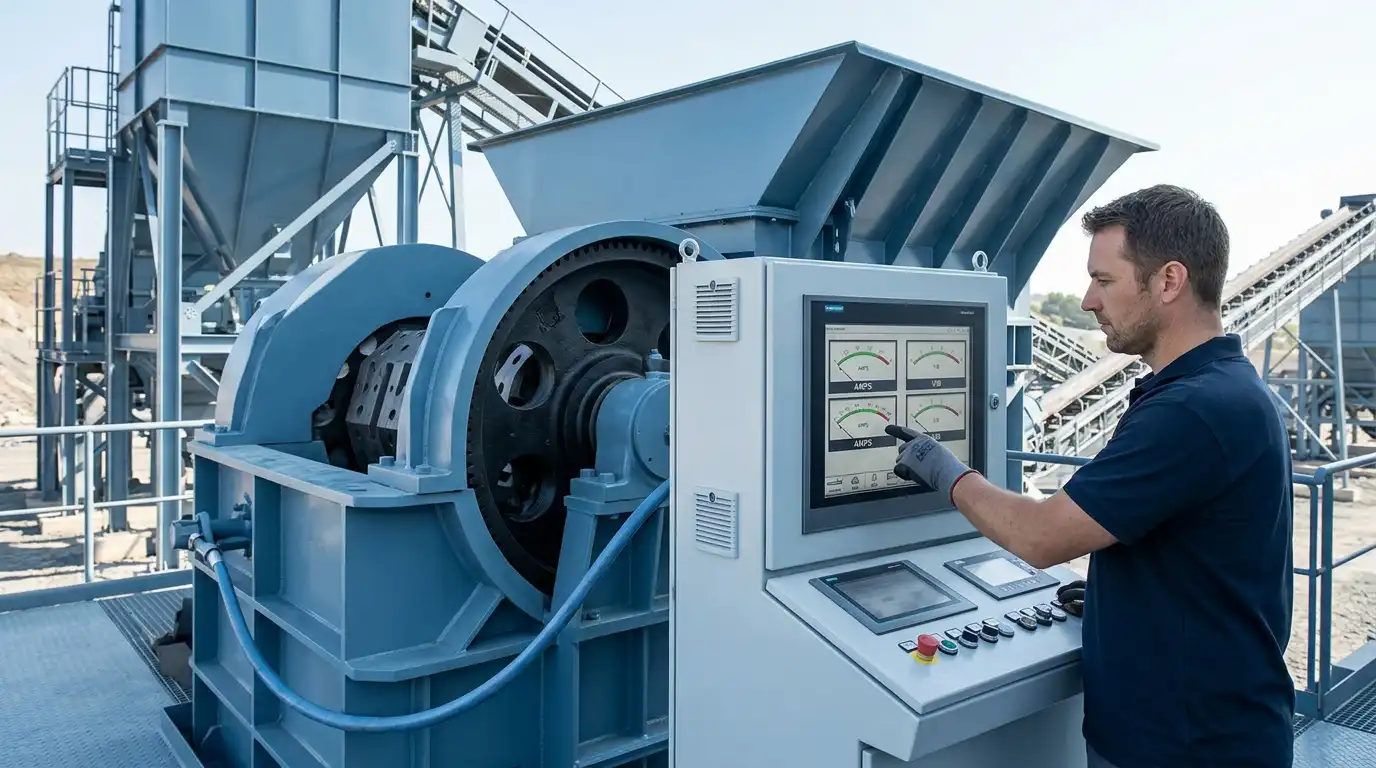
Increase feed rate in stages rather than all at once. At each stage, hold steady long enough to observe motor amperage, vibration, and bearing temperature under that specific load. Only then increase further.
Feed material into the center of the chamber, not off to one side. Off-center feed is a common cause of vibration that only appears under load. This is distinct from the mechanical vibration the no-load run would have already caught.
Watch discharge product size and flow as feed rate increases. A sudden change in particle size distribution is worth stopping to investigate. So is material spilling from an unexpected point. Both signal a problem worth resolving before continuing to ramp up.
Phase Three: Parameter Confirmation
Parameter confirmation closes the loop between what the machine is rated to do and what it is actually doing. This is not a repeat of the load run’s monitoring. It is a deliberate comparison against the datasheet, recorded rather than just observed.
Confirm the closed side setting (CSS) actually achieved matches the target setting. Check it against the intended product size, not just the dial or gauge reading at the adjustment mechanism.
Confirm measured throughput at that CSS falls within the rated capacity range published for the model. A capacity far outside that range, at a correctly set CSS, points to a feed, material, or wear issue. It is not usually a setting problem.
Confirm motor current draw stays within the rated amperage for the installed motor. Check this across the load range tested, not just at one feed rate. Record bearing temperatures and vibration readings from this phase as the commissioning baseline. Every future inspection compares against this specific reference point, not a generic industry average.
Vibration and Temperature Acceptance Criteria
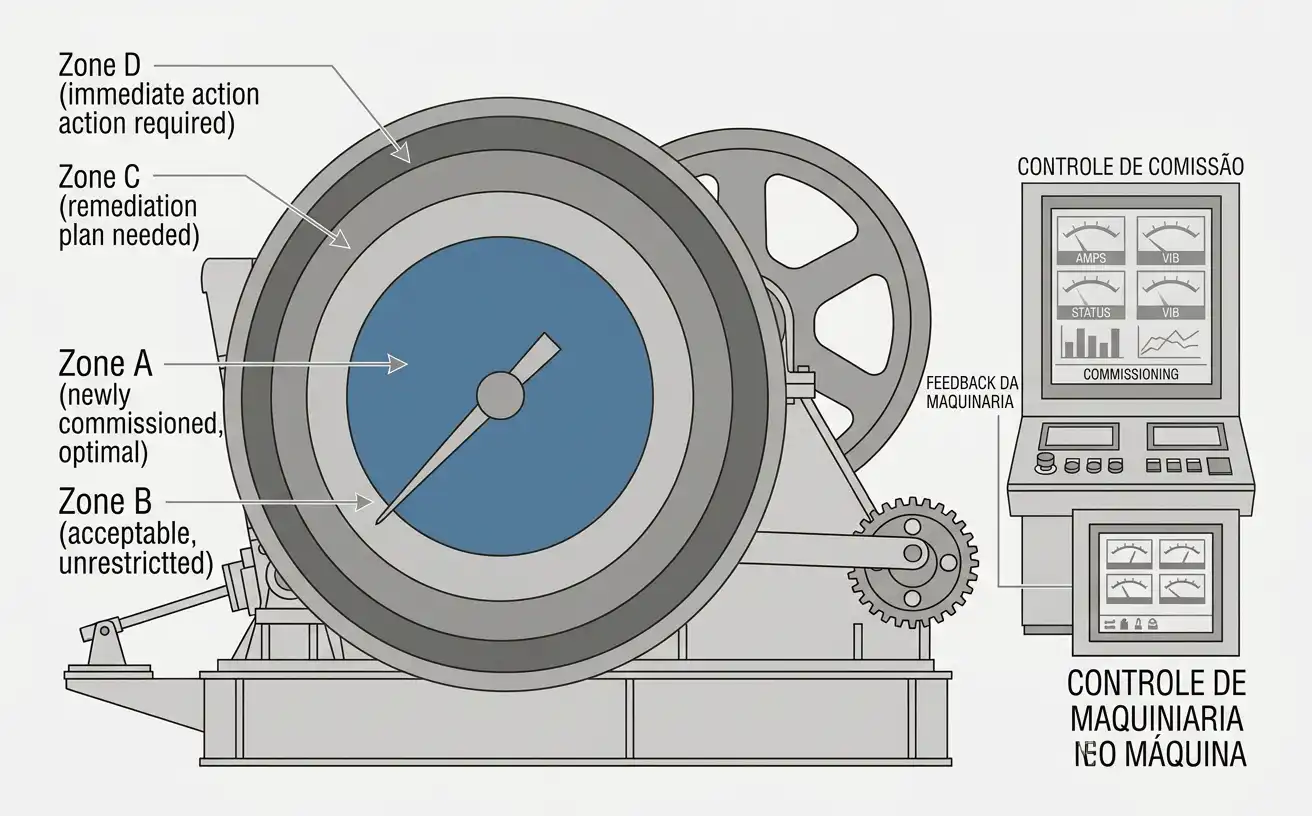
Vibration on newly commissioned rotating machinery is commonly evaluated against ISO 20816-3. This standard classifies vibration severity into zones. Zone A represents a newly commissioned machine in optimal condition. Zone B is acceptable for ongoing, unrestricted operation.
Zone C signals a developing problem. It needs a remediation plan rather than continued unmonitored running. Zone D calls for immediate action.
A jaw crusher’s drive motor, bearings, and eccentric shaft are the rotating components this framework applies to most directly. The jaw’s own crushing motion is not itself a simple rotating system. Use this zone framework as a general reference point for the drive train specifically, not as a single number that covers the whole machine.
Bearing temperature has no single universal pass or fail number. Ambient temperature, bearing type, and lubrication all shift what is normal for a given installation.
What matters more is temperature rise from a stable no-load baseline. A bearing that keeps climbing under steady load, rather than leveling off, is the signal to stop and investigate. That matters more than the absolute number on the thermometer.
A Practical Commissioning Checklist
- Chamber verified clear of tools and debris before first start.
- Rotation direction confirmed against the housing arrow before any load.
- No-load run continued until bearing temperature stabilizes, not for a fixed number of minutes.
- Feed introduced in stages, centered in the chamber, with amperage and vibration checked at each stage.
- CSS, throughput, motor current, bearing temperature, and vibration recorded as a documented baseline, not just observed.
- Any abnormal reading investigated and resolved before advancing to the next stage or phase.
When a Phase Fails
A failed check is a stopping point, not a note to revisit later. If the no-load run shows vibration or unstable bearing temperature, the load run should not begin. Load only adds stress to a problem already present at no load.
If the load run shows off-center feed vibration, or amperage that climbs faster than feed rate would explain, back off to the previous stable stage. Do not push forward to see if it resolves on its own.
Parameter confirmation that fails to match the rated datasheet, at a correctly set CSS, usually traces back to something upstream. Feed size, material hardness, or wear already present on a machine assumed to be new are common culprits.
Frequently Asked Questions
How long should a jaw crusher’s no-load run last?
There is no fixed duration. The run should continue until bearing temperature stabilizes, rather than continuing to climb. It should also continue until the flywheel and toggle mechanism show consistent behavior across repeated cycles. That can take longer than a fixed clock time suggests.
Why does the no-load run matter if the machine will be loaded anyway?
Running with no feed material isolates mechanical problems from feed-related ones. Vibration or noise present with an empty chamber points to the bearings, flywheel, or foundation. Vibration that only appears under load points to feed distribution or material issues instead.
What should be recorded during parameter confirmation?
Record the actual closed side setting achieved and measured throughput at that setting. Also record motor current draw across the tested load range, along with bearing temperature and vibration readings. This becomes the commissioning baseline future inspections compare against.
What vibration standard applies to a newly commissioned jaw crusher?
ISO 20816-3 is the commonly used framework for evaluating vibration severity on rotating industrial machinery. Zone A represents newly commissioned equipment in optimal condition. It applies most directly to the drive motor, bearings, and eccentric shaft, rather than to the jaw’s own crushing motion.
References and Sources
- ISO 20816-3 — Mechanical Vibration: Measurement and Evaluation of Machine Vibration, Part 3: Industrial Machines
- Occupational Safety and Health Administration — 29 CFR 1910.147, The Control of Hazardous Energy (Lockout/Tagout)
- U.S. Patent 7,489,254 — System and Method for Monitoring a Vertical Shaft Impact Crusher