

Primary Impact Crusher: Is It a Feasible Replacement for a Jaw Crusher in Soft Rock?
What You Will Learn from This Guide
A primary impact crusher can replace a jaw crusher in the right conditions, but the deciding factor is not rock hardness. It is rock abrasiveness. This guide explains why that distinction matters, how to actually test for it, and what changes in a crushing circuit when the substitution works. It serves an engineer or plant planner evaluating this switch specifically for soft rock, and after reading, you will have a real decision framework instead of a general impression.
Why the Question Makes Sense: The Reduction Ratio Gap
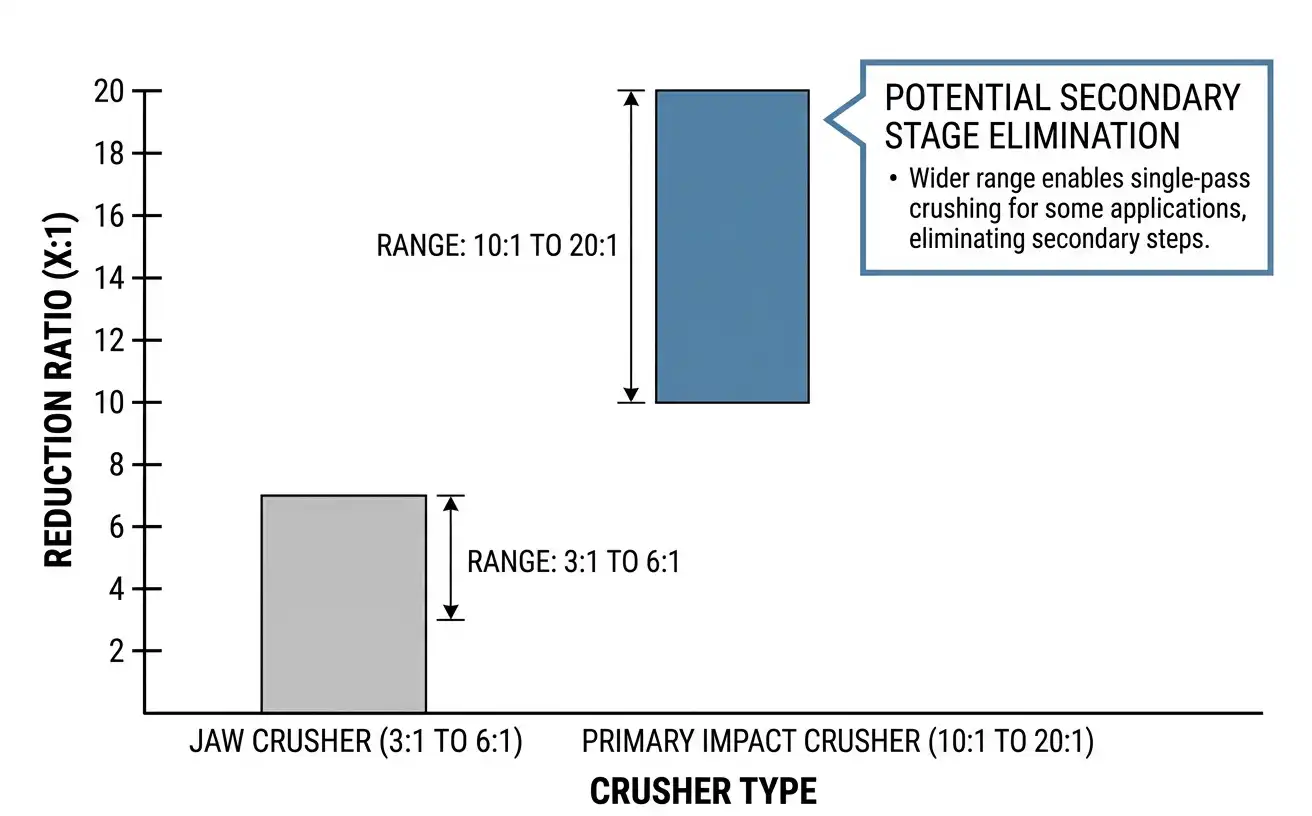
A jaw crusher achieves a reduction ratio of roughly 3:1 to 6:1 in a single pass. A primary impact crusher can reach 10:1 to 20:1 in the right material. That gap is large enough to change how a whole crushing circuit gets designed.
The reason comes down to mechanism. A jaw crusher compresses rock between two plates. A nip angle constrains this, limiting how aggressively it can grab and reduce material in one stroke.
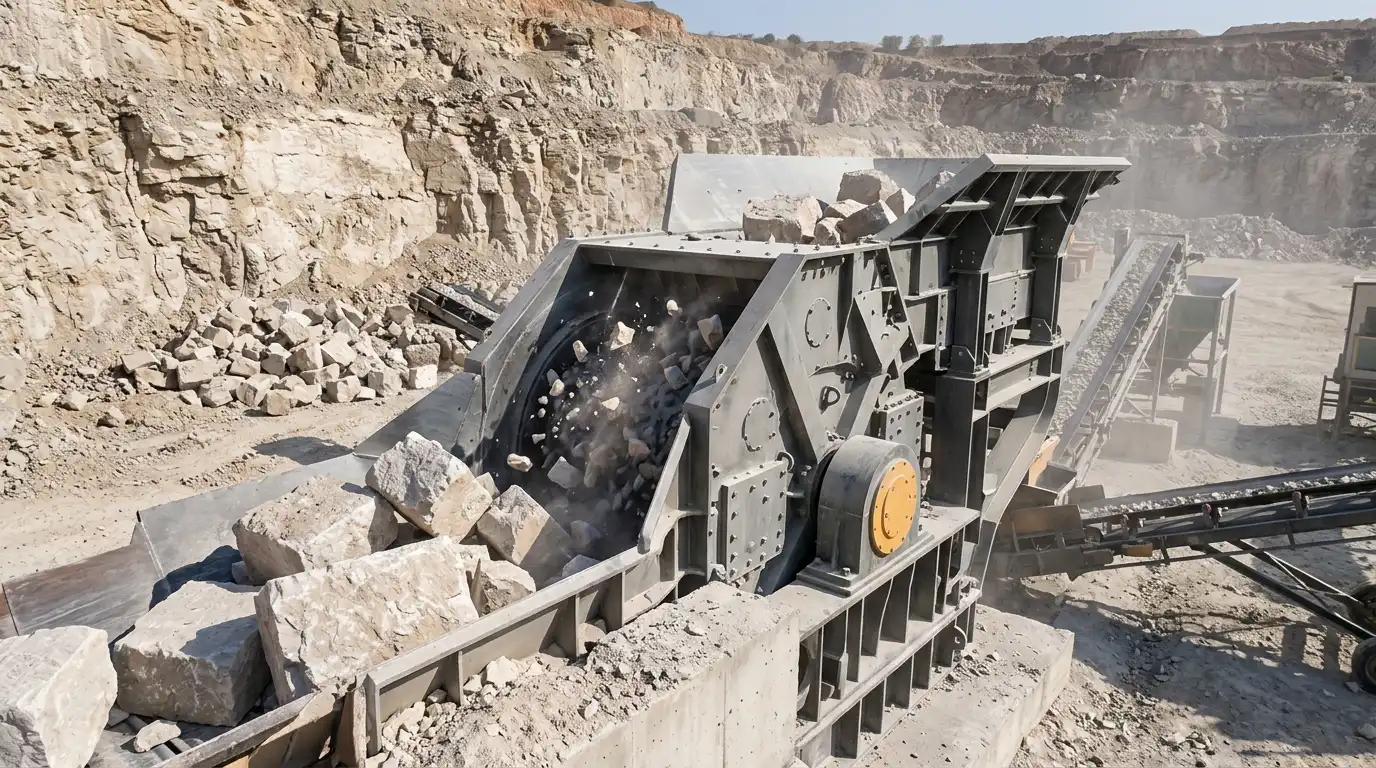
An impact crusher has no such geometric constraint. Its rotor strikes material with kinetic energy, shattering it along natural fracture lines rather than squeezing it apart.
That higher single-pass reduction ratio is exactly why the substitution question comes up. A primary impact crusher processing the right rock can sometimes take feed straight from the quarry face to near-final product size. No separate secondary crushing stage is needed at all.
The Real Constraint: Wear, Not Hardness
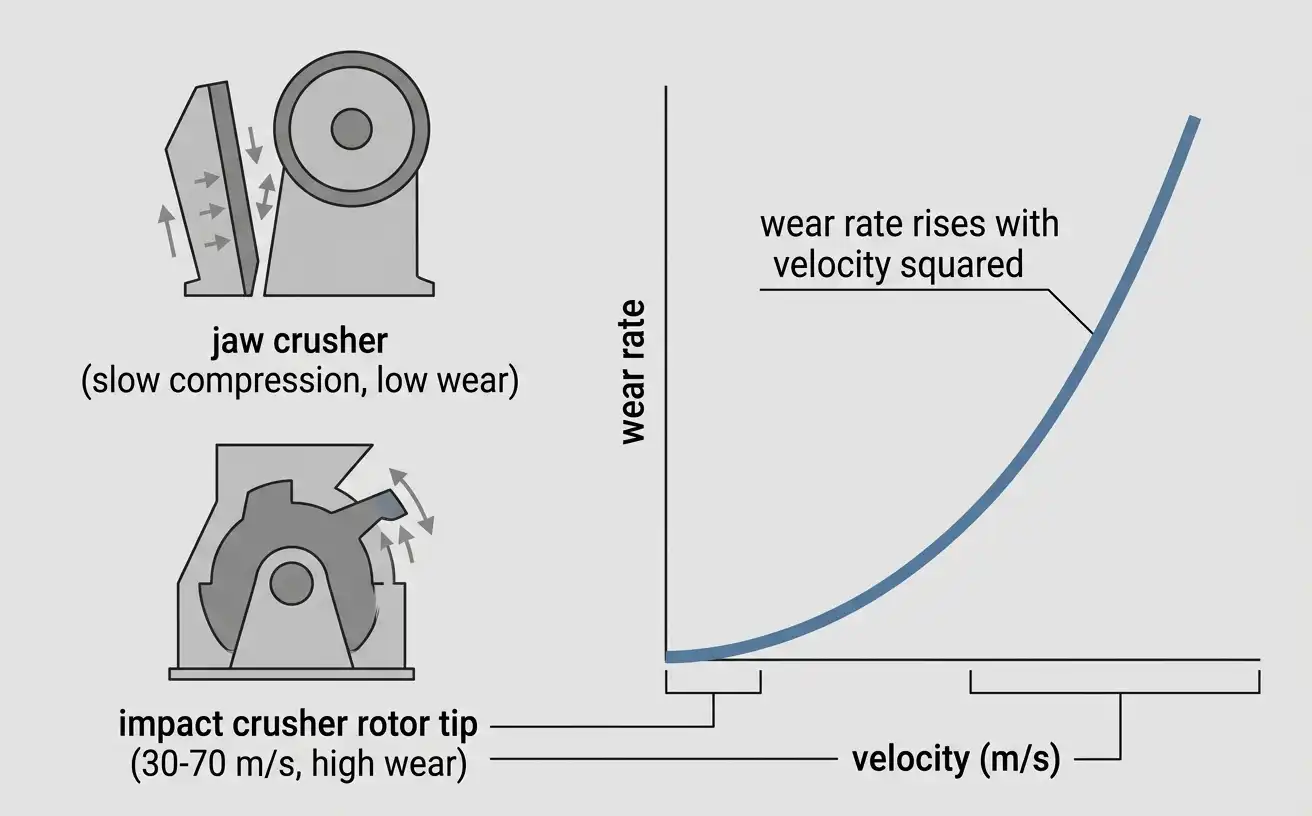
Rock hardness and rock abrasiveness are not the same property, and conflating them leads to bad equipment decisions. A rock can be relatively easy to break yet highly abrasive, or hard to break yet not particularly abrasive. Abrasiveness, driven largely by silica content, is what actually determines wear cost on an impact crusher.
The physics behind this is straightforward. Wear increases with roughly the square of contact velocity. A jaw crusher’s plates move slowly, compressing material at low relative speed.
An impact crusher’s rotor tip moves at 30 to 70 meters per second, striking material directly. That speed difference is why the same abrasive rock can wear an impact crusher’s parts many times faster than it wears a jaw crusher’s plates.
This is the actual reason primary impact crushers work well on limestone and similarly soft, low-silica materials, but become uneconomical fast on granite or basalt. It is not that granite is too hard to shatter by impact. It is that granite’s abrasiveness turns the impact crusher’s wear parts into a recurring cost the reduction ratio advantage cannot offset.
Testing the Feasibility: LA Abrasion and Related Metrics
Deciding whether a specific rock qualifies is a testing question, not a guess based on general rock type. The Los Angeles Abrasion test is standardized under ASTM C131/C131M. It measures an aggregate’s resistance to abrasion and impact by tumbling it with steel balls in a rotating drum and measuring the resulting material loss.
A low LA Abrasion loss value points toward a rock that will treat impact-crusher wear parts gently. A high value is a warning sign, regardless of how the rock feels or looks on site. Silica content is a second useful indicator. Materials commonly cited as good impact-crusher candidates, such as limestone, coal, and phosphate rock, typically run under about 5 percent silica.
Neither test alone settles the decision completely, but both together give a defensible basis for it. Guessing from rock type name alone, without testing the specific deposit, is how operations end up with wear costs no one budgeted for.
The Product-Quality Case for Impact Crushing
Reduction ratio and wear cost are not the only factors worth weighing. Product quality differs structurally between the two mechanisms, not just in appearance.
Material crushed by compression in a jaw crusher often retains internal microcracks and a less cubical shape. That output frequently needs a separate secondary crushing stage, commonly an impact crusher. Its job is to relieve those internal stresses and improve particle shape before the material meets concrete, road base, or similar specifications.
Material crushed by impact in the first place tends to come out largely free of that internal stress, with a naturally more cubical shape. On the right rock, a primary impact crusher’s output can go straight to screening and use. It skips the shape-correction step a jaw-crushed circuit often needs downstream.
Feed Size: A Secondary Consideration
Feed size limits matter less than they once did, but they still deserve a check. Older guidance sometimes cites a rough ceiling around 500 millimeters for impact crusher feed. Current model ranges vary this considerably.
The PF impact crusher line, for example, accepts feed up to 700 millimeters on its largest model. The right check is always the specific model’s rated maximum feed size. A generic industry rule of thumb may not reflect current equipment capability.
A Decision Framework
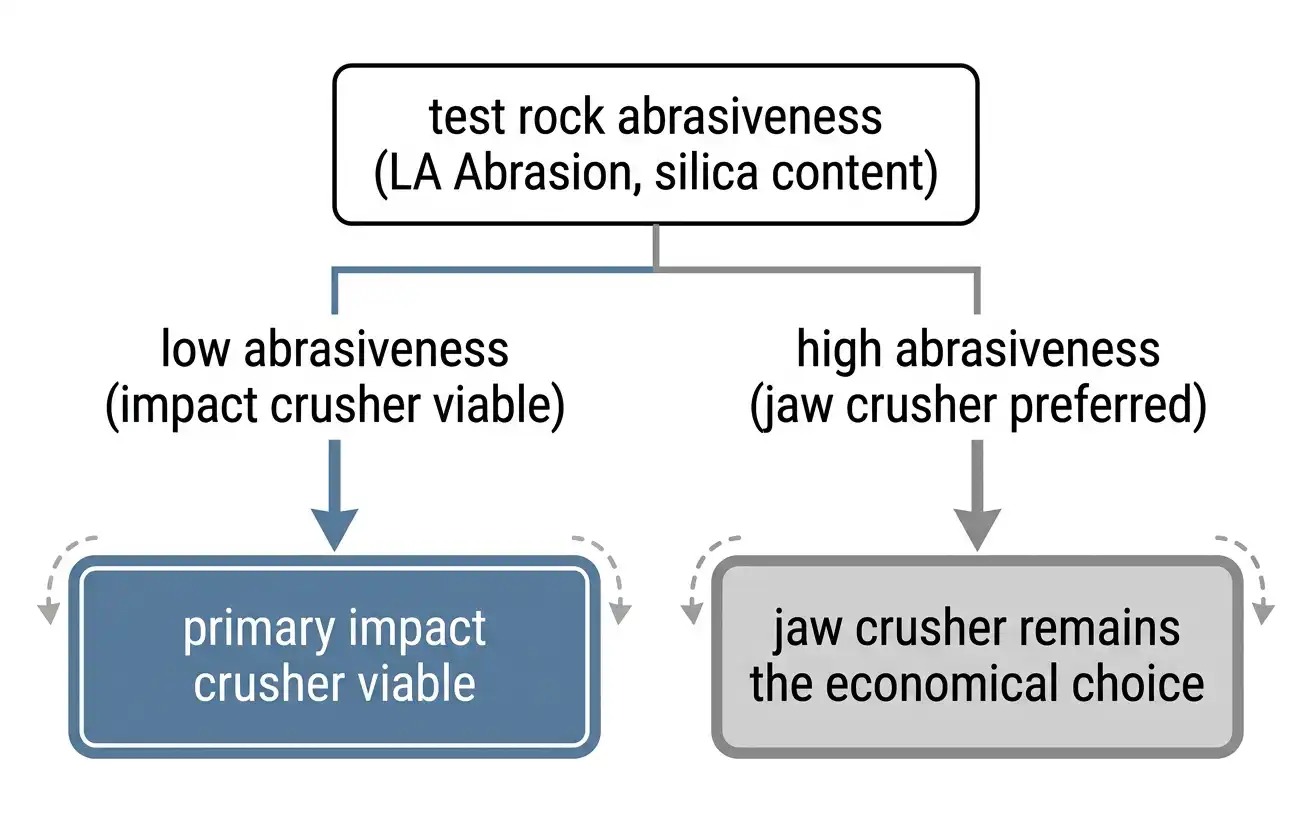
Start with material testing, not intuition. LA Abrasion results and silica content give a defensible basis for the abrasiveness question, which matters more than any other single factor in this decision.
If abrasiveness comes back low, the reduction ratio and product quality advantages of a primary impact crusher become genuinely compelling. A single machine may replace what would otherwise be a jaw crusher paired with a secondary crusher. A real capital cost and footprint advantage comes attached to that.
If abrasiveness comes back high, the jaw crusher’s slower compression action remains the economical choice at the primary stage. That holds whatever the reduction ratio difference looks like on paper. Wear cost on an unsuitable rock will erase any throughput or capital advantage the impact crusher offered.
Frequently Asked Questions
Is rock hardness the right way to decide between a jaw crusher and a primary impact crusher?
Not on its own. Abrasiveness, driven largely by silica content, determines wear cost on an impact crusher far more than compressive hardness does. A rock can be relatively easy to break yet highly abrasive, which makes hardness alone an unreliable guide for this decision.
Why does wear increase so much faster on an impact crusher than a jaw crusher?
Wear increases with roughly the square of contact velocity. An impact crusher’s rotor tip moves at 30 to 70 meters per second, while a jaw crusher’s plates move much more slowly during compression. That speed difference means the same abrasive material wears impact crusher parts far faster than jaw crusher plates.
How is rock abrasiveness actually tested before making this decision?
The Los Angeles Abrasion test, standardized under ASTM C131/C131M, measures material loss when aggregate is tumbled with steel balls in a rotating drum. A low result indicates a rock suited to impact crushing, while a high result signals the wear risk a jaw crusher would avoid.
Can a primary impact crusher really eliminate the need for a secondary crusher?
On suitable, low-abrasion rock, yes, in many cases. Its higher single-pass reduction ratio and naturally cubical, low-microcrack product can take material from quarry face to near-final size. This skips the shape-correction stage a jaw-crushed circuit often needs downstream.
References and Sources
- ASTM C131/C131M-20 — Standard Test Method for Resistance to Degradation of Small-Size Coarse Aggregate by Abrasion and Impact in the Los Angeles Machine
- National Institute of Technology Rourkela — Design and Analysis of a Horizontal Shaft Impact Crusher
- Pit & Quarry — P&Q University Lesson 7: Crushing & Secondary Breaking
- U.S. Patent 7,143,970 — Jaw Crusher