

What Is a Ball Mill? Definition, Structure, Types & Working Principle
Ask any mining engineer, cement plant manager, or materials scientist to name one piece of equipment they simply cannot do without, and the ball mill will almost always be on that list. Since its first recorded industrial use around 1870 — grinding flint for pottery — this rotating drum has anchored size-reduction circuits across dozens of industries. Its secret is deceptively simple: no cutting tools, no blades, just a cylinder full of steel balls and the relentless physics of impact and friction. This guide walks through everything you need to know, from the machine’s definition and construction to its operating principle, main types, wet versus dry modes, and honest assessment of its strengths and weaknesses.
What Is a Ball Mill?
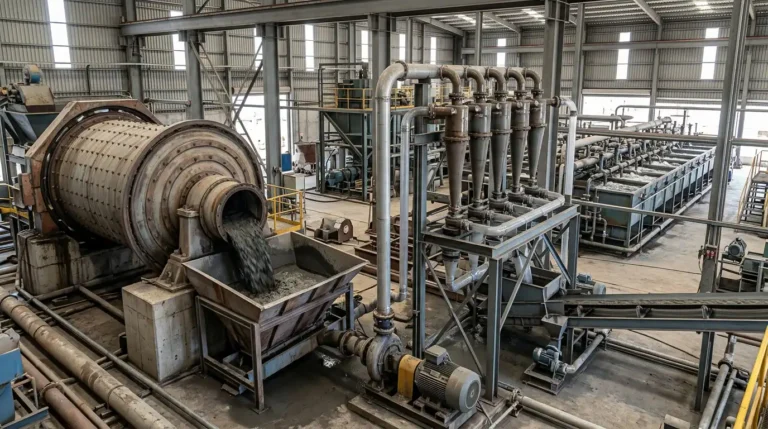
A ball mill is a rotating cylindrical drum partially filled with grinding media — usually steel or ceramic balls — that reduce solid materials to fine powder through impact and attrition. The drum turns on a horizontal or slightly inclined axis, and as it rotates, the balls are lifted and then cascade down onto the feed material, progressively breaking it into smaller particles.
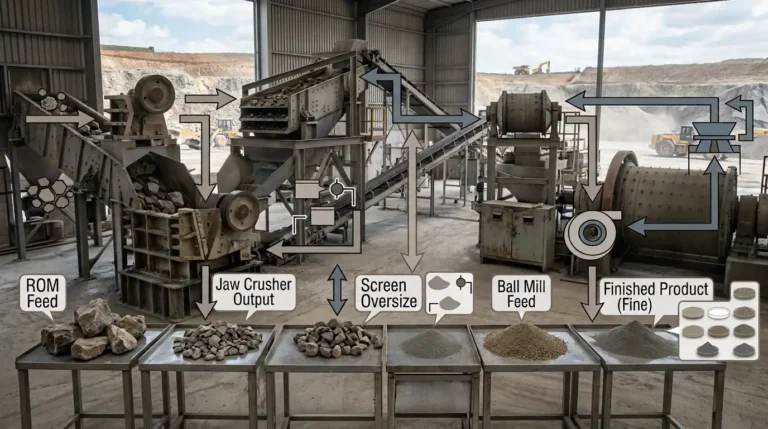
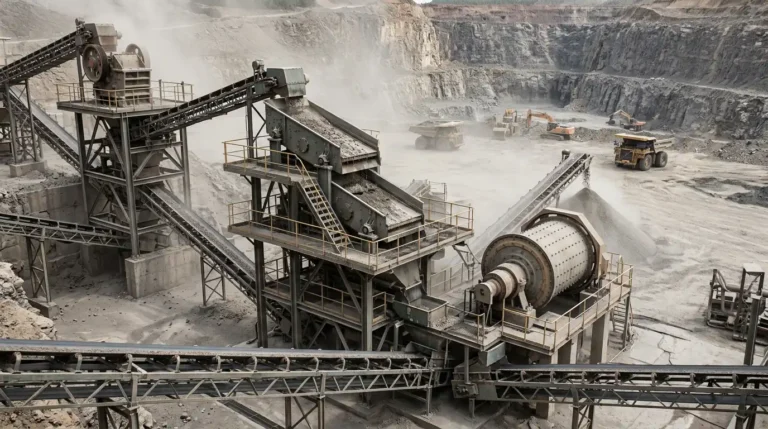
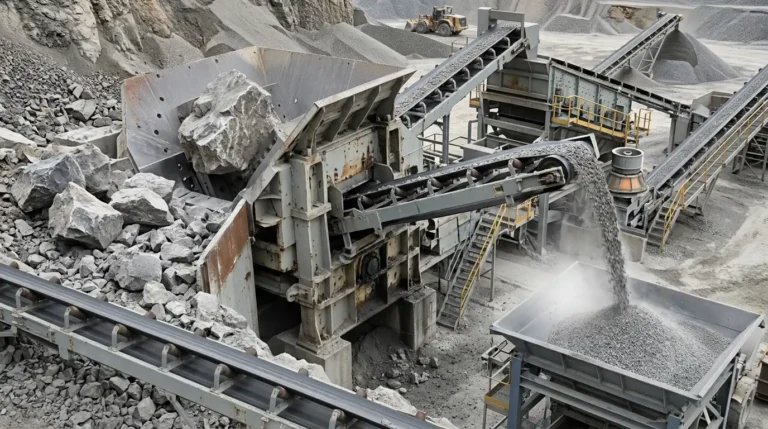
In a typical industrial process, a ball mill sits between the crushing stage and downstream beneficiation (flotation, leaching, or magnetic separation). Feed particle sizes entering the mill are usually 1–25 mm; products leaving it are commonly in the range of 75–150 micrometers, though some high-energy designs reach the nanometer scale.
View available ball mills: Ball Mill for Sale — MR CRUSHER
Construction & Design
The main body of a ball mill is a steel cylinder whose length-to-diameter ratio (L/D) typically falls between 1 and 1.5. The shell is fabricated from heavy steel plate, connected at both ends to hollow trunnions (cast steel shafts) that rest on main bearings. The inner surface is lined with wear-resistant plates made of manganese steel or rubber — manganese for harder ores, rubber for softer materials and noise reduction.
Large industrial mills are driven by a ring gear bolted to the shell periphery, meshing with a smaller pinion connected to a gearbox and motor. Small laboratory units often sit on drive rollers and spin at variable speeds.
More on ball mill structure: The Mechanical Structure of the Ball Mill
Key Components & Parts
| Component | Function |
| Shell (Cylinder) | Main rotating body; welded high-strength steel plate |
| Liner | Protects shell from wear; guides ball trajectory; manganese steel or rubber |
| Grinding Media | Steel, ceramic, or rubber balls; deliver impact and attrition forces |
| Feed System | Hollow trunnion or screw feeder; ensures steady material entry |
| Discharge System | Grate (diaphragm) or overflow type; controls product particle size |
| Drive System | Motor + gearbox + ring gear; rotates the drum at target speed |
| Bearings / Trunnions | Support the full rotating load; trunnion or roller-bearing design |
| Support Frame | Structural base; absorbs vibration and dynamic loads |
Working Principle — How a Ball Mill Works
Two physical forces do all the work inside a ball mill:
- Impact: as the drum turns, balls are carried up the rising side and then drop under gravity onto the material below, shattering large particles into smaller fragments.
- Attrition: as balls tumble over each other and press against the liner, they grind the particles between their surfaces, smoothing edges and reducing size further.
Ball Motion and the Three Operating Regimes
| Motion type | Speed range | Grinding effect |
| Cascading | Below 60% of critical speed | Balls roll gently; minimal impact, low efficiency |
| Cataracting | 65–80% of critical speed | Optimal zone; strong impact, highest efficiency |
| Centrifuging | At or above 100% critical speed | Balls pin to wall; no grinding occurs |
Critical Speed
Critical speed (Nc) is the rotational speed at which centrifugal force equals gravitational force at the mill shell’s inner surface, causing grinding media to stick to the wall rather than fall. The formula is:
Nc (rpm) = 42.3 / √D (m) — where D is the inside shell diameter in meters.
Most industrial ball mills run at 65–80% of critical speed. Other variables affecting efficiency include ball size and fill ratio (typically 30–45%), material hardness, feed rate, and liner profile.
Types of Ball Mills
By discharge method:
| Type | Discharge method | Best application |
| Grate (Diaphragm) Discharge | Grate plate controls exit | Primary grinding; fast discharge, less over-grinding |
| Overflow Discharge | Product overflows trunnion | Secondary fine grinding; simpler design |
| Tube Mill | Multi-chamber overflow | Cement ultra-fine grinding; L/D > 1.5 |
By scale and application:
- Planetary Ball Mill: high-energy lab unit; vessels spin on a rotating disc; can reach nanometer-scale particle sizes.
- Vibration Mill: high-frequency vibration drives media; ideal for brittle materials and small sample preparation.
- Stirred Ball Mill (Attritor): continuous media agitation via a central impeller; used for submicron and ultra-fine grinding.
Wet Grinding vs Dry Grinding
| Factor | Wet Grinding | Dry Grinding |
| Liquid medium | Water or solvent | None; air-swept discharge |
| Energy consumption | ~20–30% lower than dry | Higher |
| Particle size distribution | Narrower, more uniform | Broader |
| Dust handling | No dust; cleaner environment | Requires dust collection system |
| Suitable materials | Most ores and chemicals | Cement clinker; water-reactive materials |
| Post-processing | Slurry requires dewatering/drying | Product is dry powder directly |
According to MR CRUSHER’s product documentation, energy-saving ball mills using self-aligning double-row spherical roller bearings reduce running resistance and save 25–30% energy compared to conventional designs.
Wet vs dry ball mill comparison: Ball Mill vs Pebble Mill — MR CRUSHER
Advantages of Ball Mills
- Fine, uniform particle size: standard industrial mills achieve 10–75 μm; high-energy planetary mills reach sub-100 nm.
- Wide material compatibility: hard ores, soft minerals, chemicals, and food-grade materials all processable.
- Dual-mode flexibility: both wet and dry grinding supported in the same machine family.
- Simple structure, low maintenance: fewer moving parts; liners and balls are field-replaceable.
- Continuous operation capability: large industrial units run 24/7 without shutdown.
- Sealed operation: suits hazardous or high-purity materials; prevents external contamination.
Disadvantages & Limitations
- High energy consumption: actual grinding efficiency is typically below 15%; most input energy converts to heat and noise.
- Product contamination risk: steel ball wear releases iron particles — ceramic media eliminates this for sensitive applications.
- Wide particle size distribution: difficult to achieve a narrow, precisely controlled size range in a single pass.
- Significant noise: metal-shell mills are loud; sound insulation is often required in plant layouts.
- Not suitable for heat-sensitive materials: frictional heat can degrade temperature-sensitive compounds.
- Long batch processing time: intermittent operation can require several hours per batch for fine target sizes.
Conclusion
A ball mill is, at its core, a rotating cylinder that turns the physics of impact and attrition into a reliable, scalable size-reduction process. Its basic structure — shell, liner, grinding media, drive system — has changed little in over a century, yet it remains the most widely deployed grinding machine across mining, cement, ceramics, and pharmaceuticals. Understanding the relationship between critical speed, media fill ratio, and wet or dry mode allows operators to tune the mill for their specific material and target particle size. While energy efficiency and noise are real drawbacks, the machine’s structural simplicity, material versatility, and scalability make it the default choice whenever sustained, high-volume grinding is required.
FAQ
What is the difference between a ball mill and a Raymond mill for non-metallic mineral powder?
A ball mill uses steel ball impact and attrition to grind materials across a wide hardness range, typically producing 10–150 μm particles in large volumes. A Raymond mill uses grinding rollers pressed against a ring, is more energy-efficient for medium-hardness non-metallic minerals, and works best for moderate-fineness products. For non-metallic mineral coarse grinding, the ball mill is preferred; for fine-powder specialty products, Raymond or ultrafine mills are better choices.
How do you calculate ball mill critical speed, and what operating speed is recommended?
Critical speed: Nc (rpm) = 42.3 / √D, where D is the internal shell diameter in meters. Operating speed should be set at 65–80% of Nc. Large industrial mills typically run near the lower end of this range; laboratory planetary mills operate closer to the upper end. Exceeding critical speed pins the balls to the wall and stops all grinding.
How often should grinding balls be replenished, and what is the standard for doing so?
Replenishment frequency depends on ore hardness and grinding intensity. In mining applications, balls are typically added after every 500–1,000 tons of processed ore. The standard approach is to monitor ball charge fill ratio — when it drops below the target (usually 30–40% of mill volume), replenishment is triggered. Equipment suppliers can provide a refilling schedule based on measured wear rate data.
How do I choose between a grate discharge and an overflow ball mill?
Choose grate discharge for primary grinding or when over-grinding is a concern — it discharges product faster and produces a coarser, more uniform output. Choose overflow when fine grinding is needed and structural simplicity matters more than discharge speed. In mining circuits, the first grinding stage typically uses a grate mill; secondary regrinding commonly uses overflow.
When should I choose ceramic grinding media instead of steel balls?
Steel balls are cost-effective for bulk mineral grinding where trace iron contamination is acceptable. Ceramic media (alumina or zirconia) is used when product purity is critical — pharmaceuticals, electronics materials, and high-purity chemicals — because ceramics introduce zero metallic contamination. The trade-off is higher media cost, so ceramic media is usually reserved for small-batch, high-value-added applications.