

What Can a Ball Mill Do? A Complete Guide to Uses, Principles, and Applications
Walk into any mine, cement plant, or pharmaceutical facility and you will find a ball mill at the heart of the operation. Loud, heavy, and deceptively simple in appearance, this machine can grind hard rock, ceramic powders, and even cocoa beans down to particle sizes invisible to the naked eye. Few pieces of industrial equipment match its versatility. This guide covers everything you need to know — what a ball mill is, how it works, what it is made of, and which industries rely on it most.
What Is a Ball Mill?
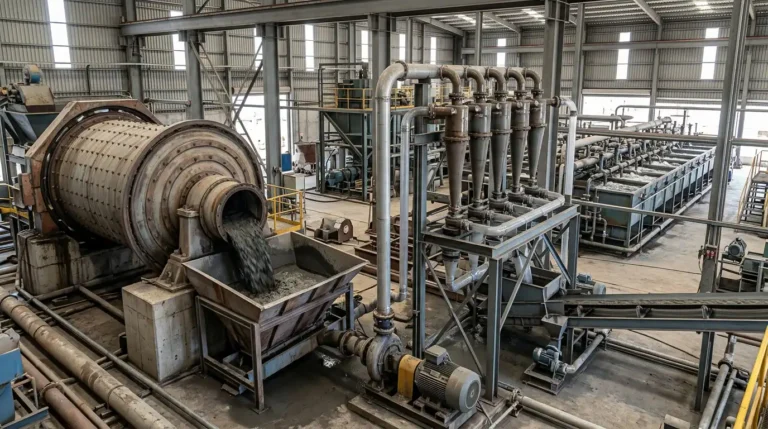
A ball mill is a rotating cylindrical drum filled with grinding media — usually steel or ceramic balls — that crush and grind materials through repeated impact and friction. The drum may be oriented horizontally or at a slight angle and can range from a bench-top laboratory unit holding less than one liter to a large industrial machine processing hundreds of tons per hour.
How Does a Ball Mill Work?
Two physical forces drive the grinding process:
- Impact: As the drum rotates, balls are lifted and then drop onto the material below, shattering large particles into smaller fragments. The energy delivered per impact depends on the ball mass, drop height, and rotational speed.
- Attrition: As balls tumble over one another and against the drum lining, they grind particles between their surfaces, smoothing edges and reducing size further.
Rotational speed is a critical variable. Most mills operate at 65–80% of their critical speed — the speed at which centrifugal force would pin the balls to the drum wall and stop all grinding. Too slow and the balls slide without impact; too fast and they simply orbit the wall.
Ball mills can operate in dry mode (no liquid) or wet mode (material suspended in water or solvent). Wet grinding typically consumes around 20–30% less energy than dry grinding and generates less dust, making it the preferred choice in mineral processing.
Key Components of a Ball Mill
| Component | Function |
| Cylindrical shell | Main rotating body; made of steel plate, carries all internal load |
| Liner | Protects the shell from wear; shaped to guide ball trajectory |
| Grinding media | Steel, ceramic, or rubber balls that deliver impact and attrition |
| Feed and discharge system | Controls material entry and exit; hollow shaft, spiral discharge device |
| Drive system | Motor, gearbox, and ring gear that rotate the drum |
| Support frame | Structural base that absorbs vibration and carries total machine weight |
For a detailed breakdown of ball mill structure, see: The Mechanical Structure of the Ball Mill
The Variable That Defines Output Quality
Choosing the right grinding media is as important as choosing the mill itself. The table below summarizes the main options:
| Media Type | Typical Application | Key Property |
| High-chrome steel balls | Hard ore grinding, cement | High hardness, excellent wear resistance |
| Low-chrome alloy balls | General mineral grinding | Cost-effective for moderate abrasion |
| Alumina ceramic balls | Pharmaceuticals, electronics, fine chemicals | Zero iron contamination, high purity |
| Stainless steel balls | Food, medical grade milling | Corrosion resistant, hygienic |
| Rubber balls | Light mineral grinding | Noise reduction, lower liner wear |
Ball size also matters. Large balls deliver stronger impact for coarse grinding; smaller balls increase contact area for fine grinding. Industrial mills typically use a graded mix of sizes to cover both stages efficiently.
What Can a Ball Mill Actually Do?
1. Mining and Ore Processing
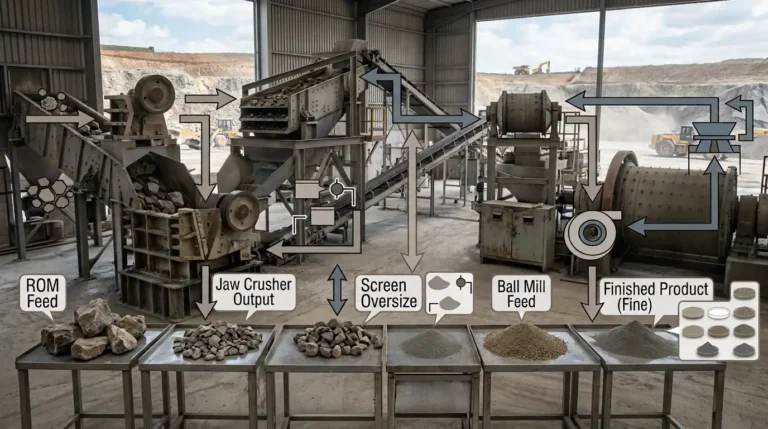
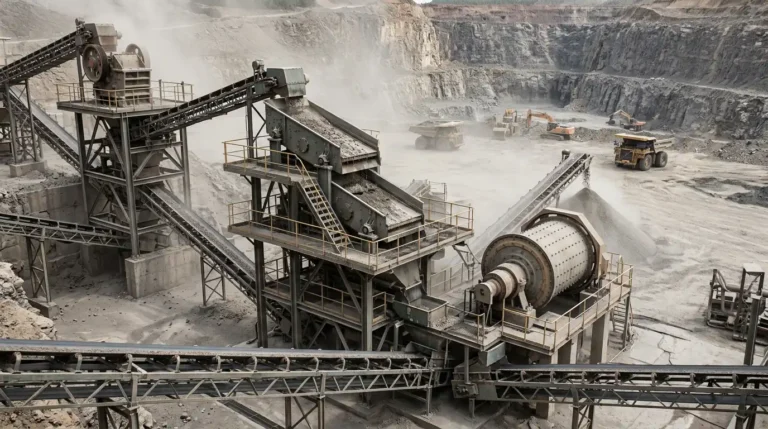
This is the ball mill’s dominant application. Valuable minerals locked inside ore must be liberated by grinding to 75–150 micrometers before flotation, leaching, or magnetic separation can recover them. According to a recent project by MR CRUSHER, high-performance ball mills delivered wear-part lifespans approximately 40% longer than standard market products.
See project details: Copper Ball Mill — Latin American Mining Project
2. Cement Manufacturing
Ball mills handle two critical stages in cement production: grinding raw materials (limestone, clay) into raw meal, and grinding clinker into finished cement powder with a fineness of 3,000–4,000 cm²/g (Blaine). Grinding fineness directly determines cement strength grade and hydration speed.
Explore ball mill options: Ball Mill for Sale — MR CRUSHER
3. Ceramics and Glass
Ceramic manufacturers grind feldspar, quartz, and clay to below 50 micrometers to achieve uniform body and glaze mixtures. Fine grinding eliminates defects such as pinholing and blistering during firing, improving product yield significantly.
4. Pharmaceuticals and Fine Chemicals
Active pharmaceutical ingredients (APIs) are milled to micron-level particle sizes to improve dissolution rates and bioavailability. The sealed operating environment also makes ball mills suitable for handling toxic or reactive compounds. In the chemical sector, the same equipment grinds pigments, fertilizers, and pesticide formulations.
5. Food Industry
Grinding cocoa beans into chocolate mass is a well-known food application. Ball mills are also used to produce specialty flours and to reduce particle size in food ingredients that require a defined fineness for texture or solubility.
Advantages of Ball Mills
- Fine and uniform particle size: capable of reaching below 10 micrometers; high-energy planetary mills can reach nanoscale
- Wide material compatibility: handles hard ores, soft minerals, chemicals, and food-grade materials
- Process flexibility: operates in both wet and dry modes
- Simple structure, low maintenance: fewer moving parts than many alternative grinding technologies
- Scalable: from 1-liter lab units to 100-ton/hour industrial machines
- Sealed operation: suitable for hazardous or high-purity materials
Limitations of Ball Mills
- High energy consumption: a significant share of input energy converts to heat and noise rather than size reduction; typical grinding efficiency is below 15%
- Product contamination risk: wear of steel grinding media releases iron particles into the product — ceramic media eliminates this problem
- Wide particle size distribution: difficult to achieve a narrow, precisely controlled size range
- Noise: metal-lined mills are loud; sound insulation is often necessary in plant layouts
- Not suitable for heat-sensitive materials: frictional heat generated during grinding can degrade temperature-sensitive compounds
Conclusion
Few machines in heavy industry match the ball mill for versatility and durability. Its ability to grind a wide range of materials — from gold ore to pharmaceutical compounds — at virtually any scale makes it a foundational piece of equipment across dozens of industries. While energy costs and noise remain genuine drawbacks, proper media selection and mill sizing go a long way toward making the technology cost-effective. If you are evaluating ball mill options, prioritize matching mill type, grinding media, and rotational parameters to your specific material and target particle size.
FAQ
What is the difference between a ball mill and a Raymond mill?
A ball mill uses steel balls to grind material through impact and attrition, making it suitable for a wide range of hardness levels and both coarse and fine grinding. A Raymond mill uses grinding rollers pressed against a ring to pulverize non-metallic minerals and is generally more energy-efficient for medium-fineness powder production. The right choice depends on material type and target particle size.
How fine can a ball mill grind?
Standard industrial ball mills typically achieve 10–75 micrometers. High-energy planetary ball mills used in laboratory settings can reach below 100 nanometers. Final particle size depends on grinding time, media size, rotational speed, and the grindability of the material.
When should I choose wet grinding over dry grinding?
Choose wet grinding for most mineral processing applications — it is more energy-efficient (20–30% less energy), produces less dust, and handles high-moisture materials well. Choose dry grinding when the material reacts with water, or when the end product needs to be a dry powder (e.g., cement clinker, some building materials).
How often do grinding balls need to be replaced or replenished?
Replenishment frequency depends on ore hardness, milling intensity, and media material. In mining applications, operators typically add balls after every 500–1,000 tons of processed ore. Equipment suppliers can recommend a refilling schedule based on measured wear rate data.
Which industries use ball mills most heavily?
Mining (gold, copper, iron) and cement manufacturing account for the largest share of global ball mill usage. Other significant sectors include ceramics, pharmaceuticals, food processing, and specialty chemicals.