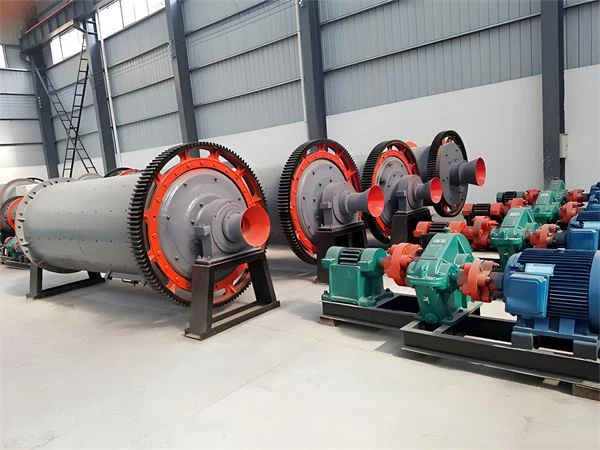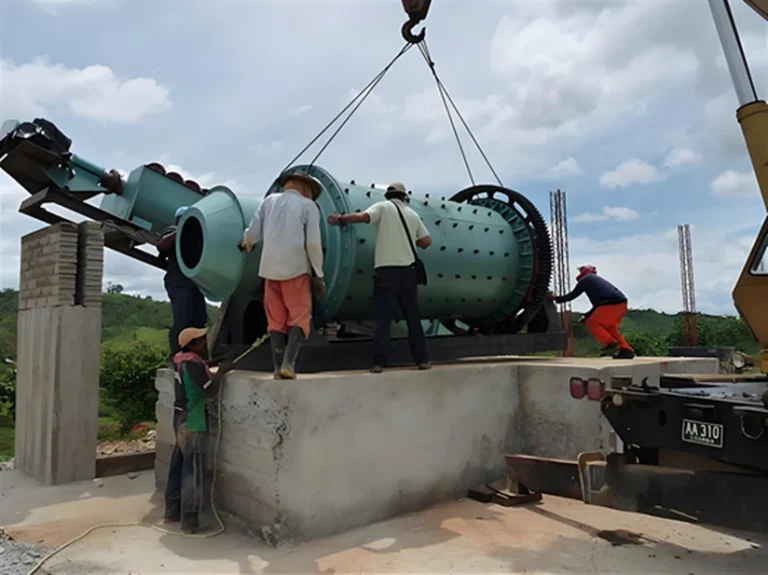


Continuous Ball Mill: How It Works, Key Advantages & Industrial Applications
In cement plants, mining operations, and chemical factories around the world, one machine quietly handles some of the most demanding work on the production floor: the continuous ball mill. Unlike equipment that needs to stop, reload, and restart between runs, a continuous ball mill keeps grinding without interruption—24 hours a day if the process demands it. That single characteristic changes the economics of large-scale powder production entirely. This guide covers everything you need to know: how the machine is built, how it works, where it excels, and where it falls short.
What Is a Continuous Ball Mill?
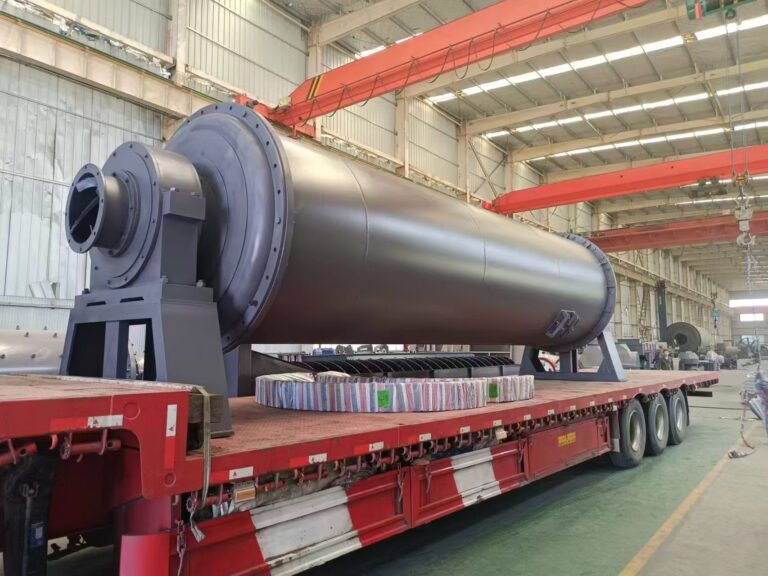
A continuous ball mill is a rotating cylindrical grinding machine that accepts material at one end and discharges ground product from the other—without stopping between cycles. Feed goes in, fine powder comes out, and the process runs uninterrupted.
The key distinction from a batch ball mill is operational. A batch mill loads a fixed charge of material, grinds it for a set time, then halts to discharge and reload. A continuous mill bypasses those idle periods entirely, which matters enormously when daily output targets are measured in hundreds of tonnes.
According to Wikipedia’s article on ball mills, ball milling systems are suitable for both batch and continuous operation and can function in open or closed circuits—making the continuous configuration one of the most versatile options in industrial size reduction.
Continuous Ball Mill Structure
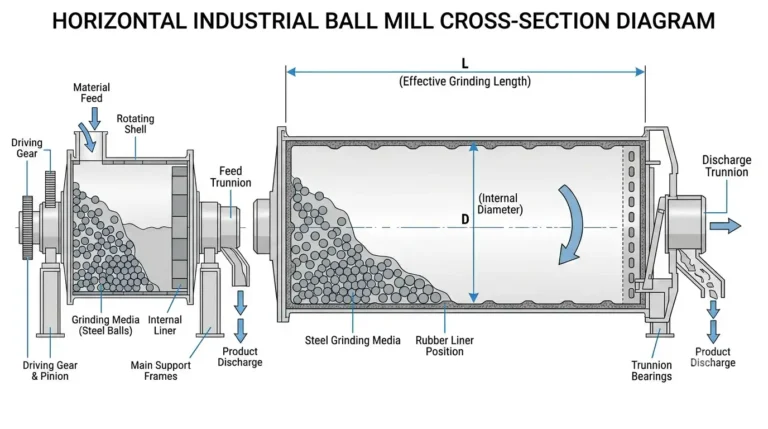
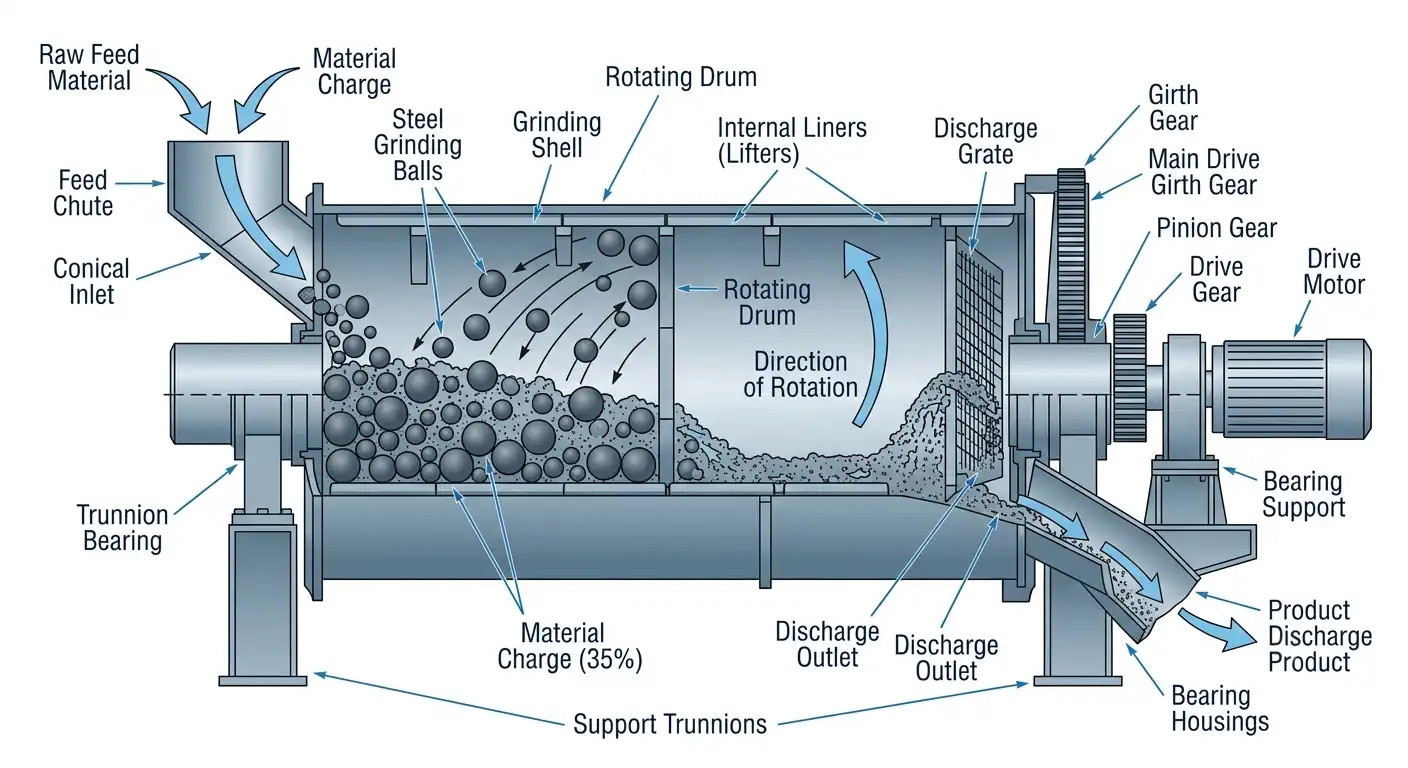
Six main components make up the machine:
- Rotating cylinder (shell): A steel drum that holds the grinding charge. The length-to-diameter ratio typically ranges from 1.5:1 to 3:1, depending on whether the application favors coarse or fine grinding.
- Liners: Replaceable wear-resistant plates (manganese steel, rubber, or ceramic) that protect the shell interior and influence how grinding media move inside. Liner shape—wave, step, or flat—affects both energy consumption and product fineness.
- Grinding media: Steel balls, ceramic balls, or steel rods loaded to roughly 30–40% of the cylinder’s internal volume. Ball size ranges from 20 mm to 120 mm depending on the feed material.
- Feed system: A screw feeder, spout feeder, or overflow pipe introduces raw material at the feed end. For operations requiring crushed feed, a C-type jaw crusher is commonly installed upstream to pre-reduce particle size before material enters the mill.
- Discharge system: Either an overflow outlet (material exits when it reaches a certain level) or a grate/diaphragm discharge (a slotted plate retains media but passes ground product). Grate discharge gives better control over residence time and is preferred for open-circuit wet grinding.
- Drive system: Motor, reducer, pinion gear, and ring gear rotate the cylinder at a controlled speed. Modern installations use variable frequency drives (VFDs) for energy savings and operational flexibility.
How Does a Continuous Ball Mill Work?
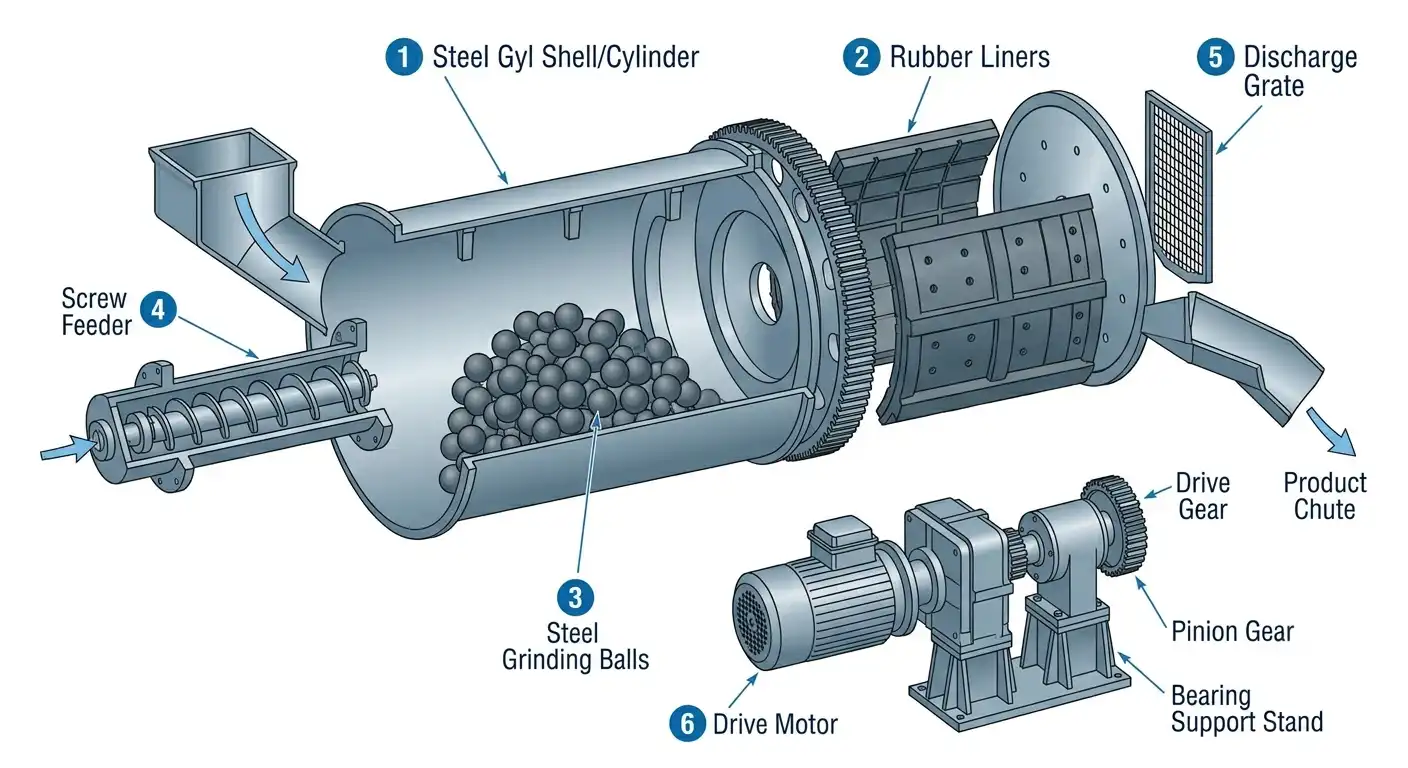
The operating principle is straightforward. Rotating the cylinder lifts the grinding balls up one side of the shell. When they reach a critical height, gravity pulls them back down in a cascading or cataracting motion. Material trapped between the balls—and between balls and the liner—is broken by two forces: impact (balls dropping from height) and attrition (balls rolling over each other).
In a continuous mill, fresh feed constantly pushes material through the cylinder from the feed end toward the discharge end. The feed rate and the mill’s rotational speed together control how long material stays inside—known as residence time. Longer residence time produces finer product but reduces throughput.
Most continuous mills operate at 70–75% of their critical speed—the theoretical speed at which centrifugal force would hold the balls against the wall instead of letting them fall.
Two grinding modes are standard:
- Wet grinding: Material mixed with water (or another liquid) forms a slurry that flows through the mill. Wet mode generally produces finer particle sizes, lowers dust generation, and reduces liner wear. It is the dominant approach in mining and mineral processing.
- Dry grinding: No liquid is added. Used when the final product must be dry (cement clinker, many industrial minerals) or when moisture would cause caking or chemical reactions. Requires dust collection systems.
Highlights of a Continuous Ball Mill
Before deciding whether this equipment fits an operation, it helps to understand its defining characteristics without the marketing framing:
- Accepts feed from ≤25 mm down to fine powder; typical output range is 0.074–0.89 mm, though finer grinding is achievable with the right configuration
- Supports both open-circuit and closed-circuit configurations (the latter paired with a screen, hydrocyclone, or air classifier)
- Operates in wet or dry mode
- Available in a wide range of sizes—from small units handling less than 1 t/h to large industrial mills exceeding 600 t/h
- High automation potential; modern units use PLC-based control systems that can adjust feed rate, water addition, and speed automatically
The MQ series ball mill is one example of a continuous-type machine designed for industrial-scale dry and wet grinding across both open and closed circuit configurations.
Performance Advantages of Continuous Ball Mill
Higher output per hour. Because there are no idle periods for loading and unloading, a continuous mill can process significantly more material per shift than a batch mill of equivalent size. The difference becomes more pronounced as target throughput rises.
More consistent product quality. Material moves through the mill in a steady flow, which tends to produce more uniform particle size distribution. In a batch mill, material at the start of a cycle can be overground by the time the preset run time ends.
Better thermal stability. The steady movement of slurry in wet-mode continuous mills prevents heat from accumulating locally. This keeps material temperatures more stable, which matters for products sensitive to thermal degradation.
Automation-compatible. The continuous feed-and-discharge design integrates cleanly with upstream conveyors and downstream classifiers, air separators, and packaging lines without manual intervention between cycles.
Lower labor cost per tonne. Once commissioned and running, a continuous mill requires less operator time per tonne of product compared to batch equipment of equivalent daily output.
Energy Consumption & Optimization
Grinding is among the most energy-intensive steps in mineral processing. According to the U.S. Geological Survey (USGS), comminution—the combined process of crushing and grinding—can account for 40–50% of total energy use in hard-rock mining operations.
Continuous ball mills are more energy-efficient per tonne than batch mills at large throughputs, primarily because steady-state operation avoids the repeated start-up energy spikes that characterize batch cycles. That advantage disappears at low throughput, however, because a partially loaded mill still draws most of its full-load power.
Key parameters that affect energy consumption:
| Parameter | Practical Range | Effect |
|---|---|---|
| Mill speed (% of critical speed) | 65–78% | Higher speed increases throughput but raises wear; optimal is typically 70–75% |
| Grinding media fill ratio | 30–40% by volume | Under-filling wastes energy; over-filling impedes cascading motion |
| Ball size distribution | 20–120 mm (graded) | Larger balls for coarse feed; finer balls for fine grinding stages |
| Feed rate | Matched to mill capacity | Under-feeding wastes energy; over-feeding reduces fineness |
| Slurry viscosity (wet mode) | Target 65–75% solids | Higher viscosity increases energy demand |
Source: Parameters compiled from Wikipedia — Ball mill and standard industry operating practice.
Practical optimization measures:
- Variable frequency drives on the main motor allow speed adjustment as feed hardness changes through the day
- Closed-circuit configuration with an air classifier recycles oversized particles, reducing unnecessary re-grinding of already-fine material
- Graded ball charging (mixing several ball sizes) can reduce specific energy consumption by 5–15% compared to single-size charging in many hard-ore applications
Why Choose a Continuous Ball Mill?
The decision comes down to production scale, material consistency, and operational requirements.
A continuous ball mill is the better choice when:
- Daily production exceeds roughly 10–20 tonnes and justifies the capital investment
- Particle size uniformity is critical (cement, paint pigments, ceramic body formulations)
- The process runs continuously and downtime between batches would hurt productivity
- The facility already has or plans to install automated feeding, conveying, and classification systems
Smaller operations, pilot plants, and producers handling many different materials in short runs are usually better served by batch equipment. There is no universal answer—the right choice depends on output volume, material variety, and budget.
For reference, real operations using continuous ball mills cover a wide range: from 2–3 t/h graphite ore grinding to 6 t/h manganese ore processing and 3–5 t/h feldspar milling.
Applications of Continuous Ball Mill
Mining & mineral processing: Grinding ore to liberate valuable minerals before flotation, leaching, or gravity separation. This is the largest single application globally, covering gold, copper, iron ore, lithium, and many other commodities.
Cement manufacturing: Grinding raw materials (limestone, clay, iron ore) into raw meal, and grinding clinker with gypsum to produce finished cement. Ball mills remain the dominant technology in this sector worldwide.
Building materials: Producing fine powders from quartz, feldspar, kaolin, and other silicates for glass, tiles, and composite materials.
Ceramics: Homogenizing ceramic body formulations and glazes to tightly controlled particle sizes that determine firing behavior and final properties.
Refractory materials: Grinding magnesite, bauxite, silicon carbide, and other high-temperature materials into powders for furnace linings and heat-resistant components.
Fertilizers & chemicals: Processing phosphate rock, potassium compounds, and chemical raw materials to the particle sizes required for downstream reactions or product formulation.
Paints & coatings: Wet grinding of pigments, fillers, and extenders (calcium carbonate, titanium dioxide) to submicron distributions that affect opacity and color consistency.
Continuous vs Batch Ball Mill
| Feature | Continuous Ball Mill | Batch Ball Mill |
|---|---|---|
| Operation mode | Uninterrupted feed and discharge | Load → grind → discharge cycles |
| Typical production scale | Medium to large (>5 t/h) | Small to medium (<5 t/h) |
| Particle size uniformity | High | Moderate (risk of overgrinding) |
| Automation potential | High | Low to moderate |
| Initial capital cost | Higher | Lower |
| Energy per tonne (at capacity) | Lower | Higher |
| Product changeover flexibility | Low | High |
| Operator labor per tonne | Lower | Higher |
| Best suited for | 24/7 large-scale production | Multi-product short runs |
Compiled from technical comparisons documented in Wikipedia — Ball mill.
Limitations to Know Before You Buy
No piece of equipment is universally right. Continuous ball mills have real drawbacks worth acknowledging:
High initial investment. The mill itself, the foundation, the drive system, and the associated feeders and classifiers represent substantial capital outlay. Operations with low throughput may never recover that investment.
Product changeover is slow. Switching between different materials in a continuous mill requires flushing the system and cleaning the grinding chamber. Batch mills handle product variety much better.
Heat generation. Grinding generates heat. In wet mode, slurry flow carries heat away reasonably well. In dry-mode operation at high throughput, temperature build-up can degrade some materials and may require active cooling systems.
Noise and vibration. Large rotating drums filled with steel balls are loud, typically above 85 dB at the mill body. Acoustic enclosures or hearing protection are standard practice in most regulatory environments.
Not suited for ultra-fine grinding. Below roughly 10 microns, ball mill efficiency drops sharply. Products requiring submicron or nanoscale particle sizes need stirred media mills, jet mills, or other specialized equipment instead. For extremely fine requirements, an ultrafine grinding mill handles that range more efficiently.
Summary
A continuous ball mill is the practical workhorse for operations that need consistent, high-volume powder production from hard or abrasive materials. Its core strengths—uninterrupted operation, uniform product quality, and compatibility with automated production lines—have made it standard equipment in mining, cement, and industrial minerals for more than a century. The trade-off is higher upfront cost, lower flexibility for varied batches, and a practical ceiling on fineness. Matching those characteristics honestly against the specific requirements of an operation will determine whether a continuous mill is the right investment.
FAQs
What is the difference between a continuous ball mill and a rod mill?
Both are tumbling mills, but a rod mill uses long steel rods instead of balls as the grinding medium. Rod mills typically produce a coarser, more uniform product and generate less slime, making them useful as a first grinding stage before a ball mill. Ball mills are preferred when finer particle sizes or higher reduction ratios are needed.
How long does a continuous ball mill run before requiring maintenance?
Liners typically last between 6 and 18 months depending on ore abrasiveness and operating hours. Grinding media are topped up continuously or on a scheduled basis. Bearings and the ring gear/pinion generally require inspection every 3–6 months. With a proper preventive maintenance schedule, planned downtime per year is usually 5–10% of total hours.
Can a continuous ball mill be used in a closed circuit with an air classifier?
Yes, and this is a common configuration for dry grinding in cement and industrial minerals. The mill discharges to an air classifier; oversized particles return to the mill, and on-spec fines exit as final product. This improves energy efficiency and tightens particle size control compared to open-circuit operation.
What is the minimum feed moisture level for dry-mode continuous ball mills?
Feed moisture should generally be below 1–3% for dry ball milling. Above that, material starts to coat the liners and balls rather than being ground, which reduces efficiency sharply. If feed is inherently wet, wet grinding mode (with controlled water addition) is typically more practical than trying to dry-grind damp material.
How does ball size affect grinding efficiency in a continuous ball mill?
Larger balls (80–120 mm) are more effective at breaking coarse, hard feed material through impact. Smaller balls (20–40 mm) create more contact points and are better at fine grinding through attrition. Most continuous mills use a graded charge—a mix of ball sizes—so that different stages of the grinding action are covered within the same mill. Optimizing this distribution for a specific ore and target particle size can reduce specific energy consumption meaningfully.