

Small Ball Mill Guide
If you’ve spent any time in mineral processing, ceramics, or small-scale chemical production, you already know that grinding efficiency makes or breaks the whole operation. A small ball mill sits at the center of that equation — compact enough to move to the ore, flexible enough to handle a dozen different materials, and simple enough that a two-person crew can keep it running for years. This guide covers everything from the physics inside the drum to the checklist you need before placing an order.
How a Small Ball Mill Works
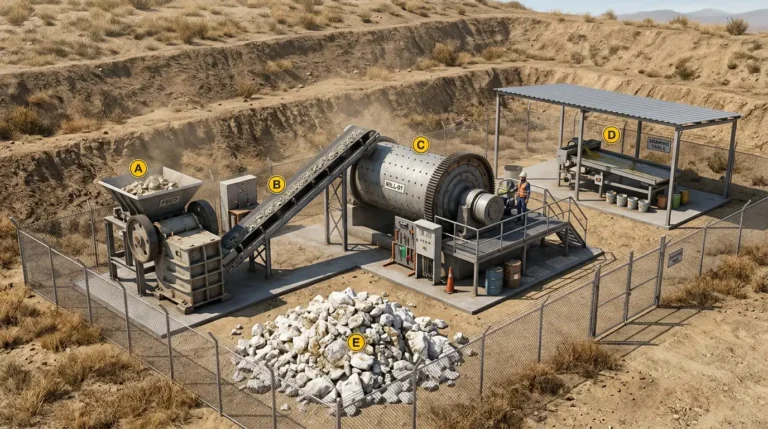
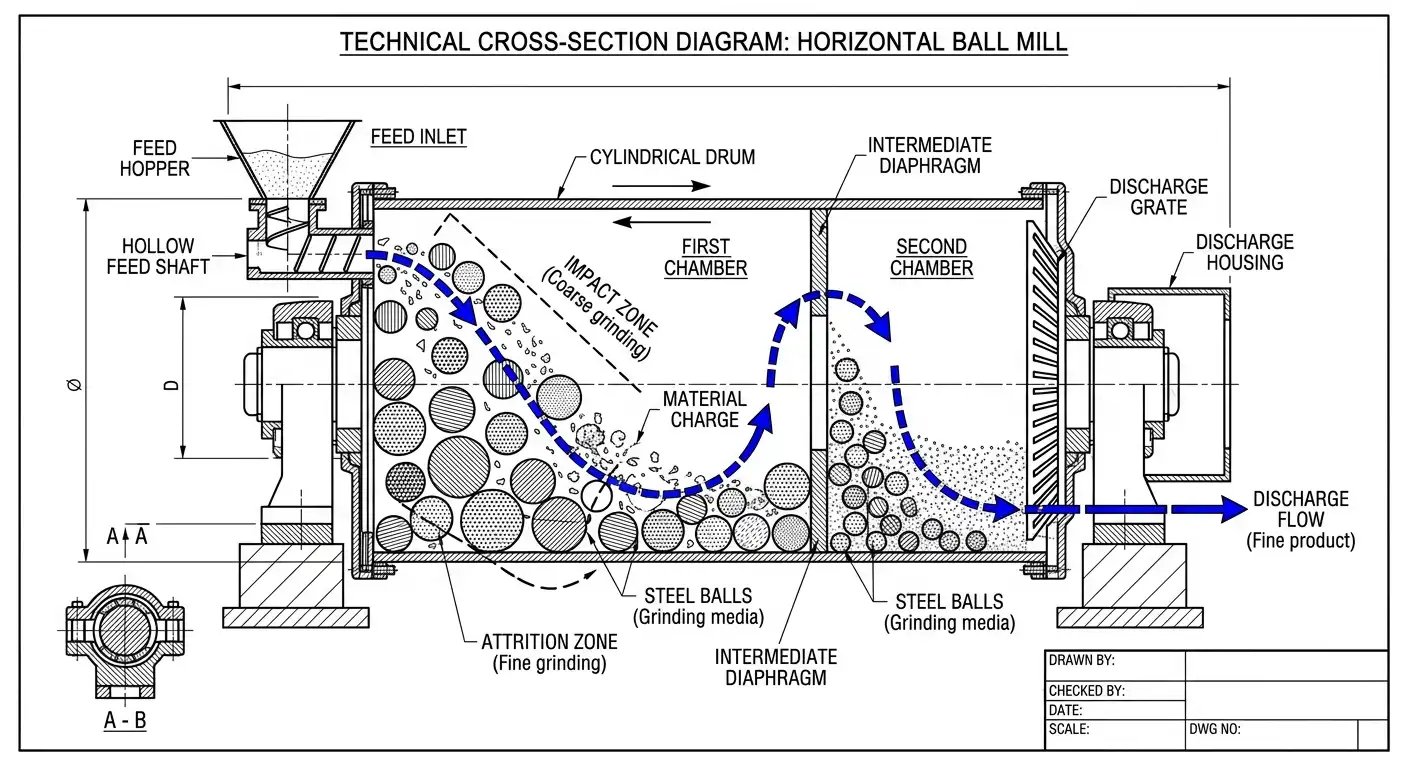
The operating principle hasn’t changed much since the early industrial era. A horizontal cylindrical drum rotates on its axis. Inside that drum, a charge of steel or ceramic balls — occupying roughly 30–45% of the drum’s internal volume — tumbles continuously. Feed material enters through the hollow shaft at the inlet end and exits, reduced in particle size, at the discharge end.
Two physical mechanisms do the actual work. Impact occurs when a ball is lifted by the rotating drum wall to a certain height and then falls freely onto the material below — this fractures coarser particles. Attrition (or abrasion) happens when balls roll against each other and against the drum lining, grinding finer particles down through surface friction.
The relationship between drum speed and grinding efficiency is not linear. At a specific rotational velocity — the critical speed — centrifugal force holds the entire ball charge against the drum wall and nothing falls. At that point, grinding stops completely. Most small ball mills run at 65–80% of critical speed, where the combination of impact and attrition produces the best size reduction. According to Wikipedia’s entry on ball mills, the critical speed in RPM can be approximated as 42.3 divided by the square root of the mill’s internal radius in meters.
In a two-chamber design, the first chamber handles coarse grinding with larger balls, and the second handles fine grinding with smaller media. Material exits when it is fine enough to pass through the discharge grate or overflow the discharge weir, depending on the mill type.
Types of Small Ball Mills
Not every small ball mill is built the same. The type determines what particle size you can reach, what materials you can handle, and what your operating costs will look like over time.
Horizontal Overflow Ball Mill — The most common configuration in small-scale mineral processing. Ground material exits by overflowing the discharge trunnion. Produces a fine, uniform product; well suited as the second grinding stage after primary crushing. A practical example is the 2–3 TPH ball mill for graphite ore grinding, where consistent particle size control was the primary requirement.
Horizontal Grate (Diaphragm) Ball Mill — Uses a perforated discharge grate to retain grinding media while letting finer pulp through. Allows a lower pulp level at the discharge end, reducing over-grinding. Common when the downstream process requires a tightly controlled product size.
Planetary Ball Mill — The grinding jar revolves around a central axis while simultaneously spinning on its own axis, generating centrifugal forces 5–20 times higher than gravity. Can produce sub-micron particle sizes down to 0.1 µm. The trade-off is throughput: planetary mills are limited to laboratory or small-batch use, typically under 10 liters per jar.
Vibratory Ball Mill — Uses high-frequency vibration rather than rotation. Effective for grinding small, brittle samples. Common in analytical laboratories and QC departments where the sample mass is measured in grams rather than kilograms.
Batch Ball Mill — Loads material, grinds for a set time, then discharges completely before the next cycle. Suited for pilot-scale testing and operations where cross-contamination between batches cannot be tolerated.
The MQ ball mill series covers both overflow and grate discharge configurations from 0.17 to 170 t/h — which illustrates how wide the capacity range is even within one design family.
Technical Specifications
The table below covers typical operating parameters for small-scale industrial ball mills. Laboratory planetary and vibratory units fall well outside these ranges.
| Parameter | Typical Range | Notes |
|---|---|---|
| Feed size | ≤ 25 mm | After primary or secondary crushing |
| Product size | 0.074 – 0.4 mm | Depends on ore hardness and retention time |
| Capacity | 0.65 – 25 t/h | Model-dependent |
| Motor power | 18.5 – 380 kW | — |
| Drum speed | 16 – 42 RPM | Typically 65–80% of critical speed |
| Ball filling ratio | 30 – 45% of drum volume | — |
| Length-to-diameter ratio | 1:1 to 1.5:1 | Higher ratio → finer grind |
Source: Standard manufacturer specifications. See also Wikipedia – Ball mill for the underlying engineering relationships.
Grinding Media Selection
The choice of grinding media affects three outcomes: grinding efficiency, product contamination, and operating cost per tonne. The right choice depends on the material being processed and the purity requirements of the final product.
| Media Type | Density (g/cm³) | Approx. Hardness | Best For | Avoid When |
|---|---|---|---|---|
| Carbon steel balls | 7.8 | HRC 60–67 | Ores, minerals, cement raw materials | High-purity products required |
| Stainless steel balls | 7.9 | HRC 58–64 | Corrosive slurries, chemical processing | Fe contamination unacceptable |
| Alumina (Al₂O₃) balls | 3.6–3.9 | Vickers 1200–1400 | Ceramics, coatings, pigments | Very abrasive hard ores (high wear) |
| Zirconia (ZrO₂) balls | 5.9–6.1 | Vickers 1200–1500 | Pharmaceuticals, electronics, fine chemicals | Budget-constrained operations |
| Flint / natural ceramic | 2.4–2.6 | Variable | Cement, tile glaze, low-purity apps | High efficiency required |
Source: Adapted from standard grinding media material data. See Wikipedia – Ball mill.
Ball diameter matters independently of material choice. Larger balls (60–100 mm) fracture coarser particles through impact. Smaller balls (15–30 mm) generate more contact surface and are more effective for fine grinding. Many small industrial mills use a mixed charge — larger balls in the first chamber, smaller media in the second.
Wet Grinding vs Dry Grinding
This decision is made at the process design stage and determines equipment configuration, liner material, and downstream circuit design.
Wet grinding — Material is mixed with water to form a slurry, typically 65–75% solids by weight. The liquid phase reduces inter-particle friction, carries fines out of the grinding zone efficiently, and cuts energy consumption per tonne of product. Wet grinding is standard in mineral processing because the slurry feeds directly into flotation or leaching circuits. The 6 TPH manganese ore grinding plant is a typical wet circuit at small industrial scale.
Dry grinding — No liquid is added. The mill must be sealed against dust and an efficient collection system is mandatory at discharge. Dry grinding typically produces a somewhat coarser product than wet grinding at equivalent energy input, but avoids downstream drying costs. Standard for cement clinker, certain chemical raw materials, and materials that react with water.
| Factor | Wet Grinding | Dry Grinding |
|---|---|---|
| Energy consumption | Lower per tonne | Higher per tonne |
| Product uniformity | Better | Acceptable |
| Minimum practical particle size | ~1 µm | Typically > 10 µm |
| Dust control required | Not needed | Mandatory |
| Downstream compatibility | Flotation, leaching | Conveying, dry classification |
| Liner wear rate | Moderate | Higher |
Applications
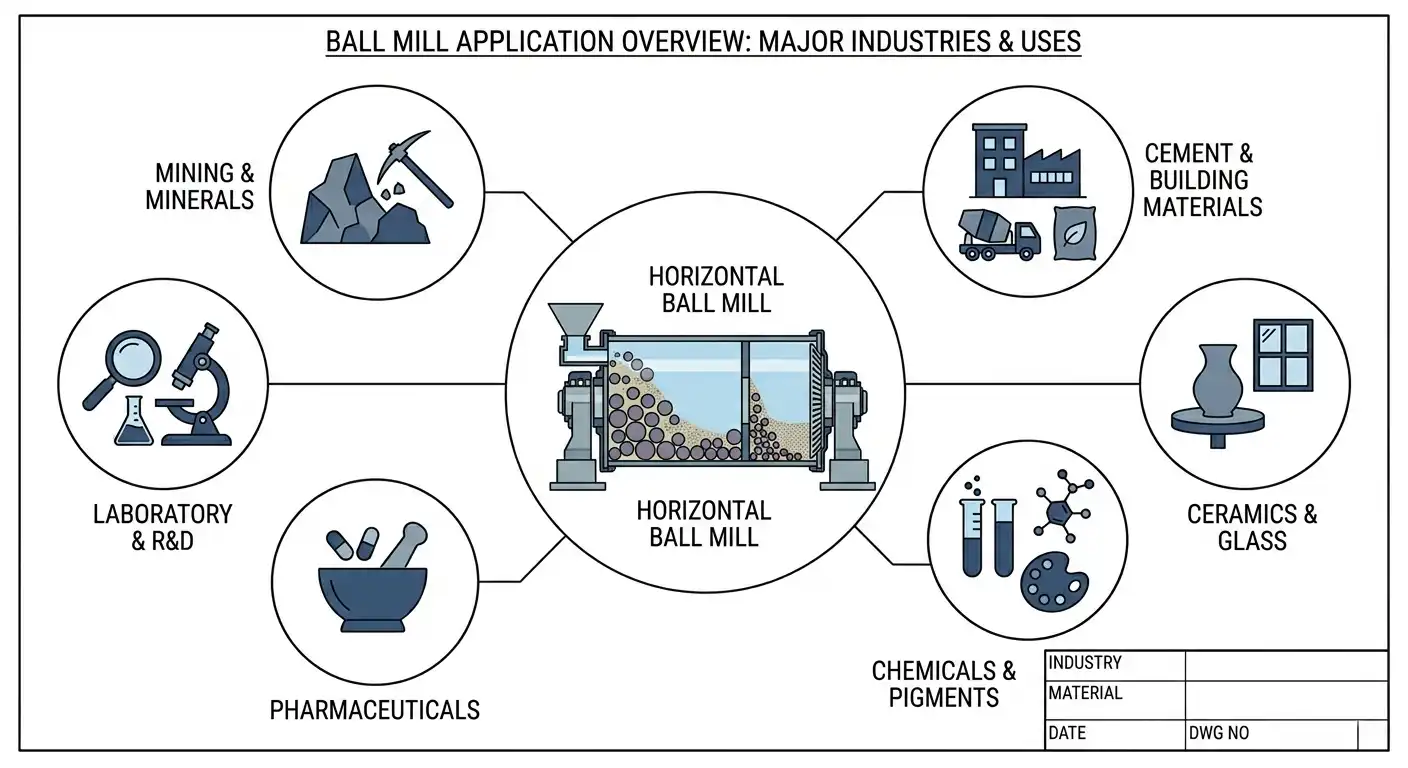
Small ball mills process a wider range of materials than many operators expect. The main industrial uses are:
- Mining and mineral processing — Gold, copper, iron ore, manganese, feldspar, graphite. The 3–5 TPH feldspar grinding plant shows how a compact ball mill handles a moderately hard silicate mineral at small production scale.
- Cement and building materials — Clinker regrinding, limestone powder, fly ash activation, slag processing.
- Ceramics and glass — Particle size reduction in tile glaze, porcelain body material, and enamel coating applications.
- Chemicals and pigments — Mixing and size reduction of paint pigments, carbon black, calcium carbonate, fertilizer additives.
- Pharmaceuticals — Micronization of active ingredients; for consistently sub-10 µm product, a dedicated MSF ultrafine grinding mill is often more energy-efficient.
- Laboratory and R&D — Sample preparation, mechanical alloying, nanoparticle synthesis in small planetary configurations.
Advantages
- Handles dry and wet feed without fundamentally changing the machine — liner choice and discharge system differ, but the drum-and-media concept remains the same.
- Closed-body design keeps dust inside the shell; for explosive or oxidation-sensitive materials, inert gas can be introduced to displace air entirely.
- Mechanically simple — few moving components, no complex seals, liners and media are replaced without specialized knowledge.
- Wide capacity range: the same horizontal drum design scales from 0.65 t/h pilot units up through full small-scale production circuits.
- Current energy-saving designs report 25–30% lower specific power consumption compared to machines built a decade ago.
- Mobile configurations allow the mill to be moved to the ore body rather than trucking material to a fixed plant — significant cost savings on remote or short-life sites.
Disadvantages and Limitations
- Noise and vibration — A running ball mill generates 90–105 dB(A) at the drum shell. Foundation design and vibration isolation are mandatory in any noise-restricted location.
- Energy intensity — Despite improvements, ball mills consume more energy per tonne than vertical roller mills at equivalent throughput. Where electricity cost dominates operating costs, this difference matters.
- Ineffective on soft, sticky, or fibrous materials — Wet clay, biomass, and fibrous materials tend to coat the balls and liner surface rather than fracture cleanly.
- Media and liner wear introduces contamination — Steel media wear introduces iron oxide into the product. In applications requiring iron-free product (white ceramics, certain pharmaceuticals), this is a real constraint.
- Over-grinding risk — Without a classifier in closed circuit, material spends more time than necessary in the mill, producing an excess of ultrafines that complicate downstream processing.
How to Choose the Right Small Ball Mill
Work through these four questions before contacting any supplier.
1. What are the material characteristics? Bond Work Index (if available), specific gravity, feed moisture, abrasiveness, and whether the material reacts with water all determine which media material, liner type, and circuit configuration are appropriate.
2. What are the throughput and product size requirements? A target of 5 t/h at 0.15 mm is a fundamentally different machine from 0.5 t/h at 0.04 mm. Be specific — vague specifications produce oversized or undersized equipment.
3. Wet or dry circuit? This single decision determines drum design, sealing system, liner material, motor sizing, and all downstream equipment. Settle it first.
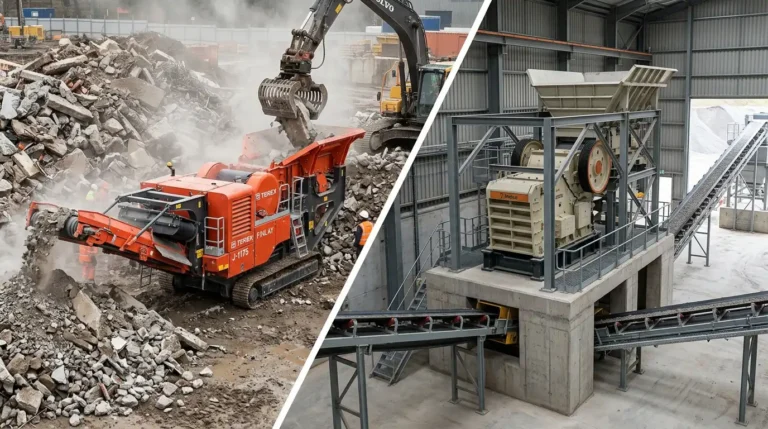
4. What does the upstream circuit produce? Ball mills are secondary grinding equipment and require feed no coarser than 25 mm in most designs. If your crushing circuit produces larger material, a C-type jaw crusher or a PEW jaw crusher stage is necessary upstream.
Checklist for supplier discussions:
- Bond Work Index or, at minimum, Mohs hardness of the feed material
- F80 (80% passing feed size) and P80 (target 80% passing product size)
- Required throughput in dry tonnes per hour
- Process water availability on site
- Power supply: voltage, frequency, available amperage
- Site constraints: floor area, headroom, noise limits, elevation above sea level
Summary
A small ball mill is the proven choice for size reduction at scales where large industrial equipment is overkill and manual grinding is impractical. The mechanics — rotating drum, tumbling media, impact and attrition — have proved reliable across mineral processing, ceramics, chemicals, and laboratory research for well over a century. The selection process isn’t complicated if you approach it systematically: understand the feed material, set a clear product size target, decide between wet and dry processing, and match those three parameters against the available types and specifications. Get those variables right and the remaining decisions follow directly.
FAQs
What is the minimum particle size achievable with a small ball mill?
In a conventional horizontal wet ball mill, reaching 74 µm (200 mesh) is routine. With fine media and extended retention time, 20–40 µm is achievable. Laboratory planetary mills can reach 0.1 µm (100 nm) under optimized conditions.
How long does a batch grinding cycle take in a small ball mill?
For small industrial batch mills, typical cycles run 1–4 hours depending on feed hardness, media size, and target fineness. Laboratory planetary mills achieve equivalent fineness in 15–60 minutes due to the much higher centrifugal forces involved.
What is the correct ball filling ratio for a small ball mill?
The standard recommendation is 30–45% of the effective drum volume. Below 30%, there is insufficient ball-to-ball contact and efficiency drops. Above 50%, the balls lack free fall distance and impact energy is wasted.
Can a small ball mill switch between wet and dry grinding?
Most horizontal mills are configured for one mode at manufacture. The discharge system, liner design, and dust sealing differ significantly between wet and dry configurations. Converting in the field requires substantial hardware changes and is generally not practical.
When does it make sense to use an ultrafine grinding mill instead of a ball mill?
When the target product size is consistently below 10 µm and throughput matters, a dedicated MSF ultrafine grinding mill delivers better energy efficiency and tighter particle size control than extending ball mill grinding time.