

Jaw Crusher Types Explained: PE, PEW, C Series, Fine, and Hydraulic-Driven Models
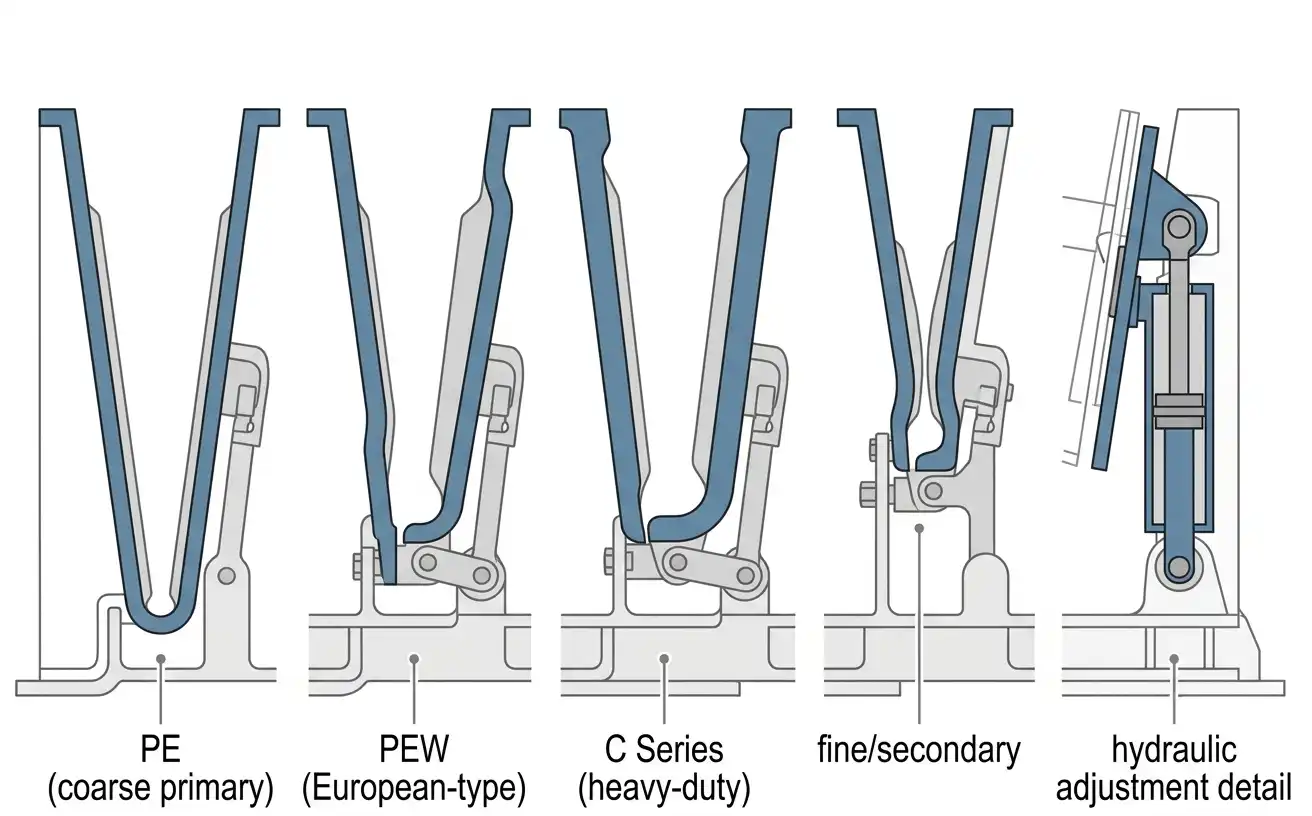
What are the different types of jaw crushers? Jaw crushers used in mining and aggregate production fall into five commonly referenced categories: PE crushers for coarse primary crushing, PEW (“European-type”) crushers with a deeper chamber and wedge-based setting adjustment, heavy-duty C Series crushers built for large open-pit and quarry operations, fine or secondary jaw crushers sized for smaller closed side settings, and hydraulic-driven models that use hydraulic cylinders instead of manual shims to adjust the discharge opening and relieve overload. These categories overlap: PE, PEW, and fine/secondary designations describe feed-opening and chamber geometry, C Series refers to a specific heavy-duty product line, and “hydraulic-driven” describes an adjustment mechanism rather than a distinct crushing principle. Selecting among them depends on feed material hardness, required capacity in tonnes per hour, target product size, and how much automation the operation needs.
What You Will Learn from This Guide
This guide sets out the mechanical working principle shared by all jaw crusher types, then breaks down the distinguishing features, typical feed opening ranges, capacity ranges, and power ratings for PE, PEW, C Series, fine/secondary, and hydraulic-driven crushers. It serves an engineer or procurement manager at the initial equipment-selection stage, before a formal quotation request, when the priority is narrowing a wide product category down to two or three candidate models. After reading this guide, a reader will be able to match a rock type and target throughput to a jaw crusher category, read a manufacturer’s specification sheet without relying on a sales engineer’s interpretation, and ask specific questions about frame construction, overload protection, and wear-part metallurgy during procurement. The guide also covers maintenance planning and the cost factors that separate a basic PE unit from a heavy-duty C Series installation.
Overview
A jaw crusher reduces large pieces of rock or ore into smaller fragments through compression between two steel plates. It is almost always the first machine in a crushing circuit, positioned directly after blasting or primary excavation and ahead of secondary crushing and screening stages, as demonstrated in a 100–150 t/h aggregate production plant built around a jaw-crusher-led flowsheet. The category spans a wide capacity range, from small units processing a few tonnes per hour in a laboratory or quarry startup to heavy-duty machines handling more than 1,000 t/h in a large open-pit mine.
The five types covered in this guide are not five parallel product lines competing on equal terms. PE and fine/secondary (often labeled PEX) describe feed-opening and chamber geometry conventions that originated with Chinese equipment manufacturers. PEW describes a European-influenced upgrade to the PE design, adding a deeper chamber and hydraulic-assisted setting adjustment. C Series is a genuine original-equipment-manufacturer product family, most closely associated with the Nordberg C Series line, built around a non-welded, pinned-and-bolted frame for heavy-duty duty cycles. Hydraulic-driven describes a feature — hydraulic setting adjustment and overload protection — that appears across several of the other categories rather than forming its own mechanical class. A procurement specification that simply asks for a “hydraulic jaw crusher” without also specifying feed opening, capacity, and frame construction is incomplete.
Working Principle
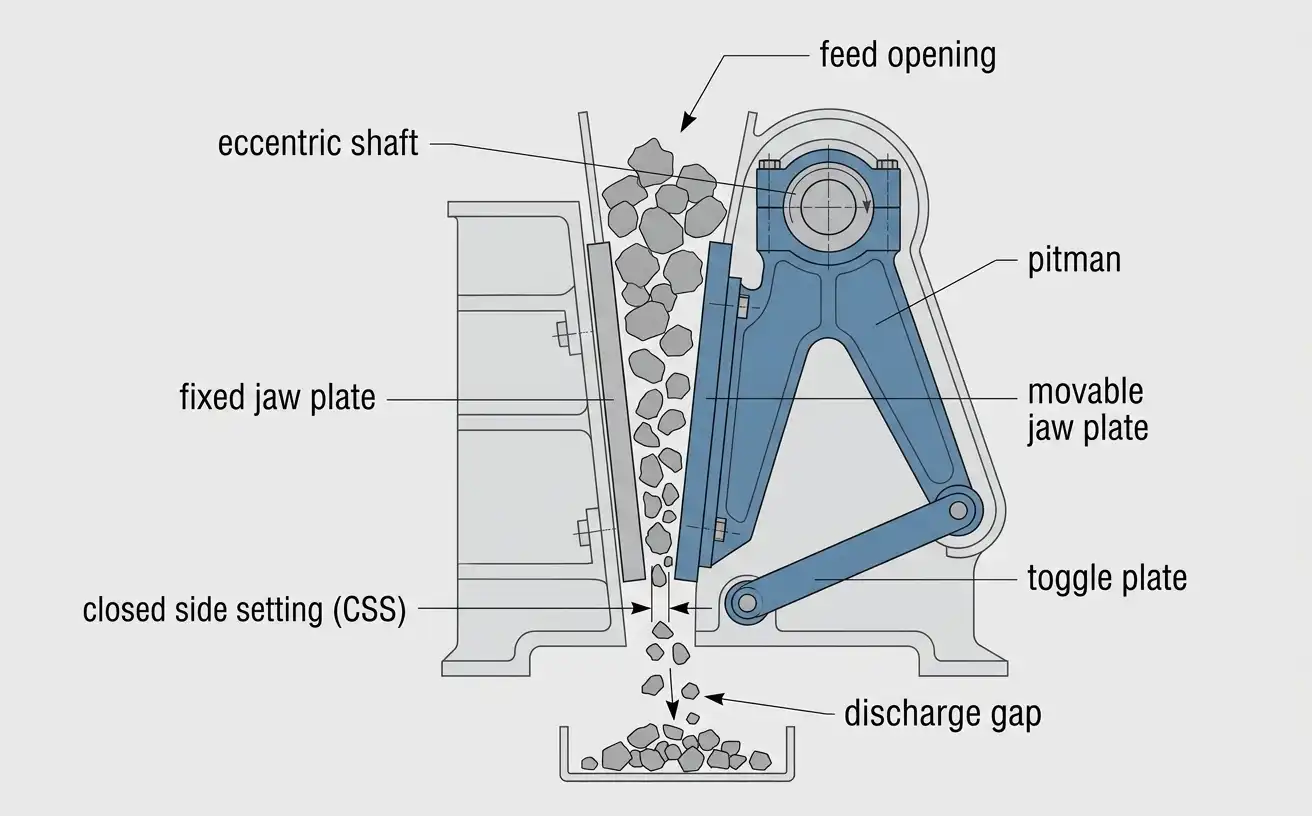
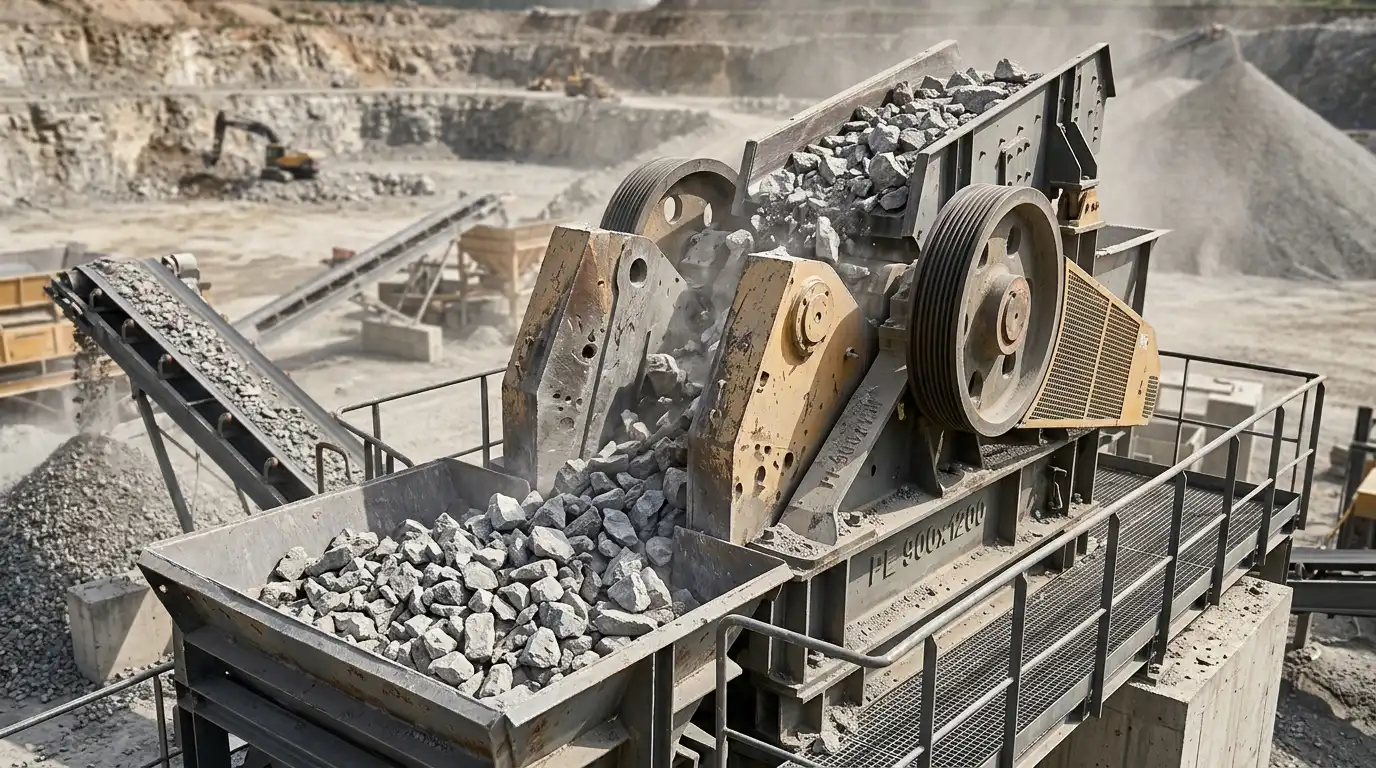
All five jaw crusher types share the same core mechanism. An electric motor drives an eccentric shaft through a V-belt and flywheel arrangement. The eccentric shaft imparts an elliptical motion to the pitman, which carries the movable jaw plate. On the closing stroke, the movable jaw plate presses rock against the fixed jaw plate, compressing and fracturing it. On the opening stroke, partially crushed material drops further into the chamber under gravity, and finished product exits through the gap at the bottom.
The angle between the two jaw plates is the nip angle. It typically falls between 19 and 23 degrees. A nip angle above roughly 26 degrees allows rock to slip upward rather than being drawn into the chamber, a condition operators describe as the crusher “boiling.” The gap at the bottom of the chamber at its narrowest point, measured when the jaws are fully closed, is the closed side setting (CSS). CSS governs the maximum product size and is the primary adjustable parameter on every jaw crusher covered in this guide.
The toggle plate performs a dual function: it transmits force from the pitman to the movable jaw, and it acts as a mechanical fuse. When an uncrushable object such as a piece of tramp steel enters the chamber, the toggle plate is designed to fail before the eccentric shaft, frame, or bearings sustain damage. Hydraulic-driven models add a secondary layer of protection on top of this mechanical fuse, using a hydraulic cylinder to relieve the setting automatically when an overload condition is detected, then reset it once the obstruction clears.
Two historical lineages underlie all modern single-toggle jaw crushers on the market today: the Blake design, patented by Eli Whitney Blake in 1858, in which the swing jaw pivots at the top and produces minimal movement at the bottom of the chamber; and the Dodge design, pivoted at the bottom, which produces a more uniform product size but at much lower throughput and is now largely confined to laboratory sample preparation.
Types and Model Comparison
PE Jaw Crusher
The PE designation covers the standard, coarse primary jaw crusher built around a deep V-shaped chamber and a square feed opening. Model numbers describe feed-opening width and length in millimeters — a PE900×1200, for example, accepts a feed opening of 900 by 1,200 mm. Setting adjustment on a baseline PE unit uses manual shims or gaskets inserted behind the toggle seat, a process that typically requires stopping the machine and takes longer than the wedge-based systems described below. PE crushers handle feed material with unconfined compressive strength up to roughly 320 MPa and are the most widely deployed jaw crusher configuration in mining and quarrying globally. Selection guidance and full specification tables for this line are available on the PE Jaw Crusher product page.
PEW Jaw Crusher (European-Type)
PEW crushers modify the PE chamber geometry to be deeper and narrower, which increases the effective crushing stroke and improves material flow through the chamber. The frame is typically an integrated cast-steel or bolted (non-welded) structure rather than a fully welded fabrication, and the eccentric shaft is forged rather than cast, which extends fatigue life under continuous duty. The defining operational difference from a baseline PE unit is the discharge setting mechanism: PEW crushers use a double-wedge adjustment system, often hydraulically assisted, that allows the CSS to be changed in two to three minutes rather than requiring a shim change. Many PEW models also include hydraulic chamber clearing, which lifts and reverses the movable jaw to clear a jammed chamber without manual intervention. Specifications for this line are available on the PEW Jaw Crusher product page.
C Series Jaw Crusher
C Series is the heavy-duty product family most associated with continuous, high-tonnage primary crushing in large open-pit mines and quarries. The defining engineering choice is a non-welded, pinned-and-bolted frame construction, validated by finite-element analysis and built with internal ribbing for fatigue resistance — a design philosophy that differs from the fully welded frames used by some competing heavy-duty product lines. This is a genuine engineering trade-off rather than a settled question: a pinned-and-bolted frame allows individual sections to be replaced in the field without welding, while a welded frame is marketed by its proponents as offering uniform strength in every direction against shock loading. Both approaches are in active commercial use on large installations. Larger C Series models add hydraulic overload protection integrated with the toggle system, which relieves the setting automatically on an uncrushable object and resets once it clears, and plant-level automation for remote setting adjustment and monitoring. Full technical data for this line is available on the C Jaw Crusher product page.
Fine and Secondary Jaw Crusher
Fine or secondary jaw crushers, often labeled PEX, invert the PE chamber proportions: the chamber is shorter and wider rather than tall and narrow, which produces a more uniform product at a smaller closed side setting. They are positioned as a second crushing stage after a PE or C Series primary, or used standalone in smaller aggregate operations where a single machine must produce a finer output than a primary crusher can achieve. Laboratory-scale fine jaw crushers are a distinct sub-application: bench-top units with manganese steel, stainless steel, or tungsten-carbide jaw plates process sample quantities down to roughly 500 kilograms per hour for material characterization work, where cross-contamination between samples is a design concern rather than throughput.
Hydraulic-Driven Jaw Crusher
“Hydraulic-driven” describes a feature set rather than a sixth mechanical category. It refers to the use of hydraulic cylinders — instead of, or in addition to, mechanical shims and wedges — for two functions: adjusting the closed side setting, and providing overload protection that relieves and automatically resets the setting when an uncrushable object enters the chamber. This feature appears on PEW models, on larger C Series models, and on other manufacturers’ equivalents. A specification written simply as “hydraulic jaw crusher” without also naming a feed opening, capacity, and base model line does not specify a machine precisely enough for quotation.
Table 1. Jaw crusher type comparison by feed opening, capacity, and power
| Type | Typical feed opening | Max feed size | CSS / discharge range | Capacity range | Motor power |
|---|---|---|---|---|---|
| PE (coarse primary) | 150×250 mm to 1,200×1,500 mm | ~125–1,020 mm | 10–360 mm | 1–1,120 t/h | 5.5–200+ kW |
| PEW (European-type) | up to ~1,200×1,000 mm | ~0–720 mm | wedge-adjustable | 15–500 t/h | mid- to high-range kW |
| C Series (heavy-duty) | 800×510 mm to 2,000×1,500 mm | 410–1,200 mm | 40–300 mm | ~55–1,435 t/h (scalped feed) | 75–400 kW |
| Fine / secondary (PEX) | 125–300 mm | ≤250 mm | 10–140 mm | 1–120 t/h | small- to mid-range kW |
| Hydraulic-driven (feature) | model-dependent | model-dependent | hydraulic adjustment | model-dependent | model-dependent |
Source: manufacturer specification sheets and technical brochures for the C Series and comparable heavy-duty jaw crusher product lines; figures for scalped-feed capacity assume a defined feed gradation and material density and will vary with actual feed conditions.
The largest models in the C Series line illustrate the scale a heavy-duty jaw crusher can reach: the largest jaw crusher currently in serial production accepts a feed opening around 1,600×1,200 mm with a rated capacity in the range of 1,145 t/h on scalped feed, running at approximately 220 revolutions per minute on a 250 kW motor. Capacity is the variable procurement teams weight most heavily when narrowing a shortlist, and it should always be checked against the CSS the application actually requires — a machine rated for high capacity at a wide CSS will not deliver the same tonnage at the narrower setting a fine-crushing duty demands.
Specifications and Parameters
Jaw crusher capacity is not a single fixed number; it is a function of feed opening, CSS, feed gradation, and material characteristics, expressed as a curve rather than a point. Manufacturers typically publish two capacity figures for the same model: a “scalped feed” rating, which assumes fines have already been removed from the feed by a grizzly or scalping screen ahead of the crusher, and a “non-scalped” rating for raw run-of-mine feed, which is lower because the crusher spends part of its cycle handling material already fine enough to pass through without further reduction. A quoted capacity figure without stating which basis it uses is not directly comparable to a competing quote.
Table 2. Representative model specifications across the size range
| Parameter | Small model | Mid-size model | Large model |
|---|---|---|---|
| Feed opening (mm) | 800 × 510 | 1,200 × 870 | 2,000 × 1,500 |
| Max feed size (mm) | 410 | 700 | 1,200 |
| CSS range (mm) | 40–175 | 70–175 | 175–300 |
| Motor power (kW) | 75 | 160 | 400 |
| Capacity, scalped feed (t/h) | 55–335 | 175–540 | 630–1,435 |
Source: heavy-duty jaw crusher manufacturer technical brochures. Capacity figures assume a stated feed material density and gradation and are provided by the manufacturer as a design reference, not a site-specific guarantee.
The table shows that capacity does not scale linearly with motor power: the large model uses roughly 2.5 times the power of the small model but delivers up to eight times the top-end capacity, reflecting the disproportionate gain in throughput from a larger feed opening and CSS range. This is the parameter set procurement teams should request from any manufacturer during quotation — feed opening, max feed size, CSS range, motor power, and capacity stated on a specified basis — rather than a single capacity number in isolation.
Manganese-steel jaw dies are the standard wear surface across every type in this guide; nickel-hard alloys are used in some abrasive, high-silica applications as an alternative. Wear-life projections depend heavily on site-specific ore abrasiveness, feed moisture, and operating hours, and published wear-life figures from one operation do not transfer reliably to another. Readers evaluating wear-part life for a specific ore or aggregate should request an application-specific projection from the manufacturer’s engineering team using representative feed samples, rather than relying on a generic figure.
Selection Criteria
Choosing among the five categories starts with three inputs: the unconfined compressive strength of the feed material, the required product size (the CSS the application needs), and the target throughput in tonnes per hour. A common sizing practice is to specify a crusher rated at 120 to 130 percent of the required average throughput, which provides margin for feed variability and scheduled downtime without oversizing the machine for its typical operating point.
Rock hardness sets the outer boundary of the selection. Granite, basalt, and quartz-bearing ores at the higher end of the compressive-strength range call for PEW or C Series designs, whose deeper chambers and reinforced frames are built for continuous high-stress duty; softer limestone and river gravel can be processed economically on a baseline PE unit. Feed size and required CSS determine whether a single-stage PE or C Series primary is sufficient or whether a fine/secondary unit is needed downstream to reach the target product size — a decision also shaped by whether a cone crusher, such as the CS Symons cone crusher, is already specified for that secondary stage, since a cone crusher performs a broadly similar size-reduction role at that point in the flowsheet.
Automation requirements are the final filter. A remote or unmanned quarry site benefits from hydraulic setting adjustment and automated overload protection, since a manual shim change requires a technician on-site and machine downtime; a smaller, closely supervised operation may not need that level of automation and can specify a mechanically adjusted PE unit at lower capital cost. The 200–250 t/h basalt crushing plant case illustrates a high-hardness, high-tonnage application where a heavy-duty configuration was the deciding factor, while the 60 t/h slate crushing plant case shows a lower-tonnage, lower-hardness duty where a standard PE configuration was sufficient.
Applications by Material and Industry
Jaw crushers process a wide range of feed materials, and the required type varies accordingly. Basalt and granite, both common in aggregate and road-base production, sit at the higher end of the compressive-strength range and typically justify a PEW or C Series primary; a 200 t/h basalt crushing plant illustrates this pairing at production scale. River stone and river pebble, rounded and moderately abrasive, are common feed materials for construction aggregate; the 200 t/h river stone crushing plant and 60 t/h river pebble crushing plant cases both use a jaw-crusher-led circuit at different production scales. Slate, softer and more fissile than basalt or granite, generally allows a lighter-duty configuration, as shown in the 60 t/h slate case referenced above.
Beyond aggregates, jaw crushers serve as the primary reduction stage in metal ore mining (copper, gold, and iron ore operations commonly use a PE or C Series primary ahead of ball milling or further crushing stages), in construction and demolition (C&D) recycling, where feed material is less predictable and toggle-plate protection against embedded rebar or steel becomes a more frequent operational concern, and in general quarrying for construction aggregate and railway ballast. A downstream vibrating screen, such as the S5X vibrating screen, is standard practice after jaw crushing to separate finished product from oversize material requiring further reduction.
Maintenance and Wear Parts
The jaw dies (fixed and movable jaw plates) are the primary wear component on every type covered in this guide and are typically manufactured from manganese steel for its work-hardening properties under repeated impact. Cheek plates, positioned on the sides of the crushing chamber, are a secondary wear item protecting the frame itself and require less frequent replacement than the jaw dies. The toggle plate, as described in the working-principle section above, is engineered as a sacrificial component: it is expected to fail before the eccentric shaft, bearings, or frame sustain damage from an uncrushable object, and a stock of replacement toggle plates is a standard maintenance-inventory item on any active site.
Setting adjustment frequency differs meaningfully between mechanical and hydraulic systems. A shim-adjusted PE unit typically requires the crusher to be stopped and partially disassembled to change the CSS, a process that can take an hour or more depending on model size. A wedge-adjusted PEW or hydraulically adjusted C Series unit can complete the same change in a few minutes without full disassembly, which reduces cumulative downtime on sites that adjust the setting frequently to manage product gradation. This difference in maintenance labor is a legitimate factor in total cost of ownership, separate from the purchase price comparison covered below. The PE Jaw Crusher product page includes recommended maintenance intervals for the baseline mechanical-adjustment configuration.
Cost and Procurement
Purchase price for a jaw crusher scales primarily with feed opening, motor power, frame construction, and the level of hydraulic automation included. A baseline PE unit at a given capacity is generally the lowest-cost option in its size class; a PEW or C Series unit of comparable capacity carries a higher purchase price, reflecting the deeper chamber, reinforced frame, and hydraulic systems described earlier in this guide. As a general reference point across the crusher category, a comparable cone crusher — such as the HP hydraulic multi-cylinder cone crusher used for secondary crushing — typically carries a purchase price in the range of 20 to 40 percent above an equivalent-capacity jaw crusher, reflecting the additional secondary-crushing machinery involved.
Lead time and spare-parts availability are practical procurement factors beyond the headline purchase price. Wear parts (jaw dies, cheek plates, toggle plates) should be sourced with a defined lead time before commissioning, since an unplanned wear-part stockout is a common cause of unscheduled downtime on new installations. Buyers should request, alongside the base equipment quotation, a documented spare-parts list with lead times and a maintenance-interval schedule specific to the quoted model, rather than treating these as a follow-up conversation after purchase.
Frequently Asked Questions
What is the difference between a PE and PEW jaw crusher?
A PE jaw crusher uses a standard chamber depth and manual shim-based setting adjustment, while a PEW jaw crusher uses a deeper chamber and a wedge-based, often hydraulically assisted, setting adjustment that can be changed in minutes rather than requiring disassembly. Both share the same underlying eccentric-shaft compression mechanism.
How is jaw crusher capacity measured?
Capacity is measured in tonnes per hour and is reported on either a scalped-feed or non-scalped-feed basis, since removing fines ahead of the crusher with a grizzly screen changes the effective tonnage the machine processes. A capacity figure is only comparable between two quotations when both state the same basis, feed gradation assumption, and material density.
What rock types is a jaw crusher suitable for?
Jaw crushers handle feed material with unconfined compressive strength up to approximately 320 MPa, covering common quarry and mining materials from limestone and river gravel through granite and basalt. Harder, more abrasive rock generally justifies a reinforced PEW or C Series configuration over a baseline PE unit.
How often does a jaw crusher need maintenance?
Jaw die inspection is typically performed at scheduled intervals tied to operating hours rather than a fixed calendar period, since wear rate depends on feed abrasiveness and tonnage processed. Toggle plates are inspected as a sacrificial safety component and replaced immediately after any uncrushable-object event rather than on a routine schedule.
Is a hydraulic jaw crusher more expensive than a mechanical one?
Hydraulic setting adjustment and overload protection add cost relative to a baseline mechanically adjusted unit of the same size class, but the difference is typically offset over the equipment’s service life by reduced downtime during setting changes and lower risk of major frame or shaft damage from tramp material.