

Ball Mill Types Explained: Wet vs Dry, Overflow vs Grate, & Selection Guide
The same rotating drum that grinds gold ore around the clock in a Chilean copper mine also exists in a pharmaceutical lab grinding APIs to micron size — yet these two machines belong to entirely different categories of ball mill. Picking the wrong type means oversized energy bills, chronic overgrinding, or a product that simply fails to meet spec. Getting it right means lower costs, longer equipment life, and a grinding circuit that fits cleanly into the downstream process. This guide cuts through the classification logic, compares the key types head to head, and gives you a decision framework you can apply immediately.
How Ball Mills Are Classified
Industrial ball mills are grouped along four main dimensions:
| Classification axis | Main sub-types |
| Grinding medium environment | Wet ball mill / Dry ball mill |
| Discharge mechanism | Overflow / Grate discharge (diaphragm) |
| Shell geometry & L/D ratio | Short-cylinder (L ≤ 2D) / Tube mill (L > 2D) / Conical mill |
| Operating mechanism & scale | Planetary / Vibratory / Stirred (Attritor) / Industrial tumbling |
The first two axes — wet/dry and overflow/grate — drive the most frequent purchasing decisions and are covered in depth below.
For a full breakdown of ball mill structure and components, see: The Mechanical Structure of the Ball Mill — MR CRUSHER
Working Principle
Regardless of type, all ball mills rely on two physical forces:
- Impact: the rotating drum lifts balls to height, then gravity drops them onto the feed material, fracturing large particles.
- Attrition: balls rubbing against each other and the liner grind particle edges down to finer sizes.
Rotational speed is the key operating variable. Most mills run at 65–80% of critical speed — the speed at which centrifugal force would pin balls to the drum wall and stop all grinding. The liquid medium in wet mills changes friction dynamics and dissipates heat; dry mills rely on airflow for product discharge, and any steel wear debris becomes part of the product. Overflow mills allow long residence times before product exits; grate mills force discharge through a grid, cutting residence time and reducing overgrinding.
Wet Ball Mill vs Dry Ball Mill
Operating Mode Differences
In a wet ball mill, water or a solvent is added during grinding and the product exits as a slurry. In a dry ball mill, no liquid is used; air sweeps the fine powder out of the drum. The discharge systems differ accordingly: wet mills use a spiral or overflow outlet; dry mills require a ventilation duct and dust collection system.
Performance Comparison
| Factor | Wet ball mill | Dry ball mill |
| Energy consumption | ~20–30% lower than dry | Higher |
| Particle size distribution | Finer, narrower distribution | Broader distribution |
| Dust handling | No dust; cleaner environment | Requires dust collection system |
| Suitable materials | Most ores, chemical raw materials | Cement clinker, building materials, water-reactive materials |
| Post-processing | Slurry requires dewatering & drying | Product is dry powder directly |
| Grinding media wear | ~20% higher than dry | Relatively lower |
| Maintenance complexity | Simpler overall | Requires ventilation & dust system upkeep |
Which to Choose
- Prefer wet grinding: metallic ore processing (gold, copper, iron), chemical slurry production, any application requiring fine particle sizes.
- Prefer dry grinding: cement clinker, construction materials, materials that react chemically with water.
Overflow Ball Mill vs Grate Discharge Ball Mill
Structural Differences
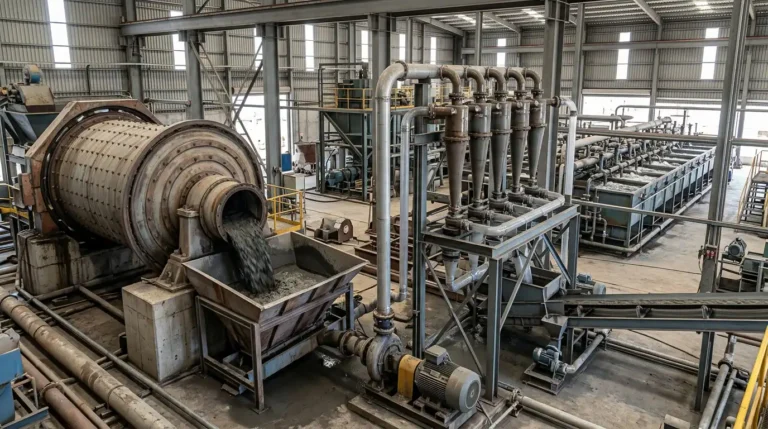
An overflow ball mill has no discharge grate — material exits by overflowing the trunnion at the discharge end when slurry level rises high enough. Its structure is simple and cost-effective. A grate discharge ball mill installs a grate plate (diaphragm) at the discharge end that physically controls the maximum particle size leaving the mill, forcing faster discharge and reducing the time material spends being ground.
Performance Comparison
| Factor | Overflow mill | Grate discharge mill |
| Discharge mechanism | Material overflows trunnion naturally | Grate plate controls forced discharge |
| Overgrinding risk | Higher — long residence time | Lower — short residence time |
| Product particle size | Finer (150–200 mesh) | Coarser (60–100 mesh) |
| Power draw | Lower | ~18–20% higher than overflow |
| Structural complexity | Simple; lower capital cost | More complex; higher maintenance cost |
| Typical application | Secondary fine grinding, regrinding | Primary coarse grinding |
Decision Logic
- Fine grinding required, overgrinding not a concern → overflow mill.
- Coarse grinding, or material sensitive to overgrinding (certain gold/copper ores) → grate discharge mill.
- In mining circuits: first-stage grinding → grate; second-stage regrinding → overflow.
For a comparison of ball mill vs pebble mill grinding media choices, see: Ball Mill vs Pebble Mill — MR CRUSHER
Grinding Media Selection
Grinding media material, size, and fill ratio are the most influential operational variables across every ball mill type.
| Media type | Hardness | Wear resistance | Contamination risk | Typical application |
| High-chrome steel balls | High | Excellent | Iron ions | Ore grinding, cement |
| Low-chrome alloy balls | Medium-high | Good | Trace iron | General mineral grinding |
| Ceramic balls (alumina) | High | Excellent | Zero | Pharmaceuticals, electronics, fine chemicals |
| Stainless steel balls | Medium | Good | Minimal | Food, medical-grade milling |
| Rubber balls | Low | Moderate | None | Light minerals, noise-sensitive environments |
Ball size matters too: large balls (50–100 mm) deliver high impact for coarse grinding; smaller balls (20–40 mm) maximize contact area for fine grinding. Industrial mills typically use a graded mix — a common ratio is large:medium:small = 3:4:3 — with fill ratios of 30–45% by drum volume. In wet grinding, media wear runs approximately 20% higher than in dry grinding, a cost that belongs in total operating cost calculations.
Energy Efficiency
According to research on grinding energy consumption, comminution processes account for roughly 50% of a mineral processing plant’s total energy demand, yet ball mill grinding efficiency typically remains below 15% — most input energy is lost as heat and noise.
| Comparison | Relative energy profile | Practical implication |
| Wet vs dry | Wet: ~20–30% lower energy | Prefer wet for ore processing |
| Grate vs overflow | Grate: ~18–20% higher power draw | Grate offsets higher draw by reducing regrind load |
| Closed-circuit vs open-circuit | Closed: ~10–15% better energy efficiency | Large operations should use closed-circuit design |
| Energy-saving ball mill design | Self-aligning bearings save 25–30% | Specify energy-saving models when selecting equipment |
Practical efficiency improvements: maintain 65–80% of critical speed; keep media fill at 30–45%; pair the mill with a hydrocyclone in closed-circuit operation to cut circulating load and overgrinding.
Advantages and Limitations by Type
| Type | Key advantages | Main limitations | Scale |
| Wet ball mill | Energy-efficient, fine particle size, no dust | Slurry dewatering needed; higher media wear | Large industrial |
| Dry ball mill | Direct dry powder; handles water-reactive materials | High dust generation; higher energy draw | Medium–large industrial |
| Overflow mill | Simple structure, low cost, fine product | Higher overgrinding risk | Secondary fine grinding |
| Grate discharge mill | Controls particle size; reduces overgrinding | More complex; higher maintenance | Primary coarse grinding |
| Planetary ball mill | Ultra-fine grinding; high energy density | Small capacity; expensive | Laboratory |
| Vibratory ball mill | High-frequency, efficient for brittle materials | Noisy; small batch size | Lab / small-scale |
| Stirred mill (Attritor) | Best efficiency for ultra-fine wet grinding | High media wear; complex maintenance | Specialty industrial / R&D |
How to Choose the Right Ball Mill
There is no universally best type — only the right type for a specific set of conditions. Work through these five steps:
- Step 1 — Define material properties: hardness, reactivity with water, sensitivity to iron contamination. Hard, abrasive ores need high-chrome steel balls; purity-critical products need ceramic media.
- Step 2 — Establish target particle size: coarse grind (60–100 mesh) → grate discharge; fine grind (150–200 mesh) → overflow; ultra-fine / nanoscale → planetary or stirred mill.
- Step 3 — Choose wet or dry mode: water-reactive materials (cement clinker) → dry; ore beneficiation → wet preferred.
- Step 4 — Match to production scale: continuous large-scale output → industrial tumbling mill; small-batch R&D → planetary or vibratory mill.
- Step 5 — Calculate total cost of ownership: capital cost + media consumption + energy + maintenance. Choose the option with the lowest total, not just lowest purchase price.
Industry quick-reference
| Industry | Recommended type | Recommended mode |
| Metal ore beneficiation | Grate (1st stage) + Overflow (2nd stage) | Wet |
| Cement production | Tube mill (multi-chamber) / dry ball mill | Dry |
| Pharmaceuticals / fine chemicals | Planetary / stirred mill (ceramic media) | Wet |
| Ceramics & glass | Overflow ball mill | Wet or dry |
| Laboratory sample prep | Planetary / vibratory mill | Either |
Conclusion
Choosing a ball mill type is an exercise in matching three variables: material properties, target particle size, and production scale. Wet grinding is more energy-efficient and produces finer, more uniform particles — the default for ore beneficiation. Dry grinding serves cement and other water-reactive materials. The grate discharge mill gives tighter particle size control at the cost of higher power draw; the overflow mill keeps things simple for fine-grinding duties. Across all types, grinding media selection — material, size, and fill ratio — remains the single most controllable variable for optimizing output. Apply the five-step selection framework above to any new project and the right mill type becomes clear before a single quote is requested.
FAQ
For a single-stage mining grinding circuit, grate discharge or overflow ball mill?
For primary grinding directly after crushing, choose grate discharge: the feed is coarse, and the grate’s faster, controlled discharge prevents sliming that would harm flotation. For secondary regrinding, where feed is already fine, switch to overflow — the longer residence time delivers the finer product needed downstream.
How much energy does wet grinding actually save, and how do you calculate total operating cost?
Wet grinding typically saves 20–30% in direct energy consumption versus dry grinding at equivalent throughput. However, wet grinding requires dewatering equipment and incurs roughly 20% higher media wear. A complete total cost of ownership calculation must include energy, media replacement, auxiliary equipment capital, and labor. For most mineral processing applications, wet grinding remains more economical overall.
How do you select grinding ball size and what is the correct grading principle?
Ball size is matched to feed particle size: large feed (>10 mm) needs large balls (60–100 mm) for high impact energy; fine feed (<5 mm) needs smaller balls (20–40 mm) for greater contact area. Industrial mills typically use a graded mix — a common starting point is large:medium:small in a 3:4:3 ratio — refined through mill-specific grindability tests.
What is the difference between open-circuit and closed-circuit ball mill operation, and which is more energy-efficient?
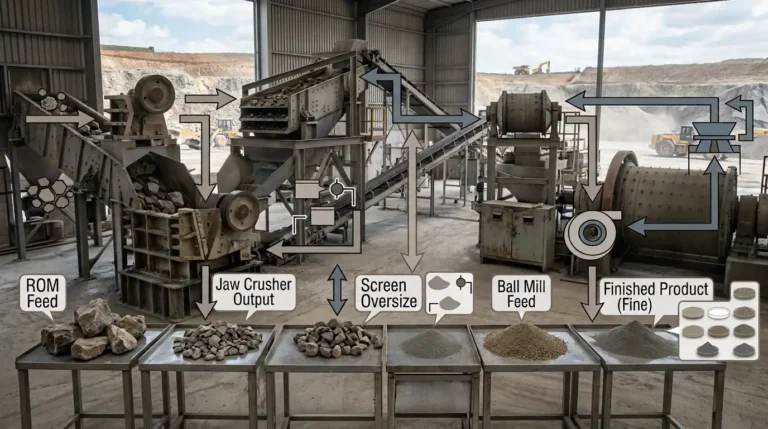
Open circuit: material passes through the mill once, suitable for coarse products where size distribution uniformity is less critical. Closed circuit: mill discharge passes through a classifier (cyclone); coarse returns to the mill, fines proceed downstream. Closed circuit reduces overgrinding and improves energy efficiency by 10–15% compared to open circuit. Virtually all large-scale mineral processing plants use closed-circuit grinding.
Is it worth switching from steel balls to ceramic grinding media?
It depends on application requirements. For pharmaceuticals, electronics materials, and high-purity chemicals where zero iron contamination is mandatory, ceramic media (alumina or zirconia) is not optional — it’s required. For general mineral grinding, ceramic balls are 3–5x the cost of steel, and their slightly lower density means less impact energy on hard ores. Standard mineral processing operations should stick with steel media unless contamination is a documented concern.