


Particle Size Terms: F80, P80, Mesh, Millimeters, and Microns Explained
What You Will Learn from This Guide
F80 and P80 are the particle sizes at which 80% of the feed and product, respectively, pass a reference size. This guide explains how F80 and P80 relate to particle-size distribution, mesh, millimeters, and microns. It also shows why mesh is not a simple reciprocal conversion and how these terms should be written in crusher and mill specifications. The guide is intended for engineers, procurement teams, and plant operators who need a clear way to compare feed and product size requirements. Related background is available in our mining grinding mill types overview.
What F80 and P80 Actually Mean
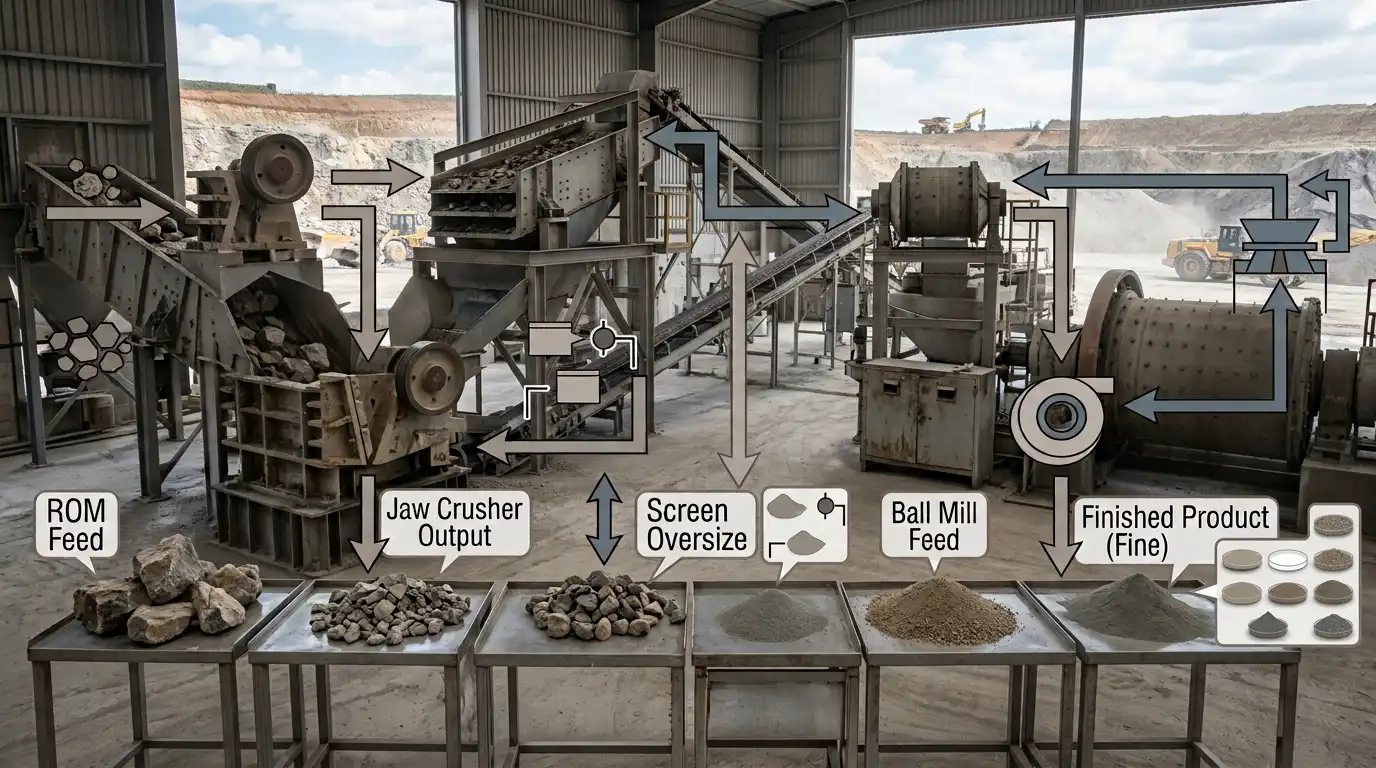
F80 and P80 describe a point on a particle-size distribution curve, not a single sieve opening. F80 is the size at which 80% of the feed mass passes. P80 is the corresponding size for the product.
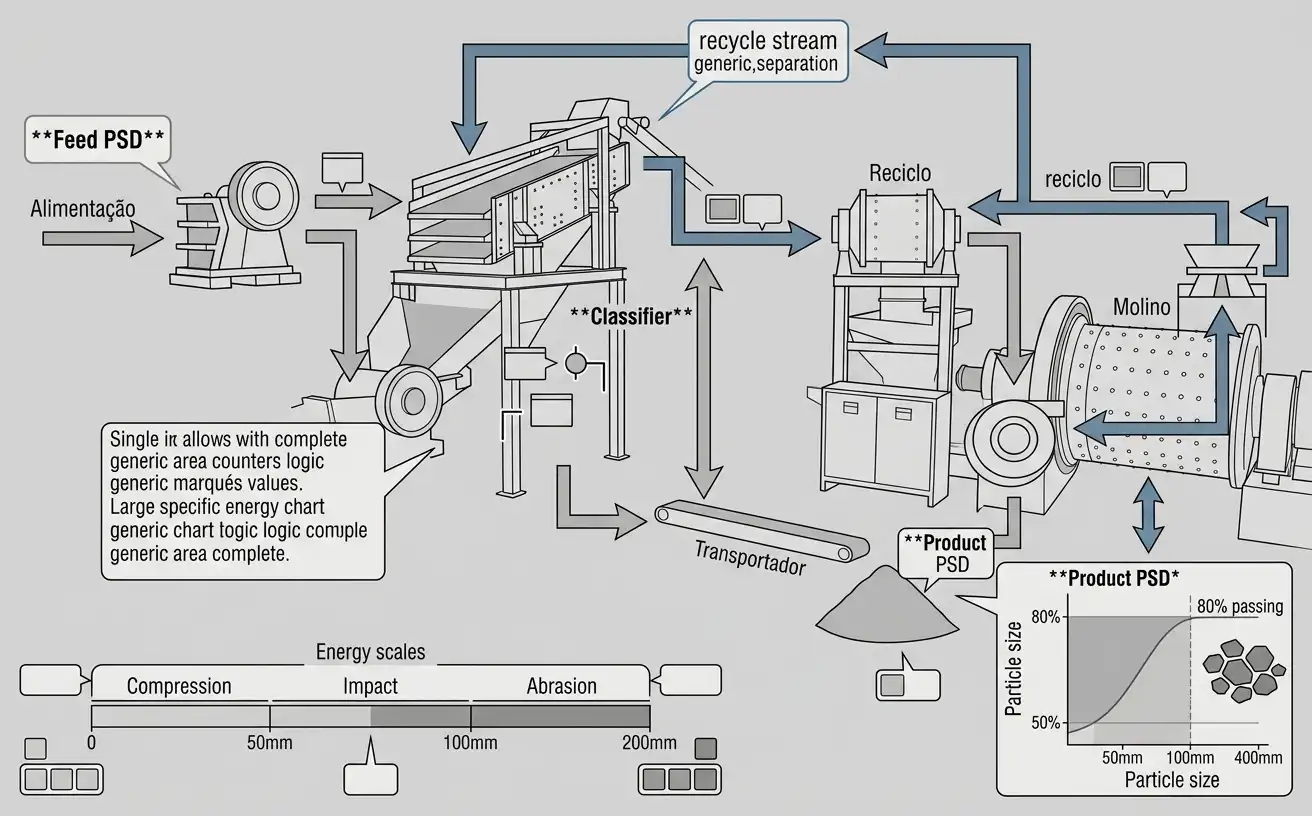
The value is normally obtained from a cumulative particle-size distribution. A laboratory sieve analysis can provide the data for coarse and medium sizes. Laser diffraction or another suitable method may be used for finer material.
The key point is that F80 and P80 are statistical descriptors of a size distribution. They are not the maximum particle size and they are not the mesh number of one sieve.
For comminution studies, the ratio F80/P80 is also used as an 80% passing size reduction ratio. The ratio is dimensionless when both sizes use the same unit.
A reduction from F80 = 10 mm to P80 = 1 mm therefore gives an RR80 of 10. It does not mean every particle is reduced by exactly ten times.
For related process context, see our mining grinding mill types overview.
Millimeters and Microns: The Direct Conversion
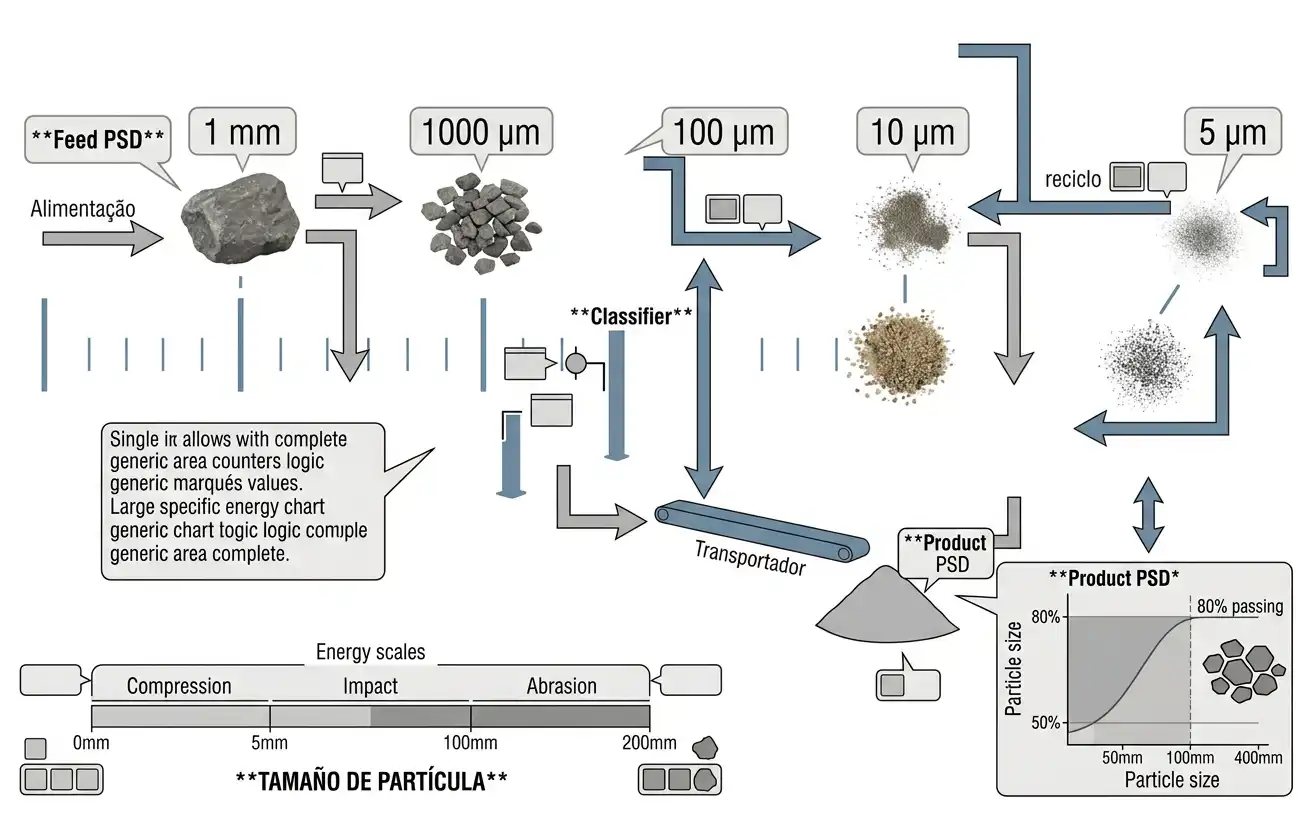
Millimeters and microns are both length units, so their conversion is exact. One millimeter equals 1,000 micrometers. One micrometer equals 0.001 millimeter.
| Size | Equivalent |
|---|---|
| 1 mm | 1,000 µm |
| 0.5 mm | 500 µm |
| 0.25 mm | 250 µm |
| 0.149 mm | 149 µm |
| 0.074 mm | 74 µm |
| 0.044 mm | 44 µm |
| 0.038 mm | 38 µm |
| 0.005 mm | 5 µm |
The conversion is a unit change, not a change in particle-size definition. Thus, an F80 of 0.50 mm is the same physical size as 500 µm.
This distinction matters when a crusher specification uses millimeters and a grinding test report uses microns. The values can be compared after unit conversion, but the underlying measurement method still matters.
The same rule applies to P80. A P80 of 74 µm is exactly 0.074 mm.
For a practical example, an MGW Intelligent Raymond Mill data table lists an output range of 1.6–0.038 mm. That corresponds to 1,600–38 µm. The product data also lists feed sizes below 30–50 mm for the models shown in the reference table.
See MGW Intelligent Raymond Mill specifications for the equipment context.
Mesh and Microns Are Related, but Not Identical
Mesh is a sieve designation, while microns and millimeters are physical length units. For small sieve sizes, mesh commonly refers to the number of openings per linear inch. The actual aperture also depends on wire diameter and sieve construction.
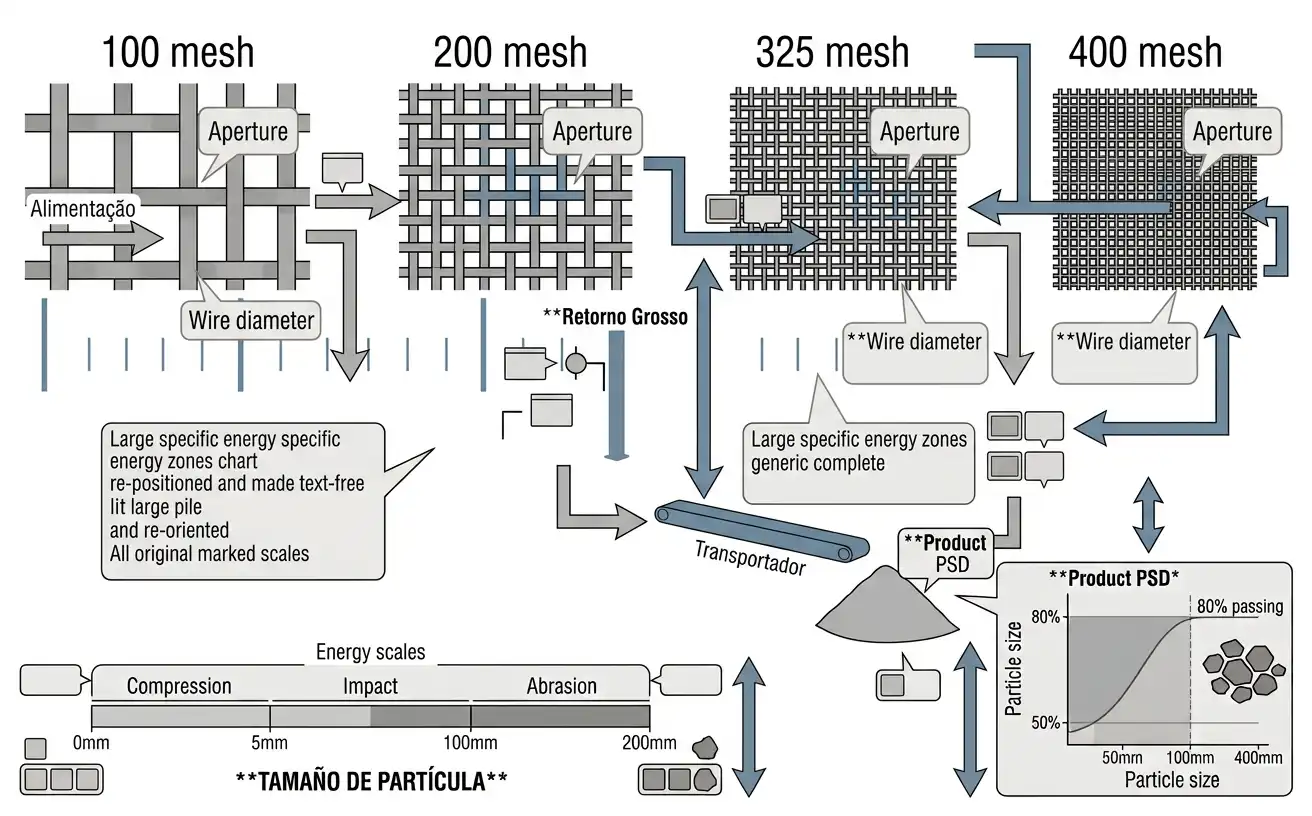
A common US sieve reference gives these nominal openings:
| Mesh | Approx. aperture (µm) | Approx. aperture (mm) |
|---|---|---|
| 20 | 841 | 0.841 |
| 40 | 420 | 0.420 |
| 60 | 250 | 0.250 |
| 80 | 177 | 0.177 |
| 100 | 149 | 0.149 |
| 140 | 105 | 0.105 |
| 170 | 88 | 0.088 |
| 200 | 74 | 0.074 |
| 230 | 63 | 0.063 |
| 270 | 53 | 0.053 |
| 325 | 44 | 0.044 |
| 400 | 37 | 0.037 |
These values are reference sieve openings. They should not be treated as an exact mathematical conversion for every mesh convention.
The same mesh number can also be described differently across sieve series. Procurement documents should therefore state the sieve standard when mesh is important.
The symbols + and − also change the meaning. A material described as −200 mesh is finer than the 200-mesh sieve opening, while +200 mesh is retained on that sieve.
For production control, a report such as “P80 = 74 µm” is more precise than simply writing “200 mesh powder.” It states the size metric directly.
For ultrafine applications, see MSF Ultrafine Mill.
How the Terms Fit Into Crushing and Grinding
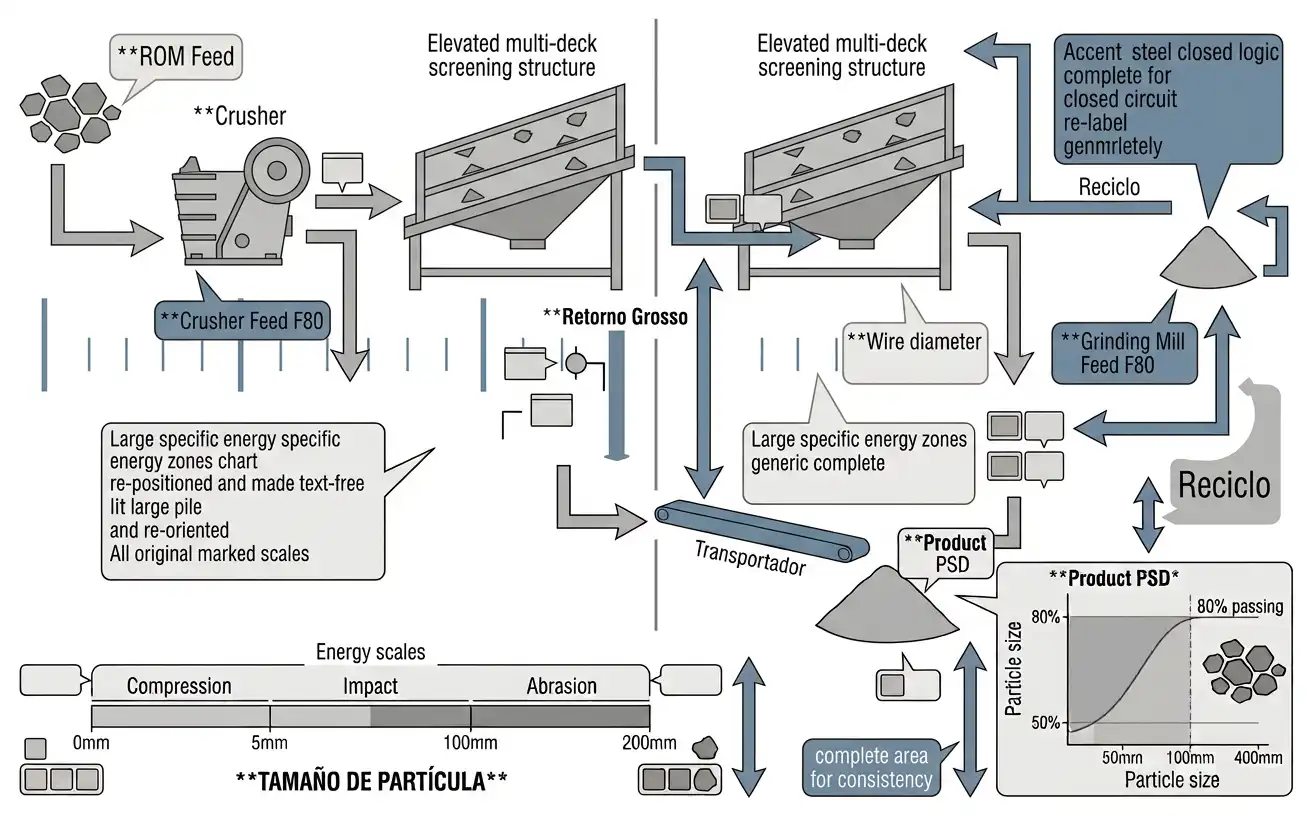
Particle-size terms serve different roles in a comminution circuit. Crusher specifications often emphasize feed opening, maximum feed, discharge setting, and product range. Grinding specifications often focus on feed size, final product size, and the required fineness distribution.
| Term | What it describes | Common unit | Typical use |
|---|---|---|---|
| Maximum feed size | Largest stated feed particle | mm | Equipment selection |
| F80 | Feed size at 80% passing | mm or µm | Comminution testing and circuit design |
| P80 | Product size at 80% passing | mm or µm | Product target and energy analysis |
| Mesh | Sieve designation | mesh | Sieve-based sizing |
| Millimeter | Length unit | mm | Coarse and medium particle sizes |
| Micrometer | Length unit | µm | Fine and ultrafine particle sizes |
The selection mistake to avoid is treating maximum feed size as F80. A feed can contain a small amount of large particles while its F80 remains much smaller.
The reverse mistake also occurs. A P80 does not define the entire product distribution. Two products can have the same P80 and still contain different proportions of fines and coarse particles.
For crusher stages, an F80 value can describe the material entering a stage. For grinding stages, the final P80 is often a key target because it affects downstream separation and liberation.
See our complete guide to grinding media for the next level of grinding terminology.
A Practical Specification Example for Procurement
A clear purchase specification should keep the size metric, percentage passing, and measurement basis separate. This makes supplier quotations easier to compare.
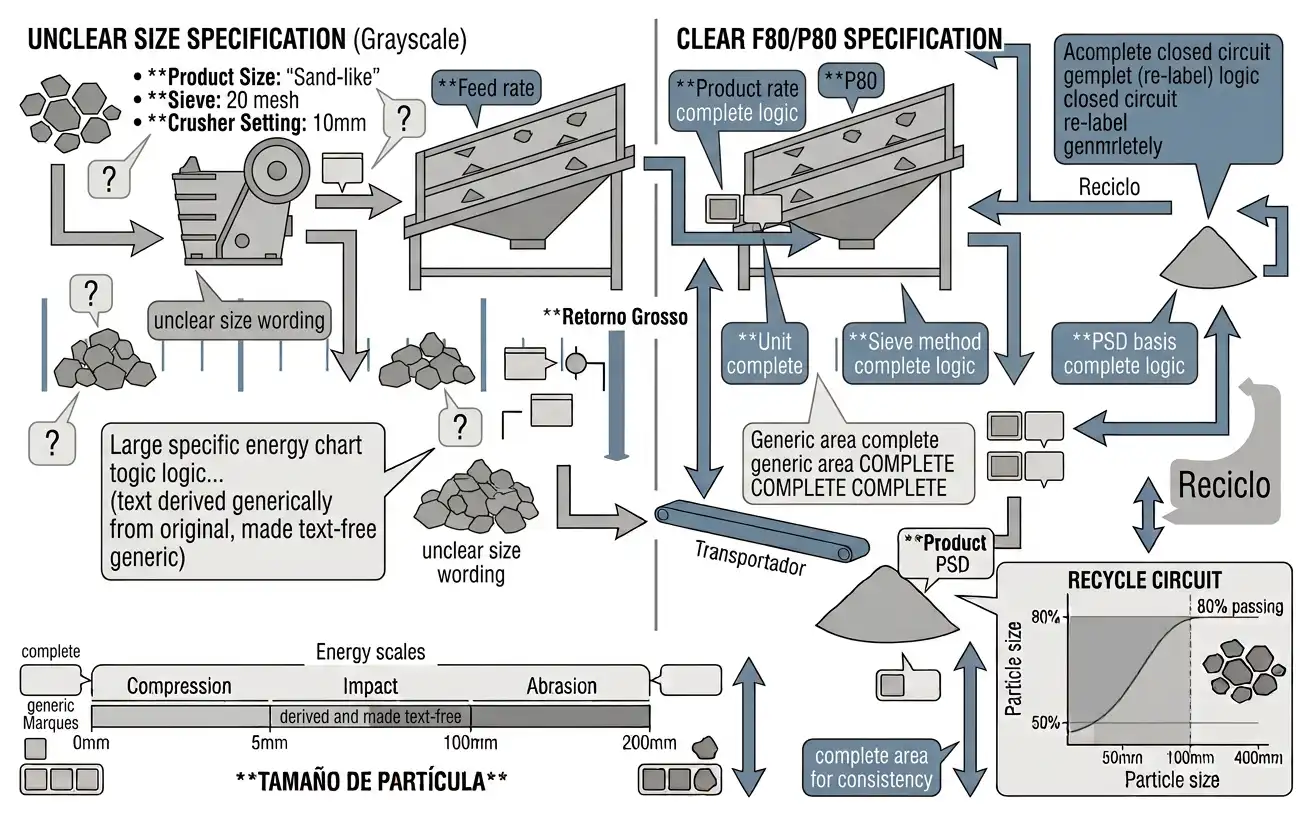
A useful grinding specification can be written like this: “Fresh feed: 80% passing 10 mm. Target product: 80% passing 150 µm.”
That wording is stronger than “10 mm feed and 150 µm product.” The percentage basis is explicit.
A procurement sheet should record the material and moisture. It should also record the test method and PSD basis. Throughput should be stated. The target should be marked as nominal or guaranteed.
For a ball mill, equipment size and power are not selected from P80 alone. Feed hardness, work index, throughput, slurry conditions, and circuit configuration also affect selection.
The MQ Ball Mill reference includes both dry and wet types and provides model dimensions, power, liner thickness, ball load, and weight. Those equipment values support the machine side of the specification, while F80 and P80 describe material size performance.
See MQ Ball Mill dimensions and size selection.
Common Conversion Mistakes to Avoid
The most common errors are simple, but they can change an equipment comparison.
- Treating mesh as a direct mathematical reciprocal of particle size.
- Mixing millimeters and microns without converting units.
- Calling maximum feed size an F80 value.
- Treating P80 as the maximum product size.
- Comparing F80/P80 values with different units.
- Omitting the sieve standard from a mesh-based requirement.
- Using a mesh number to describe an ultrafine product when a direct micron value is available.
A second issue is reporting a product range as if it were a P80 target. An output range such as 1.6–0.038 mm does not state the P80 unless a percentage-passing value is also given.
The MSF Ultrafine Mill reference lists final sizes from 325 to 2500 mesh for several models. It also states a 5 µm ultrafine product size in its general description. Those are product capability statements, not automatically P80 guarantees.
See MSF Ultrafine Mill fineness and model range for the equipment-side terminology.
How to Write a Particle-Size Requirement Clearly
A well-formed size requirement should answer four questions. It should identify the material and the passing fraction. It should state the size and the unit. It should also state how the size was measured.
A concise format is: “Feed F80 = 12 mm; product P80 = 150 µm; dry sieve analysis for coarse feed; validated particle-size method for the fine product.”
The exact test method can change with particle size and material behavior. A mesh designation should never replace the actual aperture value when the specification depends on tight particle-size control.
The supplied project materials contain no internal plant test dataset for a specific F80 and P80 operating point. Exact equipment selection therefore requires project-specific material testing and process design.
For further mill-operation context, see how a Raymond mill works.
Frequently Asked Questions
For related grinding terminology, see the ball mill operation guide before specifying a product-size target.
What does F80 mean in mineral processing?
F80 is the particle size at which 80% of the feed material passes. It is obtained from the feed particle-size distribution. It is not the maximum feed size.
What does P80 mean in grinding?
P80 is the particle size at which 80% of the grinding product passes. It is commonly used to describe the target or measured product fineness. The value can be reported in millimeters or micrometers.
Is 200 mesh equal to 74 microns?
A common US sieve reference lists the 200-mesh nominal opening as about 74 µm, or 0.074 mm. The mesh designation should still be tied to the sieve convention or standard used.
Can F80 and P80 be in different units?
Yes, during reporting, but they must be converted to the same unit before calculating F80/P80. Using 10 mm and 100 µm directly in the ratio would be incorrect because the units differ.
Is 325 mesh the same as 44 microns?
A common US sieve reference gives about 44 µm for a 325-mesh nominal opening. Actual sieve specifications depend on the applicable sieve standard and aperture tolerances.
References & Sources
- ASTM E11-24 — Standard Specification for Woven Wire Test Sieve Cloth and Test Sieves
- ISO 3310-1:2016 — Test sieves: Technical requirements and testing
- ISO 565:1990 — Test sieves: Nominal sizes of openings
- Sigma-Aldrich — Particle Size Conversion Table
- Istanbul Technical University — Grinding size estimation and beneficiation studies
- CEEC — Fine Grinding Circuit Process Improvement at the Karara Mine Concentrator
Related equipment context: MGW Intelligent Raymond Mill.