

What Is Reduction Ratio?
What You Will Learn from This Guide
Reduction ratio is the single number that describes how much smaller a crusher or mill makes its material in one pass. This guide explains the precise definition. It also explains why the number is measured a specific way, not just eyeballed, and why different equipment types are built around very different reduction ratio ranges. It serves anyone sizing a crushing circuit or trying to understand a spec sheet. After reading, you will be able to calculate reduction ratio correctly and know what a typical value should look like for a given machine.
The Basic Definition: Feed Size Divided by Product Size
Reduction ratio compares the size of material going into a crusher with the size coming out. The calculation itself is simple division: feed size divided by product size. A machine taking in material sized around 1,500 millimeters and producing output sized around 150 millimeters has a reduction ratio of 10 to 1.
That simple description hides a real complication. Crushed rock is never one uniform size. It comes out as a mix, some pieces larger, some smaller, spread across a range. Dividing “the feed size” by “the product size” only means something once those terms are defined precisely, not just eyeballed.
Why Reduction Ratio Uses F80 and P80, Not Just “Size”
The industry standard solves this by using F80 and P80. Each is the particle size at which 80 percent of the material, feed or product, passes through a screen by mass. Reduction ratio is then F80 divided by P80, not any single largest or average particle size.
The 80 percent threshold is not arbitrary. Crushed rock size distributions are log-normal, not normal. A small number of unusually coarse particles can badly skew a simple average. That skew happens without those particles representing the bulk of the material at all.
The 80th percentile avoids that problem. It is far less sensitive to a handful of outlier fines or oversized chunks than a straight average or median would be. That makes it a far more reproducible number across repeated lab sieve tests.
This matters beyond precision for its own sake. F80 and P80 feed directly into Bond’s Work Index calculations. A reduction ratio built on anything other than these two values does not connect cleanly to the energy calculations that actually matter for sizing a circuit.
A Worked Example
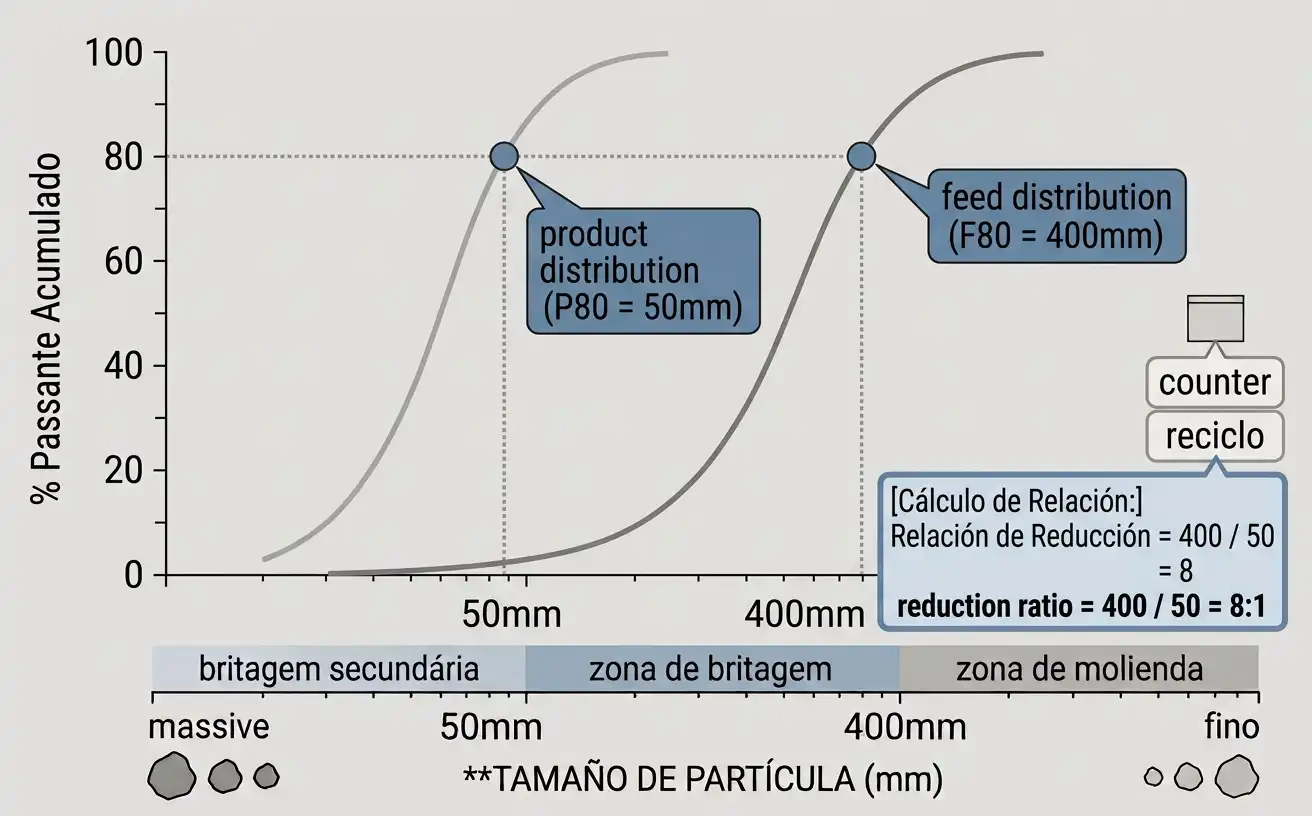
Consider a crusher fed material where 80 percent of the feed passes a 400 millimeter screen. The product coming out has 80 percent passing a 50 millimeter screen. F80 is 400, P80 is 50. Reduction ratio is 400 divided by 50, or 8 to 1.
That same math applies at any scale. It works from a primary crusher handling meter-sized blasted rock down to a tertiary stage refining material already reduced twice before. The formula never changes. Only the actual F80 and P80 values do.
Why Compression Crushers Hit a Ceiling: The Nip Angle
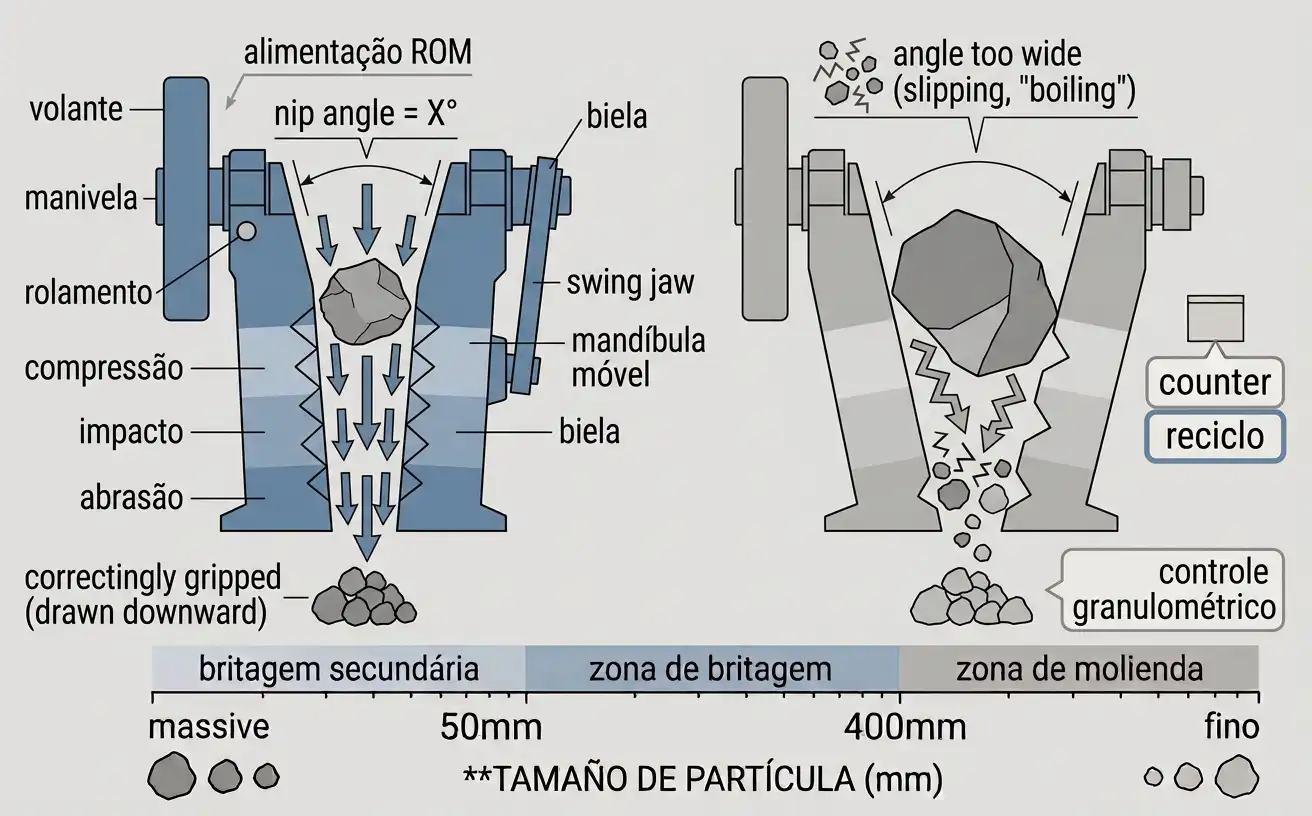
Jaw, cone, and gyratory crushers all share a mechanical limit that impact crushers do not face in the same way. These machines grip material between two surfaces at a specific nip angle. That angle typically runs between about 19 and 23 degrees.
A wide reduction ratio in a single pass asks a lot of the chamber geometry. It has to grip and pull down material across too large a size range at once.
Push the angle past what the material can grip reliably, and the rock starts slipping and bouncing inside the chamber. This happens instead of the rock being drawn downward and crushed, a condition sometimes called boiling. This is a physical limit built into the chamber geometry, not something a bigger motor can fix.
Impact crushers work differently. They decelerate material against a wall or against other rock, rather than gripping it between two converging surfaces. This particular geometric ceiling does not apply to them the same way. That is part of why impact crushers can reach much higher single-pass reduction ratios.
Typical Reduction Ratios by Equipment Type
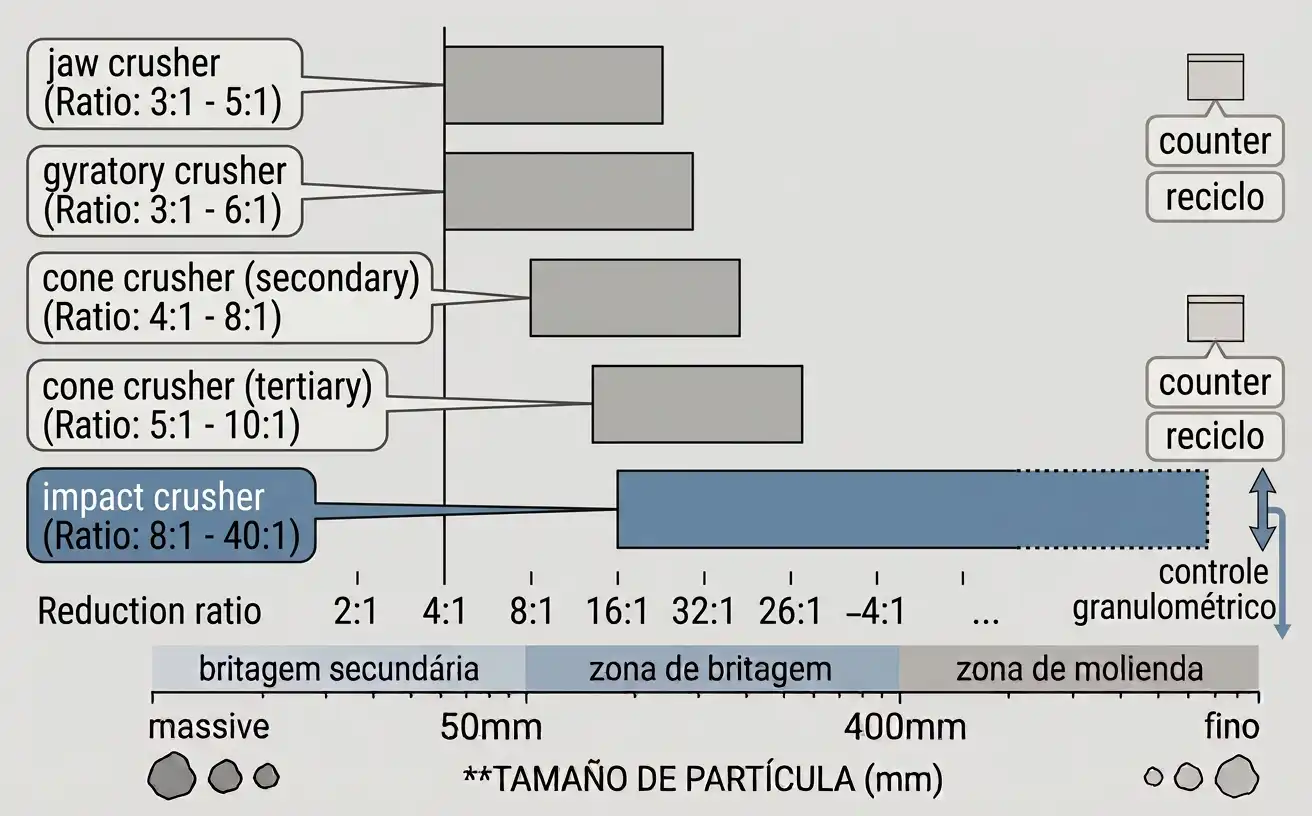
Published ranges vary somewhat by source, but the general pattern holds consistently across the industry. Jaw crushers commonly run 3 to 1 up to around 8 to 1. Many operations specifically target close to 6 to 1, a practical balance between throughput and fines generation. Gyratory crushers cover a similar range, often cited around 8 to 1 as a typical operating point.
Cone crushers in secondary duty commonly run 5 to 1 up to around 10 to 1. Tertiary cone crushers work on already-reduced material. They often run slightly higher, commonly 8 to 1 up to around 12 to 1. The absolute size range they handle is smaller, even though the ratio itself is not.
Impact crushers stand apart from the compression types. Reduction ratios of 10 to 1 up to 20 to 1 are common. Some applications push higher still. This reflects the different mechanism described above, not any difference in raw power.
Reduction Ratio and Energy: Why Chasing a Higher Ratio Costs More
A higher reduction ratio in a single stage is not simply a matter of running the same machine harder. Bond’s Work Index calculations tie energy consumption directly to the F80 and P80 values involved. That relationship is not linear.
A commonly cited illustration makes the scale of this clear. Dropping product P80 from 200 millimeters to 100 millimeters, a single halving, can roughly double the power demand for that stage. Chasing an aggressive single-pass reduction ratio carries a real energy cost. That cost is a major part of why crushing circuits stage this reduction across multiple machines instead of pushing one machine to do it all.
Frequently Asked Questions
What is the formula for reduction ratio?
Reduction ratio equals F80 divided by P80. F80 is the particle size at which 80 percent of the feed passes a screen by mass. P80 is the same measurement for the product. A crusher taking material with an F80 of 400 millimeters down to a P80 of 50 millimeters has a reduction ratio of 8 to 1.
Why is reduction ratio based on the 80 percent passing size instead of the largest particle?
Crushed rock size distributions are log-normal. A handful of unusually coarse or fine particles can distort a simple average without representing the bulk of the material. The 80th percentile is a more robust, more reproducible statistic across repeated tests. It is also the value that feeds directly into Bond’s Work Index energy calculations.
Why can impact crushers achieve a much higher reduction ratio than jaw crushers?
Jaw, cone, and gyratory crushers grip material at a nip angle, typically 19 to 23 degrees. Pushing that angle too wide causes material to slip rather than be drawn in and crushed. Impact crushers decelerate material against a wall or other rock instead of gripping it between two surfaces. This geometric ceiling does not limit them the same way.
Why does a higher reduction ratio in one stage cost more energy?
Bond’s Work Index calculations tie energy consumption directly to the F80 and P80 values, and that relationship is not linear. Dropping the product size by half in a single stage can roughly double the power required. That is a major reason crushing circuits split this reduction across multiple stages instead of one aggressive pass.