

Steel Ball Unit Consumption: Statistics and Reduction Methods
What You Will Learn from This Guide
Unit consumption is the weight of grinding media worn away per tonne of ore ground, and it rises when the alloy in use does not match the site’s dominant wear mechanism. This guide covers how to measure it correctly, what actually drives it up, and which corrective steps produce a measurable reduction. It serves a process engineer or plant metallurgist tracking media cost, and after reading, you will be able to diagnose a rising consumption trend instead of defaulting to a harder alloy as the fix.
Overview
Grinding media is one of the largest recurring costs in a mineral processing plant. Unit consumption — media weight consumed per tonne milled — is the metric that tracks this cost over time. A site that cannot state its current unit consumption figure cannot tell whether a change it makes is actually working.
Two questions drive everything that follows: how is the number produced correctly, and what actually moves it. Get the measurement wrong and every downstream decision rests on bad data. Get the diagnosis wrong and a fix aimed at the wrong mechanism can raise consumption instead of lowering it, which is the central finding this guide builds toward.
Measuring Unit Consumption
Unit consumption is calculated as media weight added over a period, divided by tonnage milled in that same period, usually expressed in grams or kilograms per tonne. The calculation only holds at steady state. A mill that just received a full re-charge, or one running down toward an empty hopper, will show a distorted figure for that period.
A complete guide to grinding media covers the broader selection and wear-monitoring context this metric sits inside; unit consumption tracking itself adds only two figures to a plant’s existing records: media weight added and tonnage milled.
Two measurement approaches exist, and they answer different questions:
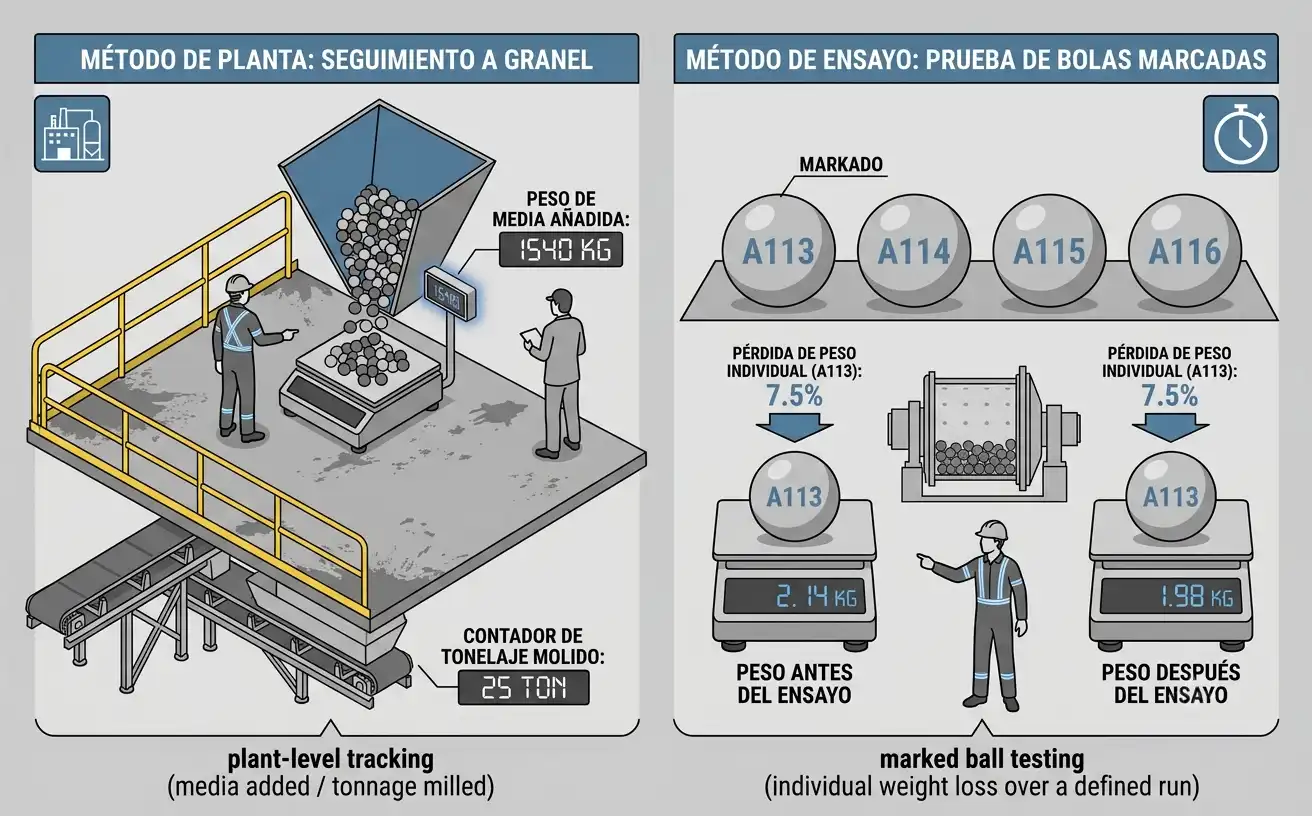
- Plant-level tracking. Media added versus tonnage milled, averaged over weeks or months. This gives an actual cost figure but blends together every factor affecting wear during that period.
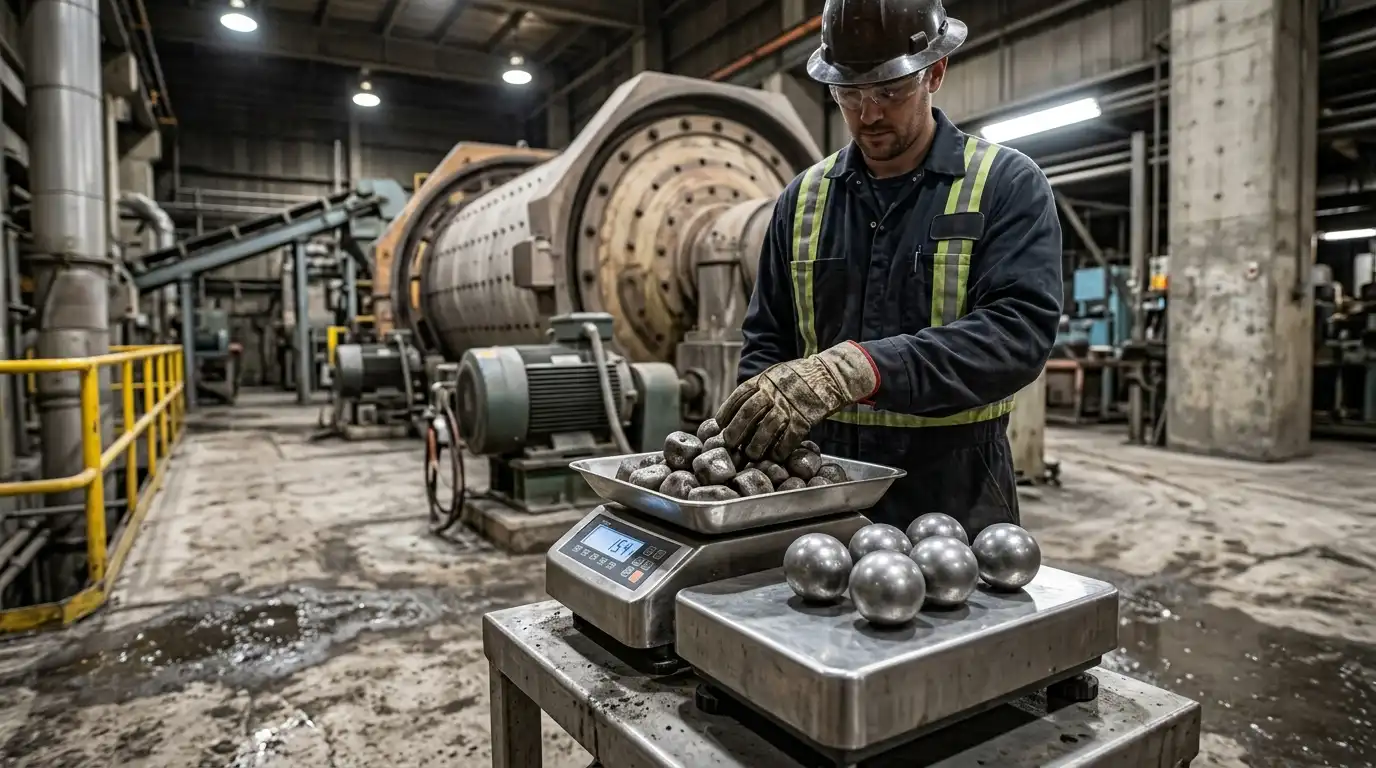
- Marked ball testing. A known batch of identifiable balls is charged, and their individual weight loss is tracked over a defined run. This isolates the wear rate for a specific ball type under specific conditions, separate from whatever else is happening in the mill.
Plant-level tracking answers “what are we actually spending.” Marked ball testing answers “would a different alloy or condition change that number.” Both are needed; neither replaces the other.
Why Consumption Rises: The Three Wear Mechanisms
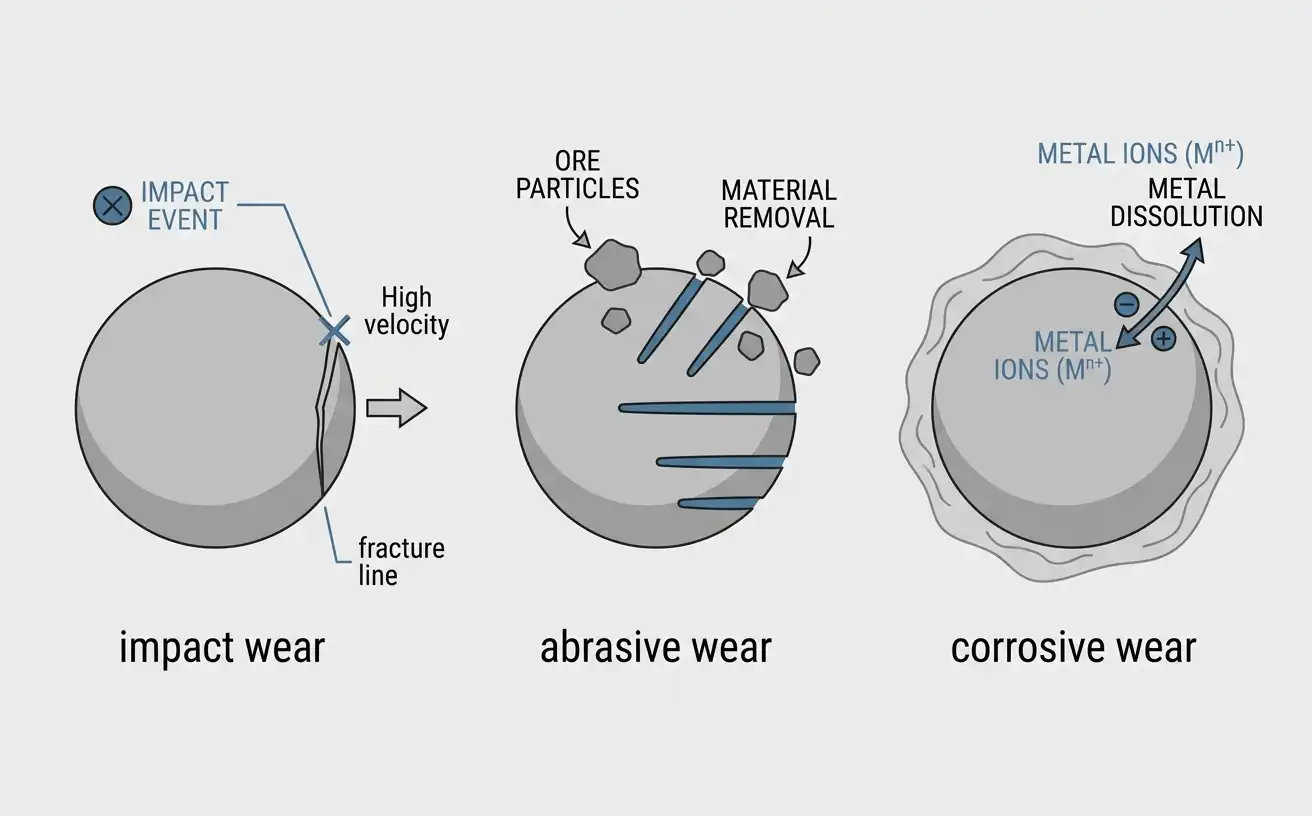
Media wear breaks down into three mechanisms, and they rarely act alone:
- Impact wear. Ball-on-ball and ball-on-liner collisions cause fracture and spalling. Impact wear scales with ball mass, so it grows with the cube of ball diameter.
- Abrasive wear. Hard ore particles grind grooves into the ball surface as they pass between media. Abrasive wear scales with surface area, so it grows with the square of ball diameter.
- Corrosive wear. In wet grinding, an electrochemical reaction between the media and the slurry removes metal directly, independent of any mechanical contact.
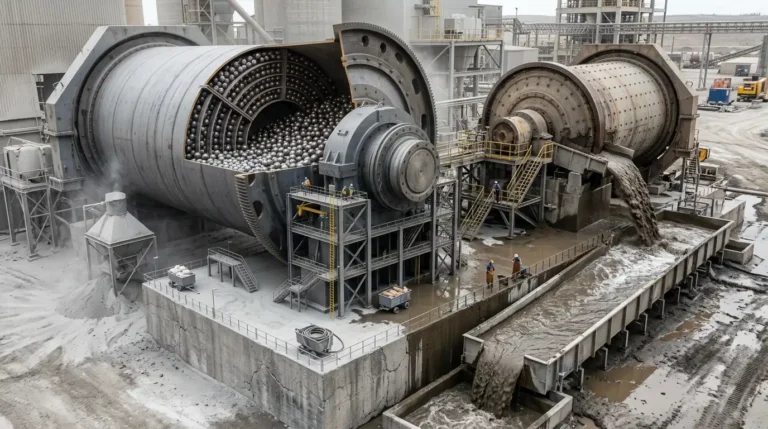
Which mechanism dominates depends heavily on mill type. In a grate discharge mill, impact tends to dominate because slurry does not pool inside the chamber. In an overflow mill, abrasion and corrosion tend to dominate instead, driven by the frictional and chemical action of the standing slurry.
Feed rate matters too. At low feed rates, particles stay in the mill longer. Published research has observed that this combination — long residence time, low throughput — tends to raise media consumption while also producing a finer grind.
Slurry density plays a related role. Pulp that is too dilute leaves ball surfaces poorly covered and wears faster. Pulp that is too thick cushions impacts and can reduce grinding efficiency, even as it lowers impact wear.
Reduction Methods: Matching Alloy to the Dominant Mechanism
The most common mistake in media selection is treating “harder” as universally better. Published mill-side data contradicts this directly. At one abrasion-dominant gold ore operation, switching from forged steel to high-chromium (HiCr) media increased consumption by 32 percent. The HiCr alloy’s carbide phase eroded faster under that specific abrasive environment than the tougher forged steel did.
The same research documented the opposite result in an impact-dominant SAG mill. Switching from a harder, high-carbon ball to a tougher, low-carbon forged ball reduced breakage and cut total media consumption by 9 percent. Toughness, not hardness, was the property that mattered in that impact-dominant environment.
The practical implication is a two-step process, not a single alloy upgrade:
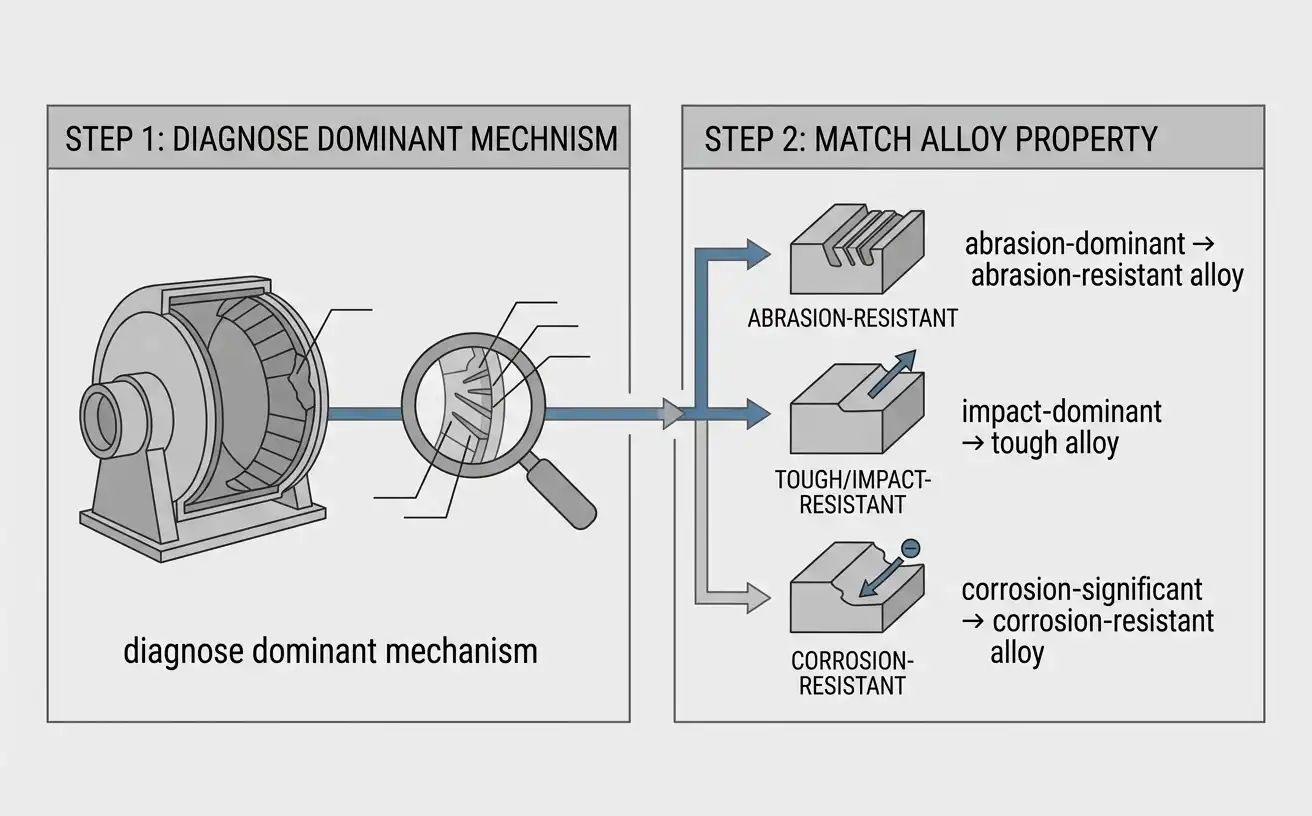
- Diagnose the dominant mechanism first, using the mill-type indicators and marked ball test results described above.
- Select alloy properties that match that specific mechanism — abrasion resistance for abrasion-dominant environments, toughness for impact-dominant ones, and corrosion-resistant compositions where wet-grinding corrosion is significant. A blanket move to a harder, more expensive alloy without this diagnosis risks the same result as the gold-ore case: paying more per ball and consuming more of them.
Reduction Methods: Operating Parameters, Liners, and Classification
Mill speed affects impact energy directly. Running significantly below the optimal fraction of critical speed wastes energy without effective grinding. Running too far above it moves toward a centrifuging condition that also reduces effective impact. Both extremes waste energy without necessarily reducing wear, so speed should be set for grinding efficiency first, with wear rate checked as a consequence.
Liner profile shapes how media falls and strikes the charge, which shapes wear at the same time. A liner that has worn out of its original profile changes ball trajectory. This can increase both liner wear and media wear simultaneously. A liner inspection schedule is therefore also a media-consumption control, not a separate maintenance item.
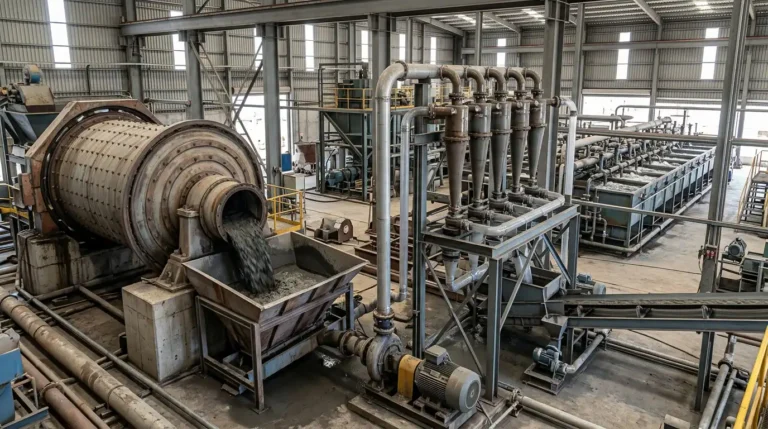
Classification efficiency has an indirect but real effect. A circuit with a high circulating load re-grinds material that is already fine enough. This adds wear-generating tumbling time without adding useful size reduction. Improving classifier cut-point accuracy reduces that wasted regrind time and lowers consumption as a side effect of an otherwise separate optimization.
Verifying and Sustaining a Reduction
A reduction achieved through alloy matching or an operating change does not stay proven on its own. Ore hardness and mineralogy shift over the life of most orebodies. A wear mechanism diagnosis made against last year’s ore may no longer hold.
Re-run a marked ball test whenever the ore source changes meaningfully. Track plant-level unit consumption continuously rather than as a one-time audit.
A 3–5 t/h ball mill grinding feldspar shows one ore-hardness profile. A 6 t/h ball mill grinding manganese ore shows a different one in an otherwise similar mill. This is exactly the kind of shift a fixed, one-time diagnosis would miss.
Site-specific wear-life and consumption data for a defined ore and alloy combination is not something a general guide can responsibly publish as a benchmark figure. The range across real operations is too wide to be useful. A number presented without its ore, alloy, and mill-condition context invites the same alloy-mismatch mistake described above. Readers needing a defensible baseline should run a marked ball test on their own feed rather than target a published average.
Frequently Asked Questions
How is grinding media unit consumption calculated?
Unit consumption is media weight added over a period, divided by tonnage milled in that same period, typically expressed in grams or kilograms per tonne. The figure is only meaningful at steady state, not immediately after a full re-charge.
What are the three wear mechanisms in grinding media?
The three mechanisms are impact, abrasion, and corrosion. Impact wear scales with ball mass and abrasive wear scales with surface area. Corrosive wear happens through an electrochemical reaction with the slurry, independent of mechanical contact.
Does a harder alloy always reduce media consumption?
No. Published mill-side data shows a harder high-chromium alloy increased consumption by 32 percent in an abrasion-dominant environment. Its carbide phase eroded faster than a tougher forged steel would have. Alloy selection has to match the dominant wear mechanism, not just maximize hardness.
How often should a marked ball test be repeated?
Repeat the test whenever the ore source or mineralogy changes meaningfully. A wear diagnosis made against one ore type does not necessarily hold for another. Continuous plant-level tracking between tests catches drift a single test would miss.