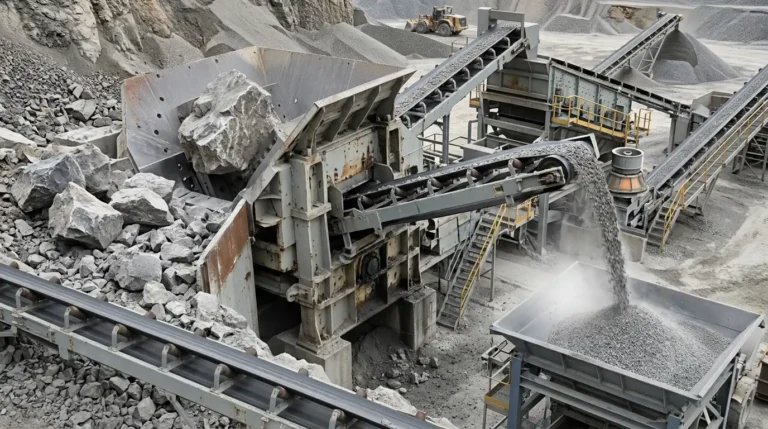


Continuous vs Batch Ball Mill: How to Match the Mill to Your Process Flow
What is the difference between a continuous and a batch ball mill? A continuous ball mill takes in feed material and discharges ground product at the same time, without stopping between cycles. A batch ball mill loads a fixed charge of material, grinds it for a set period inside a closed shell, then stops to discharge before the next charge is loaded. The continuous design suits high-throughput, single-product operations such as ore grinding ahead of flotation. The batch design suits multi-product, safety-sensitive, or low-volume operations such as pharmaceutical milling or specialty chemical grinding. The correct choice depends on throughput, particle-size-distribution requirements, material hazard class, and how often the product changes — not on which mill is generically “better.”
What You Will Learn from This Guide
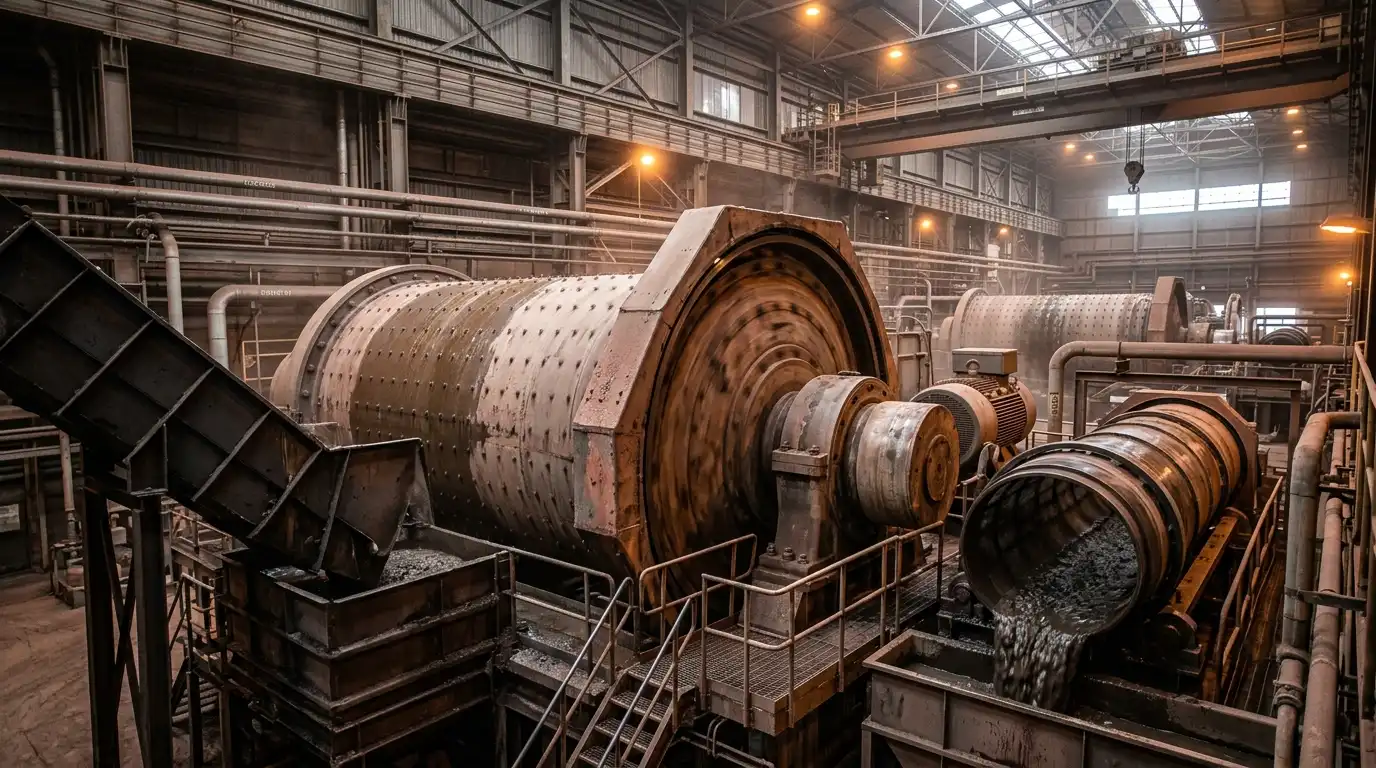
This guide compares continuous and batch ball mills — illustrated on the continuous side by installations such as a 3–5 t/h ball mill grinding feldspar — on the variables that actually drive a purchasing decision: throughput, product consistency, containment, capital cost, and operating cost. It serves the initial equipment-selection stage of a mining or chemical processing project, before a request for quotation is issued to an original equipment manufacturer. After reading this guide, a process engineer or procurement lead will be able to state which mill type fits a given duty — mining/mineral processing or chemical/pharmaceutical production — and identify the specific data (ore hardness, batch size, hazard classification, target throughput) that a mill supplier will need to size the equipment correctly.
How Continuous and Batch Ball Mills Work
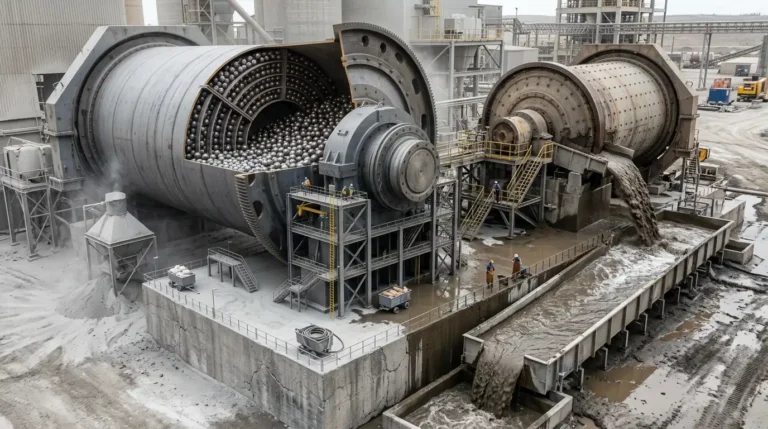
Both mill types reduce particle size through the same two mechanisms, visible in an operating installation such as a 2–3 t/h ball mill grinding graphite ore: impact, as grinding media fall from height inside the rotating shell, and attrition, as media roll and slide against each other and against the material. Rotation lifts the grinding charge along the shell wall until gravity overcomes centrifugal force, at which point the charge falls or cascades back through the material bed. The rotational speed at which centrifugal force would hold the charge against the shell wall indefinitely is called the critical speed. Industrial ball mills operate at 50–90% of critical speed, with most mineral-processing installations run in the 65–75% range for a balance of impact energy and media wear (ScienceDirect Topics, “Mill Speed”; ScienceDirect Topics, “Ball Mill”).
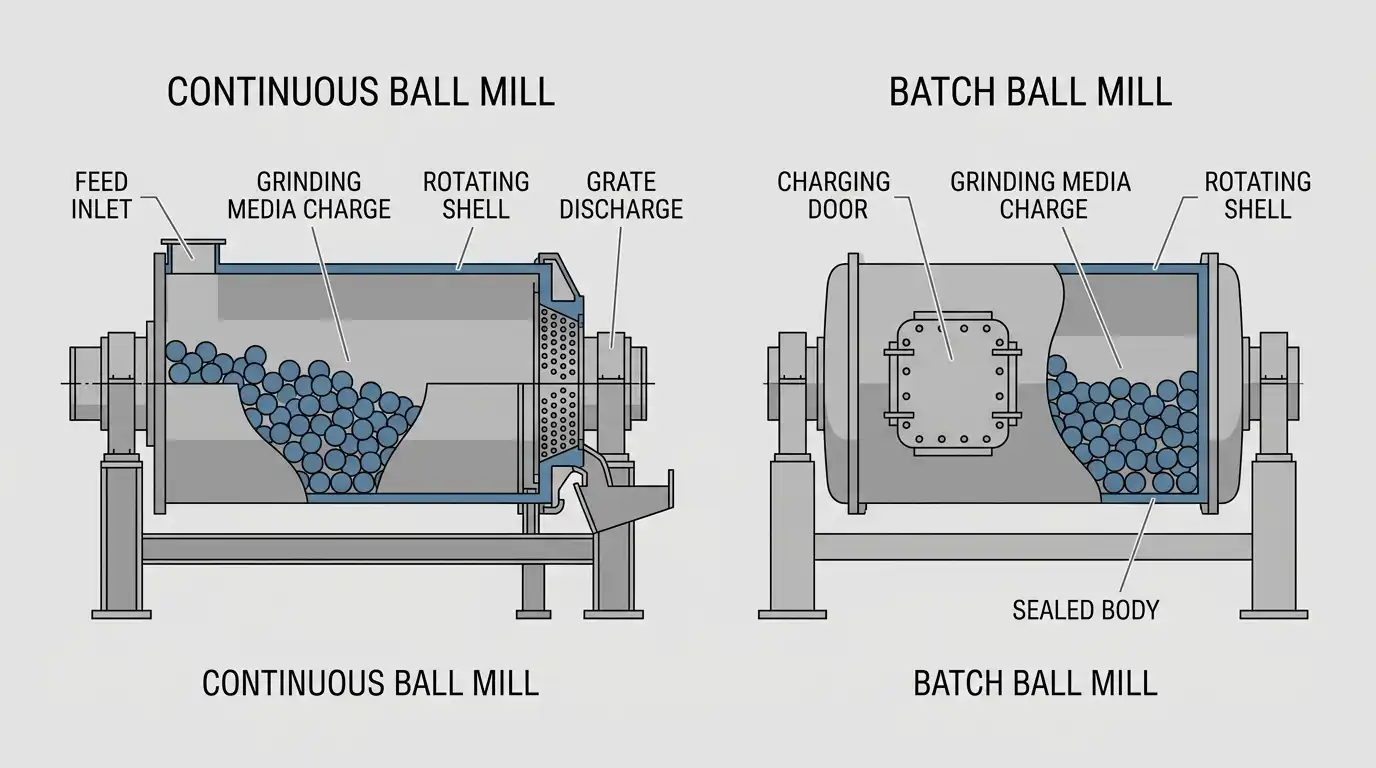
The operating difference is how material enters and leaves the shell. A continuous mill has a feed inlet at one end and a discharge — either an overflow trunnion or a grate — at the other. Fresh feed displaces partially ground material toward the discharge end in a steady flow, so the mill holds a mixture of particles at different stages of grinding at any given moment. A batch mill has a single charging point, usually a sealed door or lid. The full charge of material and grinding media is loaded, the shell is closed, and the entire charge is ground together for a fixed duration before the door is opened and the product is removed. No fresh feed enters and no product leaves during the grinding cycle.
This structural difference is the reason the two mill types perform differently on product consistency, containment, and throughput, covered in the comparison below. Sizing either type for a specific ore or compound requires bench-scale grindability testing, whether the target equipment is a conventional ball mill or a fine-grinding system such as the MSF Ultrafine Grinding Mill for sub-10-micron products.
Continuous vs Batch Ball Mill: Criterion-by-Criterion Comparison
The table below compares continuous and batch ball mills across the variables that most often decide a purchase, illustrated on the continuous side by installations such as a 3–5 t/h ball mill grinding feldspar.
Table 1. Operational and economic comparison of continuous and batch ball mills.
| Criterion | Continuous Ball Mill | Batch Ball Mill |
|---|---|---|
| Feed and discharge | Simultaneous, uninterrupted | Sequential: load, grind, stop, unload |
| Typical duty | Single product, sustained high throughput | Multiple products, intermittent runs |
| Product size-distribution consistency | Higher — material exits once it reaches target size | Lower — entire charge shares one grind time, risking over- or under-grinding of some particles |
| Automation requirement | High — feed rate, water addition, and discharge typically need continuous control | Low to moderate — cycle can be timer-controlled with manual load/unload |
| Capital cost per unit of installed capacity | Higher, due to feed systems, classifiers, and control instrumentation | Lower, for an equivalent shell volume |
| Unit energy cost at design throughput | Lower — no repeated start-up energy draw between cycles | Higher per tonne at high volumes, due to cycling |
| Product changeover time | Slow — shell must be flushed and cleaned before a new material runs | Fast — one batch can differ from the next with a standard clean-out |
| Containment for hazardous, toxic, or sterile material | Possible but adds engineering complexity | Straightforward — the shell can be sealed, purged with inert gas, or sterilized as a unit |
| Labor input per tonne of product | Lower once commissioned | Higher, due to manual loading and unloading |
Source note: Operational characteristics compiled from ScienceDirect Topics, “Ball Mill”; cost and energy-intensity patterns compiled from Ballantyne & Powell (2014), Minerals Engineering and CEEC, Mining Energy Consumption 2021.
The row that most often decides the purchase is unit energy cost at design throughput. Comminution — crushing and grinding combined — represents 35–50% of total mine site processing cost, and the grinding mill is typically the single largest energy consumer at a mine site (Ballantyne & Powell, 2014; CEEC, 2021). At sustained high tonnage, the lower unit energy cost of continuous operation compounds into a large absolute saving, which is why continuous mills dominate large-scale mineral processing. At low or variable tonnage, that saving does not materialize, because a partially loaded continuous mill still draws close to its full-load power.
Five-Factor Selection Framework
Five variables determine which mill type fits a given process flow, the same variables an engineer works through when specifying a sustained-throughput installation such as a 6 t/h ball mill grinding manganese ore. None of them is decisive alone; a batch mill can serve a large operation if the product changes weekly, and a small continuous mill can serve a modest operation if the product never changes and runs 24 hours a day.
Table 2. Selection framework: which factor favors which mill type.
| Factor | Question to answer before specifying | Favors continuous | Favors batch |
|---|---|---|---|
| Throughput and duty cycle | Does the mill run one product, most hours of most days? | Sustained high tonnage, single product | Intermittent runs, multiple products |
| Product size-distribution tolerance | How tightly must final particle size be controlled? | Tight tolerance, low over-grinding tolerance | Tolerance can be met by grind-time control |
| Material hazard class | Is the material flammable, explosive, toxic, or does it require a sterile or inert atmosphere? | Achievable, but adds engineering cost | Sealed charge simplifies containment |
| Circuit integration | Does the mill feed a continuous downstream process (flotation, leaching, classification)? | Matches continuous downstream flow | Requires a buffer or surge system downstream |
| Capital availability and changeover frequency | Can the operation absorb higher upfront cost for lower long-run unit cost? | Cost recovered at sustained high volume | Lower entry cost, faster changeover between products |
Applying the framework starts with throughput, because it eliminates one option in most cases before the other four factors are considered. An operation processing under roughly 10–20 tonnes per day, or one that changes product formulation frequently, rarely recovers the additional capital cost of a continuous mill within a normal investment horizon. An operation running a single ore or compound at sustained tonnage above that range typically does recover it, because the unit energy and labor savings compound over every operating hour.
Mining and Mineral Processing: Which Mill Type Fits
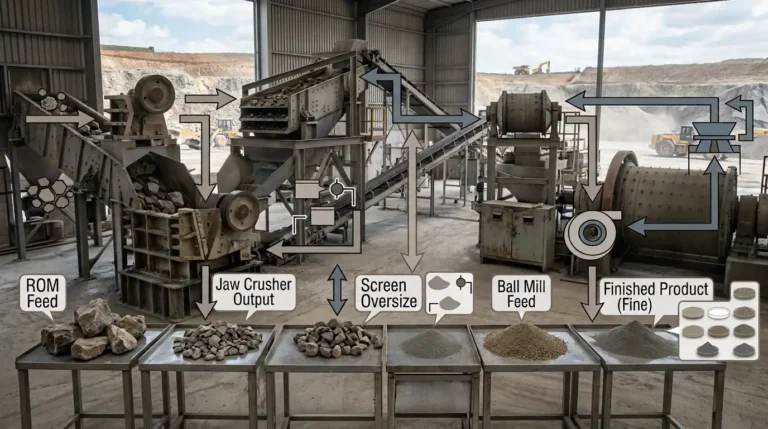
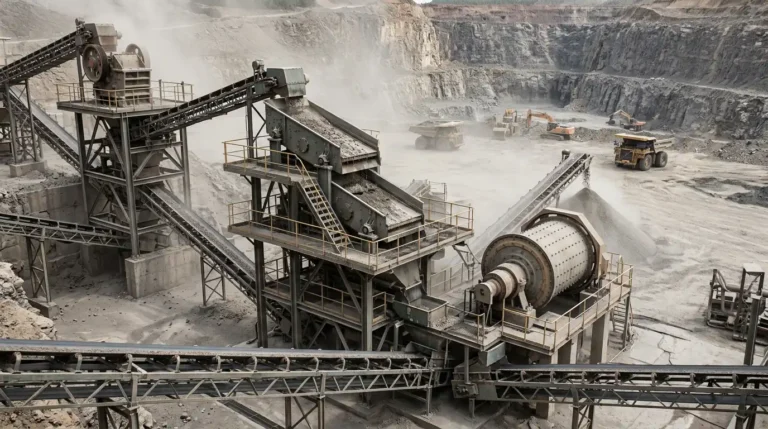
Mineral processing plants overwhelmingly specify continuous ball mills such as the MQ Ball Mill, and the reason follows directly from the five-factor framework. Ore grade and mineralogy are fixed for the life of a deposit, so the “product” does not change from shift to shift the way a specialty chemical batch might. Throughput is sustained, often 24 hours a day, to spread fixed costs across the largest possible tonnage. The mill typically feeds a continuous downstream process — flotation, leaching, or gravity concentration — so a batch mill would require a surge bin or agitated tank to smooth out the interruptions between batches.
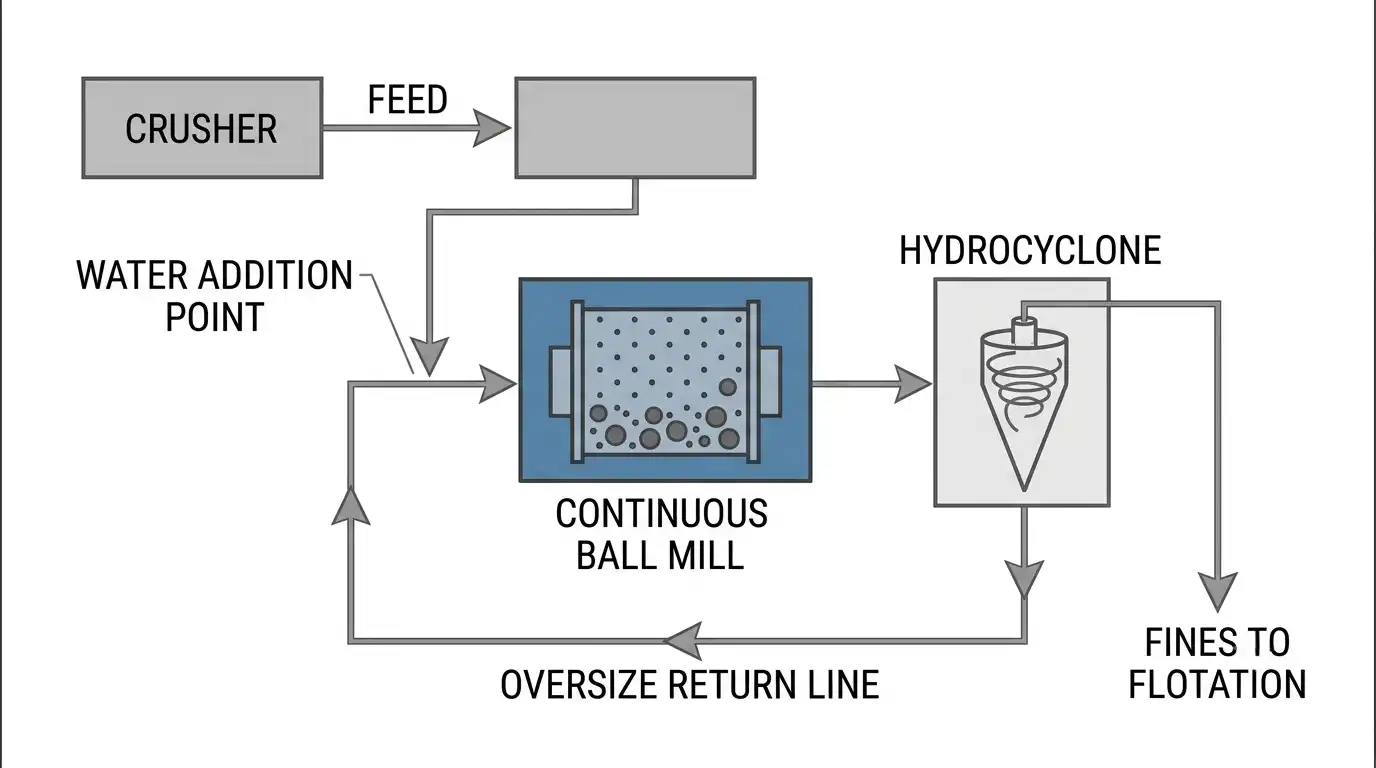
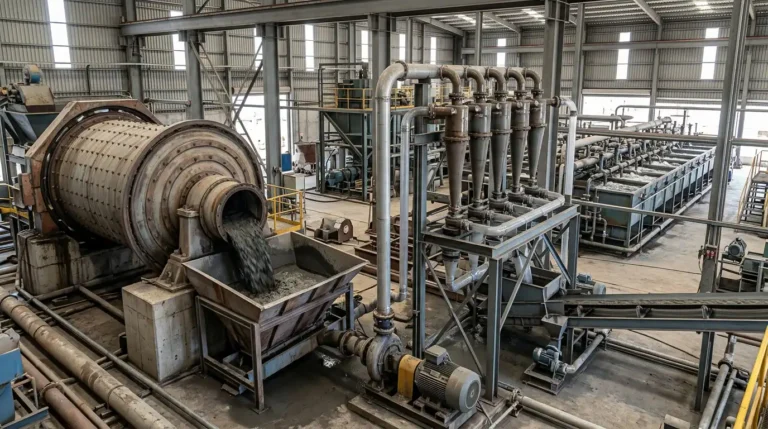
Within mining, two further decisions shape the mill specification. The first is circuit configuration. Open-circuit grinding passes material through the mill once; closed-circuit grinding routes mill discharge through a classifier, typically a hydrocyclone, and returns oversize particles to the mill for further grinding. For the same target product fineness, closed-circuit grinding requires approximately 5% less power than open-circuit grinding, because material that has already reached target size is removed from the mill instead of continuing to absorb grinding energy (Powder Technology, Elsevier). Most modern mineral processing mills run closed-circuit for this reason, accepting the added cost of a classifier and recirculating pump.
The second decision is wet versus dry grinding. Wet grinding — material ground as a slurry with water — is the default in mineral processing because it feeds directly into wet downstream processes such as flotation and leaching, controls dust, and reduces media wear from impact by cushioning the grinding action. Dry grinding is reserved for materials where downstream processing requires a dry product, such as cement raw meal, or where the mineral reacts with water (ScienceDirect Topics, “Ball Mill”; Metso, Grinding Mills). Confirming whether wet or dry grinding is appropriate for a given ore requires metallurgical testwork on the specific ore, of the kind behind closed-circuit installations such as the 6 t/h manganese ore ball mill referenced above, because the result interacts with the downstream separation process.
Chemical and Pharmaceutical Processing: Which Mill Type Fits
Chemical and pharmaceutical manufacturers favor batch ball mills for reasons that map directly onto the hazard-class and changeover-frequency rows of the selection framework. This duty sits outside the continuous product range covered by equipment such as the MQ Ball Mill; operations in this category typically source dedicated batch milling equipment instead. Active pharmaceutical ingredients, specialty pigments, and fine chemicals are typically produced in campaigns: one compound is milled, the equipment is cleaned and validated, and a different compound is milled next. A continuous mill’s long residence time and difficulty of flushing between products work against this pattern, while a batch mill’s sealed shell can be charged, ground, and emptied as a discrete, traceable lot.
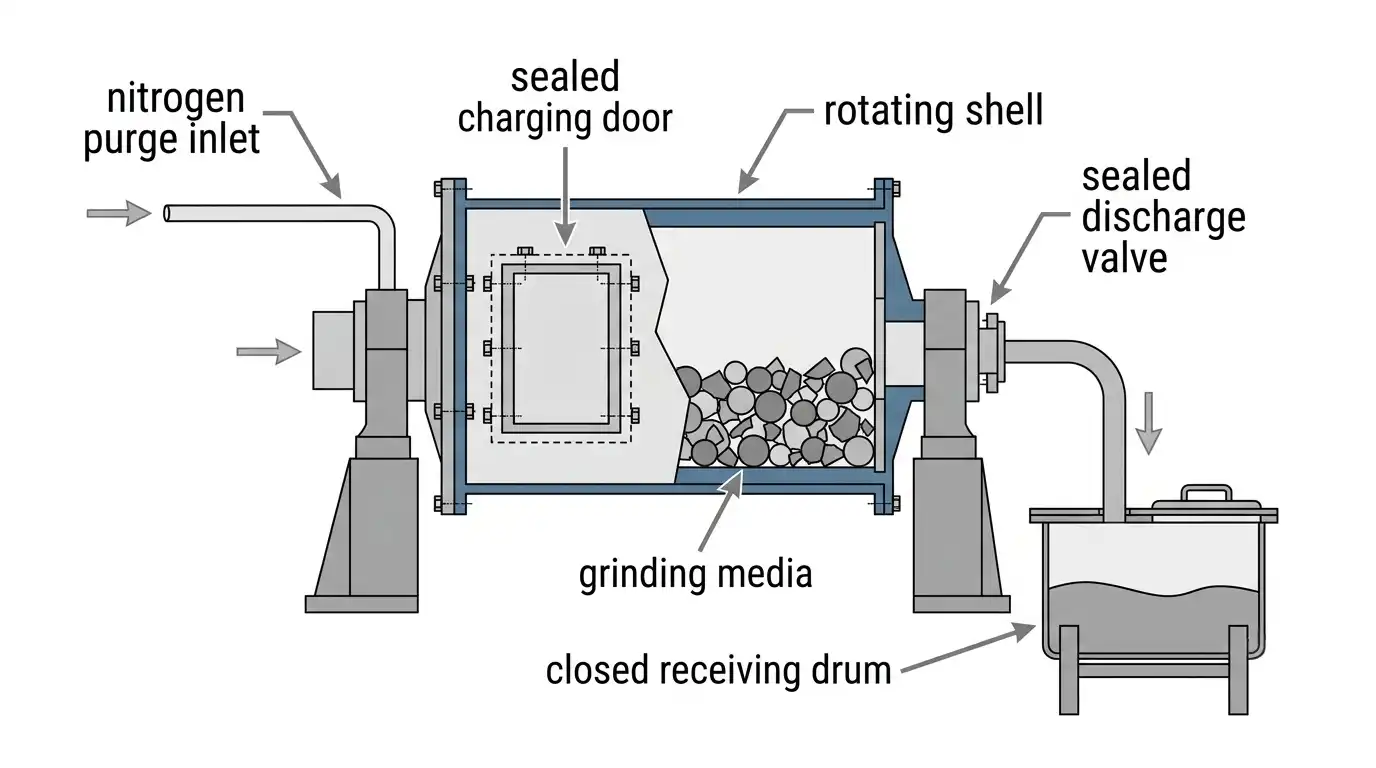
Batch operation also supports processing conditions that a continuous mill cannot easily replicate. Unstable or explosive compounds can be milled inside a sealed shell purged with an inert gas. Sterile or aseptic products can be milled in a shell that is sterilized as a single closed unit between batches, and each lot remains traceable to a specific charge, operator, and run time — a requirement under most pharmaceutical quality systems. A continuous mill can, in principle, be built with similar containment, but the added seals, purge systems, and continuous monitoring increase engineering cost and complexity relative to a batch design that achieves the same containment by default (ScienceDirect Topics, “Ball Mill”).
Chemical and pharmaceutical operations that do scale to sustained, single-product volumes — commodity fertilizer intermediates or high-volume industrial minerals, for example — follow the same logic as mining and shift toward continuous milling once volume justifies the capital cost, as in dry fine-grinding installations such as a 15–26 t/h fertilizer grinding line or a 25–30 t/h calcium oxide grinding line. The decision point is the same five-factor framework applied earlier; only the typical answers differ by industry.
Getting Site-Specific Numbers Before Specifying a Mill
Two data points determine the actual mill size and power draw for a given application: the Bond Work Index of the material, obtained through a standardized bench-scale grindability test, and the target product size distribution (P80). The mill sizing behind an installation such as the 2–3 t/h graphite ore ball mill referenced above starts from that kind of ore-specific test result, not from a general comparison figure.
The comparisons in this guide describe general operating characteristics that hold across most continuous and batch ball mill installations. They do not substitute for site-specific data. Motor power, shell dimensions, and throughput capacity vary by manufacturer and by the grindability of the specific ore or compound being processed, and no general figure published in an article can be assumed to apply to a specific project without verification. Operations preparing a mill inquiry should request a grindability test report from a metallurgical testing laboratory or from the mill manufacturer’s applications engineering group before finalizing a specification.
Frequently Asked Questions
What is the difference between a continuous ball mill and a batch ball mill?
A continuous ball mill, such as the MQ Ball Mill, feeds and discharges material at the same time, without stopping between cycles. A batch ball mill loads a fixed charge, grinds it for a set period inside a closed shell, and stops to unload before the next charge is loaded.
Can a ball mill run in both batch and continuous mode?
Some ball mill shells can be configured for either mode by changing the feed and discharge hardware, but the feed system, discharge system, and control instrumentation differ enough between the two modes that most manufacturers build and sell them as distinct product lines rather than field-convertible units.
What throughput justifies switching from batch to continuous ball milling?
There is no universal tonnage threshold; the correct figure depends on the capital cost of the continuous system, the value of the labor and energy saved per tonne, and the operation’s investment horizon. As a general pattern, operations processing a single product at sustained tonnage in the tens of tonnes per day or higher are the ones that typically recover the added capital cost of continuous equipment; lower-volume or multi-product operations typically do not.
Is wet grinding always more energy-efficient than dry grinding in a ball mill?
No. Wet grinding is generally more energy-efficient for mineral ores ground ahead of flotation or leaching, because the slurry cushions impact and improves fine-particle breakage. Dry grinding is preferred, independent of energy efficiency, when the downstream process requires a dry product or when the material reacts with water.
Why do pharmaceutical plants use batch ball mills instead of continuous mills?
A batch ball mill design allows a sealed shell to be charged, ground, sterilized, or purged with inert gas, and cleaned as a single traceable unit between product campaigns. This matches the lot-based, multi-product, and containment requirements of pharmaceutical and specialty chemical manufacturing more directly than a continuous mill’s steady-flow design.
References & Sources
- Ballantyne, G.R. & Powell, M.S. (2014). “Benchmarking comminution energy consumption for the processing of copper and gold ores.” Minerals Engineering, 65, 109–114. ScienceDirect (Elsevier).
- CEEC — Coalition for Eco-Efficient Comminution. “Mining Energy Consumption 2021.”
- “Characteristics of open- and closed-circuit grinding systems.” Powder Technology. ScienceDirect (Elsevier).
- “Ball Mill.” ScienceDirect Topics, Elsevier reference collection.
- “Mill Speed.” ScienceDirect Topics, Elsevier reference collection.
- Metso. “Grinding Mills — for Mining and Minerals Processing.”