

Cone Ball Mill vs Cylindrical Ball Mill: How to Choose the Right Grinding Mill
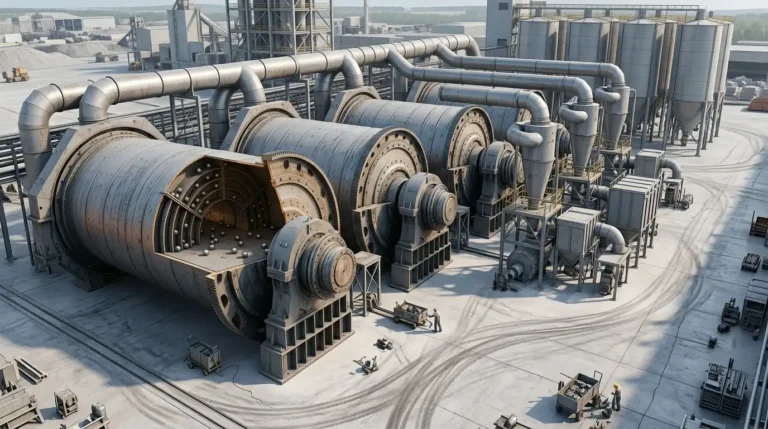
What is the difference between a cone ball mill and a cylindrical ball mill? A cone ball mill, also called a conical or Hardinge-type mill, narrows from a wide feed end to a smaller discharge end. This taper causes coarse grinding balls to settle near the feed opening and fine balls to migrate toward the discharge, so the mill self-classifies its own grinding media. A cylindrical ball mill keeps a constant shell diameter along its full length, so the ball charge stays mixed rather than self-classifying by size. Conical mills produce a narrower product size distribution in a single pass but are limited to lower capacities and are built by a smaller number of manufacturers today. Cylindrical mills scale to much higher tonnages, use simpler shell fabrication, and are the standard choice in current primary and secondary grinding circuits for mining, cement, and industrial minerals. For most new grinding projects above roughly 5 t/h, a cylindrical mill such as the MQ Ball Mill is the more common and more serviceable option; a conical mill remains relevant mainly for small-capacity regrind duty where tight particle size control outweighs throughput.
What You Will Learn from This Guide
This guide compares the structural design, grinding performance, and sizing logic of cone ball mills and cylindrical ball mills for mineral, cement, and industrial grinding applications. It is written for process engineers and procurement teams at the equipment-selection stage, before a request for quotation is issued, so a mill type can be shortlisted based on feed characteristics, target product size, and production capacity rather than on a single supplier’s default recommendation. The guide walks through working principle, structural and performance comparison tables, sizing parameters, and a scenario-based selection framework. After reading this guide, you will be able to identify which structural type fits a given ore hardness and capacity range, read a basic mill specification sheet, and ask a supplier the specific technical questions needed to compare competing quotations on equal terms.
Quick Verdict: Cylindrical or Conical Ball Mill?
A cylindrical ball mill is the correct default for most mineral processing and cement grinding duties above 5 t/h, because current OEM supply, spare-parts availability, and scale-up experience are concentrated on this shell type. A conical ball mill is the correct choice only when three conditions apply together: the required capacity is below roughly 50 t/h, the process needs a narrow product size band without a downstream classifying cyclone, and the operation can accept a smaller pool of qualified suppliers and spare-parts sources. Outside those three conditions, a cylindrical mill such as the MQ Ball Mill delivers equivalent or better grinding performance at lower capital cost per tonne of installed capacity. The remainder of this guide sets out the data behind that recommendation.
How Each Mill Type Grinds Ore: Working Principle
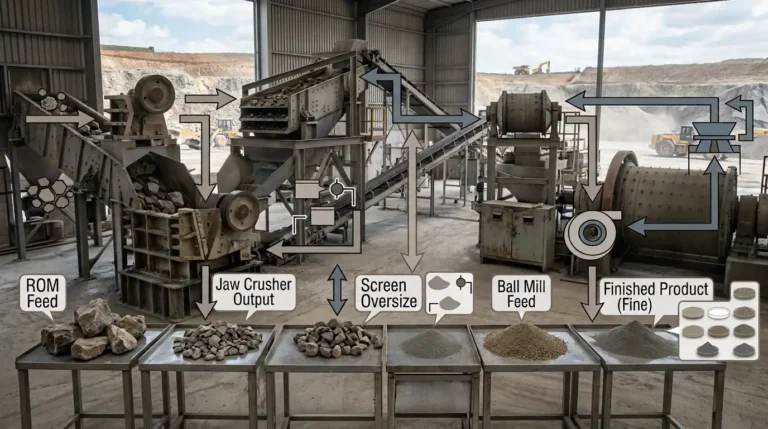
Both mill types reduce particle size through the same two mechanical actions: impact, from grinding balls falling from height onto the ore bed, and attrition, from balls sliding against each other and against the shell lining. Feed material typically arrives at the mill already reduced to 10–25 mm by a primary or secondary crusher, such as a PE Jaw Crusher or a cone crusher, before it enters the mill trunnion.
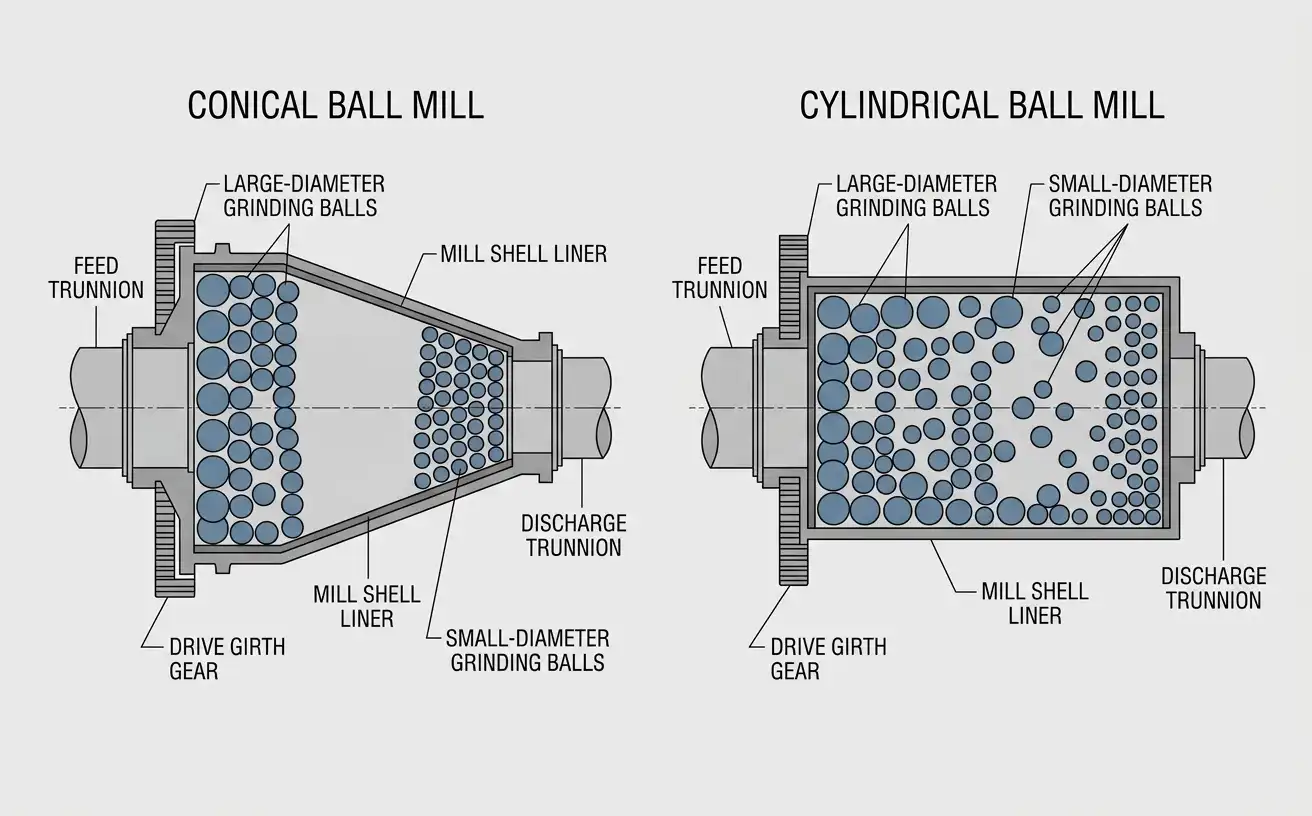
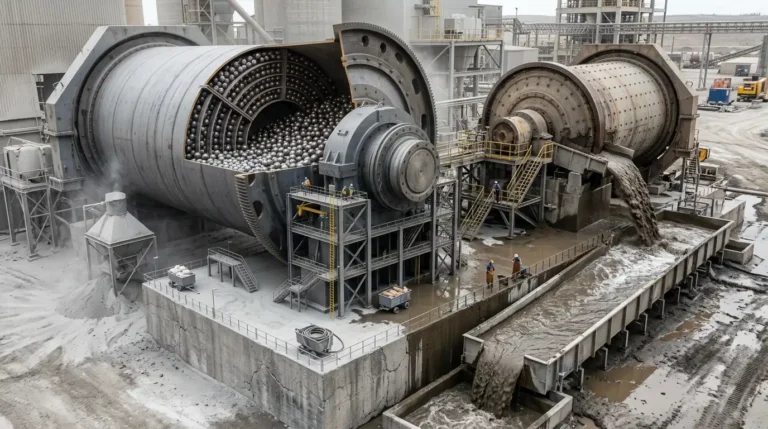
In a cylindrical mill, the shell diameter is constant from the feed trunnion to the discharge trunnion. Grinding balls of mixed diameter circulate together along the full length of the shell, and the size distribution of the ball charge is set once at loading and maintained through periodic top-up. In a conical mill, the shell tapers from a larger diameter at the feed end to a smaller diameter at the discharge end. As the shell rotates, centrifugal force pushes the largest balls toward the section of greatest diameter, which is the feed zone, while the smallest balls settle toward the section of smallest diameter, which is the discharge zone. This taper-driven separation means coarse feed particles meet large, high-impact-energy balls first, and progressively finer particles meet progressively smaller, higher-attrition-energy balls as they move toward discharge. The classification is mechanical and continuous; it does not depend on an external cyclone or screen.
Structural Comparison: Shell Geometry and Fabrication
Shell geometry is the structural feature that separates the two mill types, and it carries through to every other comparison in this guide, including the large-diameter shell sizes documented in the manganese ore ball mill installation referenced later in this section. Table 1 sets out the structural differences directly.
Table 1. Structural comparison between cone ball mills and cylindrical ball mills.
| Parameter | Cone (conical) ball mill | Cylindrical ball mill |
|---|---|---|
| Shell geometry | Tapered, larger diameter at feed, smaller at discharge | Constant diameter along full length |
| Media classification | Self-classifying by taper (large balls at feed, small balls at discharge) | Uniform mix, no internal classification |
| Typical length-to-diameter (L/D) ratio | Short, generally below 1.5 | 1.0–2.0 for short-cylinder mills; above 2.0 for tube mills |
| Shell fabrication complexity | Higher — requires rolled and welded conical plate sections and matched flanges | Lower — straight rolled cylindrical shell |
| Trunnion bearing arrangement | Standard trunnion at feed end, standard trunnion at discharge end | Standard trunnion at feed end, standard trunnion at discharge end |
| Discharge configuration available | Overflow, more rarely grate | Overflow or grate (diaphragm) |
| Current commercial capacity range observed | Roughly 1–50 t/h across manufacturer catalogs reviewed for this guide | Roughly 0.5 t/h up to several hundred t/h in large-diameter installations |
Source note: capacity ranges are compiled from published equipment catalogs of multiple grinding-mill manufacturers as of 2026 and represent typical current commercial offerings, not a single manufacturer’s full product range.
The structural comparison in Table 1 identifies fabrication complexity and capacity ceiling as the two variables that most often decide a shell type before performance data is even reviewed. A tapered shell requires conical plate rolling and a transition weld between the cylindrical and conical sections, which adds fabrication steps compared with a straight cylindrical shell of the same diameter. This is one reason large-diameter mills — those built to process several hundred tonnes per hour, such as the shell sizes used in the manganese ore ball mill installation documented by MR CRUSHER — are built with a cylindrical rather than conical shell.
Performance Comparison: Grinding Efficiency, Energy Consumption, and Product Fineness
Neither shell type is the right tool once a target fineness drops below roughly 20 microns; at that point a purpose-built fine-grinding machine such as the MSF Ultrafine Grinding Mill becomes the more direct comparison than either ball mill shell. Within the range where ball mills remain the correct equipment class, Table 2 sets out how the two shell types differ on the variables that drive a selection decision.
Table 2. Performance comparison between cone and cylindrical ball mills.
| Parameter | Cone (conical) ball mill | Cylindrical ball mill | Basis / condition |
|---|---|---|---|
| Media size grading in service | Self-graded along the taper; large media stay near feed | Set by initial charge; requires periodic re-grading top-up | Structural difference, Table 1 |
| Product size distribution in single pass | Narrower, because coarse and fine zones are physically separated | Wider, because mixed media grinds coarse and fine particles in the same zone | Consequence of media self-classification |
| Overgrinding risk | Lower in the discharge zone, because only fine media act there | Higher without a closed-circuit classifier, because coarse media can continue to act on already-fine particles | Structural difference |
| Comminution energy share of plant load | Grinding remains one of the largest single electrical loads in a concentrator regardless of shell type | Same | DOE 1981 data cited in comminution energy-consumption literature; comminution accounted for approximately 2% of total U.S. electricity consumption1 |
| Single-particle fracture energy efficiency benchmark | Not shell-type specific; applies to ball milling generally | Approximately 15% for quartz, based on comparative fracture-surface-area energy studies2 | Applies to both shell types equally; cited to establish that neither design approaches theoretical fracture efficiency |
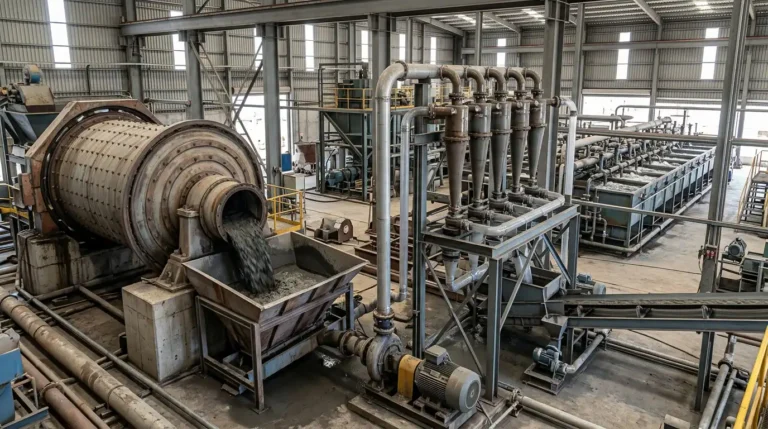
| Closed-circuit requirement for fine product | Often operable with a shorter or absent classifying circuit for narrow-spec products | Typically requires a hydrocyclone or spiral classifier in closed circuit to hold product size within specification | Circuit design consequence |
The performance comparison in Table 2 shows that the conical mill’s main functional advantage is a narrower product size distribution without relying on a downstream classifier, which matters most in regrind and precision-fineness duties. The energy-consumption data in the table is not shell-type specific: comminution is energy-intensive in both designs, and neither design approaches the theoretical minimum fracture energy, so energy consumption should not be the deciding factor between the two shell types on its own. Historical comparative trials from the early Hardinge conical-mill trade literature reported lower power draw for conical mills under equal media load, but that data predates modern instrumentation and closed-circuit control practice, and it has not been reproduced under a documented modern test protocol; it is included here for historical context only and should not be treated as a current benchmark.
Sizing and Specification Parameters
Sizing a mill for a specific duty point means matching shell diameter, length, and drive power to a target capacity and product size; the MQ Ball Mill specification range illustrates how these parameters scale together across a cylindrical product line before the same logic is applied to a conical alternative. Mill sizing for either shell type starts from the critical speed, the rotational speed at which centrifugal force holds the ball charge against the shell instead of allowing it to cascade. Critical speed is calculated as:
N_c = 42.3 / √D
where N_c is critical speed in revolutions per minute and D is the mill’s internal shell diameter in meters, measured inside the liners. Mills of both shell types normally operate at 65–80% of critical speed. Below this range, the ball charge rolls rather than cascades, which reduces impact energy; above this range, centrifugal force pins the charge to the shell wall and grinding stops.
Table 3. Typical sizing parameters for reference.
| Parameter | Typical range | Unit | Applies to |
|---|---|---|---|
| Operating speed | 65–80 | % of critical speed | Both shell types |
| Grinding media fill ratio | 30–45 | % of mill internal volume | Both shell types |
| Feed size for coarse grinding | 80–125 | mm ball diameter for corresponding feed | Cylindrical, first-chamber duty |
| Feed size for fine/regrind duty | 20–50 | mm ball diameter | Both shell types, second-stage or regrind |
| L/D ratio, short-cylinder mill | 1.0–2.0 | dimensionless | Cylindrical |
| L/D ratio, tube mill | Above 2.0 | dimensionless | Cylindrical |
Source note: ranges compiled from published mineral-processing engineering references and manufacturer specification sheets reviewed for this guide.
Table 3 shows that the operating-speed and fill-ratio ranges are shared by both shell types; the L/D ratio only applies meaningfully to cylindrical mills, since conical mills are defined by their taper rather than a constant L/D. A plant-specific duty point should always be confirmed against a grindability test result on the actual ore, rather than against catalog ranges alone.
Selection Criteria: Feed Size, Ore Hardness, Capacity, and Circuit Design
Feed size consistency is the first variable to confirm, because it is set upstream of the mill by the crushing stage: a properly adjusted CS Symons Cone Crusher produces a stable, pre-sized top size that suits either shell type, while a variable or oversized feed favors the wider operating margin of a cylindrical mill’s mixed ball charge. Three further variables complete the selection. Target capacity: below approximately 50 t/h, both shell types are commercially available; above that threshold, cylindrical mills are the practical option because few manufacturers currently offer large-diameter conical shells. Ore hardness, expressed as the Bond Work Index in kWh/t: harder ores require more grinding energy regardless of shell type, and mill length or ball charge — not shell taper — is the primary lever for handling higher hardness. Target product fineness and its tolerance band: a narrow single-pass size specification favors the conical mill’s self-classification, while a specification serviced by a closed-circuit cyclone favors the cylindrical mill, because the cyclone performs the classification function that the conical taper would otherwise provide.
Table 4. Scenario-based mill type recommendation.
| Scenario | Recommended shell type | Reason |
|---|---|---|
| Primary grinding, 50–300 t/h, metal ore | Cylindrical | Capacity range and OEM availability |
| Regrind or polishing duty, under 20 t/h, narrow product spec | Conical | Self-classification reduces reliance on external cyclone |
| Cement clinker grinding, dry circuit, high tonnage | Cylindrical, typically multi-chamber tube mill | Standard industry practice; higher L/D handles staged grinding |
| Small pilot plant or batch testing, under 5 t/h | Either, cost and supplier availability decide | Both types are available at pilot scale; procurement lead time often decides |
| Variable, inconsistent feed top size | Cylindrical | Mixed ball charge tolerates feed variability better than a taper-classified charge |
The scenario table shows that capacity and product-spec tolerance, not raw grinding efficiency, are the two variables that most often decide the outcome in practice. When a project sits in the overlapping middle ground — moderate capacity, moderate fineness tolerance — the deciding factor is usually supplier lead time and spare-parts logistics rather than a measurable performance gap between the two shell types.
Applications by Material and Industry
Grinding duty varies by material hardness, moisture sensitivity, and required final fineness, and these variables interact with shell-type selection differently across industries.
Metal ore beneficiation. Gold, copper, and manganese ore grinding circuits typically use wet, closed-circuit cylindrical mills feeding a hydrocyclone, because the downstream flotation or leaching process requires a controlled, repeatable size distribution that the cyclone — not the mill shell — is responsible for delivering. A documented example is a 6 t/h ball mill installation for manganese ore grinding, which used a cylindrical shell in closed circuit with classification equipment to hold product size within the concentrator’s flotation feed specification.
Industrial minerals and fillers. Graphite, feldspar, and similar industrial minerals often require a narrower particle size band with less tolerance for oversize than metal-ore concentrate feed, because oversize particles directly affect downstream product grade rather than only recovery rate. A 2–3 t/h ball mill case for graphite ore grinding and a 3–5 t/h ball mill case for feldspar grinding illustrate this lower-capacity, fineness-sensitive segment where a conical mill is at least worth evaluating against a cylindrical mill in closed circuit, depending on the plant’s tolerance for a smaller supplier pool.
Cement and construction materials. Cement clinker grinding is almost universally handled by cylindrical multi-chamber tube mills operating dry, because the staged grinding across chambers — coarse in the first chamber, fine in the last — replicates part of the classification benefit of a conical taper while retaining the fabrication simplicity and scale-up track record of a straight cylindrical shell.
Maintenance, Wear Parts, and Total Cost of Ownership
Liner and media wear is the largest recurring cost on either shell type, and it is the variable buyers most often underestimate when comparing a conical mill against a cylindrical mill such as the MQ Ball Mill. Shell liners on both mill types are typically specified in manganese steel or high-chromium white iron. High-chromium white iron liner grades used in abrasive grinding service are commonly specified to ASTM A532/A532M, Standard Specification for Abrasion-Resistant Cast Irons, which sets chemical composition and hardness requirements for the Class I, II, and III alloy families used in mining and milling wear applications. A conical mill’s tapered shell requires liner plates cast or formed to match the changing internal diameter along the taper, which increases the number of distinct liner part numbers a plant must stock compared with a cylindrical mill, where liner plates repeat along the constant-diameter shell.
Total cost of ownership should be calculated as capital cost plus grinding-media consumption plus liner replacement plus energy cost over the expected service life, not as purchase price alone. A cylindrical mill’s liner standardization generally reduces spare-parts inventory cost and shortens liner replacement downtime relative to a conical mill of similar throughput, because fewer distinct liner geometries need to be stocked and fitted. MR CRUSHER’s engineering team can provide installation-specific wear-life and liner-replacement-interval data for a named ore type on request; the MGW Intelligent Raymond Mill is the relevant comparison point for plants evaluating dry fine-grinding alternatives to wet ball milling as part of the same total-cost review.
Cost & Procurement
Procurement lead time is frequently the deciding factor once capacity and fineness requirements narrow the choice to a shortlist of two or three configurations, as in the lower-capacity graphite ore grinding project referenced earlier, where a cylindrical mill’s shorter delivery schedule outweighed the marginal fineness advantage a conical mill would have offered at that tonnage. Cylindrical mills, because they are built by a larger number of manufacturers and use more standardized shell fabrication, generally have shorter lead times and a wider base of alternate suppliers for liners and trunnion bearings during the equipment’s service life. A conical mill’s smaller manufacturer base can extend both initial lead time and future spare-parts lead time, which should be factored into the total-cost comparison alongside grinding performance. Buyers should request a duty-point specification sheet — feed size, target product size, capacity, and ore Bond Work Index — from any supplier before comparing quotations, so that quoted mill sizes are directly comparable rather than sized against different assumed duty points.
Frequently Asked Questions
What is the difference between a ball mill and a Raymond mill?
A ball mill grinds material with tumbling steel balls inside a rotating cylindrical or conical shell and is typically used for wet grinding in mineral processing. A Raymond mill grinds material with rollers pressing against a rotating ring and is typically used for dry fine grinding of non-metallic minerals such as barite, dolomite, or calcite.
Can a conical ball mill be converted to a cylindrical ball mill, or vice versa?
No. The shell geometry, trunnion spacing, and liner plate design are specific to each shell type and are not interchangeable. Converting from one type to the other requires a new mill shell, not a retrofit of the existing shell.
Why do most large mining projects use cylindrical ball mills instead of conical mills?
Cylindrical mills scale to larger diameters with simpler shell fabrication, and a larger number of manufacturers currently supply large-diameter cylindrical shells than conical shells. This gives cylindrical mills a wider supplier base, more standardized spare parts, and a longer track record at high tonnage.
Does a conical ball mill produce a finer product than a cylindrical ball mill?
A conical mill produces a narrower single-pass size distribution because of self-classifying media, not necessarily a finer average product size. A cylindrical mill operating in closed circuit with a hydrocyclone can reach an equivalent or finer product size, with the cyclone performing the classification function.
What ore hardness range can a cylindrical ball mill handle?
Ore hardness is expressed as Bond Work Index in kWh/t; both shell types can process a wide hardness range, and hardness is managed primarily through mill length, ball charge, and drive power rather than through shell geometry. A grindability test on the specific ore is required to confirm sizing for any Bond Work Index above approximately 15 kWh/t.
References & Sources
- ASTM A532/A532M-10 — Standard Specification for Abrasion-Resistant Cast Irons
- Benchmarking comminution energy consumption for the processing of copper and gold ores — International Journal of Mineral Processing, ScienceDirect
- Mineral comminution: Energy efficiency considerations — Minerals Engineering, ScienceDirect
- Optimizing key parameters for grinding energy efficiency and modeling of particle size distribution in a stirred ball mill — Scientific Reports, Nature