

Ball Mill Selection for Gold Flotation Circuits
What You Will Learn from This Guide
Selecting a ball mill for a gold flotation circuit is not the same problem as selecting one for general grinding. The target grind size, the circuit configuration, and even the grinding media all get shaped by what flotation actually needs to work. This guide walks through those application-specific requirements. It also explains why gold flotation circuits are built the way they are. It serves engineers and buyers sizing a grinding circuit ahead of flotation. After reading, you will understand what to actually specify beyond tonnage and horsepower.
Why Grinding Comes Before Flotation: The Liberation Requirement
Flotation separates minerals by surface chemistry, using reagents that make gold-bearing sulfide particles attach to air bubbles while gangue particles sink. That separation only works if the particles are actually free to respond individually. A particle still locked inside a larger piece of waste rock cannot float on its own, no matter how well the reagents are chosen.
Grinding is what breaks the ore down to the point where valuable mineral grains become physically separated from surrounding gangue, a state called liberation. A ball mill ahead of flotation exists specifically to reach that liberated state, not just to make particles smaller in some general sense. Everything else in mill selection for this application follows from that one requirement.
The Target Grind Size: A Window, Not a Single Number
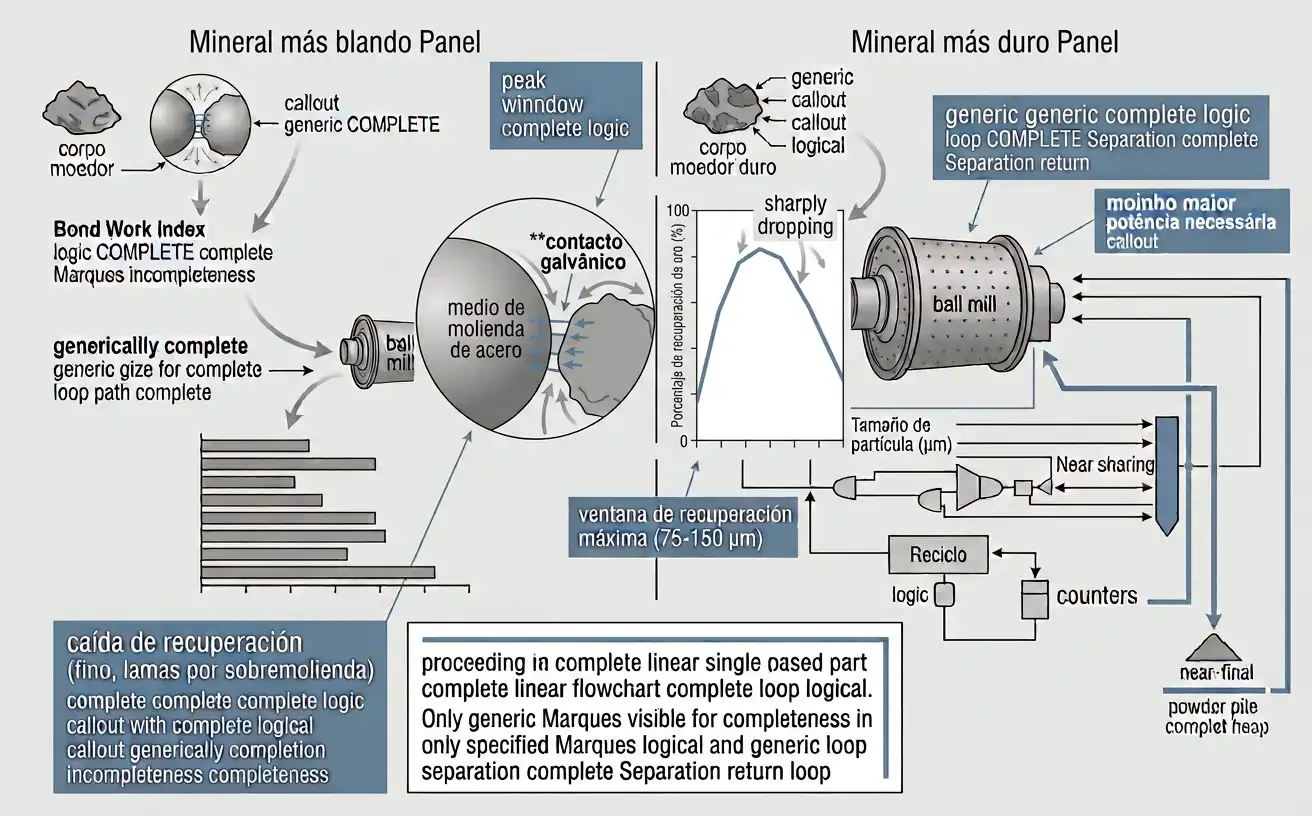
Gold flotation circuits commonly target a P80 somewhere between 75 and 150 microns. Many operations land closer to 120 to 150 microns, depending on the specific ore. That range is not arbitrary.
Documented plant data shows gold recovery dropping markedly for particles coarser than roughly 100 microns. In some cases recovery falls from around 85 percent down to around 45 percent. The same data shows recovery dropping again at the fine end. Recovery can fall from around 90 percent down to around 65 percent for particles finer than roughly 30 to 40 microns.
Grinding finer is not automatically better here. There is a real window where recovery peaks, bounded by under-grinding on one side and over-grinding on the other.
Why Overgrinding Is Worse Than Wasted Energy
Overgrinding has a reputation as an energy problem, and that reputation is well earned. Measurements from commercial flotation circuits have found something striking. Roughly 90 percent of grinding energy in a conventional ball mill and classifier circuit gets consumed on useless overgrinding. That is material ground far past what liberation actually required.
The cost goes beyond wasted power, though. Overground material produces slimes, and those slimes coat larger particles in the pulp. That coating interferes with the flotation reagents’ ability to act selectively on particles that would otherwise separate cleanly. A circuit generating excess slime can lose recoverable gold to the tailings even when the coarser fraction was ground correctly.
Circuit Configuration: Closed Circuit as the Standard
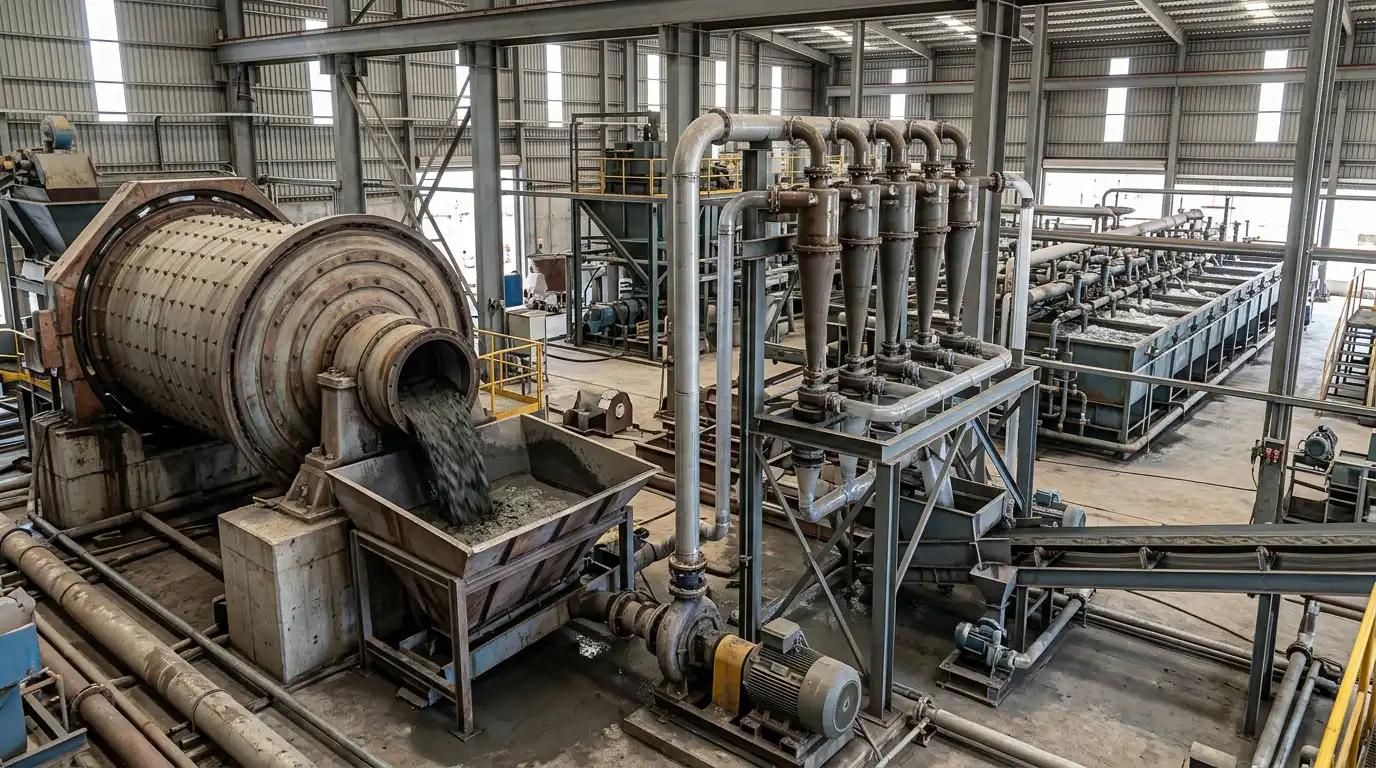
A closed circuit, with a classifier returning oversize material for another pass through the mill, is close to universal for gold flotation feed preparation. The reasoning connects directly to what flotation needs. A size specification tight enough to avoid both under-grinding and overgrinding requires a real guarantee, and only a closed circuit actually delivers one.
Hydrocyclones are the standard classifier for this duty, rather than screens, since the target particle sizes run too fine for screening to separate efficiently. The mill and its cyclone cluster function as one matched unit. The cyclone’s cut point gets set to align with the flotation feed’s target P80, rather than chosen independently of it.
Grinding Media and the Galvanic Interaction Consideration
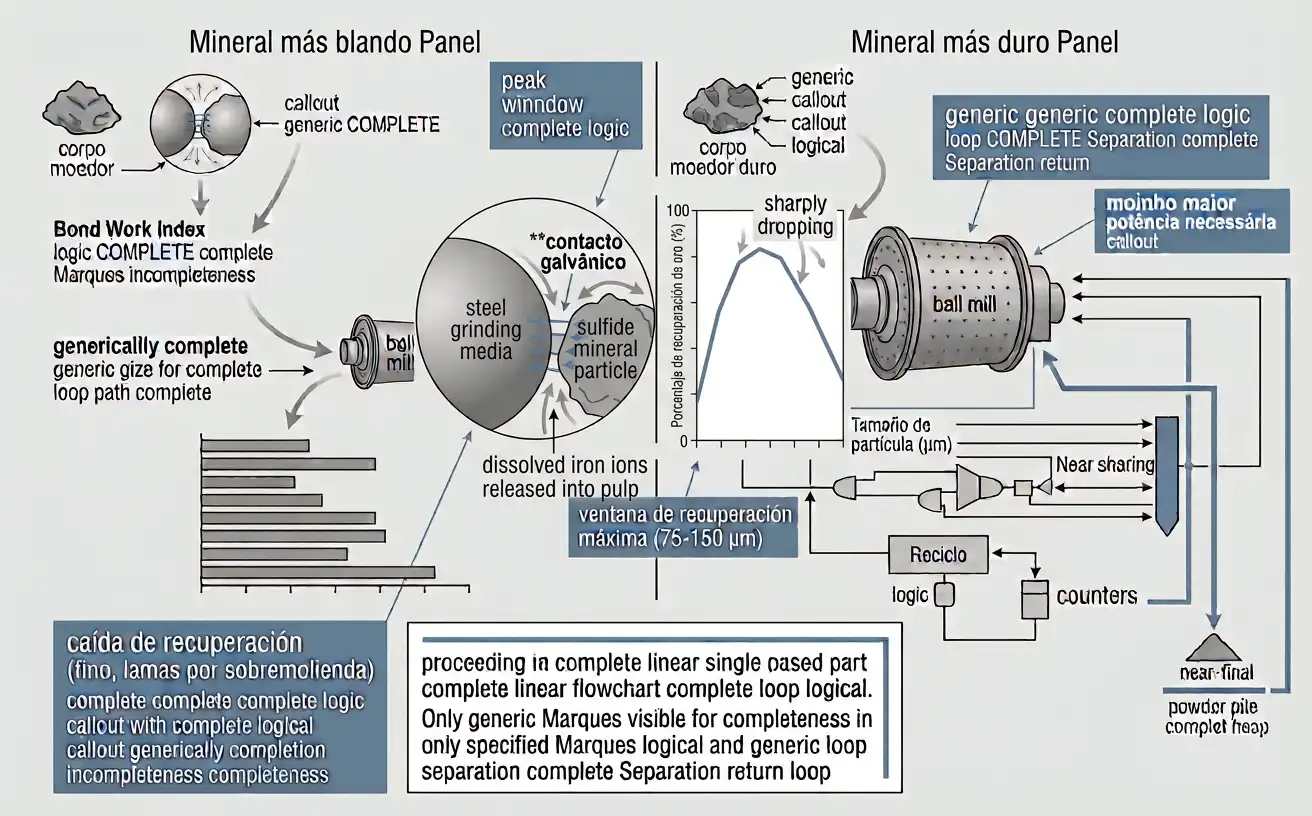
Gold ore is frequently associated with sulfide minerals like pyrite. Wet grinding those sulfides against steel media creates a genuine chemistry consideration beyond simple wear. Steel media and sulfide particles can interact galvanically in the slurry. That interaction corrodes the media faster while releasing dissolved iron into the pulp.
That released iron changes the pulp chemistry the flotation stage inherits downstream. Wet grinding of sulfides tends to drive chemical surface reactions on the mineral particles themselves. That is a different effect than the surface oxidation more typical of dry grinding.
This is a real factor in media selection for gold flotation circuits specifically, not just a general wear consideration. It is part of why some specialized gold processes have used ceramic media instead of steel. Those circuits chose ceramic where metal ion interference was a known problem.
Sizing the Mill: Matching Capacity to Ore Hardness
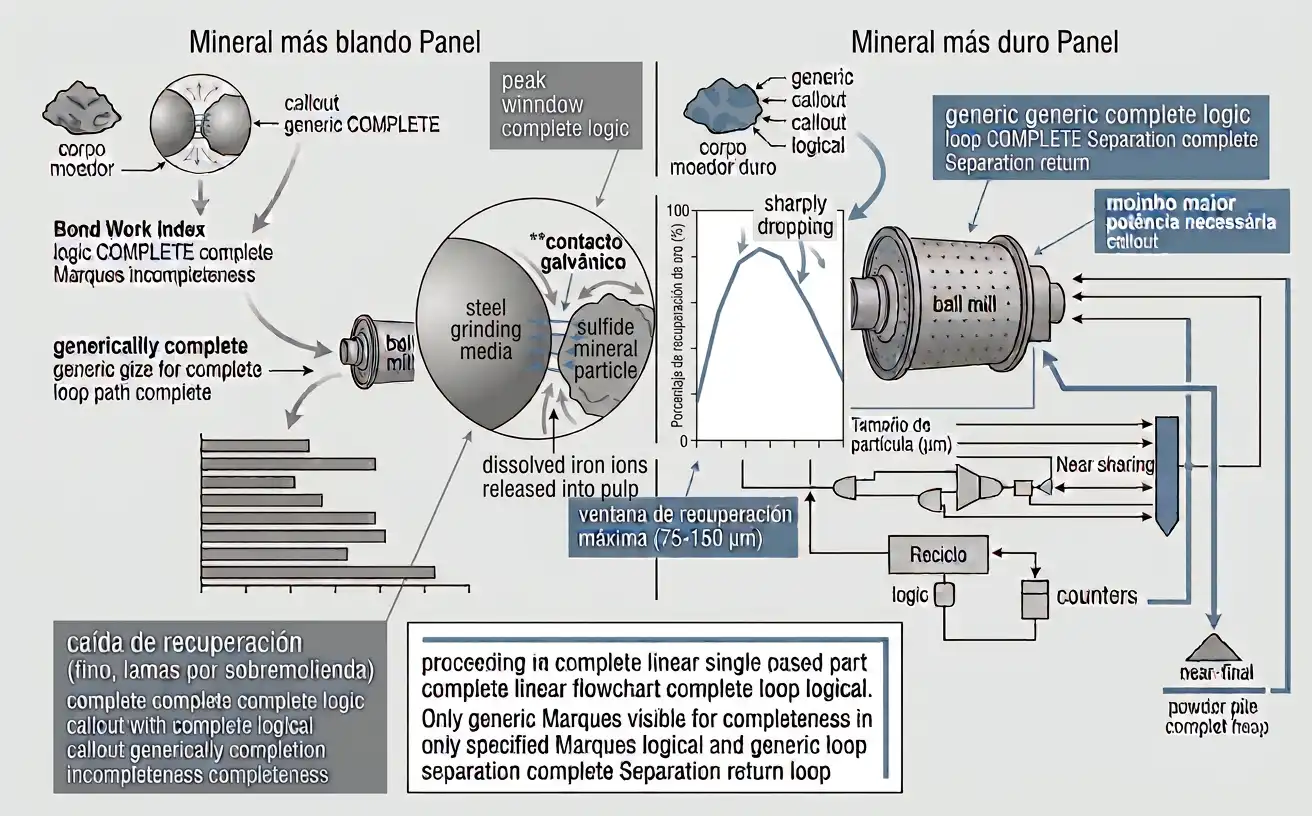
Once the target P80 and circuit configuration are set, sizing the mill itself follows the same logic used across ball mill selection generally. Ore hardness gets expressed through a Bond Work Index figure specific to that ore. That figure determines how much energy the mill actually needs to reach the target grind size at the required throughput.
A harder ore with a higher Work Index needs more installed power to hit the same P80 at the same tonnage as a softer one. Getting this match right matters more in a flotation application than in some others. Undersizing the mill risks compromising the liberation window the whole downstream process depends on. Oversizing it wastes capital without improving recovery, once that window is already being hit.
Frequently Asked Questions
What particle size should gold ore be ground to before flotation?
Most gold flotation circuits target a P80 somewhere between 75 and 150 microns, often closer to 120 to 150 microns depending on the ore. This range balances liberation, since coarser material leaves gold locked in gangue, against overgrinding, since finer material creates slimes that interfere with flotation selectivity.
Why is overgrinding a problem beyond wasting energy?
Overground material produces slimes that coat larger particles in the pulp, interfering with flotation reagents’ ability to act selectively. Commercial data has found that roughly 90 percent of grinding energy in a conventional circuit gets consumed on overgrinding. Recovery itself can also drop for gold particles ground finer than roughly 30 to 40 microns.
Why do gold flotation circuits almost always run the ball mill in closed circuit?
Flotation needs a tightly controlled feed size to avoid both under-grinding and overgrinding. Only a closed circuit, with a classifier returning oversize material for another pass, reliably delivers that guarantee. Hydrocyclones are the standard classifier for this duty, since the target particle sizes are generally too fine for screening.
Does the choice of grinding media matter for gold ore specifically?
Yes, when the ore contains sulfide minerals like pyrite. Wet grinding sulfides against steel media can create galvanic interactions that accelerate media corrosion and release dissolved iron into the pulp. That affects the chemistry the flotation stage depends on downstream. This is why media selection deserves specific attention in gold flotation circuits, not just general wear considerations.
References and Sources
- ScienceDirect — Sulfide Flotation: An Overview
- U.S. Patent 8,262,768 — Method to Improve Recovery of Gold from Double Refractory Gold Ores
- U.S. Patent 11,420,211 — Multiple-Stage Grinding Circuit
- Physicochemical Problems of Mineral Processing — A Comparison of Dry and Wet Grinding on Gold-Bearing Sulfide Ore Flotation