

Steel Ball Gradation Design: Initial Charge Scheme and Make-Up Ball System
What You Will Learn from This Guide
A well-designed ball charge uses several ball sizes, not one, and replenishes itself with top-size balls only, not a repeated full charge. This guide covers how to calculate an initial charge and how to run a make-up ball system that holds it steady over years of operation. It serves a mill operator or process engineer setting up a new circuit or auditing an underperforming one, and after reading, you will be able to size a charge and set a replenishment rate instead of copying a supplier’s default recommendation.
Overview
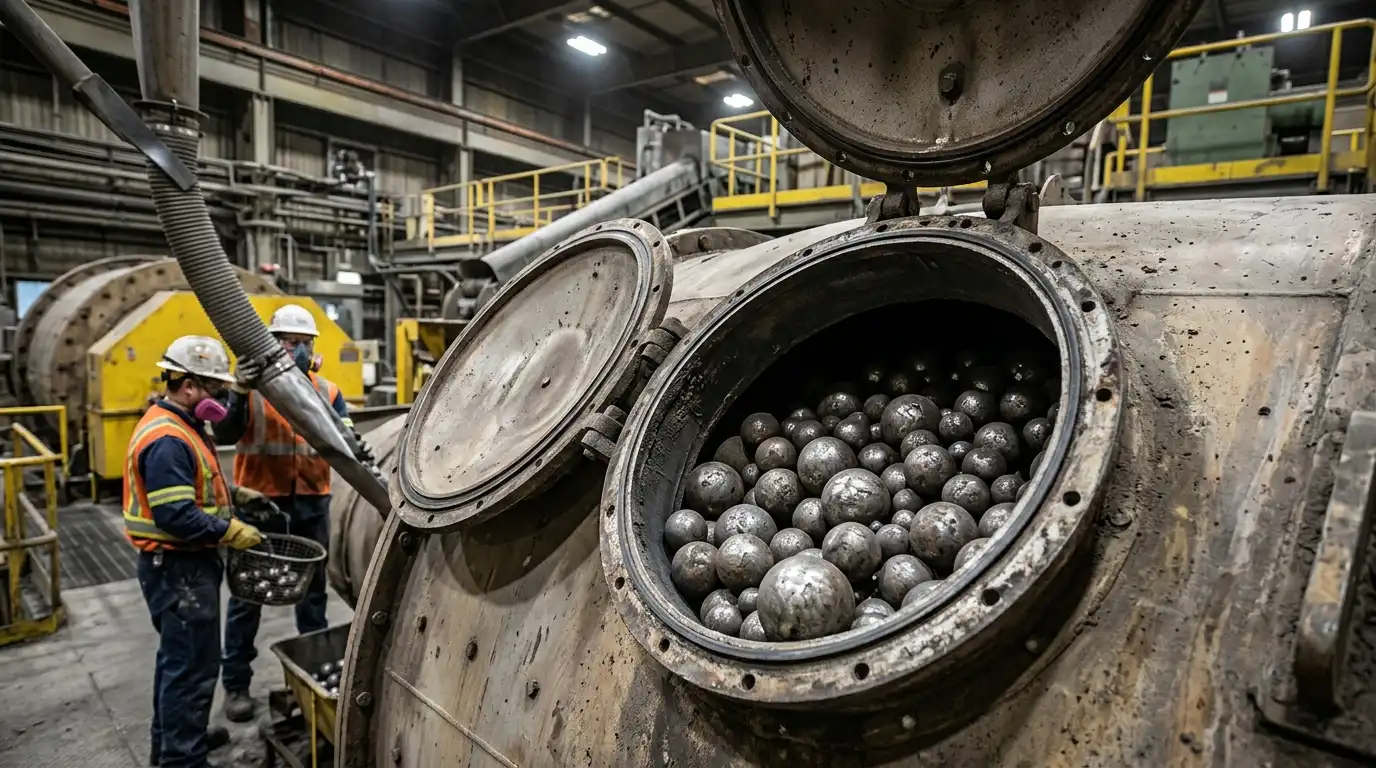
A ball mill grinds by tumbling steel balls against ore inside a rotating shell. The balls do the actual breaking; everything else in the mill exists to keep them moving correctly. Two decisions govern that charge: what sizes go in on day one, and what gets added afterward to replace what wears away.
Get the first decision wrong, and the mill never reaches its designed throughput. Get the second wrong, and a correctly designed charge drifts out of balance within months, even if nobody changes anything else about the operation.
Why a Graded Charge Outperforms a Single Ball Size
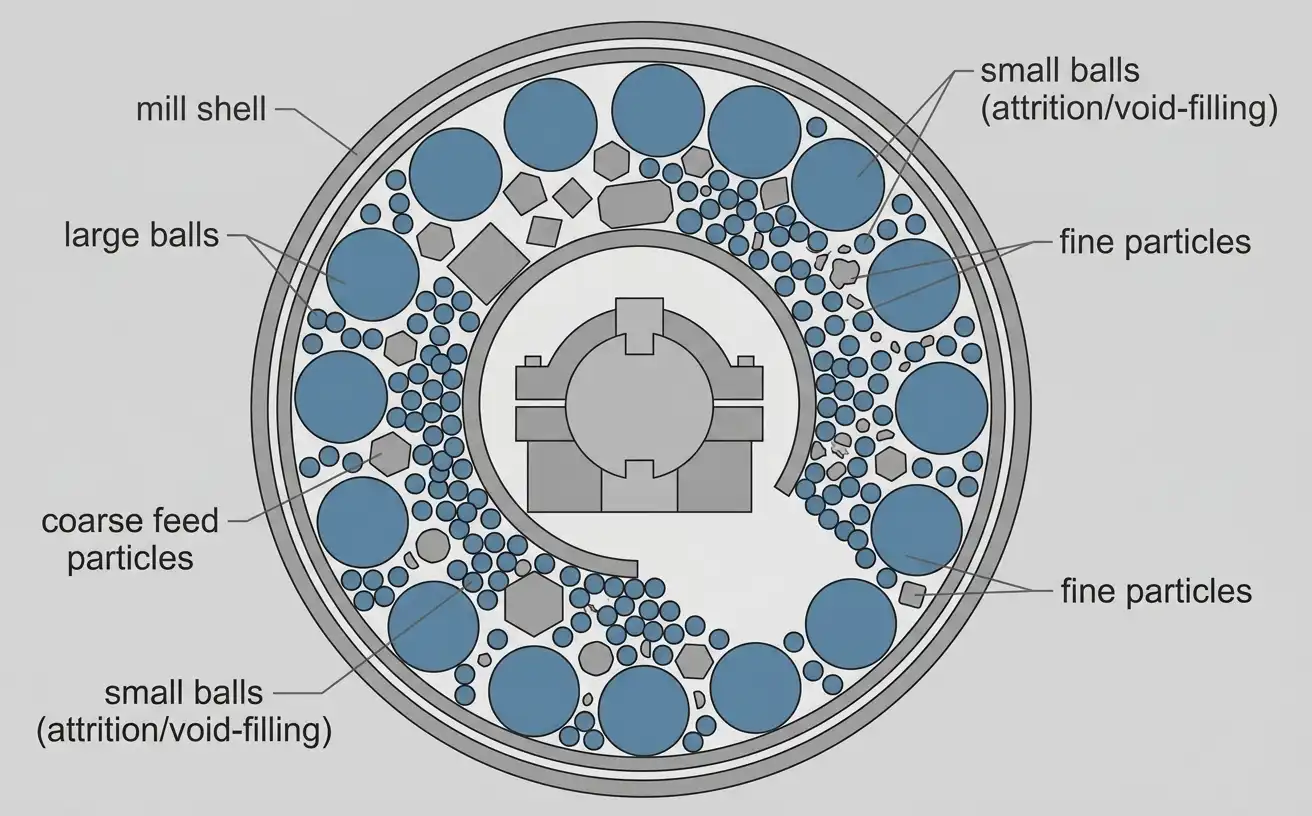
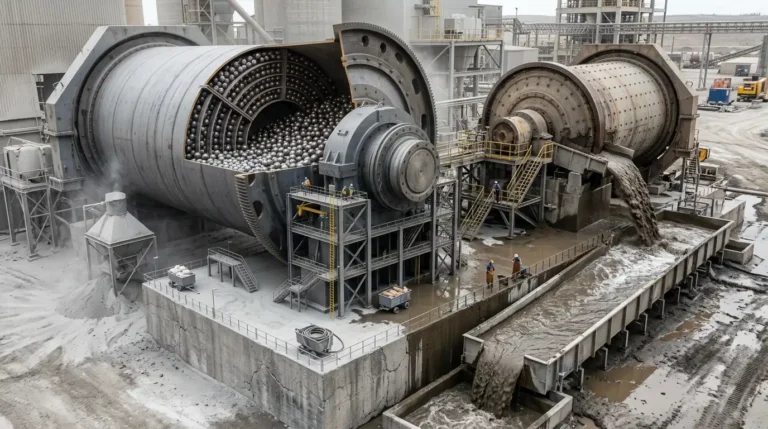
Large balls break coarse feed through impact. Small balls fill the voids between large balls and grind fine particles through attrition. A charge of only large balls leaves gaps that fine ore passes through unbroken. A charge of only small balls cannot fracture coarse feed at all.
This is why a graded charge — several distinct ball sizes in planned proportions — outperforms a single size in almost every circuit. The right proportions depend on the feed size distribution and the target product size, not on a fixed ratio that applies everywhere.
Calculating the Initial Ball Charge
The starting point is the top ball size: the largest diameter needed to break the coarsest particles the mill will actually see. Fred Bond’s formula remains the standard reference:
B = (F / K)^0.5 × (Wi × SG / (100 × Cs × √D))^0.334
B is the resulting ball diameter in mm. Table 1 below defines every other variable in the formula. Azzaroni’s formula is a commonly used alternative that produces comparable results from similar inputs.
Once the top size is set, the rest of the charge is planned as a distribution below it, not as a second independent calculation:
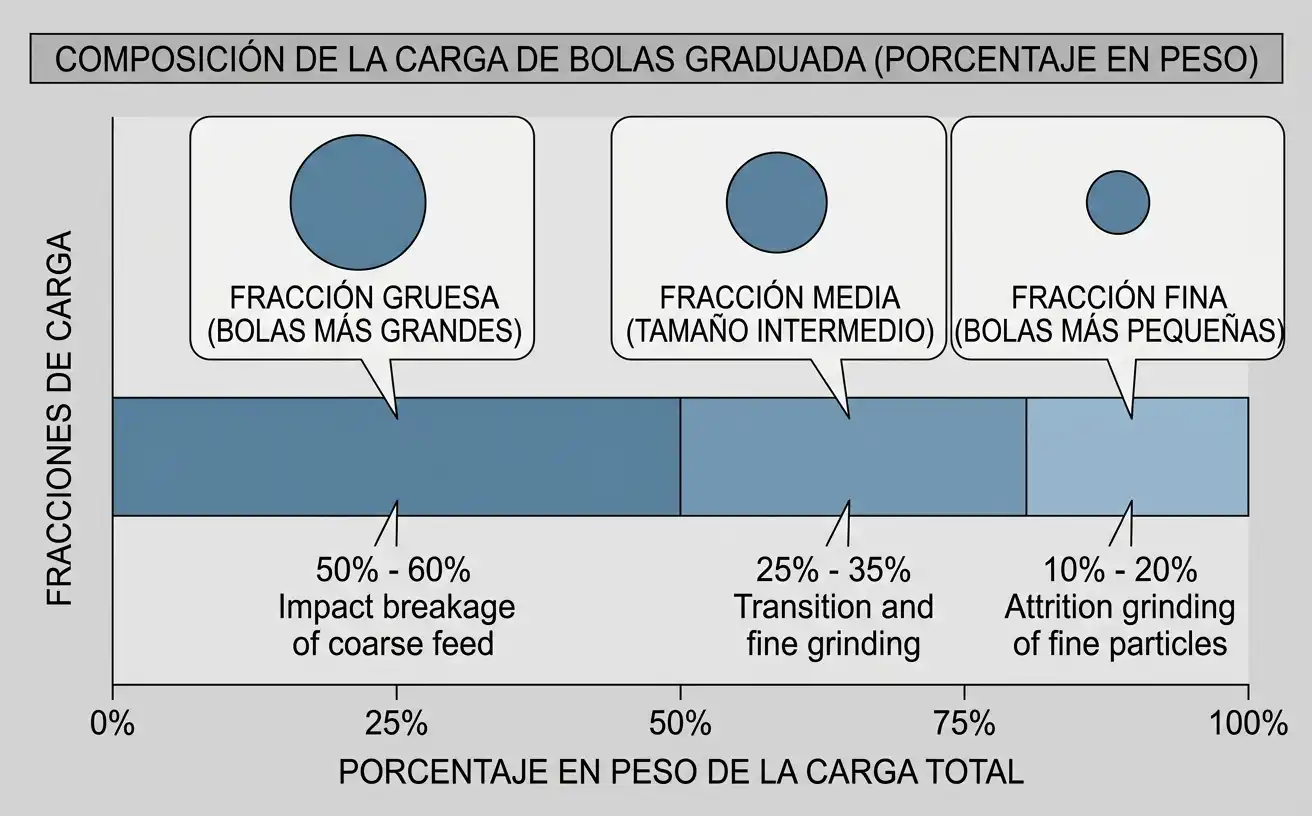
- Coarse fraction (largest size). Sized to break the coarsest fresh feed. This fraction is typically the smallest by ball count but does most of the initial-fracture work.
- Mid-range fraction. Fills voids left by the coarse fraction and handles material already reduced partway to target size.
- Fine fraction (smallest size in the initial charge). Provides surface area for final attrition grinding. In a well-run mill, this fraction is partly self-generating, since coarse balls wear down into it over time.
Total charge weight follows from the mill’s fill fraction: W = φ × V × ρ. The variables are:
- φ — the fill fraction, commonly 30 to 45 percent of internal volume for industrial ball mills
- V — internal mill volume
- ρ — the bulk density of the grinding media
A MQ Ball Mill at a given shell diameter has a fixed V. The fill-fraction choice is what actually sets total media weight for that mill.
Table 1. Bond top-size formula variables
| Variable | Meaning | Typical source |
|---|---|---|
| F | 80%-passing feed size (microns) | Feed sizing analysis |
| Wi | Bond Work Index (kWh/t) | Standard Bond grindability test |
| SG | Ore specific gravity | Ore assay/characterization |
| Cs | Fraction of critical speed | Mill operating parameter |
| D | Mill internal diameter (m) | Mill nameplate/drawing |
| K | Formula constant | ~350 for wet overflow mills |
Source: Fred C. Bond’s ball-sizing method, as documented in mineral-processing engineering literature; site-specific inputs must come from actual feed and ore testing, not assumed values.
The mill’s own diameter is one of the formula’s five inputs. A top-size figure calculated for one shell diameter does not transfer directly to a different one. A related ball mill dimension and size-selection guide covers how D and L are chosen in the first place — the step that precedes this calculation.
The Make-Up Ball System: Why Top-Size-Only Replenishment Works
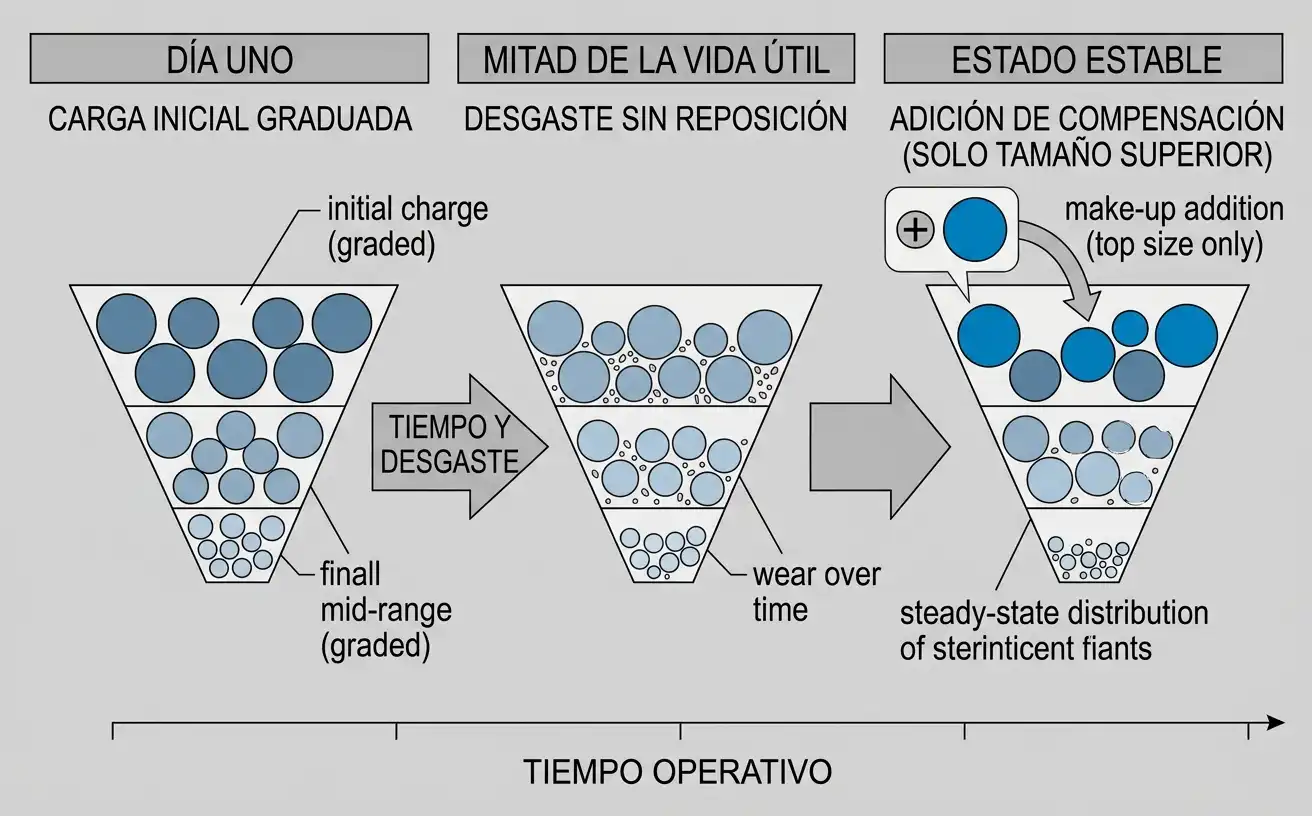
Every ball in the mill wears smaller with each hour of operation. A ball charged at top size gradually becomes a mid-size ball, then a small one, before it is finally discharged or crushed past usefulness. This natural progression is the reason make-up additions use only the largest size, not a repeat of the full initial distribution.
Adding only top-size balls lets the mill’s own wear process regenerate the mid-range and fine fractions continuously. Adding a full graded charge every time would double-count the smaller sizes that wear has already supplied. That pushes the charge toward oversupply of fines, away from the balance the initial design intended.
Over enough operating cycles, a mill running top-size-only make-up settles into a steady-state size distribution. This is a stable mix of ball sizes that repeats indefinitely, as long as the addition rate matches the wear rate. This equilibrium is well documented in comminution literature, including academic work specifically on make-up ball size selection for maximizing mill throughput.
Consumption rate is the tonnage of media worn away per tonne of ore ground. It depends on ore abrasiveness, ball alloy hardness, and mill operating speed. A marked ball test is the standard method for measuring it directly.
A known quantity of identifiable balls is charged, and their weight loss is tracked over a defined period. This produces an actual wear rate for that specific ore and mill, rather than a generic published figure.
Selecting Charge Strategy by Ore and Circuit
A primary grinding stage, taking coarser feed straight from crushing, needs a charge weighted toward larger balls. It also needs a higher top size from the Bond calculation. A regrind or secondary stage takes already-reduced feed instead, so it needs a charge weighted toward smaller balls. There is no coarse material left to justify large-ball impact energy.
Harder, more abrasive ore raises both the required top size and the consumption rate. That pushes the economic balance toward higher-hardness ball alloys, even at a higher unit cost per ball. Softer, less abrasive ore often makes a standard alloy the more economical choice instead. The wear-rate difference between alloy grades matters less when overall consumption is already low.
Monitoring and Adjusting the Charge Over Time
Mill power draw is the most accessible day-to-day indicator of charge condition. A charge that has drifted toward too many fine, worn balls typically shows reduced power draw at the same fill level. Smaller balls simply carry less impact energy per tumble. A complete ball mill operation guide covers the broader set of operating parameters power draw sits alongside.
A periodic charge audit means physically sampling or fully unloading the mill to measure the actual size distribution. It is the only way to confirm the make-up rate truly matches the wear rate, rather than assuming it does. Sites running a stable ore type can typically audit annually.
Sites with variable ore hardness benefit from checking more often. A shift in abrasiveness changes the wear rate without a visible change in daily operation.
Cost and Procurement of Grinding Media
Grinding media is a recurring consumable cost, not a one-time capital purchase, and it should be budgeted as one. Total media cost scales with tonnage milled and ore abrasiveness, not with a fixed percentage of equipment cost. A cost estimate built from a comparable operation’s media consumption rate is far more reliable than a generic industry average.
Buyers should request wear-rate data tied to a specific ore hardness and alloy grade, not a single blended figure. Blending hides the difference between a soft, low-consumption ore and a hard, high-consumption one. A marked ball test on the actual feed material is the most reliable way to validate a supplier’s consumption claim. Run it before committing to a full-scale media supply contract.
Frequently Asked Questions
What is a graded ball charge?
A graded ball charge is a mix of several distinct ball diameters in planned proportions, rather than a single uniform size. Large balls break coarse feed by impact, and smaller balls fill the gaps between them to grind finer particles by attrition.
How is the initial ball size for a mill calculated?
The top ball size is typically calculated with Fred Bond’s formula. It uses the feed’s 80%-passing size, the ore’s Bond Work Index and specific gravity, the mill’s operating speed, and its internal diameter. Azzaroni’s formula is a commonly used alternative.
Why do make-up ball additions use only the largest size?
Every ball wears smaller during operation, so the mill’s own wear process continuously regenerates the mid-range and fine fractions. Adding only top-size balls avoids double-counting the smaller sizes wear has already supplied. This keeps the charge at its intended steady-state balance.
How often should a ball mill’s charge be audited?
An operation running a stable, consistent ore type can typically audit annually. Sites with variable ore hardness should check more often. A change in abrasiveness shifts the wear rate without necessarily producing a visible change in daily operation.