

PEW European Jaw Crusher: Technical Differences from Traditional PE Models
What You Will Learn from This Guide
A PEW jaw crusher is a European-influenced upgrade of the standard PE jaw crusher, built with a deeper chamber, a forged eccentric shaft, and a wedge-based discharge adjustment in place of the manual shim system on a PE unit. This guide compares PE and PEW component by component — frame, chamber, adjustment, and maintenance labor — for an engineer or buyer already choosing between the two, and after reading, you will know which structural differences actually matter for your feed material and schedule.
Overview
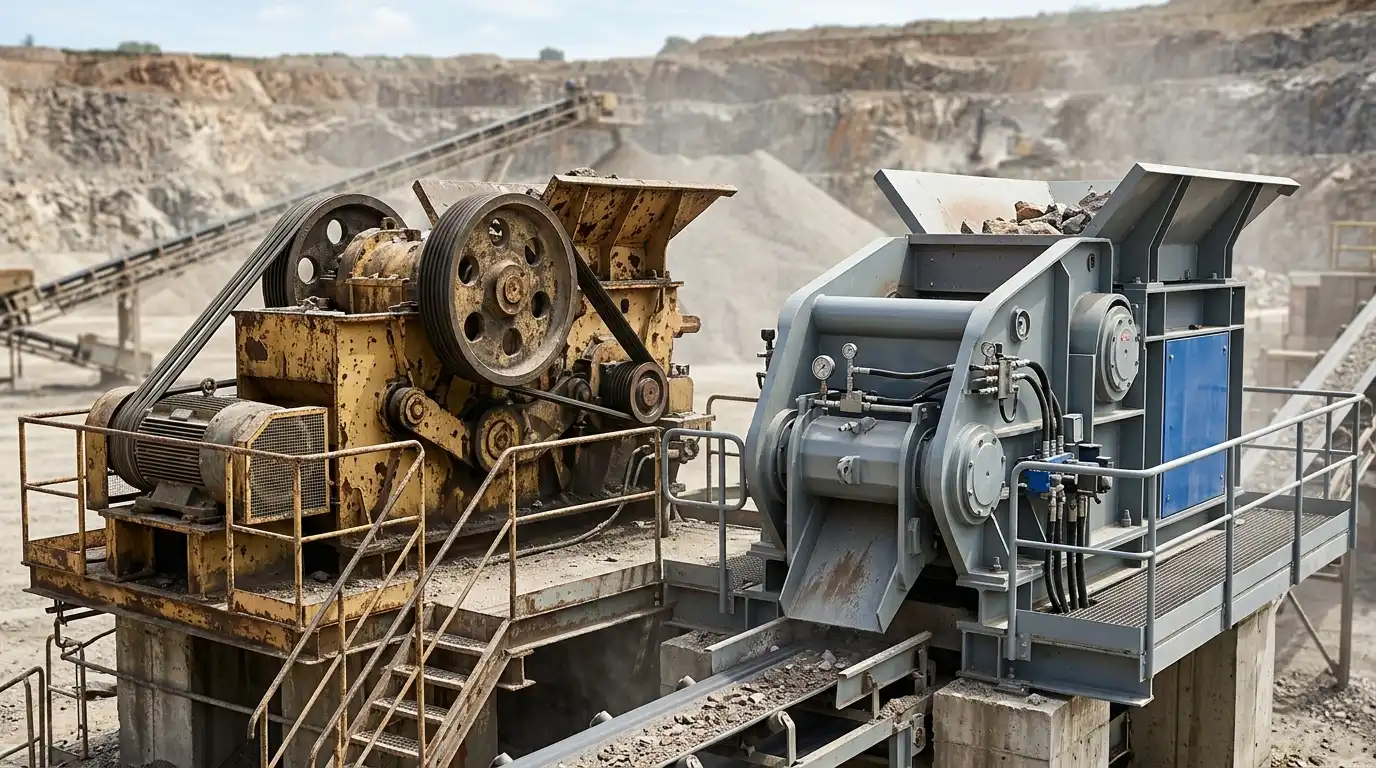
PE and PEW both describe single-toggle, overhead-eccentric jaw crushers used for primary crushing of rock and ore. The PE designation is the older, baseline configuration. The PEW designation adds a set of structural changes marketed as a “European-type” upgrade, most of which concentrate on the crushing chamber and the discharge adjustment mechanism.
The label “European-type” describes a design lineage, not a certification or a standard. No international body defines what qualifies a jaw crusher as PEW. The term is a manufacturer convention, and the specific combination of features it includes varies between suppliers. What is consistent across most PEW implementations is the direction of the change: a deeper chamber, a faster adjustment method, and — on larger models — hydraulic overload protection layered on top of the mechanical toggle fuse every jaw crusher already has.
Working Principle
Both configurations share the same basic mechanism. A motor drives an eccentric shaft through V-belts. The shaft imparts an elliptical motion to the movable jaw, which closes against the fixed jaw on the compression stroke and opens on the return stroke. Material moves down through a V-shaped chamber under gravity, and the closed side setting (CSS) at the bottom of the chamber sets the maximum product size.
The toggle plate transmits crushing force and doubles as a mechanical fuse. It is designed to fail before the eccentric shaft, bearings, or frame absorb damage from an uncrushable object. This baseline safety mechanism is identical on PE and PEW units. What differs is what happens around it — the chamber shape above it, and the adjustment hardware behind it.
Frame and Eccentric Shaft Construction
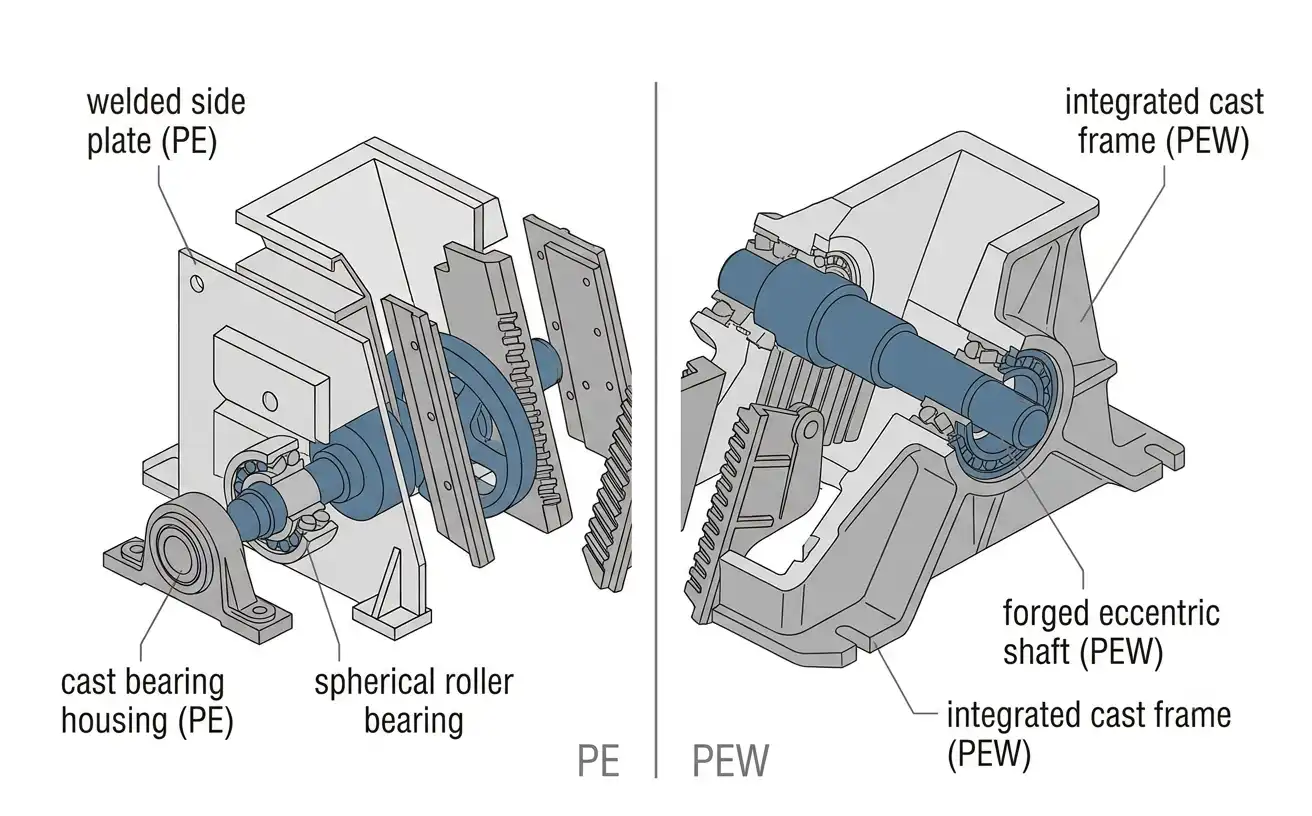
A standard PE frame combines welded, ribbed steel side plates with cast sections at the bearing housings. This construction keeps unit cost low and is adequate for intermittent or moderate-duty operation. A PEW frame more often uses an integrated cast-steel structure, or a bolted, non-welded design at the highest-duty models, which reduces stress concentration at weld joints under continuous cyclic loading.
The eccentric shaft sees the same reasoning. A forged shaft has a more uniform grain structure than a cast one, which improves fatigue resistance under sustained torque. PEW units typically specify a forged shaft as standard; PE units vary by manufacturer, with lower-cost models sometimes using a cast shaft instead. This distinction matters most for continuous, high-utilization operation. It matters far less for a site running limited daily hours, where fatigue cycles accumulate slowly regardless of shaft type.
Published finite-element studies of jaw crusher components consistently point to the same design lever: fatigue failure concentrates at stress risers, and both weld joints and cast-to-forged transitions are common failure origins. This is why heavier-duty configurations move away from welded joints and cast shafts as load and duty cycle increase, independent of any single manufacturer’s marketing description of “European” construction.
Crushing Chamber Geometry
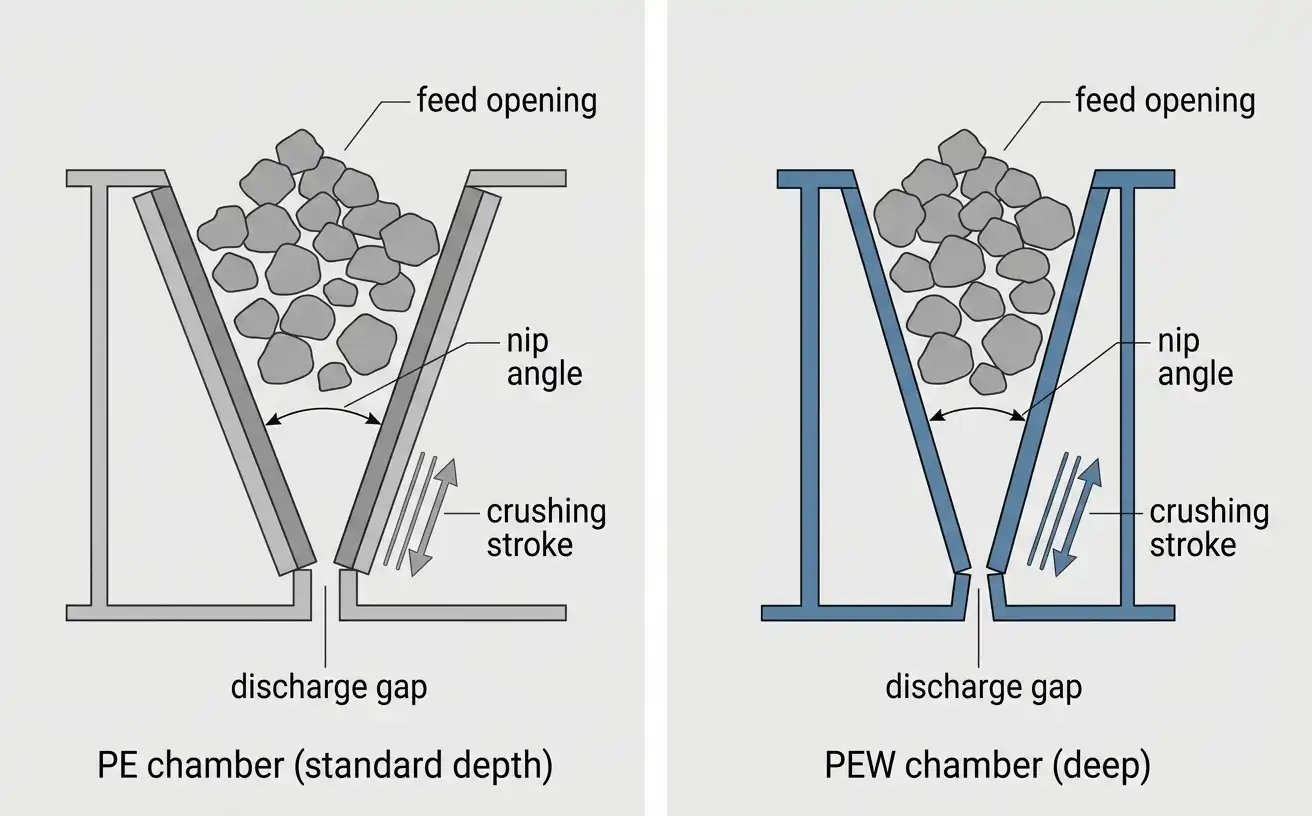
A PE chamber is a standard V-shape. A PEW chamber is typically deeper relative to its width, which increases the effective crushing stroke — the distance material travels while under compression before it can pass the discharge gap. A deeper chamber generally improves reduction ratio and reduces the tendency for flaky or slabby particles to pass through unbroken.
Nip angle governs whether the chamber grips material or lets it slip upward instead of being drawn in. Across manufacturers, jaw crusher nip angles typically fall between 19 and 23 degrees; a chamber cut steeper than roughly 26 degrees risks material slipping rather than being crushed. A deeper PEW-style chamber does not require a different nip angle in principle, but the added depth gives designers more room to hold the angle within the efficient range across a wider CSS range than a shallower PE chamber allows.
The practical effect is fewer passes needed to reach a given product size, which can translate into lower specific power consumption per tonne for equivalent feed and output — though the magnitude of that improvement depends on feed gradation and rock type, not on chamber depth alone.
Discharge Adjustment and Overload Protection
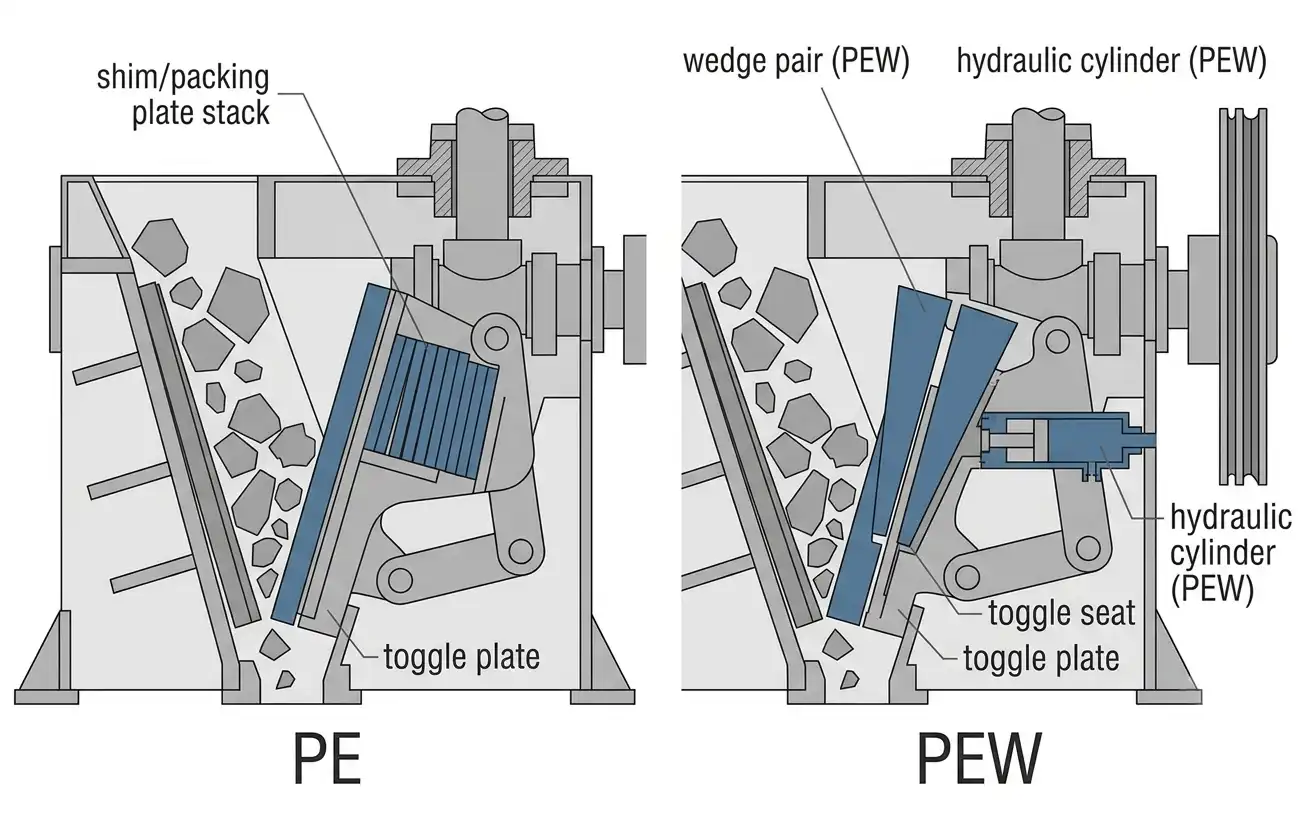
This is the single most consequential difference between the two configurations. A standard PE unit adjusts its CSS by adding or removing shims behind the toggle seat. The machine must be stopped and partially disassembled to change the stack, and the available increments are limited to the shim thicknesses on hand.
A PEW unit replaces the shim stack with a pair of wedges that slide against each other along an inclined face. Moving one wedge relative to the other changes the toggle seat’s effective position, and the CSS changes with it — without removing or replacing anything. On larger models, a hydraulic cylinder drives the wedge instead of a manual jack, which cuts a setting change from an hour or more down to a few minutes.
The same hydraulic circuit frequently does double duty as overload protection. When an uncrushable object enters the chamber, a hydraulic relief system can release pressure automatically, letting the toggle assembly retract and the object pass through, then return the jaw to its set position once the obstruction clears — without shearing anything or requiring a manual reset. This is a layered safety system on top of the mechanical toggle fuse, not a replacement for it; the toggle plate remains the final mechanical backstop on both PE and PEW machines.
This wedge-and-hydraulic approach is not a recent marketing invention. Patent filings describing wedge-based toggle adjustment paired with hydraulic overload relief date back decades, and the underlying engineering logic — replace a slow mechanical adjustment with a fast, reversible one, and add automatic overload relief on top of the existing mechanical fuse — is well established in jaw crusher design literature independent of any single manufacturer’s branding.
Table 1. Discharge adjustment comparison
| Feature | PE (standard) | PEW (European-type) |
|---|---|---|
| Adjustment method | Shims / packing plates | Wedge pair, often hydraulically driven |
| Typical time to change CSS | 1 hour or more | A few minutes |
| Disassembly required | Yes, partial | No |
| Overload protection | Mechanical toggle fuse only | Mechanical toggle fuse plus hydraulic relief (larger models) |
| Adjustment increments | Limited to available shim thicknesses | Continuous within the wedge travel range |
The adjustment method is the strongest single indicator of which configuration fits an operation. A site that sets its CSS once and runs that setting for months gains little from wedge or hydraulic adjustment. A site that changes gradation frequently, or that cannot tolerate an hour of downtime per adjustment, recovers the added cost of a PEW unit quickly through reduced adjustment labor alone.
Specifications Comparison
Table 2. PE vs PEW typical specification ranges
| Parameter | PE | PEW |
|---|---|---|
| Feed opening | 150×250 mm to 1,200×1,500 mm | Up to approximately 1,200×1,000 mm |
| Max feed size | ~125–1,020 mm | ~0–720 mm |
| CSS range | 10–360 mm | Wedge-adjustable, model-dependent |
| Capacity | 1–1,120 t/h | 15–500 t/h |
| Motor power | 5.5–200+ kW | Mid- to high-range kW, model-dependent |
Source: typical market specification ranges compiled across multiple manufacturer technical sheets; these figures are not standardized and should be confirmed against a specific supplier’s current documentation before procurement.
PE covers a wider overall size range at both ends, from small pilot-scale units to very large primary crushers. PEW’s published range clusters in the mid-to-large segment, which is consistent with it being positioned as an upgrade for operations already running meaningful tonnage rather than a small-quarry starter machine. Neither range should be read as a hard ceiling — model availability varies by manufacturer, and a buyer with an unusual duty point should request a specific quotation rather than assume the published range is exhaustive.
Selecting Between PE and PEW
Three questions narrow the choice faster than a feature-by-feature comparison. First: does the operation change its CSS often enough that adjustment downtime is a real cost? If yes, PEW’s wedge system pays for itself in reduced labor and machine downtime. If the CSS is set once and left alone, this advantage disappears.
Second: does the site run continuous, high-utilization shifts? A forged shaft and a non-welded or integrated cast frame matter most under sustained cyclic loading. A site running limited hours per day accumulates fatigue cycles slowly enough that a standard PE frame is unlikely to become the limiting factor before other components need replacement anyway.
Third: is remote or unmanned operation a factor? Hydraulic overload relief removes the need for a technician to physically reset the machine after a tramp-metal event. On a remote site, this can be worth more than the CSS-adjustment speed advantage alone. On a closely supervised site with maintenance staff on hand, the practical difference is smaller.
Where none of these three conditions is clearly present, the standard PE unit is the lower-cost, mechanically simpler choice, and the PEW’s added features are unlikely to be exercised often enough to justify their cost. Where a heavier duty point than either configuration handles is required, a heavy-duty primary line such as the C Jaw Crusher is the next step up, not a PEW unit pushed beyond its published range.
Applications by Material and Industry
Both configurations process similar rock and ore types: granite, basalt, and other hard igneous rock; limestone and sedimentary aggregate material; and metal ore ahead of further crushing or milling stages. The 200 t/h basalt crushing plant and 200–250 t/h basalt crushing plant cases both process high-hardness rock at production scale, illustrating the tonnage range where the PE/PEW choice becomes a real cost decision rather than a marginal one.
Material hardness alone does not decide between PE and PEW; both handle similar compressive-strength ranges. What changes with harder, more abrasive feed is how often wear accelerates other maintenance events — including CSS drift as jaw plates wear — which shifts the calculation toward PEW’s faster adjustment on abrasive, high-throughput duty. A 100–150 t/h aggregate production plant processing mixed, less abrasive material is a more typical fit for a standard PE primary, where adjustment frequency is lower and the cost advantage of the simpler configuration dominates.
Construction and demolition recycling favors neither configuration structurally, since the deciding factor there is usually the toggle plate’s overload protection against embedded steel rather than chamber depth or adjustment speed. Both PE and PEW handle this duty with the same underlying mechanical fuse.
Maintenance and Adjustment Labor
Wear parts are largely identical between the two configurations: manganese-steel jaw plates, side liners, and a toggle plate sized to fail before other components do. Neither configuration reduces jaw plate wear rate on its own — that is governed by feed abrasiveness and tonnage, not by adjustment mechanism.
The maintenance difference that matters is adjustment labor, already covered in the discharge adjustment section above. A shift supervisor tracking cumulative downtime should log CSS-change events separately from wear-part replacement, since the two follow different schedules: wear parts follow tonnage and abrasiveness, while adjustment frequency follows how often the target product gradation changes. A site that logs frequent CSS changes on a shim-adjusted PE unit is looking at a direct, quantifiable case for switching to wedge adjustment on the next equipment cycle.
Cost and Procurement
A PEW unit at a comparable feed opening and capacity carries a higher purchase price than an equivalent PE unit, reflecting the deeper chamber, forged shaft, and wedge or hydraulic adjustment hardware. The size of that premium varies by manufacturer and by how much hydraulic automation a specific model includes — a wedge-only unit without hydraulic assist costs less than one with a full hydraulic relief system.
Buyers should request a breakdown of what specifically drives the price difference on a given quotation, rather than treating “PEW” as a single line-item upgrade. A quotation that separates chamber and frame construction from adjustment mechanism and from any hydraulic automation lets a buyer decline features that do not match the operation’s duty cycle, rather than paying for the full package by default.
Frequently Asked Questions
What does PEW mean on a jaw crusher?
PEW identifies a European-influenced jaw crusher configuration, typically built with a deeper crushing chamber, a forged eccentric shaft, and a wedge-based discharge adjustment instead of the shim adjustment used on a standard PE unit. It is a manufacturer design convention, not an international standard or certification.
Is a PEW jaw crusher more efficient than a PE jaw crusher?
A deeper PEW chamber can improve reduction ratio and reduce power draw per tonne for equivalent feed, but the improvement depends on feed gradation and rock type rather than being a fixed percentage. The larger, more consistent efficiency gain for most operations comes from reduced adjustment downtime, not from the crushing action itself.
Can a PE jaw crusher be upgraded to PEW-style adjustment?
Retrofitting a shim-adjusted PE unit with wedge or hydraulic adjustment is mechanically possible in principle but is rarely offered as a standard aftermarket package, since the toggle seat and frame geometry are typically designed around one adjustment method from manufacture. In practice, this comparison is a specification decision made at purchase, not a later retrofit.
How much faster is a CSS change on a PEW unit?
A wedge-adjusted or hydraulically adjusted PEW unit typically changes its closed side setting in a few minutes, compared with an hour or more for a shim change on a standard PE unit, since the wedge system requires no partial disassembly.